

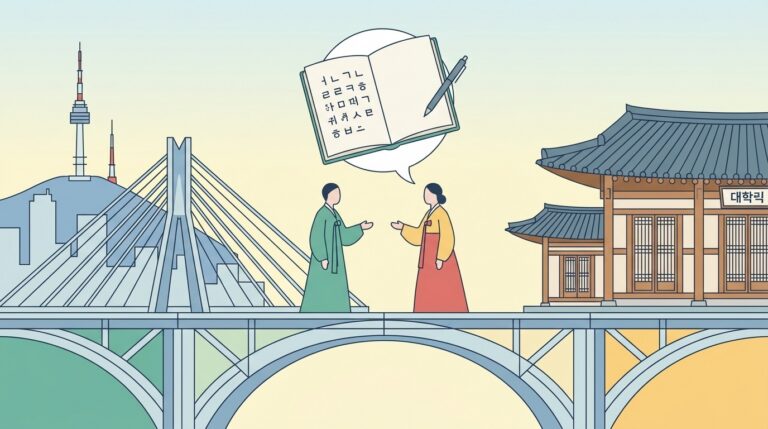
Phase 1: Empathy (Story-Immersed Opening)
안녕하세요! 매일한글 에디터입니다. (Hello! This is your Daily Hangul editor.)
Picture this: You are sitting at a cultural salon in Seongsu-dong or watching a fiery, insightful debate on a show like Difference Class (차이나는 클라스). The speakers aren’t just communicating survival needs; they are dissecting societal dynamics, unpacking nuance, and articulating philosophies with poise. You understand the words, yet when you try to contribute your own deep, cross-cultural reflections, your tongue falters. You find yourself retreating into simple conversational patterns like “제 생각에는 좋아요” (I think it’s good) or “이 문제는 나빠요” (This problem is bad).
It is deeply frustrating when your analytical mind operates at a master’s level in your native tongue, but your Korean restricts you to the sandbox of basic opinions. Many advanced learners tell me: “Editor, I know all the TOPIK II Level 6 grammar, but I sound like a robotic textbook when discussing real social issues!”
Reaching CEFR C1 is not about memorizing archaic idioms; it is about cultivating an authentic intellectual voice in Korean. When you learn to frame, pivot, and soften critical arguments, you transform from a mere foreign observer into an indispensable intellectual bridge between Korea and the global community. Let’s step into this masterclass crafted directly from real-world discourse coaching!
Phase 2: Top 3 Core Expressions for Public Discourse
Here are three indispensable, sophisticated expressions that will instantly elevate your intellectual presence in Korean debates, forums, and analytical discussions.
1. 다각도로 조명하다 (Dagakdo-ro jomyeong-hada)
- Pronunciation: [Da-gak-do-ro jo-myeong-ha-da] (Think of ‘Da’ like ‘dull’, ‘gak’ like ‘gock’, ‘do-ro’ like ‘door-o’, ‘jo-myeong’ like ‘show-myeong’—literally shining a stage spotlight from varied geometric angles.)
- Meaning:
- Literal: To illuminate from multiple angles.
- Nuance: To examine or analyze a complex social or cultural issue thoroughly from diverse perspectives without bias.
- K-Culture Moment: Regularly used by investigative journalists on shows like SBS’s Unanswered Questions (그것이 알고 싶다) and cultural critics analyzing the global footprint of K-Content.
- Editor’s Insight: Say this instead of “다양하게 생각하다” (to think diversely). It signals that you are treating the subject matter with scholarly rigor.
- Situation Spectrum: Casual 🚫 | Semi-formal ⚠️ | Formal ✅
- 🤔 Think About It: In English, we often say “look at this comprehensively.” How does the Korean metaphor of casting light (조명) convey intellectual responsibility and clarity?
2. 화두를 던지다 (Hwadu-reul deonjida)
- Pronunciation: [Hwa-du-reul deon-ji-da] (Sounds like ‘hwa-doo-reul done-jee-da’)
- Meaning:
- Literal: To throw a Buddhist meditative topic/headword.
- Nuance: To bring a profound, thought-provoking issue to the forefront of public discourse.
- K-Culture Moment: Frequently used when discussing groundbreaking works like Bong Joon-ho’s Parasite or Han Kang’s literature: “이 작품은 한국 사회에 새로운 화두를 던졌습니다.” (This work threw a fresh, critical question to Korean society.)
- Editor’s Insight: Derived from Zen Buddhist dialogue (Hwadu), this phrase carries deep philosophical gravity. Use it when initiating a serious thematic discussion.
- Situation Spectrum: Casual 🚫 | Semi-formal ✅ | Formal ✅
- 🤔 Think About It: Why does Korean society honor speakers who “throw questions” rather than those who immediately impose definitive answers?
3. 지평을 넓히다 (Jipyeong-eul neolphida)
- Pronunciation: [Ji-pyeong-eul neol-pi-da] (Think ‘jee-pyung-eul null-pee-da’)
- Meaning:
- Literal: To widen the horizon.
- Nuance: To broaden intellectual, cultural, or artistic boundaries and paradigms.
- K-Culture Moment: Used by cultural commentators praising how global collaborations expand the boundaries of K-Pop and modern Korean cinema.
- Editor’s Insight: This phrase communicates growth, intellectual humility, and vision. It is the ultimate expression for bridging cultures.
- Situation Spectrum: Casual ⚠️ | Semi-formal ✅ | Formal ✅
- 🤔 Think About It: Contrast “지평을 넓히다” with the everyday English “broaden your mind.” Notice how Korean focuses on expanding the collective horizon of understanding.
Phase 3: Textbook Korean vs. Real Native Discourse
Situation 1: Highlighting Structural Complexity in Society
- 📖 교과서 한국어 (Textbook):
이 문제는 원인이 여러 가지 있어서 아주 복잡합니다.
(I munje-neun wonini yeoreo gaji isseoseo aju bokjap-hamnida. / This problem is very complicated because it has many causes.) - 🗣️ 진짜 한국어 (Real Discourse):
단편적인 현상에 머물기보다, 이면에 깔린 구조적인 맥락을 짚어볼 필요가 있어요.
(Danpyeon-jeogin hyeonsang-e meomulgi-boda, imyeon-e kkallin gujo-jeogin maengnag-eul jipeobol piryoga isseoyo. / Rather than lingering on surface-level symptoms, we need to trace the underlying structural context.) - 💡 왜 다를까? (Cultural Insight): In professional and public arenas, reducing social phenomena to “복잡하다” (it’s complicated) sounds passive. Framing it around “구조적 맥락” (structural context) positions you as a critical thinker.
Situation 2: Expressing Sophisticated Disagreement
- 📖 교과서 한국어 (Textbook):
저는 당신의 생각에 완전히 동의하지 않습니다.
(Jeoneun dangsin-ui saenggag-e wanjeonhi dong-uihaji antheumnida. / I completely disagree with your thought.) - 🗣️ 진짜 한국어 (Real Discourse):
말씀하신 취지에는 십분 공감하지만, 논의의 결을 조금 달리할 필요가 있지 않을까요?
(Malsseumhasin chwiji-eneun sipbun gonggamhajiman, noni-ui gyeol-eul jogeum dallihal piryoga itji aneulkkayo? / I fully empathize with your underlying intent, but shouldn’t we adjust the grain of our discourse slightly?) - 💡 왜 다를까? (Cultural Insight): Flat disagreement ruptures interpersonal harmony (gibun). Using “결” (the grain/texture of thought) softens debate into collaborative refinement rather than direct confrontation.
Phase 4: K-Culture Deep Dive & Non-Verbal Rhetoric
4-1. Nunchi & Public Discourse Demeanor
In elite Korean discourse settings—such as panel seminars, academic salons, or editorial meetings—intellectual authority is paradoxically signaled through understated humility and measured pacing:
* The Empathetic Pause: Before rebutting a peer, take a breath, maintain gentle eye contact, and nod twice slowly. Never interrupt abruptly. Acknowledging the opposing party’s insight (“그 지점도 유의미합니다만…”) preserves their dignity (che-myeon).
* Hand Gestures: Avoid pointing index fingers. Keep both hands open with palms turned slightly upward or resting gently on the table. This visually invites dialogue rather than projecting dogmatism.
4-2. Cultural Code: The Evolution of Gongronjang (공론장)
From the historic court debates of the Joseon dynasty (Daegan remonstrance) to modern live-streamed civic town halls, Korea possesses an exceptionally intense public sphere (공론장). Today’s K-dramas (think legal and political dramas like Stranger or The Whirlwind) reflect this fascination with rhetorical integrity. To be an “intellectual bridge” (지적 가교), a speaker must not merely bring foreign concepts to Korea, but translate them with respect for local historical sensitivities.
Phase 5: Real-Life Roleplay Scenario
Setting: A post-symposium book salon in Anguk-dong. You are sharing tea with Min-woo, a renowned documentary producer.
- 민우 (Min-woo): 이번 K-컬처 포럼에서 발표하신 비교문화론적 발제, 아주 인상 깊게 들었습니다.
(Ibeon K-keolcheo poreom-eseo balpyohasin bigyomunhwalonjeok balje, aju insang gipge deureotseumnida.)
“Your cross-cultural presentation at the K-Culture Forum today was deeply impressive.” - 나 (You): 🎭 [양손으로 찻잔을 감싸 쥐며 겸손한 미소를 짓는다] 과찬이십니다, 감독님. 현장의 목소리를 다 담아내지 못해 외려 송구한 마음입니다.
(Gwachanisipnida, gamdongnim. Hyeonjang-ui moksorireul da dam-anaeji mothae oeryeo song-guhang maeum-imnida.)
“You flatter me, Director. I actually feel rather apologetic that I couldn’t capture more on-the-ground voices.” - 민우 (Min-woo): 아닙니다. 특히 한국 콘텐츠의 빠른 속도감 이면에 숨겨진 번아웃 담론을 다루신 대목이 신선했어요.
(Animnida. Teukhi hanguk kontencheu-ui ppareun sokdogam imyeon-e sumgyeojin beon-a-ut damroneul darusin daemogi sinseonhaesseoyo.)
“Not at all. The section where you unpacked the burnout discourse behind the rapid pace of Korean content was particularly fresh.” - 나 (You): 🎭 [천천히 고개를 끄덕이며 차분한 어조로] 단순한 성공 신화를 넘어, 사회적 비용을 다각도로 조명해 보고 싶었습니다.
(Dansunhan seonggong sinhwareul neomeo, sahoejeok biyongeul dagakdoro jomyeonghae bogo sipeosseumnida.)
“Beyond simple success narratives, I wanted to illuminate the societal costs from multiple angles.” - 민우 (Min-woo): 맞습니다. 그런 시각이야말로 우리 창작자들에게도 새로운 화두를 던져주는 것 같네요.
(Masseumnida. Geureon sigagiya-mallo uri changjakjadeul-egedo saeroun hwadureul deonjyeojuneun geot gatneyo.)
“Agreed. That kind of perspective truly brings a vital question to the forefront for creators like us.” - 나 (You): 🎭 [눈을 맞추며 설득력 있게 제안하듯] 외부의 시선과 내부의 성찰이 맞물릴 때, 담론의 지평이 한층 넓어질 수 있다고 믿습니다.
(Oebu-ui siseongwa naebu-ui seongchari manmulril ttae, damron-ui jipyeongi hancheung neolpeojil su itdago miteumnida.)
“When external observation aligns with internal self-reflection, I believe the horizon of discourse expands significantly.” - 민우 (Min-woo): 지적 가교 역할을 톡톡히 해주고 계시네요. 다음 기획 다큐멘터리 자문으로 모셔도 될까요?
(Jijeok gagyo yeokhwareul tokttokhi haejugo gyesineyo. Daeum gihoek dakyumenteori jamuneuro mosyeodo doelkkayo?)
“You are playing the role of an intellectual bridge brilliantly. May we consult you on our next documentary?” - 나 (You): 🎭 [가볍게 고개 숙여 감사를 표하며] 뜻깊은 작업에 미력이나마 보탤 수 있다면 저에게도 큰 영광입니다.
(Tteutgipeun jagyeob-e miryeog-inama botael su itdamyeon jeo-egedo keun yeong-gwang-imnida.)
“If my modest effort can contribute to such meaningful work, it would be a tremendous honor.”
🔀 Interactive Decision Point
How would you respond if Min-woo asked: “서구의 개인주의와 한국의 집단주의 중, 미래 사회엔 어느 쪽이 더 우월할까요?” (Between Western individualism and Korean collectivism, which will be superior in future society?)
- Option A: 당연히 개인의 자유가 우선시되는 서구적 가치관이 우월하다고 봅니다.
- Feedback [Risk]: Too binary and confrontational. Advanced public discourse avoids declaring cultural superiority.
- Option B: 우열을 가리기보다는, 두 가치가 상호 보완하며 빚어낼 제3의 가능성에 주목하고 싶습니다.
- Feedback [Best]: Exemplary C1 rhetoric! Reframes a false dichotomy into dialectical integration with intellectual poise.
- Option C: 글쎄요, 둘 다 장단점이 있어서 답변하기가 너무 어렵네요.
- Feedback [Bad]: Lacks intellectual depth. It simply evades the question without offering critical framing.
Phase 6: 10-Second Emotion Shadowing Drill
Read these cadence-marked sentences aloud, embodying the emotional state indicated in brackets:
[🧐 진중하고 차분하게 / Calm & Profound]
우리는 지금 / 단순한 현상을 넘어 / 구조적 맥락을 / 냉철하게 짚어봐야 합니다.
(Uri-neun jigeum / dansunhan hyeonsang-eul neomeo / gujojeok maengnageul / naengcheolhage jipeobwaya hamnida.)-
[💡 통찰력 있게 설득하듯 / Insightful & Persuasive]
이 작은 화두가 / 우리 사회의 지평을 넓히는 / 소중한 마중물이 되길 / 기대합니다.
(I jageun hwaduga / uri sahoe-ui jipyeongeul neolphineun / sojunghan majungmuri doegil / gidaehamnida.) -
[🤝 포용력 있는 어조로 / Generous & Bridging]
말씀하신 취지에 깊이 공감하며, / 논의의 결을 / 한층 풍성하게 다듬어 가고 싶습니다.
(Malsseumhasin chwijie gipi gonggamhamyeo, / noni-ui gyeoreul / hancheung pungseonghage dadeumeo gago sipeoseumnida.)
Phase 7: K-Culture Mini Dictionary
- 공론장 (Gong-ron-jang)
- Translation: The Public Sphere / Public Forum.
- Usage: Refers to open spaces where citizens and intellectuals debate matters of collective social consequence democratically.
- 행간 (Haeng-gan)
- Translation: Between the lines / The subtext.
- Usage: Essential in analytical writing: “말의 표면보다 행간에 담긴 사회적 함의를 읽어야 합니다.” (We must read the societal implications between the lines rather than just the surface words).
- 담론 (Dam-ron)
- Translation: Discourse / Thematic paradigm.
- Usage: Used widely in media critique, cultural theory, and policy: e.g., 환경 담론 (environmental discourse), 청년 담론 (youth discourse).
- 가교 (Ga-gyo)
- Translation: Bridge (Metaphorical).
- Usage: Describing an institution, idea, or bilingual person who fosters mutual intellectual and cultural exchange: e.g., 문화적 가교 (cultural bridge).
Phase 8: Cultural Navigator’s Survival Kit
Top 3 Survival Expressions for Academic & Cultural Salons
- 논의의 본질을 흐리지 않도록 주의해야 합니다.
(Noni-ui bonjireul heuriji antorok juuuihaeya hamnida.)
Pro Tip: Use this to steer a derailed discussion back to the foundational core. - 상호 맥락적인 이해가 선행되어야 합니다.
(Sangho maengnakjeogin ihaega seonhaengdoe-eoya hamnida.)
Pro Tip: Perfect when mediating international viewpoints that clash due to regional context. - 생각의 여백을 남겨두는 것도 유의미합니다.
(Saenggag-ui yeobaegeul namgyeoduneun geotdo yu-uimihamnida.)
Pro Tip: A poetic, dignified way to close an unresolved seminar discussion.
Editor’s Travel Note
- Intellectual Havens: If you are visiting Seoul, immerse yourself in deep discourse environments beyond standard tourist traps. Spend an afternoon exploring independent publishers in the Paju Book City or attending open weekend lectures in Insa-dong and Daehak-ro.
- Essential Digital Setup: Make sure you complete your 네이버 지도 앱 다운로드 to uncover hidden seminar book cafes (북살롱), and register for the 교보문고 북클럽 안내 to discover best-selling Korean sociological essays and debate transcripts.
Phase 9: Going One Step Deeper
In Western debate traditions, rhetoric is often constructed around sharp analytical dialectics: thesis meets antithesis to forge synthesis. In refined Korean discourse, however, speech is anchored by both Jeong (정 – relational empathy) and Gyeol (결 – the organic grain of harmony).
When a Korean scholar or commentator critiques another, they rarely tear down the opposing argument with harsh directness. Instead, they stroke the grain of the conversation first—affirming the speaker’s well-intentioned spirit—before gently weaving a new perspective into the tapestry. As a C1 speaker, you are not merely translating intellectual concepts; you are navigating the moral and interpersonal fabric of Korean communication.
💬 Your Turn: What is an issue in your home country that you would love to introduce to Korean society through a dignified public forum? Share your thoughts below using today’s expressions!
Phase 10: FAQ & Common Misconceptions
Q: Can I use “화두를 던지다” when chatting informally with close friends?
A: It sounds excessively grand for everyday trivia like deciding what to eat for lunch (“점심 메뉴로 제육볶음이라는 화두를 던진다” sounds comedic and overdramatic). Reserve it for meaningful social, philosophical, or artistic topics.
Q: How do native Korean scholars maintain respect when tearing apart an opposing thesis?
A: They almost universally frame their critique using hypothetical question endings like “~라고 볼 여지는 없을까요?” (Might there not be room to view it as…?) or “~라는 우려를 낳을 수 있습니다” (This could engender concerns that…). This attacks the outcome of the idea, not the character of the speaker.
Q: What is the exact difference between “토론” (Toron) and “논의” (Noni)?
A: 토론 refers to structured, oppositional debate (pro vs. con), whereas 논의 denotes collaborative discussion aimed at exploring solutions and building consensus.
🚨 Common Mistakes Alert Board
- ❌ Mistake 1: Translating “I disagree with your point” directly into “당신의 포인트에 반대합니다.”
- Correct Action: Say “그 말씀도 일리가 있지만, 다른 측면도 고려해 볼 수 있습니다.” (That makes sense as well, but we can also consider other dimensions).
- ❌ Mistake 2: Using informal pronouns like “당신” (Dangsin) in public seminars.
- Correct Action: Address peers by their role (발제자님, 교수님, 선생님) or use “앞서 말씀해주신 분” (the previous speaker).
- ❌ Mistake 3: Ending analytical statements with blunt declarations like “~는 틀렸습니다” (That is wrong).
- Correct Action: Reframe with nuanced qualification: “~는 재고의 여지가 있어 보입니다” (That appears to have room for reconsideration).
Phase 11: Action Mission & Engagement
- 🥉 Bronze Mission (Solo Mastery): Choose an editorial from a Korean newspaper (such as The Hankyoreh or JoongAng Ilbo). Highlight three occurrences of discourse vocabulary (e.g., 맥락, 지평, 화두) and read the sentences aloud.
- 🥈 Silver Mission (Social Sharing): Write a 2-sentence analytical reflection on your favorite K-Drama on Instagram or Threads. Use either 다각도로 조명하다 or 화두를 던지다, and tag
#DailyHangulDiscourse. - 🥇 Gold Mission (Real Application): Attend a Korean cultural event, book club, or language exchange meetup. Use the phrase “말씀하신 취지에는 십분 공감하지만…” to deliver a thoughtful, nuanced counter-opinion.
🎮 K-Culture Mission: Watch an episode of tvN’s You Quiz on the Block featuring a scientist, author, or philosopher. Note down how host Yoo Jae-suk introduces heavy topics with welcoming warmth!
Phase 12: Interactive Quiz Challenge
Test your critical rhetoric mastery! Solve the three challenges below:
1. Situational Judgment:
You are speaking at a university roundtable in Seoul. A fellow panelist presents a cultural theory you find biased. What is the most dignified way to intervene?
* (A) 그 이론은 완전히 틀렸으니 제가 바로잡겠습니다.
* (B) 발제자님의 문제의식에는 깊이 공감합니다만, 현상을 보다 다각도로 조명할 필요가 있습니다.
* (C) 제 생각엔 그건 너무 서구 중심적인 편견인 것 같아요.
2. Fill in the Blank:
이번 전시회는 전통 회화와 현대 미디어 아트의 만남을 통해 예술적 ( )을 넓혔다는 평가를 받는다.
* (A) 행간
* (B) 지평
* (C) 화두
3. True or False:
In Korean public discourse, adopting a direct, confrontational tone like “당신의 논리는 말이 안 됩니다” is admired as a display of bold intellectual honesty.
* (True / False)
👉 Click to reveal answers & explanations
- Answer: (B)
- Explanation: Option (B) demonstrates refined Korean discourse etiquette by validating the speaker’s core intent (문제의식에 깊이 공감합니다) before proposing a wider analytical aperture (다각도로 조명할 필요가 있습니다). Options (A) and (C) are needlessly aggressive.
- Answer: (B) 지평
- Explanation: The phrase 지평을 넓히다 (to expand the horizon) is the customary collocation for artistic, philosophical, and intellectual breakthroughs.
- Answer: False
- Explanation: In Korean intellectual culture, attacking someone’s logic with “말이 안 됩니다” (makes no sense) is considered uncouth. True mastery is shown by using delicate framing, modal verbs, and respectful vocabulary to critique arguments without humiliating individuals.
- Explanation: In Korean intellectual culture, attacking someone’s logic with “말이 안 됩니다” (makes no sense) is considered uncouth. True mastery is shown by using delicate framing, modal verbs, and respectful vocabulary to critique arguments without humiliating individuals.







