

Phase 1: Empathy (Storytelling Opening)
안녕하세요! 매일한글 에디터입니다. (Hello! I am your Daily Hangul editor.)
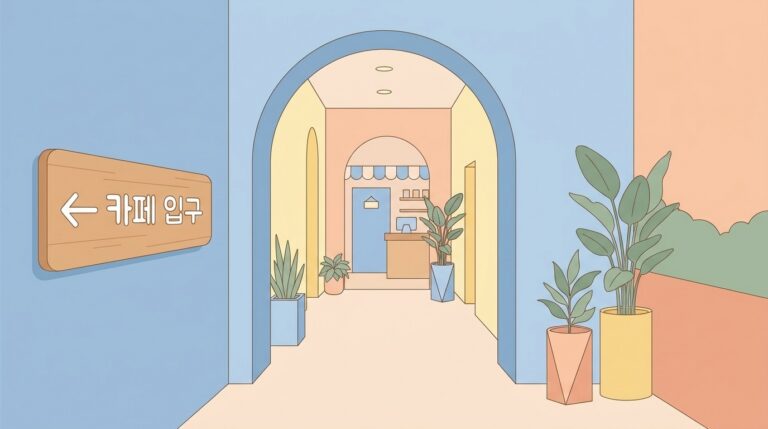
Picture this: You are in a chic, bustling cafe in Seongsu-dong, Seoul. You just enjoyed your icy ‘Ah-Ah’ (아이스 아메리카노 – Iced Americano) and a flaky salt bread pastry. But suddenly, your stomach sends an urgent SOS! Nature is calling, loud and clear. You stand up, your heart racing, and make eye contact with the friendly barista. You want to ask where the restroom is, but the words escape you. The barista smiles, notices your hesitation, points toward the hallway, and says something ending with “-isseoyo”.
Was it left? Was it right? Did they say upstairs or behind the counter? You wander around, checking door after door, only to find yourself staring at an emergency exit.
Don’t panic! We have all been there. Asking for directions—especially finding the restroom—is arguably the single most important survival skill when visiting Korea. This guide is crafted directly from our real classroom experiences with hundreds of A1 beginner learners just like you. By the end of this guide, you will master essential location words like left, right, front, back, and side so you will never get lost in a cafe, subway station, or restaurant again!
Phase 2: Top 3 Core Expressions In-Depth
1. 왼쪽에 있어요 (Oenjjoge isseoyo)
- Pronunciation: [Oen-jjo-ge i-sseo-yo] (Think of ‘oen’ like ‘when’ without the h, ‘jjok’ sounding like a sharp ‘jock’, followed by ‘e isseoyo’)
- Meaning: Literal: “It exists on the left.” / Actual Nuance: “It is on the left side.”
- K-Culture Moment: In K-Dramas, whenever a secretary guides a CEO into a VIP meeting room or an elevator, you will almost always hear them gesture gracefully and say, “왼쪽에 있습니다” or “왼쪽에 있어요.”
- Editor’s Insight: The word 왼쪽 (oenjjok) means ‘left side’, and -에 있어요 (-e isseoyo) means ‘is located at/in’. In Korean, we attach the location marker -에 (-e) directly to direction words.
- Situation Spectrum: Casual: ⚠️ (Use ‘왼쪽에 있어’ with close peers) | Semi-formal: ✅ (왼쪽에 있어요 – perfect for everyday life!) | Formal: ✅ (왼쪽에 있습니다)
- 🤔 Think About It: In English, we say “on the left”, but Korean combines the direction (왼쪽) with a static location particle (-에). How does your native language mark static location?
2. 화장실이 어디예요? (Hwajangsiri eodiyeyo?)
- Pronunciation: [Hwa-jang-si-ri eo-di-ye-yo?] (Flow ‘sil’ smoothly into ‘i’ to sound like ‘si-ri’)
- Meaning: Literal: “Where is the makeup room?” / Actual Nuance: “Where is the restroom?”
- K-Culture Moment: The literal Hanja meaning of 화장실 (Hwajangsil) is “makeup room” (화장 = makeup, 실 = room). It highlights Korean cultural discretion regarding personal hygiene!
- Editor’s Insight: This is your golden survival question. Even if you forget everything else, blurt out “화장실이 어디예요?” and any Korean person will understand and point you the right way.
- Situation Spectrum: Casual: ⚠️ (화장실 어디야?) | Semi-formal: ✅ (화장실이 어디예요? – Best choice!) | Formal: ✅ (화장실이 어디입니까?)
- 🤔 Think About It: Notice how polite Korean culture avoids crude words for bodily functions and uses elegant euphemisms like ‘makeup room’. Does your culture do the same?
3. 저기 옆에 있어요 (Jeogi yeope isseoyo)
- Pronunciation: [Jeo-gi yeo-pe i-sseo-yo] (Link the final ‘p’ sound in ‘yeop’ to the vowel ‘e’)
- Meaning: Literal: “It is next to over there.” / Actual Nuance: “It’s right next to that spot over there.”
- K-Culture Moment: Street-food vendors at Gwangjang Market often shout this while holding tongs when tourists ask where water cups or napkins are located.
- Editor’s Insight: 옆 (yeop) means ‘beside’ or ‘next to’. Combined with 저기 (jeogi) meaning ‘over there’, it creates a super handy conversational anchor.
- Situation Spectrum: Casual: ⚠️ | Semi-formal: ✅ | Formal: ✅
- 🤔 Think About It: Koreans love spatial context words like ‘이곳 (here)’, ‘그곳 (there)’, and ‘저곳/저기 (over there far away)’. Paying attention to spatial distance makes your Korean sound much more native!
Phase 3: Textbook Korean vs. Real Korean
Situation 1: Asking where the restroom is at a restaurant
- 📖 교과서 한국어 (Textbook Korean): 화장실은 어디에 위치합니까? (Hwajangsireun eodie wichi-hamnikka? / “Where is the restroom positioned?”)
- 🗣️ 진짜 한국어 (Real Korean): 저기요, 화장실 어디예요? (Jeogiyo, hwajangsil eodiyeyo? / “Excuse me, where is the restroom?”)
- 💡 왜 다를까? (Why is it different?): The textbook uses the heavy Sino-Korean noun ‘위치 (location/position)’ and an ultra-stiff formal ending. Real Koreans use the polite attention-grabber 저기요 (jeogiyo – excuse me) and keep the sentence light and direct.
Situation 2: Barista explaining where the restroom is
- 📖 교과서 한국어 (Textbook Korean): 화장실은 좌측 복도 끝에 존재합니다. (Hwajangsireun jwacheuk bokdo kkeute jonjaehamnida. / “The restroom exists at the end of the left corridor.”)
- 🗣️ 진짜 한국어 (Real Korean): 나가셔서 왼쪽 끝에 있어요! (Nagasyeoseo oenjjok kkeute isseoyo! / “Go outside and it’s at the far left!”)
- 💡 왜 다를까? (Why is it different?): Textbook Korean often uses formal directional words like 좌측 (jwacheuk – left side) and 우측 (ucheuk – right side), but native speakers in day-to-day conversation almost exclusively use pure Korean words like 왼쪽 (oenjjok) and 오른쪽 (oreunjjok).
Phase 4: K-Culture Deep Dive & Non-Verbal Manners
4-1. 눈치 (Nunchi) & Polite Gestures
When asking for or giving directions in Korea, non-verbal etiquette speaks volumes:
* Open Palm Pointing: Never point at someone or directionally toward an elder using a single index finger! Instead, extend your hand with all fingers gently held together and palm facing slightly upward. This shows utmost respect and hospitality.
* The Head Tilt and Nod: When asking a stranger “저기요…” (Jeogiyo…), tilt your head slightly forward with a polite smile. It disarms the listener and shows good 눈치 (Nunchi – social awareness).
4-2. The Secret Code of Korean Cafe Restrooms
If you travel to Korea, you will quickly notice a quirky phenomenon: many cafe restrooms are not inside the cafe! They are frequently located in the building’s central hallway or stairwell.
* The Passcode (비밀번호 – Bimilbeonho): Look closely at your paper receipt or near the cafe pickup counter. You will often see a sign saying “화장실 비번 (restroom passcode)” followed by numbers and an asterisk (e.g., 1234*).
* The Bathroom Key Doll: In smaller vintage cafes in areas like Euljiro, you might be handed a giant stuffed animal or a frying pan attached to a tiny key. That keeps guests from accidentally walking off with the restroom key!
Phase 5: Real-Life Roleplay Scenario
Setting: A trendy rooftop cafe in Yeonnam-dong.
Characters:
* 민지 (Minji): Cheerful cafe barista wearing a linen apron.
* 알렉스 (Alex): Foreign traveler who just finished a strawberry latte.
Dialogue:
1. 알렉스: 저기요, 죄송한데요… (Jeogiyo, joesonghandeyo… / “Excuse me, I’m sorry to bother you…”)
🎭 Hands politely folded in front, shy smile
2. 민지: 네, 손님! 필요한 거 있으세요? (Ne, sonnim! Pilyohan geo isseuseyo? / “Yes, customer! Do you need anything?”)
🎭 Pauses wiping the counter and looks up warmly
3. 알렉스: 화장실이 어디예요? (Hwajangsiri eodiyeyo? / “Where is the restroom?”)
🎭 Inquiring tone, leaning in slightly
4. 민지: 아, 화장실요? 저기 문으로 나가셔서 왼쪽에 있어요. (A, hwajangsillyo? Jeogi muneuro nagasyeoseo oenjjoge isseoyo. / “Ah, the restroom? Go out that door over there, and it is on the left.”)
🎭 Gesturing toward the glass door with an open palm
5. 알렉스: 문 나가서 왼쪽이요? (Mun nagaseo oenjjogiyo? / “Out the door and to the left?”)
🎭 Pointing gently to confirm direction
6. 민지: 네, 맞아요! 엘리베이터 바로 옆에 있어요. (Ne, majayo! Ellibeiteo baro yeope isseoyo. / “Yes, that’s right! It’s right next to the elevator.”)
🎭 Nodding encouragingly
7. 알렉스: 아! 혹시 비밀번호 있어요? (A! Hoksi bimilbeonho isseoyo? / “Ah! By any chance, is there a passcode?”)
🎭 Realizing the Korean cafe rule and tapping phone
8. 민지: 영수증 아래에 적혀 있어요. 0815* 예요! (Yeongsujeung araee jeokhyeo isseoyo. Gong-pal-il-o-byeol yeyo! / “It’s written at the bottom of your receipt. It’s 0815!”*)
🎭 Pointing to the bottom of the paper receipt
🔀 Interactive Choice Point
Imagine you didn’t understand Minji’s explanation about the door. What would you say next?
- Option A: “죄송하지만 한 번만 다시 말씀해 주시겠어요?” (Joesonghajiman han beonman dasi malsseumhae jusigesseoyo? / I’m sorry, but could you say that one more time?)
- Option B: “뭐라고요? 몰라요!” (Mworagoyo? Mollayo! / What did you say? I don’t know!)
- Option C: (Smile awkwardly and walk into the kitchen storage room)
Feedback:
* Option A (Best): 🌟 Outstanding! Asking someone politely to repeat themselves is standard native etiquette. Minji will happily point again slowly.
* Option B (Bad): ⚠️ Dangerous! “뭐라고요?” sounds abrasive and accusatory, as if you’re annoyed.
* Option C (Risk): 🚨 Awkward! Walking into the staff-only kitchen might surprise the chefs and create a mini-crisis!
Phase 6: 10-Second Emotion Shadowing Drill
Read these out loud with rhythm and pauses (/) matching the emotional markers!
[👀 Polite & Hesitant]
저기요… / 화장실이 / 어디예요?
(Jeogiyo… / hwajangsiri / eodiyeyo? / Excuse me… where is the restroom?)-
[💡 Clear & Confident]
문 나가서 / 왼쪽에 / 있어요!
(Mun nagaseo / oenjjoge / isseoyo! / Go out the door and it’s on the left!) -
[😊 Relieved & Grateful]
아, / 엘리베이터 옆이요? / 감사합니다!
(A, / ellibeiteo yeopiyo? / gamsahamnida! / Ah, next to the elevator? Thank you!)
Phase 7: K-Culture Mini Dictionary
- 화장실 (Hwajangsil) | Restroom / Bathroom
- Everyday usage: Essential noun everywhere from airports to subways and bars.
- 왼쪽 (Oenjjok) / 오른쪽 (Oreunjjok) | Left side / Right side
- Everyday usage: Pair these together! ‘Oen’ (left), ‘Oreun’ (right). Quick memory hack: ‘Oreun’ sounds like ‘All-right’!
- 비밀번호 (Bimilbeonho / Short form: 비번 ‘Bibeon’) | Passcode / PIN code
- Everyday usage: Crucial for door locks on restrooms, Airbnb apartments, and Wi-Fi networks in Korea.
- 휴지 (Hyuji) | Toilet tissue / Napkin
- Everyday usage: If there’s no toilet paper inside, you will spot a dispenser right outside the restroom stall entrance!
Phase 8: Traveler’s Survival Kit
Top 3 Survival Phrases
- 1. 오른쪽에 있어요? (Oreunjjoge isseoyo? / Is it on the right?)
- Pro Tip: Raise your intonation at the end to make it a confirmation question.
- 2. 휴지 있어요? (Hyuji isseoyo? / Do you have toilet paper?)
- Pro Tip: Always ask this before heading into an older subway station or traditional market restroom!
- 3. 비밀번호가 뭐예요? (Bimilbeonhoga mwoyeyo? / What is the passcode?)
- Pro Tip: Hand your receipt or phone to the staff while asking, and they will highlight the number for you.
Editor’s Travel Note
- Navigation in Korea: Google Maps does not give accurate walking directions in Korea due to national map data security regulations. Make sure you click and set up the official Naver Map app for walking directions. It displays exact subway exit numbers and public restrooms!
- Subway Restroom Tip: Seoul Metro stations have pristine restrooms, but some are inside the ticket gates and some are outside. Look at the overhead station signs for the blue/red person icon.
Phase 9: “한 발 더 깊이” (One Step Deeper)
In the Korean mindset, directions are rarely given in absolute cardinal terms like “North” or “South” in daily conversation. Instead, Koreans orient the world relative to shared landmarks and mutual relationships: “Next to the convenience store,” “Behind the bank,” or “To the left of where we are standing.” Language reflects this collective orientation. When someone tells you “왼쪽에 있어요”, they intuitively place themselves in your shoes, visualizing the world from your angle of sight. It’s a subtle linguistic manifestation of 배려 (Baeryeo – consideration for others).
💬 Your Turn: Have you ever gotten delightfully lost in an unfamiliar country because of a misunderstood direction? Share your funniest travel story below!
Phase 10: FAQ & Common Mistakes
Q: Can I just say ‘토일렛’ (Toilet) in Korea?
A: Yes, most younger Koreans will understand ‘토일렛’ (to-il-let), but older adults or staff in local markets may not catch it immediately. Saying 화장실 (Hwajangsil) ensures 100% comprehension across all generations.
Q: What is the difference between 앞 (ap), 뒤 (dwi), and 옆 (yeop)?
A: 앞 (ap) means in front, 뒤 (dwi) means behind/back, and 옆 (yeop) means next to/beside. For example: 편의점 앞에 있어요 (It’s in front of the convenience store), 은행 뒤에 있어요 (It’s behind the bank).
Q: How do I ask whether the restroom is upstairs or downstairs?
A: Use 위 (wi – up) and 아래 (arae – down)! Simply ask: “2층 위에 있어요?” (Is it upstairs on the 2nd floor?) or “지하 아래에 있어요?” (Is it down in the basement?).
🚨 Common Mistakes Warning Board
- Saying ‘왼쪽 있어요’ without the particle ‘-에’:
- Wrong: 왼쪽 있어요. (Sounds unnatural)
- Correct Action: Always attach -에 for static location: 왼쪽에 있어요 (Oenjjoge isseoyo).
- Confusing 왼쪽 (Left) with 오른쪽 (Right):
- Mistake: Mixing up ‘Oen’ and ‘Oreun’ under stress.
- Correct Action: Remember the mnemonic: 오른쪽 (Oreunjjok) = Right. Your right hand is the ‘right’ (옳은) hand for writing!
- Looking for toilet paper inside the stall after locking the door:
- Mistake: Assuming toilet paper is always beside the toilet bowl.
- Correct Action: In traditional venues, the large communal toilet roll is mounted on the wall outside in the main sink area. Grab your paper before entering the stall!
Phase 11: Action Mission & Community Challenge
- 🥉 Bronze Mission (Solo Practice): Stand in your living room. Look around and name three objects using Korean directions out loud: “컴퓨터 왼쪽에 있어요!” (The computer is on the left!).
- 🥈 Silver Mission (Social Share): Snap a photo of a cool signpost or door, post it on your Instagram Story or Threads, and write: “화장실이 어디예요? #DailyHangul #KoreanA1”.
- 🥇 Gold Mission (Real Life Action): The next time you visit a Korean restaurant or cafe in your city, ask the staff: “저기요, 화장실이 어디예요?”
- 🎮 K-Culture Media Hunt: Watch one episode of any K-Drama or variety show (like Running Man). Listen carefully whenever cast members enter a building and see if you can spot the word 왼쪽 (left) or 오른쪽 (right)!
Phase 12: Interactive Quiz Challenge
1. Situation Judgment Quiz:
You are at an underground shopping mall in Gangnam. You ask a shopkeeper for directions, and she points with an open hand and says: “편의점 옆에 있어요!” Where should you go?
* A) Inside the convenience store
* B) Next to the convenience store
* C) On the second floor above the convenience store
2. Fill in the Blank:
Complete the sentence to say: “It is on the left.”
* ( )-에 있어요.
3. True or False Cultural Check:
In Korea, it is polite to point directly at someone’s face with your index finger when confirming who is next in line for the restroom.
* [True / False]
👉 Click here for answers and explanations
- Answer: B) Next to the convenience store.
- Explanation: 옆 (yeop) means ‘next to’ or ‘beside’. So 편의점 옆 means ‘next to the convenience store’.
- Answer: 왼쪽 (Oenjjok).
- Explanation: 왼쪽 + 에 있어요 = 왼쪽에 있어요 (It is on the left).
- Answer: False.
- Explanation: Pointing with an isolated index finger can feel aggressive or rude in Korean culture. Use an open palm with gentle posture instead!
- Explanation: Pointing with an isolated index finger can feel aggressive or rude in Korean culture. Use an open palm with gentle posture instead!







