

Phase 1: Empathy & Story Opening
안녕하세요! 매일한글 에디터입니다. (Hello! It’s your Daily Hangul editor here.)
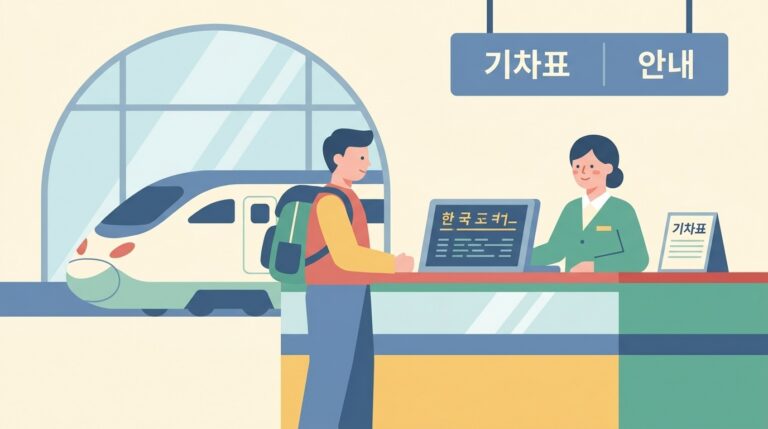
Picture this: You just touched down in Seoul, and after a whirlwind morning exploring Gyeongbokgung Palace, you need to get down to Busan for that seaside sunset you’ve been dreaming about. You rush into the bustling Seoul Station, rolling suitcase in tow. The electronic departure board flashes dozens of numbers, destinations, and red Korean letters. Your heart sinks a little—did that red text say “매진” (Sold Out)? You walk toward the ticket counter, your palms sweating slightly. The friendly station clerk smiles and asks, “어디로 가세요?” (Where are you heading?). You want the very next departure, but your mind goes blank. How do you ask for the earliest train without stumbling over complex vocabulary?
If you’ve ever felt that mini panic at a foreign train station, you are definitely not alone! Hundreds of our beginner learners tell us that buying transit tickets on the spot is one of their most nerve-wracking experiences. But don’t worry: you do not need years of language study to navigate Korea’s train stations like a local. With just one handy phrase—and a couple of lifesaver backup words—you’ll effortlessly book your high-speed KTX seat and be snacking on walnut cakes (호두과자) on your way to Busan in no time. Let’s master the art of train travel together!
Phase 2: 3 Key Expressions Deep-Dive
1. 가장 빠른 기차가 몇 시예요? (Gajang ppareun gichaga myeot siyeyo?)
- Pronunciation: [Gah-jahng pah-reun gee-cha-gah myut she-yeh-yo?] (Think of “ppar” like the explosive snap of a popped party balloon!)
- Meaning: Literal: “Most fast train what hour is it?” | Natural: “What time is the earliest train?”
- K-Culture Moment: In the classic travel-themed variety show 2 Days & 1 Night (1박 2일), cast members constantly sprint to ticket counters yelling variations of this phrase to beat opposing teams to rural destinations.
- Editor’s Insight: In Korean, “earliest” in transit context is expressed as “가장 빠른” (fastest), rather than “가장 이른” (earliest morning). Locals naturally equate “fastest arrival” with “next departing train.”
- Situation Spectrum: Casual ⚠️ | Semi-formal ✅ | Formal ✅
- 🤔 Think About It: Why does Korean culture conceptualize the “soonest” option as the “fastest”? Could it reflect the iconic Ppalli-ppalli (hurry, hurry) mindset where time efficiency is king?
2. 다음 기차로 주세요. (Daeum gicharo juseyo.)
- Pronunciation: [Dah-eum gee-cha-roh joo-seh-yo.] (Rhyme “daeum” with “now-um”)
- Meaning: Literal: “Next train with, please give.” | Natural: “Please give me the next train.”
- K-Culture Moment: You’ll hear this in K-dramas whenever a protagonist misses their scheduled train while chasing after a dramatic love interest.
- Editor’s Insight: The particle “-로” (-ro) acts like a selection arrow, meaning “in the direction of / by way of.” Using “주세요” (juseyo – please give) makes your request polite, natural, and instantly understandable.
- Situation Spectrum: Casual 🚫 | Semi-formal ✅ | Formal ✅
- 🤔 Think About It: In English, we “book” or “buy” a ticket, but Koreans often just say “주세요” (give me [the train/ticket]). Notice how direct yet gentle Korean shopping grammar can be!
3. 남은 자리 있어요? (Nameun jari isseoyo?)
- Pronunciation: [Nah-meun jah-ree ee-ssuh-yo?] (Make the “ss” crisp, like snake’s hiss!)
- Meaning: Literal: “Remaining seat exists?” | Natural: “Are there any seats left?”
- K-Culture Moment: Seen at crowded bus terminals during holiday exodus (추석/설날) coverage on local Korean evening news.
- Editor’s Insight: While textbooks teach “좌석” (jwoaseok) for seat, everyday Koreans almost always say “자리” (jari). It rolls off the tongue much faster when you’re in a rush.
- Situation Spectrum: Casual ⚠️ | Semi-formal ✅ | Formal ✅
- 🤔 Think About It: What’s the difference between asking “Is it sold out?” and “Are there seats left?” Korean speakers often prefer checking for possibility first!
Phase 3: Textbook Korean vs. Real-Life Korean
Situation 1: Asking for the next departure
- 📖 교과서 한국어 (Textbook Korean): “가장 빠른 기차 표를 예매하고 싶습니다.” (Gajang ppareun gicha pyoreul yemaehago sipseumnida. – I would like to reserve the earliest train ticket.)
- 🗣️ 진짜 한국어 (Real-life Korean): “가장 빠른 거 언제 있어요?” (Gajang ppareun geo eonje isseoyo? – When is the earliest one?)
- 💡 왜 다를까? (Why the difference?): In everyday conversation, native speakers drop formal honorific suffixes like “-하고 싶습니다” and swap bulky nouns like “기차 표” (train ticket) for the versatile pronoun “거” (thing/one).
Situation 2: Asking if a seat is available
- 📖 교과서 한국어 (Textbook Korean): “잔여 좌석이 있습니까?” (Janyeo jwaseogi itseumnikka? – Are there remaining seats?)
- 🗣️ 진짜 한국어 (Real-life Korean): “자리 남은 거 있어요?” (Jari nameun geo isseoyo? – Got any seats left?)
- 💡 왜 다를까? (Why the difference?): “잔여 좌석” sounds like an automated public announcement. At a customer window, simple and direct conversational phrasing creates immediate rapport.
Phase 4: K-Culture Deep Dive & Non-Verbal Manners
4-1. 눈치 (Nunchi) & Counter Etiquette
When approaching a ticket booth at a major hub like Seoul Station (서울역) or Busan Station (부산역):
* Two-Handed Courtesy: When handing over your credit card or cash, hold it with both hands or support your right forearm with your left hand. This tiny non-verbal gesture shows immense respect to the station staff.
* Screen Anticipation: Clerks will often spin a small desktop monitor toward you displaying the train schedule and price. Give a slight nod (목례, mok-rye) to show you are looking at it.
4-2. The K-Train Travel Culture: Snacks & Speed
Taking the KTX is an experience in itself! While the iconic push-cart snack trolley from old dramas has mostly been replaced by platform vending machines, the tradition of eating on trains remains alive. Before hopping onto your train, Koreans almost religiously stop by the station bakery to buy fresh 호두과자 (hodugwaja – warm walnut pastries filled with red bean) or pick up a gourmet 도시락 (dosirak – lunchbox). Just remember: high-speed trains mean quiet cars, so keep your phone on silent and speak in soft whispers!
Phase 5: Real-Life Roleplay Scenario
Setting: Seoul Station KTX Ticket Window. Alex is trying to get to Busan today, but it’s Friday afternoon and seats are disappearing fast.
Characters:
* Alex (Eager traveler, A1 beginner)
* Clerk Minho (Friendly Korail attendant)
- Alex: 안녕하세요! 부산 가려고 하는데요. (Annyeonghaseyo! Busan garyeogo haneundeyo. / Hello! I’m planning to go to Busan.)
🎭 Hands passport over politely with both hands. - Clerk Minho: 네, 고객님. 몇 분이세요? (Ne, gogaeknim. Myeot bun-iseyo? / Sure. How many people?)
- Alex: 한 명이요. 가장 빠른 기차가 몇 시예요? (Han myeong-iyo. Gajang ppareun gichaga myeot siyeyo? / One person. What time is the earliest train?)
🎭 Leans forward with hopeful eyes. - Clerk Minho: 지금 2시 15분 차는 매진이고요, 2시 45분 차 있어요. (Jigeum dusi sibobun chaneun maejin-igoyo, dusi sasibobun cha isseoyo. / The 2:15 train is sold out right now, but there is one at 2:45.)
- Alex: 2시 45분 차 자리 있어요? (Dusi sasibobun cha jari isseoyo? / Are there seats on the 2:45 train?)
- Clerk Minho: 네, 창가 자리 하나 남아 있습니다. (Ne, chang-ga jari hana nama itseumnida. / Yes, there is one window seat left.)
🎭 Points to the customer screen. - Alex: 좋아요! 그걸로 주세요. (Jowayo! Geugeollo juseyo. / Great! Please give me that one.)
🎭 Hands over credit card. - Clerk Minho: 결제 완료되었습니다. 4번 승강장으로 가세요! (Gyeolje wanryo-doe-eotseumnida. Sabeon seung-gangjang-euro gaseyo! / Payment complete. Please head to Platform 4!)
🔀 Interactive Decision Point
Suppose the clerk says the 2:45 PM train only has standing tickets (입석, ipseok). How do you respond?
- Option A: “괜찮아요. 입석으로 주세요.” (Gwaenchanayo. Ipseogeuro juseyo. / That’s okay. Please give me standing room.)
- Outcome: Best! You board right away, stand in the train corridor between cars, and reach Busan on time!
- Option B: “아니요, 다음 버스 타러 갈게요.” (Aniyo, daeum beoseu tareo galgeyo. / No, I will go take the next bus.)
- Outcome: Risk! Express bus terminals are across town, and weekend highway traffic might double your travel time.
- Option C: “그냥 싼 거 아무거나 줘.” (Geunyang ssan geo amugeona jwo. / Just give whatever cheap thing.)
- Outcome: Bad! This is informal, blunt language (반말) that sounds disrespectful to service workers.
Phase 6: 10-Second Emotion Shadowing Drill
Practice these with the rhythm markers (/ = pause):
[😊 Polished & Polite]
가장 빠른 기차가 / 몇 시예요?
(Gajang ppareun gichaga / myeot siyeyo?)-
[🤔 Curious & Hopeful]
지금 / 남은 자리 있어요?
(Jigeum / nameun jari isseoyo?) -
[🎉 Relieved & Decisive]
네! / 다음 기차로 / 주세요!
(Ne! / Daeum gicharo / juseyo!)
Phase 7: K-Culture Mini Dictionary
- 매진 (Maejin) | Sold Out
- Essential sight-word on train and concert boards. If you see this red word next to your destination, prepare your backup plan!
- 입석 (Ipseok) | Standing-Room Ticket
- Literally “standing seat.” When regular seats sell out, you can buy this discounted ticket and stand (or sit on fold-down chairs) in the vestibule between cars.
- 순방향 (Sunbanghyang) | Forward-Facing Seat
- On older KTX trains, some seats face backward (역방향). If motion sickness bothers you, verify you have a “순방향” seat.
- 환승 (Hwanseung) | Transfer / Transit
- Commonly heard across subways, trains, and buses when switching routes or lines.
Phase 8: Traveler’s Survival Kit
Top 3 Survival Phrases
- 부산행 티켓 있어요? (Busan-haeng tiket isseoyo? – Do you have tickets heading for Busan?)
- Pro Tip: Add “행” (haeng) right after any city name to mean “bound for [City]”!
- 창가 자리로 부탁해요. (Chang-ga jariro butakhaeyo. – Window seat, please.)
- Pro Tip: Prefer the aisle for stretching your legs? Say 통로 자리 (tongno jari) instead.
- 영수증 버려주세요. (Yeongsujeung beoryeojuseyo. – Please discard the receipt.)
- Pro Tip: Use this anywhere in Korea when you don’t need a paper slip.
Editor’s Travel Note
- Digital Booking: Skip ticket lines by downloading the KorailTalk Official App. It offers English language support and lets you select specific seat numbers directly.
- No Turnstiles: Korean train platforms have no physical ticket barriers! You simply walk onto the platform and take your designated seat. Conductors have digital seat maps on handheld devices to check empty seats. Always keep your mobile booking confirmation handy.
Phase 9: A Step Deeper (한 발 더 깊이)
In many Western transit hubs, ticket purchasing revolves around personal autonomy—browsing static timetable booklets or choosing slots independently. In Korea, ticket counter interactions reflect a communal problem-solving dynamic. When you say “가장 빠른 기차가 몇 시예요?”, the clerk doesn’t just read numbers off a screen; they actively look for connections, suggest standing options if you’re in a rush, or point out cancellations. Korean customer service is infused with Jeong (정)—a subconscious caring spirit that aims to get you to your destination as efficiently and pleasantly as possible.
💬 Your Turn: What is your favorite way to travel between cities in your home country—train, car, or bus? Have you ever had to rush for the earliest departure? Let us know in the comments below!
Phase 10: FAQ & Common Mistakes
Q: Can I buy KTX tickets on the train if I am running late?
A: No! Boarding a KTX train without a pre-purchased ticket can result in an on-the-spot penalty fee of up to 50% to 100% of the ticket price. Always buy via the mobile app or station counter before boarding.
Q: How early should I arrive at the train station?
A: Because there are no security checks or ticket turnstiles in Korean train stations, arriving 15 to 20 minutes before departure is usually plenty of time to find your platform.
Q: What is the difference between KTX, ITX, and Mugunghwa?
A: KTX is the top-tier bullet train (up to 305 km/h). ITX-Saemaeul is a medium-speed intercity express, and Mugunghwa is the slower, budget-friendly local train that stops at smaller countryside stations.
🚨 흔한 실수 (Common Mistakes)
- Mistake: Saying “가장 이른 기차” when asking for the next train.
- Correct Action: Say “가장 빠른 기차” (fastest train). “이른” implies early dawn.
- Mistake: Asking for “한 표” (han pyo) informally.
- Correct Action: Say “한 장 주세요” (han jang juseyo – one sheet/ticket please) or simply “한 명이요” (one person).
- Mistake: Leaving luggage in the aisle of the train.
- Correct Action: Place large luggage in the dedicated luggage racks located between train cars near the automatic doors.
Phase 11: Action Mission & Engagement
- 🥉 Bronze Mission: Say “가장 빠른 기차가 몇 시예요?” out loud 5 times using our emotion shadowing technique.
- 🥈 Silver Mission: Open a map app, find Seoul Station, and write down the Korean names for 3 destinations you want to visit (e.g., Busan: 부산, Gangneung: 강릉, Jeonju: 전주).
- 🥇 Gold Mission: Next time you visit a transit kiosk or ticket counter, try completing your request entirely in Korean without switching to English!
- 🎮 K-Culture Mission: Watch an episode of a travel show like Running Man or a train scene in a K-drama. Listen for words like “출발” (departure), “도착” (arrival), or “자리” (seat).
Phase 12: Interactive Quiz Challenge
Q1. (Situational Choice)
You want to ask the ticketing agent what time the next departing train is. Which phrase should you say?
a) 이 기차 어디로 가요? (I gicha eodiro gayo?)
b) 가장 빠른 기차가 몇 시예요? (Gajang ppareun gichaga myeot siyeyo?)
c) 기차표 얼마예요? (Gichapyo eolmayeyo?)
👉 Click to reveal Answer & Explanation
Answer: b) 가장 빠른 기차가 몇 시예요?
Explanation: (a) asks where the train is going, and (c) asks how much the ticket costs. To catch the earliest departure, (b) is the perfect phrase!
Q2. (Fill in the Blank)
Complete the polite request for remaining seats: “남은 _____ 있어요?”
a) 카드 (kadeu)
b) 시간 (sigan)
c) 자리 (jari)
👉 Click to reveal Answer & Explanation
Answer: c) 자리 (jari)
Explanation: “자리” means seat/room in natural spoken Korean. Asking “남은 자리 있어요?” means “Are there any seats left?”
Q3. (True or False)
In South Korea, you must scan your ticket at electronic turnstiles before stepping onto the train platform.
👉 Click to reveal Answer & Explanation
Answer: False!
Explanation: Korail operates an open-platform barrier-free system. You walk directly to your track without passing through ticket gates; train staff check assigned seats digitally on their tablets.







