

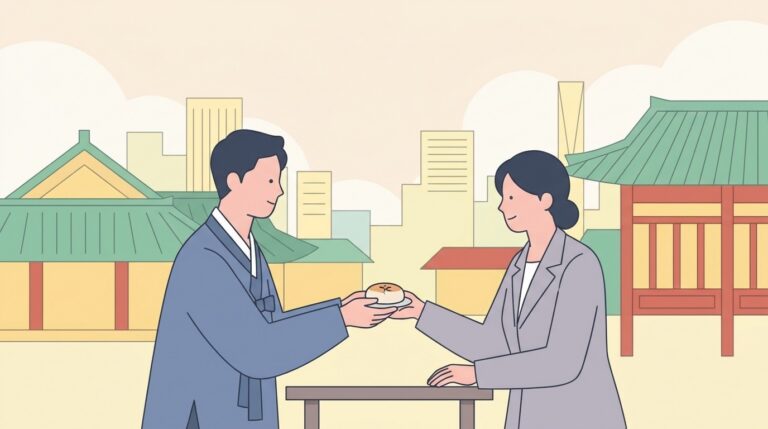
Phase 1: Empathy (Opening Story)
안녕하세요! 매일한글 에디터입니다.
Imagine this familiar scene from a sharp office K-drama like Misaeng or Agency: You poured your soul into an immaculate cross-departmental project proposal, only to have a notoriously cynical team lead from Planning—let’s call him Manager Kang—tear it apart in front of the executive board with passive-aggressive sneers. Your blood is boiling. Every fiber of your Western debate training tells you to fire back with cold hard metrics, draw boundaries, or freeze him out completely in the hallway.
Then, your veteran Korean team director catches your eye, gently puts a hand on your shoulder, and whispers with an inscrutable smirk: “내일 아침 출근길에 강 팀장 좋아하는 카라멜 마키아토 한 잔 사 들고 가봐. 미운 놈 떡 하나 더 준다잖아.” (Naeil achim chulgeun-gire Gang timjang joaha-neun karamel makiat-o han jan sa deulgo gaba. Miun nom tteok hana deo jundajana. / “Tomorrow morning on your way to work, buy Manager Kang his favorite caramel macchiato. As the old saying goes: give an extra rice cake to the one you dislike.”)
At first, your cognitive gears grind to a halt. Reward the bully? Feed the troll? Yet in Korea’s intricate web of high-context human relationships (ingan-gwan-gye), this is not defeatism or naive appeasement. It is the pinnacle of C2-level psychological warfare—a sophisticated social maneuver designed to disarm an adversary, neutralize hidden animosity, and establish uncontested moral and strategic dominance. Based on years of mentoring senior executives and global leaders navigating Seoul’s corporate trenches, this masterclass decodes the counter-intuitive genius of Korean paradoxical proverbs.
Phase 2: Deep Dive into 3 Core Expressions
1. 미운 놈 떡 하나 더 준다 (Miun nom tteok hana deo junda)
- Pronunciation: [Mi-un nom tteok ha-na deo jun-da] (Think of it like: “Mee-oon nome duck ha-na duh joon-da”)
- Meaning: Literal: “Give one more rice cake to the person you dislike.” / Actual Nuance: Disarm a hostile rival or toxic person through strategic, overwhelming generosity instead of emotional retaliation.
- K-Culture Moment: In historical period dramas (Sageuk), when a shrewd queen dowager grants royal silk to a scheming concubine, not out of love, but to suffocate her rebellion under visible public benevolence.
- Editor’s Insight: Nom (놈) is a slightly pejorative, earthy term for a guy or fellow. The charm of this proverb lies in its raw, grounded honesty. It admits, “Yes, I despise you,” while prescribing the coldest, most elegant antidote: unexpected indulgence that puts the psychological burden of guilt (b 부담 / budam) entirely onto the aggressor.
- Situation Spectrum:
- Casual banter with friends/colleagues: ✅
- Semi-formal mentoring / strategic counsel: ✅
- Formal client negotiations (addressed directly to them): 🚫
- 🤔 Think About It: In English, people say “Kill them with kindness.” But while Western kindness often focuses on moral high ground, the Korean tteok (rice cake) represents a tangible social debt (bueche). What does gifting food reveal about how Koreans resolve emotional tension?
2. 웃는 낯에 침 뱉으랴 (Unneun nache chim baeteunya)
- Pronunciation: [Un-neun na-che chim bae-teu-rya] (Sounds like: “Oon-neun nah-cheh cheem beh-teu-ryah”)
- Meaning: Literal: “Who could spit on a smiling face?” / Actual Nuance: Maintaining an unflinching, warm smile and courteous demeanor completely disarms an aggressor’s ability to attack you openly without looking monstrous.
- K-Culture Moment: A luxury department store VIP manager facing an irrational customer throwing a tantrum; the manager maintains a tranquil, flawless smile that forces the customer to slowly deflate from sheer self-consciousness.
- Editor’s Insight: This proverb is the tactical twin of Miun nom tteok hana deo junda. When you couple a tangible favor with an unshakeable smile (unneun nat), you deny your opponent any emotional ammunition to justify their hostility.
- Situation Spectrum:
- Casual: ✅
- Semi-formal: ✅
- Formal / Business discussion: ⚠️ (Use in third-person analysis, not directed at your boss)
- 🤔 Think About It: Is suppressing visible annoyance to smile seen as hypocrisy in your culture, or is it recognized as self-mastery and emotional intelligence?
3. 능구렁이 같다 (Neunggu-reongi gatda)
- Pronunciation: [Neung-gu-reong-i gat-da] (Sounds like: “Noong-goo-rung-ee got-dah”)
- Meaning: Literal: “To be like a black rat snake.” / Actual Nuance: A person who navigates conflicts slyly, smoothly, and with profound cunning, never revealing their true motives or inner rage.
- K-Culture Moment: In modern legal and political K-dramas, the veteran prosecutor who laughs heartily with his corrupt rivals over Korean barbecue, only to silently build an ironclad indictment that destroys them overnight.
- Editor’s Insight: While calling someone a “snake” in English is purely derogatory, calling an experienced mentor a neunggu-reongi in Korean carries a grudging admiration for their uncanny survival instincts and seasoned diplomatic polish.
- Situation Spectrum:
- Casual teasing among peers: ✅
- Talking about a superior: 🚫 (Highly offensive if overheard)
- Private situational debrief: ⚠️
- 🤔 Think About It: How does Korean workplace hierarchy foster this art of emotional camouflage compared to direct confrontation cultures?
Phase 3: Textbook Korean vs. Real Korean
Scenario 1: Discussing how to handle an antagonistic peer
- 📖 교과서 한국어 (Textbook):
저는 그 사람을 미워하지 않고 더욱 친절하게 대할 생각입니다.
(Jeoneun geu sarameul miwohaji anko deouk chinjeolhage daehal saenggagimnida. / “I intend not to hate that person and will treat them even more kindly.”) - 🗣️ 진짜 한국어 (Real Native C2):
미운 놈 떡 하나 더 주는 셈 치고, 모르는 척 커피 한잔 쓱 찔러줘야죠.
(Miun nom tteok hana deo juneun sem chigo, moreuneun cheok keopi hanjan sseuk jjilleojwoyajyo. / “I’ll just chalk it up to giving an extra rice cake to the one I dislike, slip him a coffee, and play dumb.”) - 💡 왜 다를까? (Cultural Insight): The native expression uses idiomatic verbs like sseuk jjilleojuda (to slyly slip someone a treat) and ~sem chigo (considering it as), transforming naive altruism into tactical, grounded maturity.
Scenario 2: Advising a junior colleague under fire
- 📖 교과서 한국어 (Textbook):
감정적으로 대응하지 말고 상대방의 기분을 맞춰주세요.
(Gamjeongjeogeuro daeeunghaji malgo sangdaebang-ui gibuneul matchwojuseyo. / “Do not respond emotionally, and accommodate the other party’s feelings.”) - 🗣️ 진짜 한국어 (Real Native C2):
웃는 낯에 침 못 뱉는 법이니까, 일단 허허 웃으면서 상대방 페이스를 말리게 하세요.
(Unneun nache chim mot baenneun beob-inikka, ildan heoheo useumyeonseo sangdaebang peiseureul mallige haseyo. / “No one spits on a smiling face; laugh it off comfortably and make them lose their rhythm.”) - 💡 왜 다를까? (Cultural Insight): Textbook phrases sound passive. Native speakers use expressions like peiseureul mallige hada (to disrupt someone’s momentum/tempo), highlighting that generosity is an offensive strategy, not a retreat.
Phase 4: K-Culture Deep Dive & Non-Verbal Manners
4-1. Nunchi (눈치) & Gestures: The Art of the Strategic Offering
When executing this proverb in real Korean life, your non-verbal cues dictate whether your “extra rice cake” comes across as a masterstroke of diplomacy or a pathetic brown-nosing surrender.
* The Angle of Delivery: Never hand over an offering (be it coffee, a snack from a business trip, or a key document) with obsequious, bowed shoulders. Keep your posture upright, tilt your head slightly at a 15-degree angle, and offer the item with both hands supporting the base or with your right hand supported at the elbow by your left wrist.
* Micro-Expressions: Maintain relaxed eye contact with an open, untroubled expression (yeon-yeon-han pyojeong). Do not grin eagerly. A neutral, warm gaze signals: “I see through your game, but I am choosing to be generous because I am undisturbed.”
4-2. The Cultural Matrix: Food as Tactical Debt in K-Culture
In Korea, eating together or receiving food is never just caloric intake; it forms an invisible emotional contract known as Jeong (정) and mutual obligation (Eun-hye / 은혜). When someone mistreats you and you hand them food, you create a profound cognitive dissonance. In the traditional communal village (Pumasi culture), publicly receiving someone’s food after acting maliciously toward them makes one look dishonorable in front of the group. In modern corporate settings, accepting that coffee or snack makes it socially impossible for your critic to attack you aggressively in the next meeting without losing face (chemyun).
Phase 5: Real-World Roleplay Scenario
Setting: A late-night pojangmacha (street tent bar) in Jongno. Rain taps against the vinyl tarp. You are sharing soju and spicy sea snails with Manager Min (민 과장), your workplace mentor, after an exhausting confrontation with a territorial partner team.
- You: 민 과장님, 오늘 기획팀 최 과장 태도 보셨죠? 사사건건 트집 잡는데 정말 폭발할 뻔했습니다.
(Min gwajangnim, oneul gihoek-tim Choe gwajang taedo bosyeottjyo? Sasageongeon teujip jamneunde jeongmal pokbalhal ppeonhaetseumnida. / “Manager Min, did you see Manager Choi’s attitude today? Nitpicking every single detail… I was about to explode.”)
🎭 한숨을 내쉬며 소주잔을 힘없이 내려놓는다 (Sighs deeply and sets down the soju shot glass with a clink) -
Manager Min: 하하, 최 과장 그 친구 원래 자기 밥그릇 뺏길까 봐 가시부터 세우는 스타일이야. 거기에 말려들면 너만 손해지.
(Haha, Choe gwajang geu chingu wonrae jagi bapgeureut ppaetgilkka bwa gasibuteo seuneun seutair-iya. Geogie mallyeodeulmyeon neoman sonhaeji. / “Haha, that guy Choi always bristles with thorns whenever he fears someone touching his rice bowl. If you get sucked into that, you’re the only one losing.”)
🎭 잔을 채워주며 덤덤하게 웃는다 (Fills your glass calmly with a knowing smile) -
You: 솔직히 내일 팀 회의 때 데이터로 제대로 망신을 줘버릴까 생각 중입니다.
(Soljikhi naeil tim hoeui ttae de-iteoro jedaero mangsineul jwobeorilkka saenggak jung-imnida. / “Honestly, I’m thinking of thoroughly humiliating him with data at tomorrow’s team meeting.”)
🎭 눈빛을 번뜩이며 이를 악문다 (Eyes flashing, gritting your teeth) -
Manager Min: 에이, 칼을 뽑으면 피를 보지만, 떡을 주면 사람을 얻는 법이야. 미운 놈 떡 하나 더 준다고 생각 못 해봤어?
(Ei, kareul ppob-eumyeon pireul bojiman, tteog-eul jumyeon sarameul eonneun beob-iya. Miun nom tteok hana deo jundago saenggak mot haebwasseo? / “Hey now, pull a sword and you see blood, but give a rice cake and you gain an ally. Haven’t you ever thought of giving an extra rice cake to the one you dislike?”)
🎭 젓가락으로 안주를 집어 권하며 (Gestures toward the dish with chopsticks) -
You: 떡을 주라고요? 저를 그렇게 무시한 사람한테요?
(Tteog-eul juragoyo? Jeoreul geureoke musihan saram-hanteyo? / “Give him a rice cake? To someone who disrespected me like that?”)
🎭 억울한 표정으로 되묻는다 (Asks back with an aggrieved expression) -
Manager Min: 최 과장이 맡은 신사업 자료 있지? 그 친구한테 꼭 필요한 레퍼런스를 내일 네가 먼저 살짝 챙겨줘 봐. ‘최 과장님 이번 발표에 도움 될 것 같아 정리해 봤습니다’ 하면서.
(Choe gwajang-i mateun sinsaeop jaryo itji? Geu chinguhante kkok piryohan repeoreonseureul naeil nega meonjeo saljjak chaenggyeojwo bwa. ‘Choe gwajangnim ibeon balpyoe doum doel geot gata jeongrihae bwatseumnida’ hamyeonseo. / “You know that new business project Choi is handling? Tomorrow, quietly send him crucial reference data he desperately needs before he even asks. Say, ‘Manager Choi, I organized this thinking it might assist your presentation.'”)
🎭 나직하고 전략적인 목소리로 속삭인다 (Whispers in a low, strategic voice) -
You: 아… 웃는 낯에 침 못 뱉게 만든다는 말씀이시군요.
(A… unneun nache chim mot baetge mandeundaneun malsseum-isigun-yo. / “Ah… you mean making it impossible for him to spit on a smiling face.”)
🎭 깨달음을 얻은 듯 눈이 커지며 (Eyes widening in sudden realization) -
Manager Min: 그렇지! 떡을 배부르게 먹여놓으면, 다음 회의에서 네 발목 잡으려다가도 목이 메어 멈칫하게 되는 거야. 그게 진짜 고단수 처세술이지.
(Geureochi! Tteog-eul baebureuge meogyeo-noh-eumyeon, daeum hoeui-eseo ne balmok jabeuryeodagado mog-i mee meomchit-hage doeneun geoya. Geuge jinjja godansu cheosesur-iji. / “Exactly! Stuff him with rice cakes, and when he tries to trip you up in the next meeting, he’ll choke on his own guilt and hesitate. That is true masterclass survival skill.”)
🎭 소주잔을 부딪치며 껄껄 웃는다 (Clinks glasses together and chuckles hearty)
🔀 Interactive Decision Point
How will you respond to Manager Min’s advice tomorrow morning?
- Option A: Send Manager Choi the data with a brief, impeccably polite message: “Manager Choi, came across this while researching. Hope it helps your deck!”
- Option B: Confront Manager Choi publicly in the cafeteria, loudly offering him a pastry while saying: “Here’s a snack since you seem stressed by my work!”
- Option C: Do nothing, maintain cold silence, and wait for him to fail on his own.
[Result Analysis]
* Best Choice (Option A): Pure perfection. Disarming generosity delivered quietly without public mockery gives the adversary a dignified way to back down while leaving them socially indebted to you.
* Bad Choice (Option B): Catastrophic. Sarcastic pseudo-generosity in public humiliates the other party, weaponizing their spite into lifelong vengeance.
* Risk Choice (Option C): Passive-aggressive stalemate. You avoid immediate conflict, but his sabotage will continue unabated because no relational dynamic has shifted.
Phase 6: 10-Second Emotional Shadowing Drill
Master the emotional cadence of paradoxical generosity. Pay close attention to the pause markers (/) and embody the tonal shifts.
[😏 능청스럽고 여유롭게 / Playfully nonchalant and composed]
미운 놈한테는 말이야, / 오히려 떡 하나 더 쥐여주는 게 / 제일 무서운 복수야.
(Miun nom-hante-neun mariya, / ohiryeo tteok hana deo jwiyeojuneun ge / je-il museoun boksuya. / “Dealing with an adversary, you see… / casually handing them an extra rice cake / is actually the most terrifying revenge.”)-
[😌 초연하고 단호하게 / Serene, detached, and unwavering]
웃는 얼굴로 다가가면 / 결국 그쪽에서도 / 함부로 칼을 휘두를 순 없지.
(Unneun eolgullo dagagamyeon / gyeolguk geujjog-eseodo / hamburo kareul hwidureul sun eopji. / “If you approach with a calm smile, / in the end, even they / cannot recklessly swing their blade.”) -
[🤝 차분하면서도 속 깊게 / Calm, seasoned, and deeply perceptive]
감정 낭비하지 말고, / 떡 하나 쓱 건네면서 / 상대방 페이스부터 흔들어 놔.
(Gamjeong nangbihaji malgo, / tteok hana sseuk geonnemyeonseo / sangdaebang peiseubuteo heundeureo nwa. / “Don’t waste emotional energy; / smoothly hand over an offering / and shatter their momentum first.”)
Phase 7: K-Culture Mini Dictionary
-
처세술 (Cheosesul)
Translation: The art of living / Social navigation skills
Practical Usage: Highly prized in corporate Korea, cheosesul does not mean being fake; it refers to the strategic wisdom of surviving complex human hierarchies without burning bridges. -
앙금 (Anggeum)
Translation: Sediment / Lingering emotional grudge
Practical Usage: Originally referring to the settled starch at the bottom of a liquid, Koreans say angeumi namda (앙금이 남다) when unresolved petty resentment remains between two people after an argument. -
넉살 (Neoksal)
Translation: Audacious, thick-skinned geniality
Practical Usage: Someone with good neoksal (넉살 좋은 사람) can walk into an icy, hostile room, crack a warm self-deprecating joke, hand out snacks, and completely thaw the atmosphere without batting an eye. -
페이스에 말리다 (Peiseue mallida)
Translation: To get swept up in someone else’s tempo/trap
Practical Usage: Used in business negotiations or interpersonal disputes when you lose your cool and start reacting defensively to someone else’s deliberate provocations.
Phase 8: Expat & Traveler Survival Kit
Even if you aren’t fighting corporate wars in Gangnam, paradoxical generosity works magic in local markets, taxis, and guesthouses!
Top 3 Survival Expressions
- 이것도 한번 맛보세요! (Igeotto hanbeon matboseyo!)
Pronunciation: [Ee-got-tto han-beon mat-bo-seh-yo!]
Pro Tip: If a street food vendor seems grumpy or curt, offer a small treat you bought elsewhere or praise their food enthusiastically. Grumpiness instantly melts into bonus helpings (Service / 서비스). -
제가 한턱 쏘겠습니다! (Jega hanteok ssogesseumnida!)
Pronunciation: [Je-ga han-teok sso-get-seum-ni-da!]
Pro Tip: If team dynamics are prickly after a grueling group project, volunteering to buy the round of iced coffees acts as an instant reboot button. -
마음 쓰지 마세요, 다 잘 될 겁니다. (Maeum sseuji maseyo, da jal doel geomnida.)
Pronunciation: [Ma-eum sseu-ji ma-seh-yo, da jal doel geom-ni-da.]
Pro Tip: When an awkward blunder occurs with a senior colleague, this phrase smoothly diffuses the tension without placing blame.
Editor’s Travel Note: Conquering Local Korea Smoothly
When navigating traditional markets or busy subway hubs, tensions occasionally flare over misunderstood cultural cues. Download the Naver Map app download to avoid getting lost and stressed in crowded corridors. If an elder accidentally bumps into you without apologizing, don’t scowl. A polite head-bow and a steady smile (Unneun nat) will often elicit a sudden, warm “어이쿠, 미안해요” (Oops, sorry dear) in return.
Phase 9: “One Step Deeper” (Reflective Humanities Essay)
Korea’s geographic density and historically close-knit agricultural collectivism created a society where permanent exile was virtually impossible. If you fell out with a neighbor or a fellow clerk, you still had to irrigate rice paddies together the next morning or bow to the same village elder. Thus, total scorched-earth conflict was an existential luxury no one could afford.
“Miun nom tteok hana deo junda” embodies this profound historical necessity: conflict resolution through relational entanglement rather than legalistic severance. By extending generosity to an enemy, you convert an active threat into an indebted acquaintance, trading transient emotional vindication for sustainable social peace.
💬 Your Turn: Have you ever disarmed a hostile colleague or stranger by offering unexpected kindness instead of fighting back? Drop your story in the comments below!
Phase 10: FAQ & Common Mistakes
Q: Does using this proverb imply that I am being weak or submissive to a bully?
A: Absolutely not. In Korean cultural epistemology, direct explosive anger is often viewed as a lack of self-control (Hasu / 하수, novice behavior). Strategic generosity is seen as Godansu (고단수, high-tier mastery). You maintain the moral high ground and dictate the terms of engagement.
Q: Can I use “미운 놈 떡 하나 더 준다” directly in front of the person I dislike?
A: Never! The word nom (놈) is inherently derogatory. Saying this to their face is essentially an open insult: “I think you’re despicable, so here’s a cookie.” It should only be used in internal reflection, private counsel with trusted confidants, or philosophical banter.
Q: What is the modern equivalent of giving a ‘rice cake’ (떡)?
A: In today’s Seoul, it is most commonly a branded coffee voucher (KakaoTalk gift), sharing an insightful work template without being asked, or praising that person’s minor contribution in front of a third party.
🚨 Common Mistakes Warning Box
- Mistake 1: Delivering the gift with obvious passive-aggressive sarcasm.
Correct Action: Deliver the favor casually and genuinely. If your sarcasm is perceptible, you hand them legitimate reason to hate you. - Mistake 2: Confusing ‘Miun nom’ with someone who has committed a serious ethical violation or crime.
Correct Action: This proverb applies to interpersonal rivalries, petty territorialism, and difficult personalities—not severe corporate fraud or abuse. - Mistake 3: Pronouncing ‘Tteok’ (떡) like ‘Deok’ (덕).
Correct Action: Ensure you tense your vocal cords for the double consonant ㄸ (tense unaspirated sound), rather than the soft ㄷ.
Phase 11: Action Missions
- 🥉 Bronze Level (Solo Reflection): Write down the name of one person who triggers your workplace or personal anxiety. Formulate one realistic, low-cost “rice cake” (a compliment, an insightful article link, a modest beverage) you could strategically offer them.
- 🥈 Silver Level (Community Connection): Share this blog post on your social media or language study group with the caption: “Learning the Korean art of ‘처세술’—giving extra rice cakes to those who annoy you.”
- 🥇 Gold Level (Real-World Deployment): The next time an interaction turns frosty with a barista, peer, or client, do not withdraw. Smile warmly, use honorifics flawlessly, and slip them an unexpected pleasantry.
- 🎮 K-Culture Mission: Watch Episode 1 of Misaeng (Incomplete Life) or Hospital Playlist. Identify a moment where a character diffuses hostility through shared food or coffee. Notice their facial expressions!
Phase 12: Interactive Quiz Challenge
Test your mastery of advanced Korean paradoxical wisdom!
1. Situational Judgment
Your coworker, Min-su, constantly criticizes your spreadsheet formatting during team meetings. According to the spirit of “미운 놈 떡 하나 더 준다”, what is the most sophisticated response?
A) Publicly call out his typos during his next slide deck presentation.
B) Privately send him an exclusive set of automated financial templates you built, with a polite note saying you thought it might save him time.
C) Block him on Slack and refuse to make eye contact at the water cooler.
👉 Click to reveal Answer & Explanation
Correct Answer: B
Explanation: Option B embodies high-level cheosesul. By giving him a valuable tool, you neutralize his pretext for criticizing you, showcase your superior skill without arrogance, and leave him feeling subtly indebted to you.
2. Fill-in-the-Blank
Complete the classic twin proverb that prevents conflict through radiant courtesy:
“[ ] 낯에 침 뱉으랴.”
👉 Click to reveal Answer & Explanation
Correct Answer: 웃는 (Unneun)
Explanation: “웃는 낯에 침 뱉으랴” translates to “Who could spit on a smiling face?” It highlights how genuine poise and a pleasant demeanor disarm hostility.
3. True or False Cultural Insight
True or False: Calling your respected team director a “능구렁이” (black rat snake) directly to his face during his promotion speech is a high-level, affectionate compliment.
👉 Click to reveal Answer & Explanation
Correct Answer: False
Explanation: While neunggu-reongi denotes formidable diplomatic cunning and survival prowess, it contains a strong undertone of slyness and secrecy. It should only be used to describe someone in analytical, third-person contexts among close confidants, never addressed directly to a superior!







