

Master the Korean Taxi Drop-Off: Pointing Out Signs Like a Local
Phase 1: 공감 (Story-Driven Opening)
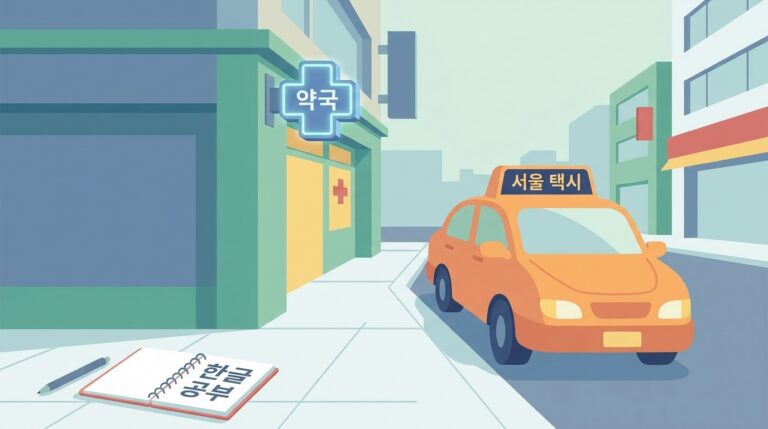
안녕하세요! (Annyeonghaseyo!) It is your Daily Hangul editor here. Picture this: You are riding in an orange Seoul taxi after a fun evening in Hongdae. Your hotel is tucked just behind an alley, right past a 24-hour pharmacy. The meter is ticking, the driver is cruising at full speed down the boulevard, and suddenly you realize—if you don’t speak up in the next five seconds, he is going to miss the turn and launch onto the Mapo Bridge! Your heart races. You want to say, “Stop! Right there! By the blue sign!” but your brain freezes. You end up blurting out “Stop!” in English, the driver brakes abruptly, and everyone feels awkward. Sound familiar? Over 80% of our beginner learners tell us that giving quick, accurate stopping cues in a moving taxi is their #1 anxiety trigger in Korea. Today, we will conquer that fear. By mastering this single, crystal-clear phrase—”저기 보이는 파란색 간판 약국 앞에서 세워 주세요”—you will glide to the curb smoothly and confidently, just like a Seoul local.
Phase 2: 핵심 표현 3선 심층 분석 (3 Core Expressions)
1. 저기 보이는 [Noun] 앞에서 세워 주세요 (Jeogi boineun [noun] ap-eseo sewo juseyo)
- Pronunciation: [Jeo-gee boy-noon … ap-eh-seo say-wo joo-say-yo] (Think of ‘sewo’ like saying ‘say war’ quickly without the ‘r’ sound!)
- Meaning: Literal: “Please stop in front of the [noun] visible over there.” | Nuance: “Please pull over right by that [landmark] ahead.”
- K-Culture Moment: Seen constantly in K-dramas when the lead character insists on getting dropped off a block early so their family doesn’t see who gave them a ride home!
- Editor’s Insight: “보이는 (boineun)” means “that can be seen.” Using this helps the driver’s eyes scan ahead for the specific visual anchor you are pointing at.
- Situation Spectrum: Casual: ⚠️ (Too formal for close friends) | Semi-formal: ✅ (Perfect for taxi drivers) | Formal: ✅
- 🤔 Think About It: In English, we often give street numbers or intersection names. Why do you think Korean directions rely so heavily on visible storefronts and commercial landmarks?
2. 파란색 간판 (Paransaek ganpan)
- Pronunciation: [Pah-rahn-sek gahn-pahn] (Rhymes with ‘car-on-deck gun-pun’)
- Meaning: Literal: “Blue signboard” | Nuance: “The blue sign / The store with the blue awning.”
- K-Culture Moment: Korean streets are dense neon jungles! Describing storefront colors (“노란색 간판” – yellow sign, “빨간색 간판” – red sign) is the universal secret code locals use to direct taxis.
- Editor’s Insight: “간판 (ganpan)” refers to the business sign hanging outside. Adding a color word before it instantly narrows the driver’s focus among dozens of crowded shops.
- Situation Spectrum: Casual: ✅ | Semi-formal: ✅ | Formal: ✅
- 🤔 Think About It: Notice how colors in Korean attach directly with “색 (saek – color)”. How does identifying colors simplify communication in high-stress situations?
3. 여기서 내려 주세요 (Yeogiseo naeryeo juseyo)
- Pronunciation: [Yeo-gee-seo neh-ryeo joo-say-yo] (Say ‘yuh-key-saw’ followed by ‘neh-ryuh zoo-say-yo’)
- Meaning: Literal: “Please let me get off here.” | Nuance: “Right here is fine, please drop me off.”
- K-Culture Moment: That classic scene where someone realizes they arrived at their blind date’s venue and urgently tells the driver to pull over immediately.
- Editor’s Insight: While “세워 주세요 (sewo juseyo)” focuses on stopping the vehicle, “내려 주세요 (naeryeo juseyo)” focuses on your action of exiting. Both work seamlessly in any taxi!
- Situation Spectrum: Casual: ⚠️ | Semi-formal: ✅ | Formal: ✅
- 🤔 Think About It: Is it more polite in your native language to ask the driver to stop the car, or to ask permission to get out?
Phase 3: 교과서 한국어 vs 진짜 한국어 (Textbook vs. Real Life)
Situation 1: Asking the driver to pull over soon
- 📖 교과서 한국어 (Textbook): 저곳에 정차해 주십시오. (Jeogose jeongchahae jusipsio. – “Please bring the vehicle to a halt over there.”)
- 🗣️ 진짜 한국어 (Real Life): 저기서 세워 주세요! (Jeogiseo sewo juseyo! – “Please pull over right over there!”)
- 💡 왜 다를까? (Why the difference?): “정차 (jeongcha)” is technical legal jargon used in driver license handbooks. Real passengers use the everyday verb “세우다 (seuda – to stop/park)” combined with polite request “~주세요”.
Situation 2: Spotting your stop suddenly
- 📖 교과서 한국어 (Textbook): 약국 근처에서 멈춰 주시기 바랍니다. (Yakguk geuncheo-eseo meomchwo jusigi baramnida. – “I request that you stop in the vicinity of the pharmacy.”)
- 🗣️ 진짜 한국어 (Real Life): 저기 약국 앞이요! (Jeogi yakguk apiyo! – “Right in front of the pharmacy there!”)
- 💡 왜 다를까? (Why the difference?): In fast-moving city traffic, short and punchy phrases are safer. Dropping unnecessary grammatical markers and ending cleanly with “~앞이요 (in front of [place], please)” is standard native practice.
Phase 4: K-Culture 딥다이브 & 비언어적 매너 (Deep Dive & Body Language)
4-1. 눈치 (Nunchi) & Gestures in a Korean Taxi
- The Center Console Point: Never point your finger directly next to the driver’s face from the back seat—it can startle them. Instead, lean slightly forward between the two front seats and point outward through the front windshield toward your landmark.
- Tone & Volume: Korean taxi partitions or open windows combined with the GPS voice mean drivers are often half-listening to radio noise. Speak up one notch louder than your normal conversational tone, keeping your pitch steady and clear.
- Eye Contact via the Rearview Mirror: Experienced drivers glance at you via the rearview mirror when you speak. A small nod of acknowledgment shows you are ready to hop out.
4-2. Culture Code: Korean Pharmacies as Urban Lighthouses
Why the “약국 (yakguk – pharmacy)”? In Korean residential and commercial neighborhoods, pharmacies almost always feature bright blue, green, or red illuminated signs with the massive single character 약 (Yak). Because they are universally recognized landmarks visible from blocks away, Koreans frequently use them as meeting spots and taxi drop-off beacons.
Phase 5: 실전 롤플레이 시나리오 (Interactive Roleplay)
Setting: It is 9:30 PM on a rainy night. You are riding in the back seat of a silver sedan taxi driven by Mr. Park (기사님 – Gisanim), a veteran Seoul driver listening to trot music.
- Turn 1 (Driver): 손님, 거의 다 왔는데 어디서 내려드릴까요? (Sonnim, geoui da wanneunde eodiseo naeryeodeurilkkayo? – “Customer, we’re almost there. Where should I drop you off?”)
- Turn 2 (You): 🎭 Leaning slightly forward, peering through the windshield: 저기 앞에 사거리 지나가 주세요. (Jeogi ape sageori jinaga juseyo. – “Please go through that intersection ahead.”)
- Turn 3 (Driver): 네, 사거리 지나서요? (Ne, sageori jinaseoyo? – “Okay, past the intersection?”)
- Turn 4 (You): 🎭 Spotting the bright blue neon cross and sign: 네, 저기 보이는 파란색 간판 약국 앞에서 세워 주세요. (Ne, jeogi boineun paransaek ganpan yakguk ap-eseo sewo juseyo. – “Yes, please pull over in front of the pharmacy with the blue sign over there.”)
- Turn 5 (Driver): 아, 저 파란 약국요? 갓길에 바로 대 드릴게요. (A, jeo paran yakguk-yo? Gatgire baro dae deurilgeyo. – “Ah, that blue pharmacy? I’ll pull right up to the curb for you.”)
- Turn 6 (You): 🎭 Taking out your transportation card: 감사합니다. 카드로 계산할게요. (Gamsahamnida. Kadeuro gyesanhalgeyo. – “Thank you. I will pay by card.”)
- Turn 7 (Driver): 삑— 결제됐습니다. 비 오니까 조심히 들어가세요! (Ppik— Gyeoljewaetseumnida. Bi onikka josimhi deureogaseyo! – “Beep— Payment complete. Watch your step in the rain!”)
- Turn 8 (You): 🎭 Bowing head as you open the door: 네, 감사합니다. 안녕히 계세요! (Ne, gamsahamnida. Annyeonghi gyeseyo! – “Yes, thank you. Goodbye!”)
🔀 Interactive Choice Point!
The driver asks: “골목 안쪽까지 들어갈까요?” (Golmok anjjok-kkaji deureogalkkayo? – “Shall I drive right into the narrow alley?”) How do you respond?
* Option A: “아니요, 그냥 여기서 내려 주세요!” (Aniyo, geunyang yeogiseo naeryeo juseyo! – No, just let me off here!)
* Feedback: [Best Choice!] Super clear and prevents the taxi from getting stuck in narrow Korean residential alleys.
* Option B: “스톱! 정지!” (Seutop! Jeongji! – Stop! Halt!)
* Feedback: [Bad Choice] Sounds like an emergency command and might cause sudden braking.
* Option C: “마음대로 하세요.” (Maeumdaero haseyo. – Do whatever you want.)
* Feedback: [Risk!] Sounds dismissive or indifferent in Korean, leaving the driver confused.
Phase 6: 10초 감정 섀도잉 드릴 (10-Second Emotional Shadowing)
Practice reading these out loud with breathing pauses marked by /:
[👀 차분하게 발견하며](Calmly spotting the landmark)
저기 / 보이는 / 파란색 간판 / 약국 앞에서 / 세워 주세요.
(Jeogi / boineun / paransaek ganpan / yakguk ap-eseo / sewo juseyo.)-
[🚨 조금 급하지만 공손하게](A bit rushed, but polite)
기사님! / 저기 모퉁이 돌아서 / 바로 세워 주세요!
(Gisanim! / Jeogi motung-i doraseo / baro sewo juseyo!) -
[😊 환하게 미소 지으며](Smiling brightly while paying)
여기서 내릴게요! / 계산해 주세요!
(Yeogiseo naerilgeyo! / Gyesanhae juseyo!)
Phase 7: K-Culture 미니 사전 (Mini Dictionary)
- 기사님 (Gisanim) | Respectful title for drivers / technicians.
Usage: Always address your taxi, bus, or delivery driver as “기사님”, never as “아저씨 (ajeossi)” which can sound impersonal. - 간판 (Ganpan) | Storefront sign / billboard.
Usage: Essential when pointing out visual landmarks: “노란 간판 (yellow sign)”, “편의점 간판 (convenience store sign)”. - 약국 (Yakguk) | Pharmacy.
Usage: Korea’s classic neighborhood marker, open late in commercial zones and easily identified by the bold letter “약”. - 갓길 (Gat-gil) | Street shoulder / roadside curb.
Usage: Drivers often say “갓길에 세울게요 (I’ll stop on the curb shoulder)” to let you know they are maneuvering out of traffic.
Phase 8: 여행자를 위한 생존 키트 (Traveler Survival Kit)
Top 3 Survival Lines:
- 저기 앞에서 세워 주세요. (Jeogi ap-eseo sewo juseyo.) – “Please pull over up ahead.”
Pro Tip: Use this when you don’t know the store name yet, but see an open curb area. - 천천히 가셔도 돼요. (Cheoncheonhi gasyeodo dwaeyo.) – “You can go slowly, no rush.”
Pro Tip: Great if the driver seems to be speeding and you are worried about missing your stop. - 영수증 주세요. (Yeongsujeung juseyo.) – “Please give me the receipt.”
Pro Tip: Always get the receipt! If you leave your phone or bag in the taxi, the receipt contains the vehicle license plate and the driver’s direct dispatch number.
Editor’s Travel Note:
When taking cabs in Korea, do not rely on verbal street addresses alone. Always open the Naver Map street navigation application or hail your ride through the Kakao T ride-hailing mobile guide so the destination is digitally preset on the dashboard screen. You can pay with your physical T-Money card or foreign Visa/Mastercard without exchanging won in advance!
Phase 9: “한 발 더 깊이” (Cultural Reflection)
In western urban planning, navigation is built around numerical grids and fixed street coordinates (e.g., “Corner of 5th and Elm”). In Korea, traditional navigation has always been dynamic and relational, defined by communal landmarks like the local bakery, the church steeple, or the neighborhood pharmacy. When you tell a driver to look for the “파란색 간판 약국 (pharmacy with the blue sign)”, you are participating in a relational way of seeing space that connects people directly to their lived environment.
💬 Your Turn: Have you ever tried to describe a building to a taxi driver in a foreign country? What kind of landmarks do you usually search for first? Share your story in the comments below!
Phase 10: FAQ & 흔한 실수 (FAQ Schema & Mistake Prevention)
Q: Can I just shout “스톱 (Stop)!” if I see my hotel?
A: While drivers understand the English word “stop,” shouting it abruptly can cause them to slam on the brakes, risking a rear-end collision. It also sounds rude in Korean. Instead, use a firm but polite “여기서 세워 주세요! (Yeogiseo sewo juseyo!)”.
Q: What if I don’t know the color of the sign in Korean?
A: Simply use generic demonstrative words! Say: “저기 편의점 앞에서 세워 주세요 (Jeogi pyeon-uijeom ap-eseo sewo juseyo – In front of that convenience store over there)” or simply point and say “저기요! (Right over there!)”.
Q: Is tipping taxi drivers expected in Korea?
A: No! Tipping is not part of Korean culture. You pay only the exact meter fare displayed on the dashboard. Leaving extra change might confuse the driver into chasing you down to return it.
🚨 흔한 실수 (Common Mistakes) Warning Board:
- Calling the driver “아저씨 (Ajeossi)”: While not vulgar, it feels overly informal. Always use 기사님 (Gisanim).
- Giving instructions too late: Saying “Stop right here!” while moving at 60 km/h is dangerous. Give your cue 30 to 50 meters in advance using “저기 보이는… (That … visible ahead)”.
- Trying to open the door manually before the cab stops: Most Korean taxis do not have automatic passenger doors like in Japan, but drivers prefer to unlock or settle in the curb before you push the door open into bike traffic.
Phase 11: 액션 미션 & 참여 유도 (Action Missions)
- 🥉 Bronze Mission (Solo Practice): Look around your current room or out the window. Pick an object with a distinct color and say out loud: “저기 보이는 [Color] 간판 앞에서 세워 주세요!”
- 🥈 Silver Mission (Voice Note Challenge): Record a 5-second voice memo saying: “기사님, 저기 파란색 간판 앞에서 세워 주세요!” and listen back to ensure your pauses match our shadowing drill.
- 🥇 Gold Mission (Real World / Virtual Simulation): Next time you watch a modern K-drama, listen carefully for the moment a character steps out of a cab. Did they say “세워 주세요” or “내려 주세요”?
🎮 K-Culture Mission: Search YouTube for a “Seoul Taxi POV Drive” video. Pretend you are in the backseat and shout your drop-off phrase right when an orange or blue building flashes past the window!
Phase 12: 인터랙티브 퀴즈 챌린지 (Quiz Challenge)
Q1. Fill in the blank:
“저기 보이는 파란색 ______ 약국 앞에서 세워 주세요.” (Hint: The word for storefront sign/board)
👉 Click to reveal Answer & Explanation
Answer: 간판 (Ganpan)
Explanation: “간판” means outdoor sign or billboard. Together with “파란색 (blue)”, it creates the phrase “파란색 간판” (blue signboard).
Q2. Situation Judgment:
You see your subway entrance 20 meters ahead. Which sentence is the most polite and natural to tell the driver?
(A) 야! 차 세워라!
(B) 저기 지하철역 입구 앞에서 세워 주세요.
(C) 정차를 신속히 완료해 주시기 바랍니다.
👉 Click to reveal Answer & Explanation
Answer: (B)
Explanation: (A) is extremely rude informal speech (반말), and (C) is rigid military-style Korean. (B) hits the perfect polite everyday tone.
Q3. True or False:
Calling your taxi driver “기사님 (Gisanim)” is more polite and respectful than calling them “아저씨 (Ajeossi)”.
👉 Click to reveal Answer & Explanation
Answer: True!
Explanation: “기사 (gisa)” signifies a skilled technician/driver, and adding the honorific suffix “~님 (nim)” shows genuine appreciation for their profession.







