

How to Write a Heartfelt Thank-You Letter to Your Korean Teacher or Mentor
Phase 1: Empathy & Story Opening
안녕하세요! 매일한글 에디터입니다. (Hello! I’m your Daily Hangul editor.)
Think back to your first few weeks in South Korea. Do you remember standing frozen in front of a self-service kiosk at a crowded restaurant in Hongdae, while a line formed behind you? Or that moment when an elderly neighbor spoke to you in rapid-fire Korean in the apartment elevator, and your mind went completely blank?
We have all been there. Living in Korea is full of tiny cultural landmines—from knowing whether to hand over a credit card with two hands, to deciphering whether “밥 먹었어? (Did you eat?)” is an invitation or just a friendly hello.
Whenever we overcome these awkward hurdles, there is almost always a patient Korean teacher or mentor behind the scenes. They were the ones who didn’t just teach you sterile grammar from a textbook; they explained why elders hand you side dishes with a warm smile, and how a tiny suffix like ~시~ (-si-) transforms everyday words into expressions of respect.
Now, semester finals are wrapping up, or perhaps Teachers’ Day (스승의 날, Seuseungui Nal) is approaching on May 15th. You want to write a card that goes far beyond a simple “감사합니다 (Thank you).” You want your teacher to feel the profound impact their lessons had on your actual daily life.
In this guide, crafted from real classroom feedback and heartfelt student letters, you will master the ultimate tribute: “수업 시간에 알려 주신 표현 하나하나와 한국 문화 이야기 덕분에 한국 생활에 무사히 적응할 수 있었습니다” (Thanks to every expression and story about Korean culture you taught in class, I was able to adapt safely to life in Korea.) Let’s turn your genuine gratitude into fluent, moving Korean.
Phase 2: Core Expression Deep Dive
Let’s break down this master sentence into three high-impact expressions you can use in any letter to a mentor.
1. 수업 시간에 알려 주신 표현 하나하나 (Sueop sigane allyeo jusin pyohyeon hanahana)
- Pronunciation: sueop sigane allyeo jusin pyohyeon hanahana (Think of allyeo like “ahl-ryuh”, with the gentle flowing ‘l-r’ transition, and hanahana rhythmic like tapping your fingers twice: hah-nah-hah-nah).
- Meaning: Literally “expression by expression that you graciously taught in class,” idiomatically meaning “every single expression you taught.”
- K-Culture Moment: You often hear this in graduation speeches or award shows when an actor thanks their veteran acting coach: “선배님이 짚어 주신 디테일 하나하나 덕분입니다 (It’s all thanks to every single detail you pointed out).”
- Editor’s Insight: Doubling 하나 (one) into 하나하나 (hana-hana) adds deep emotional texture. It signifies that you didn’t just passively absorb lectures as a blur; you cherished each piece of advice individually.
- Situation Spectrum:
- Casual (Friends): 🚫
- Semi-formal (Colleagues): ⚠️
- Formal / Honorific (Teachers, Mentors): ✅
- 🤔 Think About It: In English, we often say “everything you taught.” Why do you think Korean emphasizes “each single one” (하나하나) when expressing deep gratitude to a superior?
2. 한국 문화 이야기 덕분에 (Hanguk munhwa iyagi deokbune)
- Pronunciation: hanguk munhwa iyagi deokbune (Pronounce deokbune like “dock-boo-neh”, crisp and light on the final syllable).
- Meaning: Literally “Thanks to the Korean culture stories.” In reality, it acknowledges that their guidance was the direct cause of your positive outcome.
- K-Culture Moment: When K-pop idols win first place on music programs, the first sentence out of their mouths is almost invariably: “팬 여러분 덕분에… (Thanks to our fans…).”
- Editor’s Insight: Never confuse 덕분에 (deokbune, thanks to [positive result]) with 때문에 (ttaemune, because of [neutral or negative blame]). Using 때문에 to a mentor can sound strangely dry or accusatory if misused!
- Situation Spectrum:
- Casual: ✅ (네 덕분에 – thanks to you [to close peers])
- Semi-formal: ✅ (선배님 덕분에)
- Formal: ✅ (선생님 덕분에)
- 🤔 Think About It: Notice how Korean culture instinctively shares credit with others. How does saying “Thanks to you” shift the emotional weight compared to saying “I did well”?
3. 무사히 적응할 수 있었습니다 (Musahi jeogeunghal su isseotseumnida)
- Pronunciation: musahi jeogeunghal su isseotseumnida (Pronounce musahi like “moo-sah-hee”, soft breathing out on the hi).
- Meaning: “I was able to adapt safely, without incident, and settle in comfortably.”
- K-Culture Moment: Used by characters returning home from a tough journey or overcoming cultural culture shock in dramas like Hospital Playlist or Misaeng when completing an overseas assignment.
- Editor’s Insight: 무사히 (musahi) comes from Hanja meaning “no accident / peace.” When a foreigner uses this word, Korean teachers feel a wave of relief and pride, because they know living abroad can be daunting and stressful.
- Situation Spectrum:
- Casual: 🚫 (무사히 적응했어 is okay with friends)
- Semi-formal: ⚠️
- Formal: ✅
- 🤔 Think About It: Why is “safe adaptation” such an emotional milestone for both a mentor and an international student?
Phase 3: Textbook Korean vs. Real Korean
Situation 1: Giving credit to your teacher for your smooth transition
- 📖 Textbook Korean: 선생님이 잘 가르쳐 줘서 한국에서 잘 살고 있습니다. (Seonsaengnimi jal gareuchyeo jwoseo hangugeseo jal salgo isseotseumnida. – Because the teacher taught well, I am living well in Korea.)
- 🗣️ Real Korean: 선생님 덕분에 한국 생활에 큰 힘을 얻고 무사히 정착할 수 있었습니다. (Seonsaengnim deokbune hanguk saenghware keun himeul eotgo musahi jeongchakal su isseotseumnida. – Thanks to you, teacher, I gained immense strength and could settle into Korean life smoothly.)
- 💡 Why Different? The textbook phrasing sounds like an objective cause-and-effect report. Real Korean uses 덕분에 and emotional metaphors like 큰 힘을 얻다 (gain great strength) to show warmth.
Situation 2: Expressing that you still cherish their classroom lessons
- 📖 Textbook Korean: 수업 시간에 배운 모든 문법을 기억합니다. (Sueop sigane baeun modeun munbeobeul gieokhamnida. – I remember all the grammar learned in class.)
- 🗣️ Real Korean: 수업 때 해 주신 말씀 하나하나가 아직도 마음에 깊이 남아 있습니다. (Sueop ttae hae jusin malsseum hanahanaga ajikdo maeume gipi nama isseumnida. – Every word you shared in class still lingers deeply in my heart.)
- 💡 Why Different? Replacing “grammar” (문법) with “honorable words” (말씀) and stating they stay in your heart (마음에 남다) displays intermediate-level cultural elegance.
Phase 4: K-Culture Deep Dive & Non-verbal Manners
4-1. Nunchi & Physical Etiquette When Giving a Letter
When presenting a written card or a small thank-you gift to a mentor:
* Two-Hand Rule (두 손): Always hold the envelope with both hands. Your thumbs should rest lightly on the top edge, offering the card so the text orientation faces the teacher.
* Slight Bow (목례): Bow your head around 15 to 30 degrees while extending the letter.
* Gaze Timing: Avoid intense, unbroken eye contact while they receive it. Look downward respectfully, then make warm eye contact with a modest smile once they have taken the envelope.
4-2. Cultural Code: Teachers’ Day & The Carnation Tradition
In South Korea, May 15th is 스승의 날 (Seuseungui Nal – Teachers’ Day). Historically rooted in Confucian values, there is a traditional proverb: “스승의 그림자도 밟지 않는다” (“One does not even step on a teacher’s shadow”).
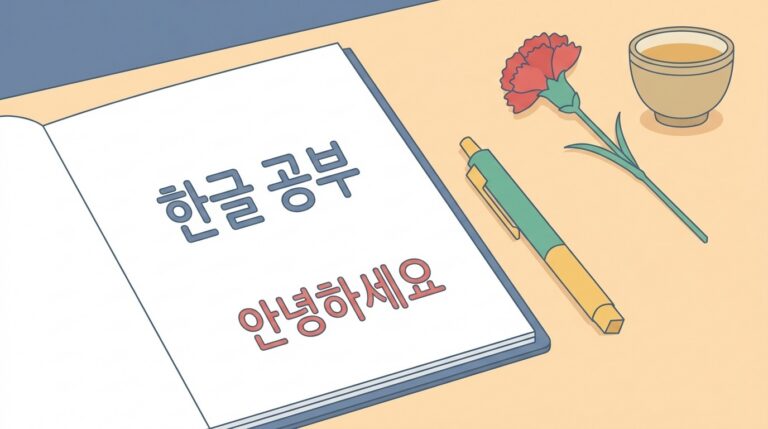
While modern Korea is far more relaxed, teachers remain venerated guides who shape a person’s life trajectory. Giving a red carnation (카네이션) alongside a heartfelt, handwritten letter is standard. Under anti-graft regulations (the Kim Young-ran Act), students currently enrolled in school cannot give expensive physical gifts to active teachers, which makes a handwritten letter the most precious, legal, and cherished gift of all.
Phase 5: Real-World Roleplay Scenario
Setting: Professor Park’s office (박 선생님 연구실) at the Korean Language Institute during the final week of the term.
Characters:
* 박 선생님 (Teacher Park): A warm, dedicated mentor who often shared stories about street markets and festive holidays in class.
* 알렉스 (Alex): A B1 student finishing their second semester in Seoul.
Turn 1
* 박 선생님: 알렉스 씨, 이번 학기도 정말 고생 많았어요. 다음 학기 준비는 잘 돼 가요?
(Alex ssi, ibeon hakgido jeongmal gosaeng manasseoyo. Daeum hakgi junbineun jal dwae gayo?)
“Alex, you worked so hard this semester. Are preparations for next semester going well?”
🎭 따뜻한 미소로 차를 건네며 (Handing over a cup of tea with a warm smile)
Turn 2
* 알렉스: 네, 선생님. 덕분에요! 사실 오늘 선생님께 꼭 드리고 싶은 말씀이 있어서 찾아왔습니다.
(Ne, seonsaengnim. Deokbuneyo! Sasil oneul seonsaengnimkke kkok deurigo sipeun malsseumi isseoseo chajawasseumnida.)
“Yes, teacher. Thanks to you! Actually, I came today because there was something I really wanted to tell you.”
🎭 두 손으로 찻잔을 받으며 정중하게 (Receiving the teacup politely with two hands)
Turn 3
* 박 선생님: 어머, 무슨 일인데요? 사뭇 진지하네요!
(Eomeo, museun irindeoyo? Samut jinjihaneyo!)
“Oh my, what is it? You seem quite serious!”
🎭 눈을 동그랗게 뜨며 웃음 짓는다 (Eyes widening playfully with a laugh)
Turn 4
* 알렉스: 처음 한국에 왔을 때는 길 찾는 것조차 무서웠거든요. 그런데 수업 시간에 알려 주신 표현 하나하나와 한국 문화 이야기 덕분에 한국 생활에 무사히 적응할 수 있었습니다.
(Cheoeum hanguge wasseul ttaeneun gil chatneun geotjocha museowotgeodeunyo. Geureonde sueop sigane allyeo jusin pyohyeon hanahana-wa hanguk munhwa iyagi deokbune hanguk saenghware musahi jeogeunghal su isseotseumnida.)
“When I first arrived in Korea, even finding my way was terrifying. But thanks to every expression and story about Korean culture you taught in class, I was able to adapt safely to life in Korea.”
🎭 가방에서 손수 쓴 카드를 꺼내 두 손으로 건네며 (Pulling out a handwritten card from a bag and offering it with both hands)
Turn 5
* 박 선생님: 아이고, 알렉스 씨… 편지까지 썼어요? 수업 시간에 항상 맨 앞자리에서 눈을 반짝이더니, 제가 오히려 큰 보람을 느꼈어요.
(Aigo, Alex ssi… Pyeonjikaji sseosseoyo? Sueop sigane hangsang maen apjarieseo nuneul banjjagideoni, jega ohiryeo keun borameul neukkyeosseoyo.)
“Oh goodness, Alex… you wrote a letter too? Seeing your eyes sparkling in the front row every class made me feel such deep fulfillment.”
🎭 감동받은 표정으로 편지 봉투를 조심스레 쓰다듬는다 (Caressing the envelope gently with a touched expression)
Turn 6
* 알렉스: 선생님께서 은행 업무 보는 법이랑 쓰레기 분리수거 문화까지 알려 주셨잖아요. 그게 정말 큰 도움이 되었어요.
(Seonsaengnimkkeseo eunhaeng eommu boneun beobirang sseuregi bunrisugeo munhwakkaji allyeo jusyeotjanhayo. Geuge jeongmal keun doumi doeeosseoyo.)
“You even taught us how to handle banking and garbage sorting etiquette. That was truly a lifesaver.”
🎭 쑥스러운 듯 머리를 살짝 긁적이며 (Scratching head slightly in modest embarrassment)
Turn 7
* 박 선생님: 한국 생활을 즐겁게 해내 줘서 내가 더 고마워요. 이 편지는 평생 간직할게요.
(Hanguk saenghwareul jeulgeopge haenae jwoseo naega deo gomawoyo. I pyeonjineun pyeongsaeng ganjikhalkeyo.)
“I am even more grateful to you for thriving and enjoying life in Korea. I will treasure this letter for life.”
🎭 편지를 가슴에 꼭 대며 고마움을 표한다 (Holding the letter close to her chest in gratitude)
Turn 8
* 알렉스: 앞으로도 부끄럽지 않은 제자가 되겠습니다. 정말 감사드립니다!
(Apeurodo bukkeureopji aneun jejaga doegetseumnida. Jeongmal gamsadeurimnida!)
“I will continue to be a student you can be proud of. Thank you so very much!”
🎭 깊게 허리 숙여 90도 인사를 올린다 (Bowing deeply at a 90-degree angle)
🔀 Interactive Decision Point
How would you conclude your letter or final meeting? Choose your response:
- Option A: “선생님, 밥 한 끼 사 주세요! 언제 시간 되세요?” (Seonsaengnim, bap han kki sa juseyo! Eonje sigan doeseyo? – “Teacher, buy me a meal! When are you free?”)
- Option B: “선생님께서 베풀어 주신 은혜 잊지 않겠습니다. 늘 건강하세요.” (Seonsaengnimkkeseo bepureo jusin eunhye itji anketseumnida. Neul geonganghaseyo. – “I will never forget the grace you have shown me. Please stay healthy always.”)
- Option C: “선생님의 가르침은 완벽했습니다. 다음 학기에도 저를 가르쳐야 합니다.” (Seonsaengnimui gareuchimeun wanbyeokhaesseumnida. Daeum hakgiedo jeoreul gareuchyeoya hamnida. – “Your teaching was perfect. You must teach me next semester too.”)
Editor’s Feedback:
* Option A (Risk): In casual Korean culture, asking an older person to buy a meal is common, but in a formal thank-you letter, it risks sounding overly flippant or demanding.
* Option B (Best!): 은혜 (eunhye, benevolent grace) and 늘 건강하세요 (stay healthy always) are classic, deeply touching B1-B2 honorific closures that Korean mentors adore.
* Option C (Bad): Using command forms like ~해야 합니다 (must do) towards a teacher sounds unnatural and unintentionally rude.
Phase 6: 10-Second Emotion Shadowing Drill
Read these sentences aloud, pausing precisely at the / marks to mirror native Korean cadence.
[🥺 진심 어린 감사와 감동을 담아]
수업 시간에 / 알려 주신 표현 하나하나가 / 저에게는 / 큰 힘이 되었습니다.
(Sueop sigane / allyeo jusin pyohyeon hanahanaga / joegeneun / keun himi doeeotseumnida.)
“Every single expression / taught in class / became a great source / of strength to me.”-
[😊 환한 미소와 뿌듯함을 듬뿍 싣고]
선생님 덕분에 / 한국 생활에 / 무사히 / 적응할 수 있었어요!
(Seonsaengnim deokbune / hanguk saenghware / musahi / jeogeunghal su isseosseoyo!)
“Thanks to you, teacher / to life in Korea / safely and smoothly / I was able to adapt!” -
[🙇♂️ 고개 숙여 깊은 존경을 표하며]
베풀어 주신 사랑 / 잊지 않고 / 더 열심히 / 공부하겠습니다.
(Bepureo jusin sarang / itji anko / deo yeolsimhi / gongbuhagetseumnida.)
“The care you have bestowed upon me / without forgetting / even harder / I will study.”
Phase 7: K-Culture Mini Dictionary
-
은사님 (Eunsanim)
Meaning: A respected teacher or mentor who has bestowed life-changing wisdom upon you.
Usage: Stronger and more emotional than just 선생님 (teacher). When speaking to others about your favorite mentor, you say: “제 인생의 은사님이십니다 (They are the cherished mentor of my life).” -
덕분에 (Deokbune)
Meaning: Thanks to (someone/something).
Usage: Always tied to favorable outcomes. In professional emails, use 팀장님 덕분에 무사히 끝났습니다 (“Thanks to you, Team Leader, it finished smoothly”). -
적응하다 (Jeogeunghada)
Meaning: To adapt, adjust, or accustom oneself to a new environment.
Usage: Essential for expats and travelers. Combined with 무사히 (safely), it expresses settling down without trauma or crisis. -
보람 (Boram)
Meaning: A profound feeling of reward, worthwhile accomplishment, or fruitfulness.
Usage: Teachers frequently say: “가르치는 보람이 있다” (“It feels worthwhile and fulfilling to teach”). Mentioning that you felt rewarding progress brings joy to your mentor.
Phase 8: Traveler & Expat Survival Kit
Survival Expressions Top 3 for Gifting & Cards
- 선물 포장 가능한가요? (Seonmul pojang ganeunghangayo?)
“Is gift wrapping available?”
Pro Tip: Korean department stores and stationers often have dedicated wrapping counters (포장 코너). - 감사 카드 어디에 있어요? (Gamsa kadeu eodie isseoyo?)
“Where are the thank-you cards?”
Pro Tip: Use this when browsing bookstores to locate premium letter sets. - 마음을 담아 드립니다. (Maeumeul dama deurimnida.)
“I give this to you with all my heart.”
Pro Tip: A beautiful sentence to say when handing over your letter envelope.
Editor’s Travel Note: Stationery Hunting in Seoul
Don’t write your heartfelt letter on a piece of scrap notebook paper! Koreans place high aesthetic value on stationery (문구류). Head to the flagship branches of Kyobo Hottracks at Gwanghwamun for elegant traditional Hanji paper and embroidered envelopes. To browse stationery stores in advance, check the 교보문고 핫트랙스 매장 찾기 portal. If you are mailing a card across cities, you can use the 인터넷 우체국 편지 서비스 to send customized physical letters directly.
Phase 9: “One Step Deeper” (Cultural Reflection)
In Western individualist pedagogy, a language teacher is often viewed as a skilled contractor hired to deliver information. In Korea, however, the concept of 사제지간 (Sajejigan – the relationship between teacher and disciple) carries quasi-parental warmth. A Korean teacher often worries about whether an overseas student is skipping meals, catching a cold during the winter freeze, or getting lonely.
When you express that their cultural tips helped you “adapt safely,” you validate their role not just as an instructor of grammar rules, but as your cultural protector and guide.
💬 Your Turn: Who was the Korean teacher or mentor who made you feel safe in an unfamiliar country? Drop a line in the comments thanking them using the phrase: “선생님 덕분에 한국 생활에 잘 적응하고 있어요!”
Phase 10: FAQ & Common Mistakes
Q: Can I use “당신 (Dangsin)” to address my teacher in a letter since it means “you” in the dictionary?
A: Absolutely not! 당신 is only used between married couples or in hostile arguments between strangers on the street. In Korean letters, always replace “you” with their title, such as 선생님 (Teacher) or 은사님 (Venerated Mentor).
Q: Is it okay to type and print the thank-you letter instead of handwriting it?
A: While a typed letter is better than nothing, handwritten letters (손편지) hold special emotional weight in Korean culture. Even if your Hangul handwriting looks a bit shaky or imperfect, Korean teachers find handwritten effort deeply endearing.
Q: How should I sign my name at the end of the letter?
A: Sign off using the humble apprentice title: 제자 [Your Name] 올림 (Jeja [Your Name] ollim – “Presented by your student, [Your Name]”) or [Your Name] 드림 ([Your Name] deurim – “Given by [Your Name]”). 올림 is the highest respect.
🚨 Common Mistakes Alert!
- Mistake: Writing “선생은 고마워요.” (Addressing the teacher as 선생 without the honorific ~님).
Correct Action: Always write 선생님 (Seonsaengnim). - Mistake: Mixing casual suffixes with polite verb stems, like “선생님 덕분에 적응했어.”
Correct Action: Keep the ending formal and consistent: 적응할 수 있었습니다 or 적응했어요. - Mistake: Using 너의 수업 (“your class”).
Correct Action: Say 선생님의 수업 (“Teacher’s class”). Never use 너 (you) with superiors.
Phase 11: Action Mission
- 🥉 Bronze Level (Solo Practice): Transcribe the master sentence on a piece of paper 3 times. Focus on writing 수업 시간에 알려 주신 표현 하나하나 neatly.
- 🥈 Silver Level (Community Share): Share your favorite Korean phrase learned in class on Instagram or X (Twitter) using the hashtag #매일한글 #DailyHangul, tagging your language school.
- 🥇 Gold Level (Real-World Impact): Buy a physical card, write a 3-sentence thank-you note to your past or current Korean teacher, and deliver it to them with both hands!
- 🎮 K-Culture Mission: Watch an episode of a school or workplace K-drama (like Black Dog: Being A Teacher or Crash Course in Romance) and spot when a character bows and says “덕분입니다”.
Phase 12: Interactive Quiz Challenge
Test your knowledge before you seal that envelope!
- Situational Check: You want to thank your mentor for their help on your scholarship essay. Which phrase is most culturally appropriate?
- A) 내 덕분에 장학금 탔어요.
- B) 선생님 덕분에 무사히 합격할 수 있었습니다.
- C) 선생님 때문에 시험 봤어요.
- Fill in the Blank: 수업 시간에 알려 주신 말씀 (_______) 가슴 깊이 간직하겠습니다. (Hint: “Every single one”)
- A) 하나하나
- B) 조금조금
- C) 가끔가끔
- True or False Culture Check: In Korea, handing a thank-you letter to a teacher using only one hand while holding your phone in the other is considered totally fine if you smile.
- [ ] True
- [ ] False
👉 Click to view answers and explanations!
- Answer: B. 선생님 덕분에 무사히 합격할 수 있었습니다 properly gives credit to the teacher and uses formal honorifics.
- Answer: A. 하나하나 adds the poetic and sincere nuance of “every single one.”
- Answer: False! Always offer letters and gifts using both hands (두 손) while tucking other objects away, accompanied by a modest bow.







