

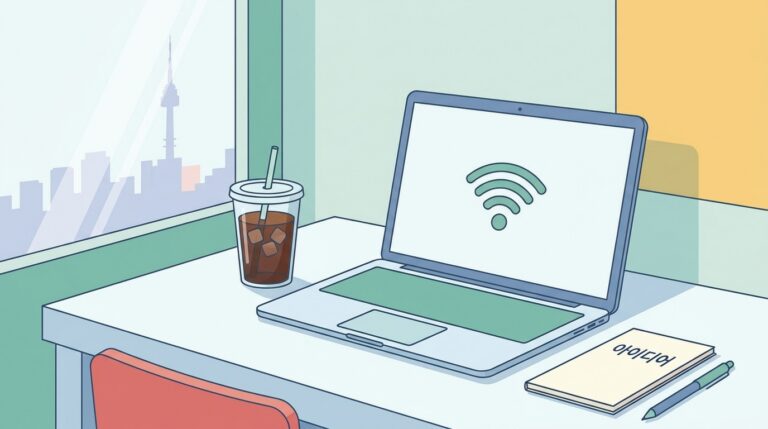
Connect to the Company Wi-Fi: Your First Office Day in Korea
Phase 1: Empathy (Story-Driven Opening)
안녕하세요! 매일한글 에디터입니다. (Hello! I am your Daily Hangul editor.)
Imagine this: You have just landed an internship or your first gig at a buzzing startup in Pangyo Techno Valley—Korea’s very own Silicon Valley. You walk into an open-plan office straight out of the K-drama Start-Up (스타트업). Glass meeting pods, sleek standing desks, and people typing away furiously while sipping iced americanos. You unpack your laptop, ready to show off your tech skills, when sudden dread hits: your screen shows five different internal networks labeled Corp_Secure_5G, Guest_Open, and Dev_Mesh. Worse, your mobile roaming is lagging, and your onboarding Slack invite is trapped behind an authentication wall!
You look at the teammate sitting next to you. They are rocking noise-canceling headphones and typing at lightning speed. How do you tap their shoulder and ask for network credentials without sounding like a total burden? Over the past decade coaching foreign tech professionals in Korea, “How do I connect to the office Wi-Fi?” is consistently the #1 awkward hurdle on Day 1. Getting connected is not just about internet access; in Korea’s hyper-digital workplace, it is your very first handshake. Let’s make sure you nail it with natural, polite Korean that makes your colleagues instantly smile and help you out.
Phase 2: Core 3 Expressions In-Depth
1. 와이파이 비밀번호가 뭐예요? (Wai-pai bimilbeonhoga mwoyeyo?)
- Pronunciation: [Wai-pai bi-mil-beon-ho-ga mwo-ye-yo?] (Sounds like: Why-pie be-meal-bun-ho-ga mwo-ye-yo?)
- Meaning: “What is the Wi-Fi password?” (Direct: Wi-Fi secret number-subject what is it?)
- K-Culture Moment: Walk into any trendy office lounge or cafe in Seongsu-dong, and you will hear foreign interns and locals alike asking this exact sentence before opening their laptops.
- Editor’s Insight: 와이파이 is the standard loanword for Wi-Fi. 비밀번호 (bimilbeonho) literally combines “secret” (비밀) and “number” (번호). The ending ~가 뭐예요? is the friendliest, most versatile A1 question pattern for asking “What is [noun]?”
- Situation Spectrum: Casual ⚠️ | Semi-formal ✅ | Formal ✅
- 🤔 Think About It: In English, we say “password” (a word), but Korean emphasizes “secret number” (번호). How does visualizing a passcode as numbers change how you remember it?
2. 사내 와이파이 어떻게 연결해요? (Sanae wai-pai eotteoke yeongyeolhaeyo?)
- Pronunciation: [Sa-nae wai-pai eo-tteo-ke yeon-gyeol-hae-yo?] (Sounds like: Sah-neh why-pie uh-ttuh-keh yun-gyuhl-heh-yo?)
- Meaning: “How do I connect to the company Wi-Fi?”
- K-Culture Moment: Think of the onboarding scene in Start-Up where rookies must register their MAC address to the in-house server.
- Editor’s Insight: 사내 (Sanae) combines “company/office” (사) and “inside” (내), meaning “internal” or “company-internal.” Use this word instead of generic Wi-Fi so your coworkers know you need the employee network, not the slow guest access!
- Situation Spectrum: Casual ⚠️ | Semi-formal ✅ | Formal ✅
- 🤔 Think About It: Korean workplace culture clearly separates “inside the clan/company” (사내) from “outside” (사외). Notice how one small prefix completely changes the level of technical access.
3. 와이파이가 안 잡혀요. (Wai-paiga an japhyeoyo.)
- Pronunciation: [Wai-pai-ga an jap-hyeo-yo] (Sounds like: Why-pie-gah ahn jahp-hyuh-yo)
- Meaning: “I cannot catch the Wi-Fi signal / The Wi-Fi is not connecting.”
- K-Culture Moment: When you move into a soundproof meeting booth and your Zoom video call starts buffering, you hold up your phone with an apologetic grin and drop this line.
- Editor’s Insight: Koreans do not say Wi-Fi is “disconnected” in casual conversation; they say the signal is not being “caught” (잡히다 – to be caught). 안 simply means “not.”
- Situation Spectrum: Casual ✅ | Semi-formal ✅ | Formal ✅
- 🤔 Think About It: Why does the Korean language treat invisible radio signals like wild fish or balls that need to be “caught”? It reflects a dynamic, physical way of describing digital phenomena!
Phase 3: Textbook Korean vs. Real Korean
Situation 1: Asking for the Network Password
- 📖 교과서 한국어 (Textbook Korean): 무선 인터넷 비밀번호를 알려주시겠습니까? (Museon inteonet bimilbeonhoreul allyeojusigesseumnikka? – “Would you be kind enough to inform me of the wireless internet password?”)
- 🗣️ 진짜 한국어 (Real Korean): 저기요, 와이파이 비번 뭐예요? (Jeogiyo, wai-pai bibeon mwoyeyo? – “Excuse me, what is the Wi-Fi password?”)
- 💡 왜 다를까? (Why is it different?): Nobody says “wireless internet” (무선 인터넷) at a modern desk; everyone says 와이파이. Furthermore, locals almost always abbreviate 비밀번호 (bimilbeonho) down to the super-snappy 비번 (bi-beon)!
Situation 2: When the Signal Drops
- 📖 교과서 한국어 (Textbook Korean): 인터넷 신호가 미약하여 접속할 수 없습니다. (Inteonet sinhoga miyakhayeo jeopsokhal su eopseumnida? – “The internet signal is weak, therefore connection is not possible.”)
- 🗣️ 진짜 한국어 (Real Korean): 와이파이가 자꾸 끊겨요! (Wai-paiga jakku kkeunkeoyo! – “The Wi-Fi keeps dropping!”)
- 💡 왜 다를까? (Why is it different?): Rather than sounding like an automated server error log, real humans express their frustration using 자꾸 끊겨요 (keeps cutting off / getting severed).
Phase 4: K-Culture Deep Dive & Non-Verbal Manners
4-1. 눈치 (Nunchi) & Office Gestures
In a bustling Korean startup, almost everyone has oversized active noise-canceling headphones on. Tapping someone directly on the shoulder can startle them. Instead, employ proper 눈치 (Nunchi – social situational awareness):
1. Stand at a 45-degree angle near their peripheral vision and give a light hand wave or a gentle head tilt.
2. When they slide one headphone cup off, give a slight 15-degree polite head bow before speaking.
3. Turn your laptop screen toward them slightly so they can immediately see your Wi-Fi settings panel. Showing visual context saves them time and honors the fast-paced office rhythm.
4-2. The “Pali-Pali” (빨리빨리) Speed Culture & Gigabit Workspace
South Korea ranks among the fastest internet hubs in the world. In tech clusters like Pangyo, Yeouido, and Teheran-ro (Gangnam), seamless connectivity is considered a basic human right rather than a perk. Startup employees expect internal upload speeds fast enough to transfer 4K video files or push code deployments in seconds. Because of this 빨리빨리 (hurry, hurry) efficiency culture, admitting your Wi-Fi is broken is not seen as an annoyance; coworkers will jump in immediately to fix it so the team does not slow down!
Phase 5: Real-Life Roleplay Scenario
Setting: Monday, 9:30 AM. You are seated at the shared desk pod at a FinTech startup in Gangnam. Next to you sits Min-jun (민준), a friendly junior backend developer clutching a 1-liter iced americano.
- Turn 1 (You): 🎭 Hesitantly leaning forward, making eye contact as Min-jun removes his headset.
저기요, 민준 씨! (Jeogiyo, Minjun ssi!)
“Excuse me, Min-jun!” - Turn 2 (Min-jun): 🎭 Smiling warmly with a slight nod.
네! 무슨 일 있으세요? (Ne! Museun il isseuseyo?)
“Yes! Is something the matter?” - Turn 3 (You): 🎭 Turning your laptop screen so he can see the available networks.
사내 와이파이 어떻게 연결해요? (Sanae wai-pai eotteoke yeongyeolhaeyo?)
“How do I connect to the company Wi-Fi?” - Turn 4 (Min-jun): 🎭 Pointing his pen toward the second network on your list.
아, 저기 ‘Startup_5G’ 보이시죠? 그거 누르시면 돼요. (A, jeogi ‘Startup_5G’ boisijyo? Geugeo nureusimyeon dwaeyo.)
“Ah, you see ‘Startup_5G’ over there? You can just click that one.” - Turn 5 (You): 🎭 Clicking the network, looking at the password prompt.
네, 눌렀어요. 와이파이 비번이 뭐예요? (Ne, nulleosseoyo. Wai-pai bibeoni mwoyeyo?)
“Yes, clicked it. What is the Wi-Fi password?” - Turn 6 (Min-jun): 🎭 Grabbing a neon Post-it note from his desk and writing it down.
비번은 영어 소문자로 ‘welcome2024’예요. 여기 적어드릴게요. (Bibeoneun yeongeo somunjaro ‘welcome2024’yeyo. Yeogi jeogeodeurilgeyo.)
“The password is all lowercase English ‘welcome2024’. I will write it down right here for you.” - Turn 7 (You): 🎭 Typing it in, seeing the green checkmark appear.
와, 연결됐어요! 감사합니다! (Wa, yeongyeoldwaesseoyo! Gamsahamnida!)
“Wow, it’s connected! Thank you so much!” - Turn 8 (Min-jun): 🎭 Giving a double thumbs up and putting his headset back on.
다행이네요! 안 잡히면 또 말씀하세요. (Dahaengineyo! An japhimyeon tto malsseumhaseyo.)
“Glad to hear! If it doesn’t catch again, let me know.”
🔀 Interactive Decision Point
Suppose Min-jun gives you the password, but your laptop displays “Cannot connect to this network.” What do you say?
- Option A: 이거 왜 안 돼요? 고쳐줘요. (Igeo wae an dwaeyo? Gochyeojwoyo. – “Why doesn’t this work? Fix it.”)
- Option B: 죄송한데, 와이파이가 안 잡혀요. 한번 봐주실 수 있어요? (Joesonghande, wai-paiga an japhyeoyo. Hanbeon bwajusil su isseoyo? – “I am sorry, but the Wi-Fi isn’t connecting. Could you take a quick look?”)
- Option C: 인터넷이 고장 났어요. 집에 갈게요. (Inteonesi gojang nasseoyo. Jibe galgeyo. – “The internet broke down. I am going home.”)
Feedback:
* Option A (Risk): Far too blunt and commanding! Using 반말-adjacent imperative (고쳐줘요) sounds rude to a colleague.
* Option B (Best ✅): Perfect politeness! Opening with 죄송한데 (soft excuse me) and using the natural expression 안 잡혀요 accompanied by a humble request shows stellar workplace Nunchi.
* Option C (Bad 🚫): While hilarious in an office comedy drama, going home over a Day-1 Wi-Fi glitch will surprise HR!
Phase 6: 10-Second Emotional Shadowing Drill
Practice reading these out loud at normal conversational speed. Pause momentarily at the / marks!
[😅 Polite & Slightly Hesitant]
저기요, / 사내 와이파이 / 어떻게 연결해요?
(Jeogiyo, / sanae wai-pai / eotteoke yeongyeolhaeyo?)-
[🤔 Curious & Crisp]
혹시 / 와이파이 비번이 / 뭐예요?
(Hoksi / wai-pai bibeoni / mwoyeyo?) -
[🥺 Frustrated but Gentle]
와이파이가 / 자꾸 끊겨서 / 안 잡혀요.
(Wai-paiga / jakku kkeun-kyeo-seo / an japhyeoyo.) -
[😊 Bright & Relieved]
와! / 이제 / 인터넷 연결됐어요!
(Wa! / Ije / inteonet yeongyeoldwaesseoyo!)
Phase 7: K-Culture Mini Dictionary
- 비번 (Bibeon) | Short for 비밀번호 (Password)
- Essential slang-shortening used across office Slack channels, coffee shops, and front door digital keypads.
- 사내 (Sanae) | In-house / Internal to the company
- Used in compound terms like 사내 메신저 (company messenger/Slack) and 사내 식당 (company cafeteria).
- 연결 (Yeongyeol) | Connection / Linking
- High-frequency tech verb root: 연결하다 (to connect), 연결되다 (to become connected).
- 핫스팟 (Hat-seupat) | Mobile Hotspot / Tethering
- When company Wi-Fi drops, teammates often say: “제 핫스팟 켜드릴까요?” (Shall I turn on my hotspot for you?)
Phase 8: Traveler & Expat Survival Kit
Top 3 Survival Phrases for Digital Nomads
- 와이파이 있어요? (Wai-pai isseoyo?)
- Pronunciation: [Wai-pai is-seo-yo?]
- Pro Tip: Use this inside cafes or co-working lobbies. Most places will point directly to the bottom of the order receipt!
- 영수증에 비번 있어요? (Yeongsujeunge bibeon isseoyo?)
- Pronunciation: [Yeong-su-jeung-e bi-beon is-seo-yo?]
- Pro Tip: In Korea, 90% of indie cafes print both the Wi-Fi SSID and password at the very bottom of the paper receipt.
- 인터넷이 너무 느려요. (Inteonesi neomu neuryeoyo.)
- Pronunciation: [In-teo-ne-si neo-mu neu-ryeo-yo.]
- Pro Tip: Helpful when checking in to guesthouses or rental offices.
Editor’s Travel Note
When navigating Korean workspaces and cafes, never rely on global maps which lack local walking pathways. Make sure to download and set up the Naver Map app installation guide before your trip. Furthermore, in major Seoul metro stations and public tech lounges, look for the official network named Public WiFi Free or Seoul_Secure for quick high-speed emergency connections without a password!
Phase 9: “One Step Deeper” (Cultural Reflection)
In many Western cultures, asking for internet access can feel like asking for an extra utility or private privilege. In South Korea, however, seamless internet is treated like complimentary water (물은 셀프) at a restaurant. When Korean companies invite guests or onboard new hires, having instantaneous digital access is viewed as the cornerstone of hospitality. Notice also how Koreans prefer collective terms: coworkers will rarely say “my internet is slow,” but rather “우리 사무실 와이파이 안 잡혀요” (Our office Wi-Fi isn’t catching). Digital connectivity is shared community infrastructure.
💬 Your Turn: What was the most awkward or funny moment you experienced trying to connect to the internet in a foreign country? Share your story in the comments below!
Phase 10: FAQ & Common Mistakes
Q: Can I just ask “와이파이 비밀번호 주세요” (Please give me the Wi-Fi password)?
A: Yes, but adding ~가 뭐예요? (“What is it?”) sounds much softer and less demanding for an A1 beginner in an office environment. “주세요” can sound slightly transactional, like ordering food.
Q: What is the difference between 와이파이 (Wi-Fi) and 데이터 (Data)?
A: 와이파이 refers specifically to wireless local area network routers, while 데이터 (dae-i-teo) refers to cellular LTE/5G network data on your smartphone plan.
Q: Do I need honorifics like ~하십니까 when asking a colleague?
A: In modern Korean startups, stiff military-style endings (-ㅂ니까/-습니다) are rapidly being replaced by the polite, friendly ~요 (yo) style. Using “어떻게 연결해요?” is polite, natural, and perfectly respectful.
🚨 Common Mistakes Alert!
- Mistake 1: Saying “인터넷을 잡아요” (I catch the internet).
- Fix: The verb must be passive! Say 와이파이가 잡혀요 (The Wi-Fi gets caught/connected).
- Mistake 2: Pronouncing Wi-Fi as “Wee-Fee”.
- Fix: In Korea, it is always pronounced matching the English sounds: 와이-파이 (Wai-pai).
- Mistake 3: Asking for “Password” in plain English with heavy accent.
- Fix: Use the Korean loanword adaptation or native term: say 비번 (bi-beon) or 비밀번호 (bimilbeonho).
Phase 11: Action Mission & Participation
- 🥉 Bronze Mission (Solo Practice): Look at your phone’s Wi-Fi list right now and say out loud three times:
와이파이 비번이 뭐예요?with natural intonation. - 🥈 Silver Mission (Social Share): Share this post with a friend planning to work remotely or study in Korea, and quiz them on the shortcut word for password (비번).
- 🥇 Gold Mission (Real-world Challenge): Next time you visit a Korean cafe, restaurant, or meetup, do not look for the router sticker yourself. Ask the staff directly:
저기요, 와이파이 비번 뭐예요? - 🎮 K-Culture Mission: Watch an episode of a modern office K-drama (like Start-Up or Misaeng) and spot how junior employees politely approach their seniors at their desks!
Phase 12: Interactive Quiz Challenge
Test your knowledge with these three rapid-fire questions!
Q1. Situation Judgment
You are sitting at a shared startup lounge and want to ask your desk-mate for the internal network password politely. Which sentence is the most natural?
* 1) 야! 비번 내놔. (Ya! Bibeon naenwa.)
* 2) 저기요, 와이파이 비밀번호가 뭐예요? (Jeogiyo, wai-pai bimilbeonhoga mwoyeyo?)
* 3) 무선 랜 전파 신호가 끊어졌습니다. (Museon raen jeonpa sinhoga kkeuneojyeosseumnida.)
Q2. Fill in the Blank
Complete the sentence to say: “How do I connect to the company Wi-Fi?”
사내 와이파이 어떻게 _________? (yeongyeolhaeyo)
Q3. True or False
In Korean, people frequently shorten “비밀번호” (password) to “비번” in office and casual conversations.
* True
* False
👉 Click to reveal answers & explanations!
- Q1 Answer: 2)
저기요, 와이파이 비밀번호가 뭐예요?is the gold standard for polite, natural beginner Korean.
(Option 1 is aggressive street slang; Option 3 sounds like an engineering textbook!) - Q2 Answer: 연결해요 (yeongyeolhaeyo)
The full phrase is “사내 와이파이 어떻게 연결해요?” (How do I connect to the company Wi-Fi?) - Q3 Answer: True!
비번 (Bibeon) is the ubiquitous everyday contraction for password used by almost all native speakers.







