

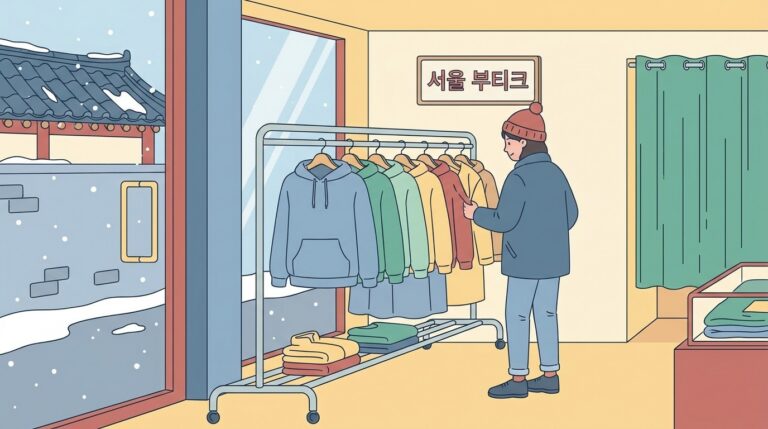
Stay Cozy in Seoul: The Ultimate Guide to Winter Clothes, Fleece Fabrics, and Laundry Care
Phase 1: Empathy & Story Opening
안녕하세요! Welcome back to Daily Hangul, your personal cultural navigator! It is your editor here, ready to tackle one of winter’s greatest shopping adventures.
Imagine this: You are exploring the neon-lit, frosty streets of Hongdae or Seongsu on a crisp December evening. The Siberian winter wind (known locally as 칼바람, kalbaram or ‘knife wind’) cuts right through your denim jacket. Shivering, you dash into a trendy minimalist boutique. The warm air smells like cozy cedarwood, and rows of stylish oversized hoodies greet you. You find an olive green sweatshirt that looks stunning. The friendly clerk notices you shivering, walks over, gently turns out the sleeve cuff, and smiles:
“안감이 기모로 되어 있어서 겨울에 입기 따뜻해요.”
(Angami gimoro doe-eo isseoseo gyeoure ipgi ttatteut-haeyo.)
Wait… gimo? Is that wool? Cashmere? Polyester? Will it shrink if you wash it back at your Airbnb?
Every winter, thousands of our international learners share this exact pain point: standing in front of Korean clothing racks, wanting cozy winter clothes, but freezing up when trying to decipher fabrics, fit, and washing instructions. That is why we built this real-world survival lesson based directly on learner feedback. By the time you finish this guide, you will browse Korean apparel like an insider, ask for snug fleece linings with effortless confidence, and protect your wardrobe from shrinking catastrophes!
Phase 2: Three Core Expressions Deep Dive
1. 안감이 기모로 되어 있어요 (Angami gimoro doe-eo isseoyo)
- Pronunciation: [An-gam-i gi-mo-ro doe-eo i-sseo-yo] (Sounds like: Ahn-gahm-ee ghee-mo-ro dway-uh ee-ssuh-yo)
- Meaning: Literal: “The inner lining is made of fleece (napped fabric).” / Real Nuance: “It has a super soft brushed fleece lining inside to keep you toasty.”
- K-Culture Moment: You will hear this in winter vlogs when K-Pop idols show off their practice outfits or airport fashion—recommending comfy gimo joggers for long flights.
- Editor’s Insight: 기모 (gimo) refers to napping—raising the fuzzy fibers of fabric to trap air and heat. From November through March, Korea transforms into a “gimo nation.” You will see gimo jeans, gimo tights, and even gimo socks!
- Situation Spectrum: Casual (✅ – without yo) / Semi-formal (✅ – with yo) / Formal (✅ – doeeo itseumnida)
- 🤔 Think About It: In English, we simply label a whole piece “a fleece hoodie.” Korean often specifies 안감 (angam – inner lining) separately from the outside fabric. Why do you think Korean fashion vocabulary pays so much attention to what touches the skin directly?
2. 겨울에 입기 따뜻해요 (Gyeoure ipgi ttatteut-haeyo)
- Pronunciation: [Gyeo-ul-e ip-gi tta-tteut-hae-yo] (Sounds like: Gyuh-ool-eh eep-gee DDAH-DDEUT-hay-yo)
- Meaning: Literal: “Warm for wearing in winter.” / Real Nuance: “It is cozy enough to get you through the freezing winter weather.”
- K-Culture Moment: In K-Dramas, when a thoughtful love interest buys a scarf or padded coat for the protagonist and insists they put it on right away.
- Editor’s Insight: The pattern
[Verb stem + -기] + 형용사nominalizes the action: “wearing it is [warm].” It sounds much more natural and conversational than simply saying “This clothing is hot.”- Situation Spectrum: Casual (✅) / Semi-formal (✅) / Formal (✅)
- 🤔 Think About It: English says “This will keep you warm” (focusing on the clothing’s action on the person). Korean highlights the state of wearing it (입기 따뜻하다). Notice how Korean grammar reflects subjective personal experience!
3. 물세탁 해도 돼요? (Mulsetak haedo dwaeyo?)
- Pronunciation: [Mul-se-tak hae-do dwae-yo?] (Sounds like: Mool-seh-tahk hay-doh dway-yo?)
- Meaning: Literal: “Is water washing allowed?” / Real Nuance: “Can I wash this in a normal washing machine at home, or does it need dry cleaning?”
- K-Culture Moment: Reality variety shows where cast members panic in a laundromat because their favorite knitwear shrunk down to baby size!
- Editor’s Insight: Winter wear often features delicate blends. Asking about 물세탁 (mulsetak) immediately reveals whether you can toss it into your laundry machine or if you need to visit a 세탁소 (laundromat/dry cleaner).
- Situation Spectrum: Casual (⚠️ – use only with close friends) / Semi-formal (✅) / Formal (✅)
- 🤔 Think About It: Korean divides laundering into 물세탁 (water washing) and 드라이클리닝 (dry cleaning). Remembering this word saves your clothes and your travel budget!
Phase 3: Textbook Korean vs. Real Korean
Situation 1: Asking if a garment is warm enough for sub-zero days
- 📖 교과서 한국어 (Textbook): 이 옷은 보온성이 우수합니까? (I oseun bo-onseongi usuhamnikka? – Does this garment possess superior heat retention capability?)
- 🗣️ 진짜 한국어 (Real-World): 이거 한겨울에 입어도 안 추워요? (Igeo han-gyeoure ibeodo an chuwoyo? – Will I stay warm in this even in the dead of winter?)
- 💡 왜 다를까? (Why the difference?): Nobody talks like a technical garment manual while shopping with friends! Real shoppers ask about 한겨울 (han-gyeol – mid-winter chill) to know if it holds up to sub-zero temperatures.
Situation 2: Asking if the fleece lining makes the fit snug
- 📖 교과서 한국어 (Textbook): 안감이 두꺼워서 치수가 작아집니까? (Angami dukkeowoseo chisuga jag-ajimnikka? – Because the lining is thick, does the dimension become small?)
- 🗣️ 진짜 한국어 (Real-World): 기모 때문에 핏이 좀 타이트해요? (Gimo ttaemune pisi jom taiteuhaeyo? – Is the fit a bit snug because of the fleece?)
- 💡 왜 다를까? (Why the difference?): Koreans effortlessly combine fashion loanwords like 핏 (fit) and 타이트하다 (to be tight) with native descriptors like 기모 for crisp, modern dialogue.
Phase 4: K-Culture Deep Dive & Non-Verbal Manners
4-1. 눈치 (Nunchi) & Tactful Gestures
When checking fabric inside a Korean boutique, proper etiquette keeps store owners happy:
* The Two-Finger Fold: Do not turn the entire garment inside out roughly. Instead, gently pinch the sleeve cuff or lower hem with two hands and turn it outward by an inch to inspect the lining.
* The Texture Inquire: Point lightly with an open palm (not an aggressive index finger) toward the inner fabric, catch the clerk’s eye with a slight head tilt, and ask: “이거 안감 기모 맞죠?” (This inside lining is fleece, right?)
* White Garment Etiquette: In Korean shopping districts like Express Bus Terminal Underground Mall or Hongdae, never pull white clothes over your head without permission due to makeup stains. Always ask first: “입어봐도 돼요?” (Can I try this on?).
4-2. The Korean “Gimo” Cultural Code
Winter in South Korea is notoriously dry and windy. Survival isn’t just about big puffer coats (롱패딩, long padding); it is about clever internal layering. The secret weapon of every stylish Korean student and office worker is 기모. You can stay chic without looking like a marshmallow by wearing sleek trousers lined with micro-fleece. Even on K-Pop stages during outdoor winter festivals, idols wear custom skin-tone 기모 inner layers underneath glamorous stage outfits!
Phase 5: Real-World Roleplay Scenario
Setting: A hip streetwear boutique nestled in an alleyway near Yeonnam-dong, Seoul. Outside, snow flurries fall. Inside, indie lo-fi beats play softly.
Characters:
* Alex (알렉스): An exchange student looking for a durable, warm everyday top.
* Minji (민지): The stylish, approachable store associate wearing an oversized cardigan.
- Alex: 저기요, 이 후드티 예쁜데 겨울에 입기 괜찮아요?
(Jeogiyo, i hudeuti yeppeunde gyeoure ipgi gwaenchannayo?)
“Excuse me, this hoodie looks great—is it good for winter wear?”
🎭 Points gently at a charcoal hoodie displayed on the center hanger with a warm smile. -
Minji: 네! 그 제품은 안감이 기모로 되어 있어서 겨울에 입기 따뜻해요.
(Ne! Geu jepumeun angami gimoro doe-eo isseoseo gyeoure ipgi ttatteut-haeyo.)
“Yes! That one has a fleece lining inside, so it’s really warm to wear in winter.”
🎭 Steps closer and neatly folds back the sleeve cuff to reveal the soft, fluffy interior lining. -
Alex: 아, 만져보니까 진짜 부드럽네요! 핏은 어때요?
(A, manjeobonikka jinjja budeureomneyo! Piseun eottaeyo?)
“Ah, touching it now, it feels so soft! How is the fit?”
🎭 Gently feels the brushed fleece between thumb and forefinger. -
Minji: 루즈핏이라서 안에 히트텍이나 얇은 티 받쳐 입기 딱 좋아요.
(Rujeupisiraseo ane hiteutegina yalbeun ti batchyeo ipgi ttak joayo.)
“It’s a loose fit, so it’s perfect for layering heat-tech or a thin t-shirt underneath.”
🎭 Holds the shoulders outward slightly to demonstrate the relaxed silhouette. -
Alex: 기모 옷은 세탁이 걱정인데, 이거 물세탁 해도 돼요?
(Gimo oseun setagi geokjeong-inde, igeo mulsetak haedo dwaeyo?)
“I’m always worried about washing fleece—can I machine-wash this with water?”
🎭 Glances down at the care label on the inner side seam. -
Minji: 네, 찬물로 세탁기 돌리시면 돼요. 건조기는 줄어드니까 자연 건조 해주세요!
(Ne, chanmullo setakgi dollisimyeon dwaeyo. Geonjogineun jureodeunikka jayeon geonjo haejuseyo!)
“Yes, you can run it through the washing machine with cold water. Dryers can shrink it, so please air dry!”
🎭 Smiles warmly while making a playful small ‘X’ shape with her fingers at the word dryer. -
Alex: 그렇군요! 저 피팅룸에서 한번 입어봐도 될까요?
(Geureokgunyo! Jeo pitingrum-eseo hanbeon ibeobwado doelkkayo?)
“Got it! May I try this on in the fitting room?”
🎭 Points politely toward the linen curtain in the corner. -
Minji: 물론이죠! 저쪽 피팅룸 편하게 이용해주세요.
(Mullonijyo! Jeojjok pitingrum pyeonhage iyonghaejuseyo.)
“Of course! Please feel free to use the dressing booth over there.”
🎭 Steps aside and gestures cordially toward the fitting room entrance.
🔀 Interactive Choice: What should Alex ask next before buying?
- Choice A: “혹시 첫 세탁 때 기모 털 빠짐이 심해요?” (Hoksi cheot setak ttae gimo teol ppajimi simhaeyo? – Does the fleece fluff shed a lot during the first wash?)
- 👉 Feedback [Best Choice]: Outstanding! Asking about shedding (털 빠짐) shows genuine practical fluency. The clerk will usually advise washing it once inside-out.
- Choice B: “야, 이거 뜨거운 물에 팍팍 삶아도 되지?” (Ya, igeo tteugeoun mure pakpak salm-ado doeji? – Hey, I can boil this in hot water, right?)
- 👉 Feedback [Bad Choice]: Whoops! “야” (ya) is rude slang used only with very close friends, and boiling water will completely ruin the synthetic fleece lining!
- Choice C: “이거 비싸니까 50% 깎아주세요!” (Igeo bissanikka osip peosenteu kkakka-juseyo! – This is expensive, give me 50% off!)
- 👉 Feedback [Risk Choice]: In modern boutique shops in Seoul, prices are fixed (정찰제). Bargaining aggressively like this creates awkwardness.
Phase 6: 10-Second Emotion Shadowing Drill
Practice speaking these phrases with real feelings! Breathe at the slashes (/).
[😊 Curiously & Lightly]
저기요, / 이 맨투맨 / 안감이 기모예요?
(Jeogiyo, / i maentumaen / angami gimoyeyo?)
“Excuse me, / this sweatshirt / is the lining fleece?”-
[✨ Proud & Reassuringly]
안감이 기모로 되어 있어서 / 겨울에 입기 / 완전 따뜻해요!
(Angami gimoro doe-eo isseoseo / gyeoure ipgi / wanjeon ttatteut-haeyo!)
“The lining is fleece, / so for winter wear / it is completely warm!” -
[🧐 Thoughtful & Cautious]
이거 집에서 / 찬물로 / 물세탁 해도 돼요?
(Igeo jibeseo / chanmullo / mulsetak haedo dwaeyo?)
“Can I wash this at home / with cold water / in a regular wash?”
Phase 7: K-Culture Mini Dictionary
- 기모 (Gimo) | Brushed Fleece / Napped Lining
Fabric treated to have a fluffy, soft texture on the inside surface. Found in 기모 후드 (fleece hoodie), 기모 레깅스 (fleece leggings), and 기모 슬랙스 (fleece dress pants). - 안감 (Angam) vs. 겉감 (Geotgam) | Inner Lining vs. Outer Shell
Essential for understanding garment tags and asking clerks about what layer keeps you insulated. - 루즈핏 / 오버핏 (Rujeu-pit / Obeo-pit) | Loose Fit / Oversized Silhouette
The gold standard of Korean street style that allows comfortable layering of thermal shirts without feeling restricted. - 자연 건조 (Jayeon Geonjo) | Air Dry / Hang Dry
The most common phrase on care tags. Korea’s fleece items love rack drying; high-temperature dryers will shrink them fast!
Phase 8: Traveler’s Survival Kit
Top 3 Survival Expressions
- 기모 없는 버전도 있어요? (Gimo eomneun beojeondo isseoyo?)
“Do you have a version without fleece lining?”
Pro Tip: Perfect if you tend to overheat easily or are shopping in late February for spring. - 피팅룸 어디에 있어요? (Pitingrum eodie isseoyo?)
“Where is the fitting room?”
Pro Tip: Look around the corners; fitting rooms in small Seoul shops are often tucked discreetly behind aesthetic linen drapes. - 건조기 돌려도 돼요? (Geonjogi dollyeodo dwaeyo?)
“Can I tumble dry this in a clothes dryer?”
Pro Tip: If the staff says “줄어들어요” (Jureodeureoyo – It will shrink), stick strictly to air drying.
Editor’s Travel Note
Before embarking on a shopping spree in Seongsu or Dongdaemun, navigate the trendy alleys smoothly using the 네이버 지도 앱 (Naver Map App). Note that underground shopping centers (like Goto Mall at Express Bus Terminal) frequently offer small cash or Korean transfer discounts, whereas road shops in Myeongdong accept credit cards seamlessly. Always look for signs that read “교환/환불 불가” (Gyo-hwan / Hwan-bul Bul-ga), which means “No Exchanges or Refunds”—especially on clearance items!
Phase 9: Step Deeper (Thinking Question)
In Korean culture, the sensory vocabulary for clothing is deeply linked to the feeling of cozy safety. Words like 포근하다 (warm and snug like a blanket) and 보들보들하다 (tenderly soft) reflect how clothes are viewed as personal emotional shelters against the harsh metropolitan winter. Dressing warmly is not just about health; asking someone “따뜻하게 입고 나왔어?” (Did you dress warmly today?) is one of the most common ways Koreans say “I care about you.”
💬 Your Turn: When you buy winter clothes in your home country, what matters most: the warmth of the inner fabric, ease of laundry care, or the cut of the silhouette? Let us know in the comments below!
Phase 10: FAQ & Common Mistakes
Q: Is “기모” (gimo) the exact same thing as a fuzzy “Sherpa” fleece jacket?
A: Not quite! In Korea, fuzzy teddy-bear textured jackets with exterior fleece are affectionately nicknamed 뽀글이 (ppogeuri) or called “플리스” (fleece). On the other hand, 기모 (gimo) almost always refers to the smooth, brushed felt-like fleece lining hidden inside garments like sweatshirts, sweatpants, or thermal underwear.
Q: What if an underground market seller tells me I cannot try on a top?
A: This is very common in budget shopping hubs across Seoul. To protect inventory from makeup smudges, stores often prohibit trying on tops. Do not be offended! Simply hold the garment against your shoulders in the mirror, check the shoulder seam drop, and ask: “이거 넉넉한 핏이에요?” (Is this a roomy fit?).
Q: How do I read laundry symbols on Korean care tags?
A: Look for the water bucket icon with “약30°” and “중성” (neutral detergent). If you see the Korean characters 드라이 (Dry), it requires dry cleaning. If you see an icon of a hanger with a t-shirt, it means hang dry (옷걸이 건조).
🚨 Common Mistakes Warning Board
- ❌ Mistake 1: Calling all winter jackets “패딩” (padding).
Correct Action: Reserve 패딩 for down puffer coats. For fleece-lined shirts or tracksuits, specify 기모 맨투맨 (fleece sweatshirt) or 기모 트레이닝 (fleece sweatpants). - ❌ Mistake 2: Putting newly purchased Korean 기모 items straight into a hot dryer.
Correct Action: Korean fleece is often cotton-poly blend; hot heat will shrink it by one full size. Hang it dry on a drying rack! - ❌ Mistake 3: Translating “water wash” literally as “워터 워시”.
Correct Action: Use the natural term 물세탁 (mulsetak) so store clerks understand you immediately.
Phase 11: Action Mission
- 🥉 Bronze Level (Solo Practice): Stand in front of your mirror and repeat aloud 3 times: “안감이 기모로 되어 있어서 따뜻해요!”
- 🥈 Silver Level (Social Share): Find a warm sweatshirt in your closet. Check its inside texture, take a photo for your Instagram or TikTok story, and tag us with the caption: “내 옷도 안감이 기모예요! (My clothes have fleece lining too!)”
- 🥇 Gold Level (Real-World Application): Open a Korean shopping app (like Musinsa, Ably, or Zigzag) or visit a local Korean store. Search for “기모 후드” and locate the washing instructions in the product description!
- 🎮 K-Culture Mission: Watch any winter episode of Running Man or an outdoor winter reality show. Spot when the members are wearing matching colorful tracksuits and guess whether they are wearing 기모 tracksuits based on their thickness!
Phase 12: Interactive Quiz Challenge
Test your new Korean shopping superpowers!
1. Situational Judgment:
You are at a boutique in Hongdae. You want to ask the clerk if this sweatshirt can be washed at home in your apartment washing machine instead of the dry cleaners. What is the best phrase?
* A) 이거 드라이클리닝만 돼요?
* B) 이거 집에서 물세탁 해도 돼요?
* C) 이거 기모 빼주세요.
🔍 Click here to reveal the answer & explanation!
Correct Answer: B
Explanation: 물세탁 (mulsetak) specifically means water washing (machine or hand wash at home). Option A asks if it can only be dry-cleaned, and Option C asks the clerk to remove the fleece lining, which is impossible!
2. Fill in the Blank:
“이 후드티는 안감이 _______(으)로 되어 있어서 겨울에 입기 딱 좋아요!”
(This hoodie has a ________ lining inside, so it’s perfect to wear in winter!)
🔍 Click here to reveal the answer & explanation!
Correct Answer: 기모 (Gimo)
Explanation: 기모 is the magic word for brushed fleece lining that keeps winter clothes warm!
3. True or False Culture Check:
True or False: All Korean clothes containing 기모 lining can be tossed into high-heat tumble dryers without any risk of shrinking.
🔍 Click here to reveal the answer & explanation!
Correct Answer: False (거짓)
Explanation: Korean fleece items typically shrink significantly when exposed to the high heat of tumble dryers. Always opt for cold water washing (찬물 세탁) and natural air drying (자연 건조)!







