

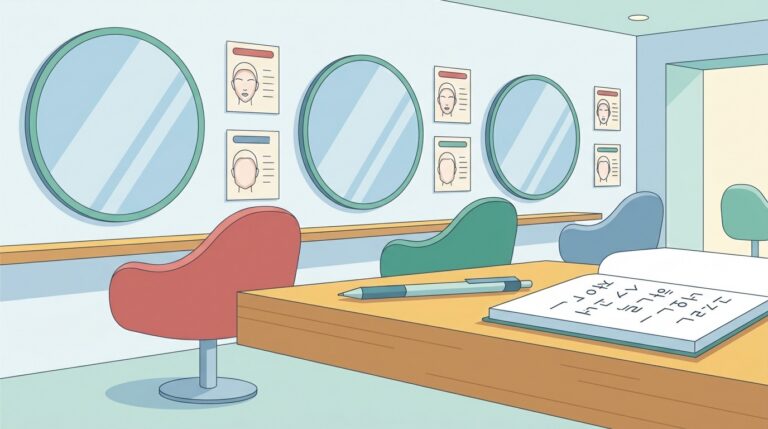
Phase 1: Empathy & Storytelling Opening
안녕하세요! 매일한글 에디터입니다.
Have you ever walked into a chic Korean salon in Hongdae or Cheongdam-dong clutching a photo of your favorite K-drama actor or K-pop idol, only to freeze when the stylist asks, “어떤 스타일 원하세요?” (What kind of style do you want?) You point at the picture, heart pounding, but deep down, you wonder: Will this style actually suit my round cheeks? Will this collar look flattering with my shoulders?
Many of our intermediate learners share this exact frustration. In Korea, the standard for looking great isn’t about copying a celebrity’s look verbatim; it’s about mastering 자기관리 (self-care and personal grooming). True K-style self-care means knowing your own canvas—identifying your unique bone structure and body silhouette, then deliberately picking cuts and necklines that emphasize your best traits while softening angles you’d rather tone down. Today, let’s explore the exact phrases native Koreans use to analyze face shapes, flatter body proportions, and walk out of styling consultations looking radiant and confident.
Phase 2: Core Expressions Deep Dive
1. 장점을 살리다 (Jangjeomeul sallida)
- Pronunciation: [Jang-jeom-eul sal-li-da] (Pronounce ‘jang’ like “jangle” and ‘sal’ like the first beat in “salsa”)
- Meaning: Literally “to bring strengths to life”; in styling, it means “to accentuate or flatter one’s best features.”
- K-Culture Moment: Seen frequently on makeover shows like Get It Beauty or fashion YouTube channels, where a stylist says, “턱선이라는 장점을 살리는 컷이에요!” (This cut accentuates your sharp jawline!)
- Editor’s Insight: Koreans avoid obsessing purely over “fixing flaws”; instead, elevating an existing positive feature (장점) creates the most effortless, radiant charm.
- Situation Spectrum: Casual ✅ | Semi-formal ✅ | Formal ✅
- 🤔 Think About It: Does your native language focus more on “hiding flaws” or “highlighting assets” when describing fashion consultations?
2. 단점을 보완하다 (Danjeomeul bowanhada)
- Pronunciation: [Dan-jeom-eul bo-wan-ha-da] (Think of “dan” like “dancer” and “bo-wan” like saying “bow-one” swiftly)
- Meaning: Literally “to supplement weaknesses”; in fashion, “to balance out proportions or camouflage insecurities.”
- K-Culture Moment: In K-drama styling scenes where an assistant explains choosing a soft square neckline to soften a prominent collarbone or wide shoulders.
- Editor’s Insight: Notice the word 보완하다 (to supplement/harmonize) rather than 숨기다 (to hide). It highlights architectural balance rather than shame.
- Situation Spectrum: Casual ✅ | Semi-formal ✅ | Formal ✅
- 🤔 Think About It: How does viewing physical traits as elements that can be “balanced” rather than “corrected” reshape our relationship with personal grooming?
3. 얼굴형에 맞추다 (Eolgulhyeonge matchuda)
- Pronunciation: [Eol-gul-hyeong-e mat-chu-da] (Rhyme “eol-gul” with “all-cool” and “matchuda” sounds like “match-who-da”)
- Meaning: Literally “to match to one’s face shape”; nuance: “to customize a cut specifically to flatter one’s facial silhouette.”
- K-Culture Moment: Beauty consultants in Seongsu-dong using face mapping apps to recommend layered hush cuts or side-swept bangs based on oval, square, or heart face shapes.
- Editor’s Insight: In Korean aesthetics, harmony (조화) with facial contours takes priority over blindly following current viral trends.
- Situation Spectrum: Casual ✅ | Semi-formal ✅ | Formal ⚠️
- 🤔 Think About It: Why has hyper-personalized styling become synonymous with modern self-discipline and self-respect in metropolitan Korea?
Phase 3: Textbook Korean vs. Real Korean
Situation A: Asking the stylist for a custom recommendation
- 📖 교과서 한국어: 제 머리를 어떻게 자르면 예쁩니까? (Je meorireul eotteoke jareumyeon yeppeumnikka? / How should I cut my hair to look pretty?)
- 🗣️ 진짜 한국어: 제 얼굴형 장점은 살리고 광대는 살짝 보완하는 스타일로 추천해 주실 수 있나요? (Je eolgulhyeong jangjeomeun salligo gwangdaeneun saljjak bowanhaneun seutaillo chucheonhae jusil su innayo? / Could you recommend a style that flatters my face shape while softly balancing my cheekbones?)
- 💡 왜 다를까? Textbook Korean sounds overly generic, whereas natural Korean names specific facial anatomy (like cheekbones or jawline) and focuses on architectural harmony.
Situation B: Choosing an outfit collar that flatters your neck
- 📖 교과서 한국어: 목이 긴 옷을 사고 싶습니다. (Mogi gin oseul sago sipseumnida. / I want to buy clothes with a long neck.)
- 🗣️ 진짜 한국어: 목선이 시원하게 트여 보이는 V넥이 제 체형에 훨씬 잘 받아요. (Mokseoni siwonhage teuyeo boineun buinek-i je chehyeonge hwolssin jal badayo. / A V-neck that cleanly opens up the neckline suits my body proportions much better.)
- 💡 왜 다를까? Native speakers use vibrant sensory descriptions like “시원하게 트이다” (to be cleanly opened up) and the verb “잘 받다” (to flatter someone’s complexion or build).
Phase 4: K-Culture Deep Dive & Non-Verbal Manners
4-1. Nunchi & Salon Body Language
When consulting with a Korean hair designer or personal colorist, communication goes far beyond words. Avoid staring directly into the mirror with a stiff, critical expression; instead, gently angle your head slightly toward your stylist as they speak. When pointing out areas you’d like balanced—such as prominent temples or a shorter neck—gently frame your face with both palms in an open gesture. This non-verbal 눈치 (Nunchi) conveys trust in the designer’s craft while clearly marking the boundaries of your comfort zone.
4-2. Cultural Code: The Evolution of 자기관리 (Self-Care)
In contemporary Korea, 자기관리 (Self-management/grooming) has evolved far beyond traditional diet and fitness routines. Today, having a defined 추구미 (aesthetic goal/ideal mood) and understanding your structural silhouette represents mindful living. Knowing whether a boatneck (보트넥), square neck (스퀘어넥), or layered cut (레이어드 컷) harmonizes with your bone structure is seen as a sign of intelligent self-awareness and quiet confidence.
Phase 5: Real-Life Roleplay Scenario
Setting: A sunlit salon in Yeonnam-dong. Master Stylist Minsu is gently parting your hair while looking at your reflection.
Character: Minsu (민수 원장님) – Intuitive, warm, and highly meticulous.
턴 1: 민수: 어서 오세요! 오늘 특별히 생각해 두신 스타일이나 기장이 있으실까요?
(Eoseo oseyo! Oneul teukbyeolhi saenggakhae dusin seutairina gijang-i issusilkkayo?)
Welcome! Did you have a specific style or hair length in mind today?
🎭 Drapes the cutting cape smoothly around your shoulders and smiles warmly through the mirror.
턴 2: 당신: 사실 단발로 자르고 싶은데, 턱선이 부각될까 봐 살짝 고민돼요.
(Sasil danballo jareugo sipeunde, teokseoni bugakdoelkka bwa saljjak gomindoeyo.)
Actually, I want to cut a bob, but I’m slightly worried it might over-accentuate my jawline.
🎭 Lightly gestures along your chin line with a hesitant smile.
턴 3: 민수: 아, 그런 걱정 안 하셔도 돼요! 고객님 이목구비가 워낙 뚜렷하셔서 라인만 잘 잡으면 멋질 거예요.
(A, geureon geokjeong an hasyeodo dwaeyo! Gogaengnim imokgubiga wonak tturyeothasyeoseo rainman jal jabeumyeon meotjil geoyeyo.)
Ah, no need to worry about that! Your facial features are so well-defined that with the right lines, it will look stunning.
🎭 Gently tilts your chin to inspect your profile angle.
턴 4: 당신: 제 얼굴형의 장점은 살리고 턱 쪽 단점은 보완하려면 어떻게 하는 게 좋을까요?
(Je eolgulhyeong-ui jangjeomeun salligo teok jjok danjeomeun bowanharyeomyeon eotteoke haneun ge joeulkkayo?)
What would you suggest to highlight the strengths of my face shape while balancing out the jaw area?
🎭 Leans in slightly, meeting the stylist’s eyes in the mirror with curious confidence.
턴 5: 민수: 일자 단발보다는 앞쪽 기장을 살짝 길게 빼는 태슬컷에 사이드뱅을 내는 걸 추천드려요.
(Ilja danbalbodaneun apjjok gijang-eul saljjak gilge ppaeneun taeseulkeose saideubaeng-eul naeneun geol chucheondryeoyo.)
Rather than a blunt cut, I recommend a tassel cut with slightly longer front pieces paired with side-swept bangs.
🎭 Demonstrates the draping shape with comb and fingertips alongside your cheekbones.
턴 6: 당신: 아, 사이드뱅이 시선을 위로 분산시켜 주는 거군요!
(A, saideubaeng-i siseoneul wiro bunsansikyeo juneun geogunyo!)
Ah, so the side bangs help draw the eyes upward!
🎭 Nods in realization with a relieved, bright expression.
턴 7: 민수: 맞아요! 평소 입으시는 셔츠 넥라인이랑도 찰떡처럼 잘 어울릴 거예요. 맡겨 주시겠어요?
(Majayo! Pyeongso ibeusineun syeocheu nekrain-irangdo chaltteokcheoreom jal eoullil geoyeyo. Matgyeo jusigesseoyo?)
Exactly! It’ll also pair like a dream with your everyday shirt necklines. Ready to let me work my magic?
🎭 Picks up scissors deftly and gives an encouraging wink.
턴 8: 당신: 네, 원장님 안목 믿고 제 머리 맡길게요! 예쁘게 부탁드려요.
(Ne, wonjangnim anmok mitgo je meori matgilgeyo! Yeppeuge butakdeuryeoyo.)
Yes, I trust your aesthetic eye! Please make it look great.
🎭 Clasps hands lightly in front of chest in polite gratitude.
🔀 Interactive Decision Point
Minsu asks if you want to keep the bangs parted in the middle or sweep them diagonally. How do you respond?
* Option A: “제 동그란 얼굴형을 길어 보이게 하려면 어떤 가르마가 더 나을까요?” (Which parting would make my round face shape appear longer?)
Feedback: [BEST] 🌟 Proactive, flattering, and invites professional consultation smoothly.
* Option B: “아무거나 대충 알아서 잘라 주세요.” (Just cut whatever, casually.)
Feedback: [BAD] ❌ Sounds dismissive, uninvested, and strips the stylist of specific aesthetic direction.
* Option C: “아이유 머리랑 똑같이 한 올도 안 틀리게 잘라 주세요.” (Cut it exactly like IU’s hair down to every single strand.)
Feedback: [RISK] ⚠️ Sets unrealistic expectations without accounting for unique hair density or natural cowlicks.
Phase 6: 10-Second Emotion Shadowing Drill
- Drill 1:
[😊 Confidently & politely]
“제 얼굴형에 맞는 / 헤어스타일을 / 추천받고 싶어요.”
(Je eolgulhyeonge manneun / he-eo-seuta-i-reul / chucheonbatgo sipeoyo.)
(I want to get recommendations for a hairstyle that matches my face shape.) -
Drill 2:
[🤔 Inquiring thoughtfully]
“이 넥라인이 / 제 넓은 어깨를 / 보완해 줄 수 있을까요?”
(I nekrain-i / je neolbeun eokkaereul / bowanhae jul su isseulkkayo?)
(Could this neckline help balance out my broad shoulders?) -
Drill 3:
[✨ Brightly & appreciative]
“단점을 가리기보다 / 장점을 살려 주셔서 / 정말 마음에 들어요!”
(Danjeomeul garigiboda / jangjeomeul sallyeo jusyeoseo / jeongmal maeume deureoyo!)
(I love that you highlighted my strengths rather than just hiding flaws!)
Phase 7: K-Culture Mini Dictionary
- 넥라인 (Nek-ra-in): Neckline. Widely referenced when coordinating knitwear or shirts with haircut lengths to avoid a visually “cramped” upper torso.
- 보완하다 (Bo-wan-ha-da): To complement or balance. Essential term across beauty, fitness, and fashion to discuss adjusting silhouettes without negative body talk.
- 체형 커버 (Che-hyeong keo-beo): Silhouette styling. Dressing strategically to balance physical proportions, e.g., using A-line skirts or wide collars.
- 인생 머리 (In-saeng meo-ri): Literally “life hair.” Refers to that once-in-a-lifetime signature haircut that flatters your features so perfectly you never want to change it.
Phase 8: Traveler’s Survival Kit
Top 3 Survival Phrases for Salons & Boutiques
- “옆머리로 광대 라인 살짝 가려주세요.” (Yeommeoriro gwangdae rain saljjak garyeojuseyo.)
Pro Tip: Use this to request face-framing tendrils or soft curtain bangs around the cheekbones. - “목선이 길어 보이는 기장으로 부탁드려요.” (Mokseoni gileo boineun gijang-euro butakdeuryeoyo.)
Pro Tip: Perfect when you want a bob or layered cut that doesn’t shorten your neck. - “제 피부 톤과 체형에 이게 더 잘 받나요?” (Je pibu ton-gwa chehyeonge ige deo jal bannayo?)
Pro Tip: Excellent for shopping in Dongdaemun or Hannam-dong boutiques to ask the clerk’s objective opinion.
Editor’s Travel Note
Before heading to trendy styling districts like Sinsa-dong Garosu-gil, check out client photos and reviews directly on the 네이버 지도 앱 확인 search engine. Booking in advance via Kakao services or searching popular designer portfolios with 카카오헤어샵 앱 다운로드 will ensure you get top-tier service. Tipping is not customary in Korean salons—the price quoted on the menu is all you pay, making your styling adventure delightfully stress-free.
Phase 9: One Step Deeper (Reflective Essay)
In Western fashion discourse, body positivity frequently champions complete neutrality, encouraging people to disregard convention and wear whatever they like regardless of silhouette. In contrast, modern Korean culture treats styling as a collaborative visual language. Finding cuts that balance one’s bone structure is considered a proactive, refined act of self-regard—a way of honoring one’s physical form with intentional balance and grace. It is not about self-erasure; it is about uncovering your clearest, most comfortable harmony.
💬 Your Turn: Have you identified your own signature neckline or haircut balance yet? Share your favorite aesthetic styling goals in the comments below!
Phase 10: FAQ & Common Mistakes
Q: Can I use “단점을 숨기다” instead of “단점을 보완하다” during a salon consultation?
A: While understood, “숨기다” means literally “to conceal/hide,” which sounds somewhat insecure or self-conscious. “보완하다” (to balance/complement) sounds far more stylish, objective, and collaborative.
Q: What is the difference between 체형 (Chehyeong) and 몸매 (Mommae)?
A: 체형 refers structurally to your frame, skeletal proportions, and body geometry (e.g., pear shape, inverted triangle). 몸매 refers more casually to your overall figure or curves.
Q: How do I tell a Korean stylist that I want them to decide what suits me best?
A: You can say with a warm smile: “원장님 전문가 안목으로 제 얼굴형에 제일 잘 어울리게 맡길게요!” (I’ll leave it to your professional eye to do what suits my face shape best!)
🚨 Common Mistakes Alert
- Mistake: Saying “내 결점을 고쳐주세요” (Please fix my defect).
Correct Action: Use 단점을 보완하다 (balance out areas) to maintain a positive, dignified tone. - Mistake: Demanding a celebrity style without mentioning personal proportions.
Correct Action: Ask “이 스타일을 제 얼굴형에 맞게 변형할 수 있을까요?” (Can we adapt this style to suit my face shape?). - Mistake: Forgetting that Korean salon consultations are deeply conversational.
Correct Action: Actively share your daily styling habits (e.g., “평소에 고데기 잘 안 해요” – I rarely use a curling iron).
Phase 11: Action Missions
- Bronze Mission (Solo Practice): Stand before a mirror and record a 10-second voice memo saying: “제 얼굴형의 장점은 살리고, 턱선은 보완하는 스타일을 찾고 있어요.”
- Silver Mission (Social Connection): Snap an outfit with your favorite neckline, upload it to your Instagram story or study log, and caption it with: “오늘 넥라인 내 체형에 찰떡! #자기관리”
- Gold Mission (Real Application): Visit a Korean hair salon or clothing store and ask the designer or staff: “제 체형에 어떤 라인이 더 잘 어울릴까요?”
- 🎮 K-Culture Mission: Watch a K-beauty YouTube vlog (e.g., Risabae or LeoJ) and pause when you hear the words “단점”, “장점”, or “보완”. Note down the exact context!
Phase 12: Interactive Quiz Challenge
- Scenario Judgment: You want a layered haircut that prevents your cheekbones from standing out too starkly. Which phrase should you say?
- (A) 제 광대를 완전히 없애 주세요. (Eliminate my cheekbones entirely.)
- (B) 광대 라인을 부드럽게 보완해 주는 사이드뱅 부탁드려요. (Please give me side bangs that softly balance my cheekbone line.)
- (C) 제 머리를 아무 연예인처럼 똑같이 해주세요. (Make my hair identical to any celebrity.)
- Fill in the Blank:
“옷을 입을 때 단점을 가리기만 하기보다는, 내 몸의 ________을/를 살리는 것이 진정한 자기관리예요.”
(When dressing, rather than just hiding flaws, highlighting your body’s ________ is true self-care.) -
True / False Cultural Check:
In Korea, analyzing necklines (넥라인) and face shapes (얼굴형) is regarded as shallow vanity rather than a legitimate aspect of personal self-care (자기관리). [ T / F ]
Click to view answers and explanations
1. Answer: (B)
Explanation: Option (B) uses the natural, nuanced term “부드럽게 보완해 주다” (softly balance out). Option (A) is unnaturally dramatic, and Option (C) ignores personalized adaptation.
2. Answer: 장점 (Strengths / Best features)
Explanation: The core philosophy of K-styling is balancing flaws (단점을 보완하다) while emphasizing natural strengths (장점을 살리다).
3. Answer: False
Explanation: In modern Korean culture, understanding your structural lines, personal color, and aesthetic balance is widely respected as an intentional, healthy form of personal care (자기관리).







