

Good Night in Korean: Say It Right Without Awkward Moments
Phase 1: Empathy & Story Opening
안녕하세요! 매일한글 에디터입니다. (Hello! I’m your Daily Hangul editor.)
Picture this: You are on your dream trip to Seoul, staying with an incredibly kind Korean homestay family in a historic Hanok near Bukchon. You just enjoyed a heartwarming dinner of bubbling kimchi jjigae, bonded over laughs, and helped clear the side dishes. It is now 10:30 PM. The host parents stand up, smile softly, and announce they are heading to bed. You want to show how friendly and comfortable you feel, so you flash a big smile and cheerfully shout: “잘 자! (Jal ja!)”
Instantly, the living room freezes. The father pauses with a baffled chuckle, the mother blinks in surprise, and your Korean exchange buddy frantically makes a discreet “cut-it-out” throat-slash gesture from the kitchen corridor. What went wrong?
In English, a casual “Good night!” works just fine whether you are tucking in your eight-year-old nephew, waving to your roommate, or wrapping up a late-night Zoom call with your division manager. But in Korean, dropping a bare “잘 자 (Jal ja)” to an elder or boss is the linguistic equivalent of slapping a CEO on the shoulder and saying, “Sleep tight, buddy!”
Bedtime expressions in Korean are an emotional compass of respect, warmth, and social distance. Over the past ten years navigating Seoul’s classrooms and homes, I have seen countless bright learners freeze up in this exact scenario. This guide is crafted directly from those real-world beginner pain points so you can breeze through bedtime interactions with poise and genuine Korean warmth.
Phase 2: Top 3 Essential Bedtime Expressions
1. 안녕히 주무세요 (Annyeonghi jumuseyo)
- Pronunciation: [Annyeonghi jumuseyo] (Sounds like: Ahn-nyong-hee joo-moo-seh-yo. Tip: Ahn as in “on”, nyong like “young” with an “n”, joo-moo like “Juice” without “ice” and a cow’s “moo”, seh-yo like “say-yo”).
- Meaning: Literal: “Please sleep in peaceful wellness.” / Actual Nuance: “Good night (Honored elder/senior).”
- K-Culture Moment: Think of emotional family scenes in Reply 1988 or Crash Landing on You, where junior characters make a polite, reverent bow toward family elders before sliding the room doors shut.
- Editor’s Insight: Notice how the root word for sleeping changes completely from “자다 (jada)” to the special honorific verb “주무시다 (jumusida)”. This is not just a polite suffix; it is an entirely dedicated word that elevates the recipient.
- Situation Spectrum: Casual: 🚫 | Semi-formal: ⚠️ | Formal/Elders: ✅
- 🤔 Think About It: Why do you think Korean creates entirely separate honorific verbs for bodily functions like sleeping and eating when referring to elders, rather than just adding “please”?
2. 잘 자요 (Jal jayo)
- Pronunciation: [Jal jayo] (Sounds like: Jahl jah-yo. Analogy: Jal rhymes with “pal”, ja like “java”, and yo like the friendly greeting “yo!”).
- Meaning: Literal: “Sleep well (polite).” / Actual Nuance: “Good night / Sweet dreams (Soft, polite, affectionate).”
- K-Culture Moment: That heart-fluttering midnight phone call in your favorite romance drama where the lead actor whispers softly into the phone right before hanging up. K-pop idols also love closing their late-night Weverse livestreams with this exact phrase.
- Editor’s Insight: The magical ending “-요 (-yo)” adds a gentle blanket of respect. It creates an atmosphere of warmth and intimacy without violating basic politeness boundaries.
- Situation Spectrum: Casual: ⚠️ | Semi-formal / Friendly Polite: ✅ | Formal/Elders: 🚫
- 🤔 Think About It: In your native tongue, does adding a polite tone increase emotional distance, or can politeness feel cozy and romantic like “잘 자요 (Jal jayo)”?
3. 잘 자 (Jal ja)
- Pronunciation: [Jal ja] (Sounds like: Jahl jah. Crisp, two-beat rhythm).
- Meaning: Literal: “Sleep well (casual).” / Actual Nuance: “Night night / Sleep tight (Friends only).”
- K-Culture Moment: The chaotic pajama party scenes in Hospital Playlist where lifelong friends throw pillows at each other and bluntly turn off the bedroom light.
- Editor’s Insight: This is pure “반말 (banmal – intimate language)”. Use it exclusively with friends of the same age, younger siblings, children, or people who have explicitly agreed to drop honorifics with you.
- Situation Spectrum: Casual: ✅ | Semi-formal: 🚫 | Formal/Elders: 🚫
- 🤔 Think About It: How does dropping just one syllable (-요) act as an unspoken cultural handshake confirming that you and the listener share zero social barriers?
Phase 3: Textbook Korean vs. Real-Life Korean
Situation 1: Texting a Friend Late at Night on KakaoTalk
- 📖 교과서 한국어: 좋은 꿈을 꾸십시오. (Joeun kkumeul kkusipsio.) – “Please dream good dreams.”
- 🗣️ 진짜 한국어: 꿀잠 자요~ (Kkuljam jayo~) or “굿밤! (Gut-bam!)”
- 💡 왜 다를까?: The textbook version feels like an excerpt from a 19th-century poem. In everyday mobile chats, Koreans love combining “꿀 (kkul – honey)” with “잠 (jam – sleep)” to wish someone sweet, deep sleep, or blending English “Good” with Korean “밤 (bam – night)”.
Situation 2: Leaving a Late-Night Team Dinner (회식 – Hoeshik)
- 📖 교과서 한국어: 안녕히 계십시오. (Annyeonghi gyesipsio.) – “Please remain in peace.”
- 🗣️ 진짜 한국어: 먼저 들어가 보겠습니다. 편안한 밤 되세요! (Meonjeo deureoga bogesseumnida. Pyeon-an-han bam doeseyo!)
- 💡 왜 다를까?: Shouting “안녕히 계십시오” sounds like an army cadet reporting for duty. Real professionals acknowledge that others are still chatting by saying “I will step out first (먼저 들어가 보겠습니다)” followed by wishing them a comfortable night.
Phase 4: K-Culture Deep Dive & Non-Verbal Manners
4-1. 눈치 (Nunchi) & Physical Gestures
When delivering bedtime greetings in Korea, your posture speaks louder than your vocal cords:
* The Bedtime Angle: When telling host parents, homestay elders, or professors “안녕히 주무세요 (Annyeonghi jumuseyo)”, never wave your hands above shoulder level. Keep your arms neatly positioned down in front of your body or lightly resting at your thighs, and bow smoothly at approximately 15 to 30 degrees.
* Eye Line Etiquette: Do not lock intense eye contact while bowing. Cast your gaze downward toward the floor, rise back up gracefully, and offer a gentle, warm smile.
4-2. Cultural Code: The Warmth of “Ondol (온돌)” and Sleep Wellbeing
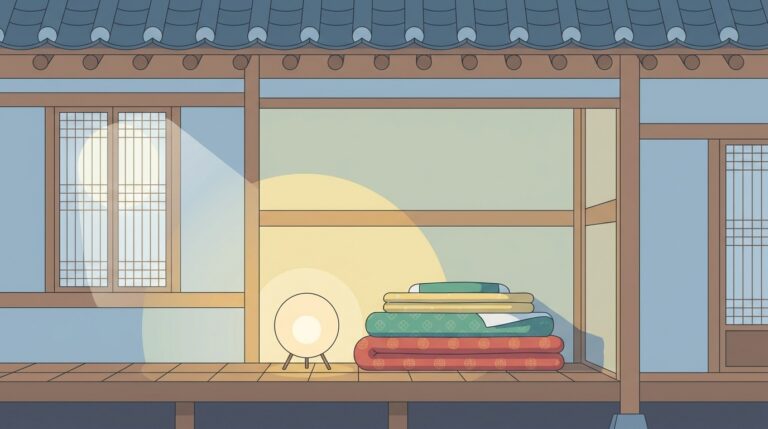
Traditional Korean homes are built on an architectural marvel called Ondol (온돌)—an underfloor radiant stone heating system. Historically, families slept together on thick quilted mats (요 – yo) warmed by the floor. Because winters on the Korean peninsula were brutally cold, surviving the night in good health was a serious everyday concern. Wishing someone peaceful rest wasn’t empty small talk; it was a genuine inquiry about their bodily safety. Today, asking if someone slept soundly remains the ultimate manifestation of “정 (Jeong – relational warmth)”.
Phase 5: Real-Life Roleplay Scenario
Setting: 10:45 PM in a quiet Bukchon Hanok living room. The soothing scent of roasted barley tea lingers in the air.
Characters: Mr. Kim (Homestay Host, 58) & Alex (You, foreign guest).
- Turn 1 (Mr. Kim): 알렉스 씨, 오늘 서울 구경 재미있었어요? (Alex-ssi, oneul Seoul gugyeong jaemi-isseosseoyo?) [Did you have fun exploring Seoul today, Alex?] 🎭 Gently wiping the wooden tea table with a warm smile.
- Turn 2 (Alex): 네, 정말 즐거웠어요! 특히 북촌 골목이 예뻤어요. (Ne, jeongmal jeulgeowosseoyo! Teukhi Bukchon golmogi yeppeosseoyo.) [Yes, I really enjoyed it! Especially the Bukchon alleys were beautiful.] 🎭 Setting down the empty teacup with both hands.
- Turn 3 (Mr. Kim): 다행이네요. 벌써 시간이 늦었으니 피곤하겠어요. (Dahaeng-ineyoyo. Beolsse sigani neujeosseuni pigonhagesseoyo.) [I am glad to hear that. It is already late, so you must be tired.] 🎭 Checking his wristwatch and preparing to stand up.
- Turn 4 (Alex): 조금 피곤하지만 괜찮아요. 사장님도 오늘 바쁘셨죠? (Jogeum pigonhajiman gwaenchanayo. Sajangnimdo oneul bappeusyeotjyo?) [A little tired, but I am okay. You had a busy day too, right, host?] 🎭 Looking up respectfully with relaxed posture.
- Turn 5 (Mr. Kim): 네, 내일 아침 일찍 시장에 가야 해서 먼저 방에 들어갈게요. (Ne, naeil achim iljjik sijange gaya haeseo meonjeo bange deureogalgeyo.) [Yes, I need to head to the market early tomorrow, so I will retire to my room first.] 🎭 Turning comfortably toward his bedroom door.
- Turn 6 (Alex): 오늘 따뜻하게 챙겨주셔서 감사합니다. (Oneul ttatteuthage chaenggyeojusyeoseo gamsahamnida.) [Thank you for taking such warm care of me today.] 🎭 Standing up to match the host’s height.
- Turn 7 (Mr. Kim): 푹 쉬고, 내일 아침 8시에 식사해요. (Puk swigo, naeil achim yeodeolsie siksahaeyo.) [Get plenty of rest, and let’s have breakfast tomorrow at 8 AM.] 🎭 Nodding kindly with hands folded in front.
- Turn 8 (Alex): [Your Turn to Choose!] 🎭 Delivering your final bedtime farewell.
🔀 Interactive Decision Point
How should Alex deliver the final good night greeting to Mr. Kim?
* Choice A: “잘 자, 내일 봐!” (Jal ja, naeil bwa!)
* Choice B: “안녕히 주무세요, 사장님!” (Annyeonghi jumuseyo, sajangnim!)
* Choice C: “굿밤 되세요!” (Gut-bam doeseyo!)
Decision Feedback:
* Choice A (❌ BAD): Instant social blunder! Mr. Kim is almost thirty years older than you. Using casual “잘 자” sounds like talking down to him.
* Choice B (🌟 BEST): Flawless! You acknowledged his title (사장님) and used the honorable verb form (주무세요). Mr. Kim will feel deeply respected.
* Choice C (⚠️ RISK): “굿밤” is trendy internet slang. Using it with a homestay parent comes across as overly flippant and slightly disrespectful.
Phase 6: 10-Second Emotional Shadowing Drill
Practice these three lines aloud, following the slash marks / for natural pacing and pausing:
- Line 1: Respectful & Polite to Elders / Hosts
[😴 졸리지만 정중하게 (Sleepy but deeply respectful)]
“오늘 / 감사했습니다. / 안녕히 / 주무세요. (Oneul / gamsahaesseumnida. / Annyeonghi / jumuseyo.)” -
Line 2: Sweet & Caring to a Date or Good Friend
[💖 달달하고 다정하게 (Warm, sweet, and caring)]
“오늘 / 하루도 / 수고했어. / 잘 자요~ (Oneul / harudo / sugohaesseo. / Jal jayo~)” -
Line 3: Casual & Relaxed to Roommates or Close Friends
[🥱 편안하고 나른하게 (Relaxed, sleepy bestie vibe)]
“나 / 먼저 / 잘게. / 내일 / 연락해! (Na / meonjeo / jalge. / Naeil / yeollakhae!)”
Phase 7: K-Culture Mini Dictionary
- 꿀잠 (Kkuljam): “Honey sleep”. Refers to unbroken, deeply restorative sleep. Koreans often text, “오늘 꿀잠 자! (Have a honey sleep tonight!)”
- 야식 (Yashik): “Late-night snack”. The cultural habit of ordering fried chicken (치맥) or tteokbokki at 11:00 PM before wishing friends good night.
- 온돌 (Ondol): Korea’s radiant underfloor heating technology that keeps winter floors warm and makes curling up in bed a heavenly experience.
- 불면증 (Bulmyeonjeung): “Insomnia”. A very common empathy-builder when you notice a friend lingering active online late at night.
Phase 8: Traveler’s Survival Kit
TOP 3 Bedtime Survival Expressions
- 내일 봬요! (Naeil bwaeyo!)
Meaning: “See you tomorrow! (Polite honorific)”
Pro Tip: The smoothest parting phrase when leaving a guesthouse common room for your private room. - 피곤하시죠? 먼저 쉬세요. (Pigonhasijyo? Meonjeo swiseyo.)
Meaning: “You must be tired? Please rest first.”
Pro Tip: Demonstrates high emotional intelligence (눈치) toward tired travel guides or hosts. - 불 꺼도 될까요? (Bul kkeodo doelkkayo?)
Meaning: “May I turn off the light?”
Pro Tip: An absolute essential survival phrase when staying in multi-bed hostel dorms.
Editor’s Travel Note
- Late-Night Transit Tip: Seoul subways generally wind down around midnight. If you are returning late to your accommodation, consider checking the Seoul Owl Bus (올빼미 버스) routes on your phone. Make sure to download Naver Map for late-night transit routes to track accurate real-time bus arrivals.
- Midnight Taxi Strategy: Hailing late-night street cabs in bustling nightlife spots like Hongdae or Gangnam can be difficult. Be sure to install Kakao T for safe midnight rides to book verified taxis directly without language barriers.
Phase 9: “One Step Deeper” (Reflective Question)
In Korean culture, wishing someone a good night is never just an offhand comment about the time of day; it is an active inquiry into their peace. The foundational root word “안녕 (Annyeong)” literally translates to “being safe, healthy, and undisturbed by misfortune.” Historically, surviving bitter winter nights and sudden illnesses was never guaranteed. When you say “안녕히 주무세요 (Annyeonghi jumuseyo),” you are expressing a communal hope that the other person stays safe from harm until daybreak. It illustrates a society where individual rest is valued as part of collective wellness.
💬 Your Turn: Have you ever experienced a funny or awkward moment when choosing between casual and formal language in a foreign country? Share your story in the comments below!
Phase 10: FAQ & Common Mistakes
Q: Can I use “좋은 밤 되세요 (Joeun bam doeseyo)” when heading to bed?
A: While you might see this phrase on automated marketing emails or translated subtitles, native Koreans rarely say “좋은 밤 되세요” when going to sleep. It is an awkward direct calque of “Have a good night.” Use “안녕히 주무세요” or “편안한 밤 되세요 (Have a peaceful night)” instead.
Q: How should I reply if an elder tells me “잘 자라 (Jal jara)”?
A: Never repeat “잘 자라” back to them! “잘 자라” is an elder-to-youth imperative. You should bow slightly and reply with the higher honorific: “네, 안녕히 주무세요! (Ne, annyeonghi jumuseyo!)”
Q: Is it okay to use “굿나잇 (Gunnait)” with Koreans?
A: Yes, but only with friends your age, younger peers, or in flirty KakaoTalk text messages. Never say it to your host parents, hotel managers, or workplace seniors.
🚨 Common Mistakes Warning Board
- Mistake: Saying “안녕히 가세요 (Go in peace)” to someone who is simply walking into their own bedroom in the same apartment.
Correct Action: “안녕히 가세요” is strictly for someone leaving the building. For bedtime within the same house, say “안녕히 주무세요.” - Mistake: Adding “-요” to “잘 자” to make “잘 자요” when addressing in-laws or company bosses.
Correct Action: The base verb “자다” is too casual for elders, even with “-요”. You must shift to the honorific verb: “안녕히 주무세요.” - Mistake: Waving enthusiastically while bowing your head to an older host.
Correct Action: Keep hands resting naturally at your front or sides; never mix casual Western hand-waving with an Eastern bow.
Phase 11: Action Missions
- 🥉 Bronze Mission (Solo Practice): Stand in front of your bathroom mirror tonight. Bow at a clean 20-degree angle and say “안녕히 주무세요 (Annyeonghi jumuseyo)” 5 times smoothly without pausing.
- 🥈 Silver Mission (Social Media): Hop onto your favorite K-pop idol’s late-night Instagram or Weverse post and leave a warm comment: “오늘 하루도 수고했어요. 꿀잠 자요! (Good job today as well. Have a honey sleep!)”
- 🥇 Gold Mission (Real Life): Use “먼저 들어가 보겠습니다 (Meonjeo deureoga bogesseumnida)” or “편안한 밤 되세요 (Pyeon-an-han bam doeseyo)” with a Korean friend, tutor, or host.
- 🎮 K-Culture Mission: Watch one episode of a slice-of-life K-drama (like Hospital Playlist). Pay close attention to bedtime scenes and identify whether the characters use “잘 자” or “주무세요”.
Phase 12: Interactive Quiz Challenge
Question 1: Scenario Judgment
You just finished having dinner with your Korean language school professor (age 52) and classmates. The professor is walking toward their car to go home. What is the most natural and polite bedtime farewell?
A) 교수님, 잘 자요! (Gyosunim, jal jayo!)
B) 교수님, 안녕히 주무세요! (Gyosunim, annyeonghi jumuseyo!)
C) 교수님, 편안한 밤 되세요! 조심히 들어가세요. (Gyosunim, pyeon-an-han bam doeseyo! Josimhi deureogaseyo.)
Question 2: Fill in the Blank
To your close best friend of the same age who is getting sleepy on a voice call:
“오늘 너무 재미있었어. 피곤할 텐데 얼른 ____! (Oneul neomu jaemi-isseosseo. Pigonhal tende eolleun ____!)”
Question 3: Cultural True or False
True or False: In Korea, it is polite to wave your right hand cheerfully above your head while saying “안녕히 주무세요” to your host family’s grandfather.
👉 Click here to reveal the answers and explanations!
- Answer 1: C
Explanation: While B (“안녕히 주무세요”) is polite, they are parting ways on the street rather than going to sleep right that second. Wishing them a comfortable night (“편안한 밤 되세요”) combined with “Get home safely (조심히 들어가세요)” is the most natural native Korean etiquette! - Answer 2: 잘 자 (Jal ja)
Explanation: Since this is your close friend of the same age, casual banmal (“잘 자”) is the most natural fit. - Answer 3: False
Explanation: Hand waving mixed with an elder greeting looks contradictory and disrespectful. Keep your hands gathered calmly at your front or sides while bowing.







