

Phase 1: Empathy (Story-Immersive Opening)
안녕하세요! 매일한글 에디터입니다. (Annyeonghaseyo! This is your Daily Hangul editor.)
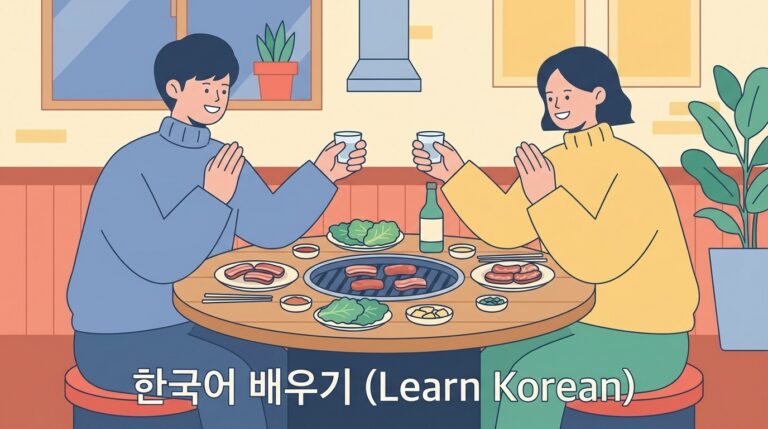
Picture this: You are sitting at a bustling Korean barbecue restaurant in Hongdae. The pork belly is sizzling on the grill, laughter fills the air, and small green soju glasses are placed in front of everyone. Suddenly, your Korean colleague smiles warmly, holds up a chilled bottle of soju, and asks: “주량이 어떻게 되세요? 술 잘 드시는 편이에요?” (What is your alcohol tolerance? Do you drink well?)
Your mind goes completely blank. You want to be polite and join the fun, but you are terrified that answering wrong means receiving non-stop shots all night! You might wonder: If I say I don’t drink, will I ruin the mood? How do Koreans answer this naturally?
Take a deep breath! You are not alone. Asking about drinking tolerance is not a test or a pressure tactic—it is a warm Korean way of checking in on your comfort level. In this guide, backed by hundreds of real learner experiences, you will master friendly, natural A2-level responses that keep you safe, respectful, and completely confident at any Korean gathering.
Phase 2: Top 3 Core Expressions
Here are the three must-know expressions to handle any drinking conversation smoothly.
1. 주량이 어떻게 되세요? (Juryangi eotteoke doeseyo?)
- Pronunciation: [Ju-ryang-i eo-tteo-ke doe-se-yo?] (Think: “Joo-ryahng-ee uh-ttoh-keh dweh-seh-yo?”)
- Meaning: Literal: “What is your alcohol amount?” / Nuance: “What is your drinking tolerance?”
- K-Culture Moment: This is the universal opening line at every hoesik (company dinner) or college welcome party before pouring the second round.
- Editor’s Insight: 주량 (Juryang) is the key noun meaning “drinking capacity.” When Koreans ask this, the expected answer is almost always measured in “soju bottles” (e.g., half a bottle, one bottle).
- Situation Spectrum: Casual ✅ | Semi-formal ✅ | Formal ⚠️ (In very formal situations with executives, use ‘술을 좀 드십니까?’)
- 🤔 Think About It: In many Western cultures, asking how much alcohol someone can consume right after meeting might feel intrusive. Why do you think Korean culture asks this early to ensure group harmony?
2. 술 잘 못 마셔요. (Sul jal mot masyeoyo.)
- Pronunciation: [Sul jal mot ma-syeo-yo.] (Think: “Sool jahl moht mah-shyuh-yo.”)
- Meaning: Literal: “I cannot drink alcohol well.” / Nuance: “I’m not a big drinker / My tolerance is low.”
- K-Culture Moment: You will hear this humble phrase in countless K-Dramas whenever a character wants to politely decline a shot without offending the senior colleague pouring it.
- Editor’s Insight: Notice the combination of 잘 (well) and 못 (cannot). Rather than bluntly declaring “I don’t drink,” adding 잘 softens the statement, showing that you appreciate the gathering even if your body can’t handle alcohol.
- Situation Spectrum: Casual ✅ | Semi-formal ✅ | Formal ✅
- 🤔 Think About It: Notice how Korean politeness often leans on softening negations. How does this compare to saying a direct “No” in your native language?
3. 한 잔만 받을게요. (Han janman badeulgeyo.)
- Pronunciation: [Han jan-man ba-deul-ge-yo.] (Think: “Hahn jahn-mahn bah-deul-geh-yo.”)
- Meaning: Literal: “I will receive just one glass.” / Nuance: “I’ll have just one glass (to join the toast).”
- K-Culture Moment: Used by smart characters who participate in the celebratory geonbae (toast) without getting pressured into a second or third drink.
- Editor’s Insight: This is the ultimate Korean social hack! Taking the first glass shows respect for the table, while the particle -만 (-man, “only”) sets a clear, polite boundary from the very beginning.
- Situation Spectrum: Casual ✅ | Semi-formal ✅ | Formal ✅
- 🤔 Think About It: Why is holding an empty glass or accepting just one glass seen as teamwork in Korean dining?
Phase 3: Textbook Korean vs. Real Korean
Let’s upgrade your textbook phrases to what real native speakers say today!
Situation 1: Asking how well someone handles alcohol
- 📖 교과서 한국어 (Textbook): 당신은 술을 얼마나 마십니까? (Dangsineun sureul eolmana masimnikka? – “How much alcohol do you drink?”)
- 🗣️ 진짜 한국어 (Real-Life): 술 잘 드시는 편이에요? (Sul jal deusineun pyeon-ieyo? – “Do you tend to drink well?”)
- 💡 왜 다를까? (Why the difference?): The textbook phrasing sounds like an immigration officer interrogating you! Real Koreans use the honorific 드시다 (deusida, to drink) combined with -는 편이다 (-neun pyeon-ida, “to tend to”), which creates a polite, conversational tone.
Situation 2: Explaining that you cannot drink much
- 📖 교과서 한국어 (Textbook): 저는 알코올을 거부합니다. (Jeoneun alko-oreul geobuhapnida. – “I reject alcohol.”)
- 🗣️ 진짜 한국어 (Real-Life): 저 술 진짜 약해요! (Jeo sul jinjja yakhaeyo! – “I’m really weak with alcohol!”)
- 💡 왜 다를까? (Why the difference?): Using the word 약하다 (yakhada, to be weak) is a beloved, self-deprecating Korean idiom that immediately draws sympathetic smiles and stops people from forcing drinks on you.
Phase 4: K-Culture Deep Dive & Non-Verbal Manners
4-1. 눈치 (Nunchi) & Body Gestures
Korean drinking etiquette is 50% language and 50% respectful body language:
* Two Hands Rule (두 손 예절): When an older person or colleague pours you a drink, always hold your glass with both hands (or touch your right forearm with your left hand). When pouring for someone else, support the bottle with both hands.
* Turning Your Head (고개 돌리기): When taking a sip in front of someone older or senior in rank, gently turn your head and torso slightly to the side and shield your glass with your hand. Gulping straight while making direct eye contact can come across as aggressive.
4-2. Cultural Code: The Universal Soju Unit
In Korea, alcohol tolerance is never measured in percentages or milliliters. The universal unit is 소주 병 (Soju bottles):
* 반 병 (Ban byeong): Half a bottle (~3-4 shots). This signals you can enjoy a drink but have clear limits.
* 한 병 (Han byeong): One bottle (~7 shots). Considered the benchmark average for an adult social drinker.
* 한두 잔 (Han-du jan): One or two glasses. The best answer if you get red easily or dislike alcohol.
Phase 5: Real-Life Roleplay Scenario
Setting: A warm, noisy pork barbecue restaurant near Gangnam Station. Minjun (민준 대리), a friendly senior coworker, is grilling meat and holding a green soju bottle with a smile.
- Turn 1 (Minjun):
“지수 씨, 오늘 프로젝트 끝났는데 한잔해야죠! 술 잘 드시는 편이에요?”
(Jisu ssi, oneul peurojekteu kkeutnanneunde hanjanhaeyajyo! Sul jal deusineun pyeon-ieyo?)
“Jisu, we finished the project today, so we must have a drink! Do you tend to drink well?”
🎭 [Grinning warmly while tilting the cold soju bottle towards your glass] -
Turn 2 (You):
“아, 민준 대리님! 저 사실 술 진짜 약해요.”
(A, Minjun daerinim! Jeo sasil sul jinjja yakhaeyo.)
“Ah, Assistant Manager Minjun! Honestly, I am really weak with alcohol.”
🎭 [Smiling sheepishly while raising both hands slightly in modest defense] -
Turn 3 (Minjun):
“진짜요? 주량이 어떻게 되는데요?”
(Jinjja-yo? Juryangi eotteoke doeneundeyo?)
“Really? What is your tolerance normally?”
🎭 [Curious and pausing the bottle] -
Turn 4 (You):
“소주 한두 잔 마시면 얼굴이 엄청 빨개져요.”
(Soju han-du jan masimyeon eolguri eomcheong ppalgaejyeoyo.)
“If I drink one or two glasses of soju, my face gets super red.”
🎭 [Gently patting both cheeks with a laugh] -
Turn 5 (Minjun):
“아이고, 무리하면 안 되죠! 그럼 오늘은 첫 잔만 가볍게 짠할까요?”
(Aigo, murihamyeon an doejo! Geureom oneureun cheot janman gabyeopge jjan-halkkayo?)
“Oh no, we shouldn’t push you! Then shall we just do a light toast for the first glass?”
🎭 [Nodding supportively and adjusting the pour to a tiny splash] -
Turn 6 (You):
“네! 딱 한 잔만 받을게요. 감사합니다!”
(Ne! Ttak han janman badeulgeyo. Gamsahamnida!)
“Yes! I will take just one glass. Thank you!”
🎭 [Holding the glass with both hands respectfully] -
Turn 7 (Minjun):
“자, 다들 고생 많았어요. 건배!”
(Ja, dadeul gosaeng manasseoyo. Geonbae!)
“Well, great job everyone. Cheers!”
🎭 [Clinking glasses in the center of the table] -
Turn 8 (You):
“건배! 수고하셨습니다!”
(Geonbae! Sugohasyeotseumnida!)
“Cheers! Thank you for your hard work!”
🎭 [Turning head slightly to the side to take a small sip]
🔀 Interactive Branching Point
If Minjun asks to pour you a second glass right after the toast, what will you say?
- Choice A: “전 이제 사이다 마실게요!” (Jeon ije saida masilgeyo! – “I’ll drink cider/soda from now on!”)
- Feedback (Best): Perfect! It smoothly substitutes alcohol with a soda without breaking the festive mood. Everyone appreciates clarity.
- Choice B: “주지 마세요. 취하기 싫어요.” (Juji maseyo. Chwihagi sileoyo. – “Don’t give it to me. I hate getting drunk.”)
- Feedback (Bad): Too aggressive and blunt. It sounds like a reprimand and can freeze the friendly table atmosphere instantly.
- Choice C: “한 잔만 더 주시면 마셔볼게요…” (Han janman deo jusimyeon masyeobolgeyo… – “If you give me one more, I’ll try drinking it…”)
- Feedback (Risk): Dangerous! Koreans will assume you actually want to keep drinking. Only say this if you truly want another round.
Phase 6: 10-Second Emotion Shadowing Drill
Practice these natural rhythm pauses (/) while matching the emotional cue in brackets!
[😅 쑥스러운 듯 솔직하게 - Shy yet honest]
“저 / 술 진짜 약해요! / 한두 잔이면 끝나요.”
(Jeo / sul jinjja yakhaeyo! / han-du jan-imyeon kkeutnayo.)
“I’m / really weak with alcohol! / One or two glasses and I’m done.”-
[😊 미소 지으며 정중하게 - Polite with a warm smile]
“분위기는 좋아하는데 / 주량은 / 맥주 한 캔이에요.”
(Bunwigineun joahaneunde / juryangeun / maekju han kaen-ieyo.)
“I love the gathering vibe / but my tolerance / is one can of beer.” -
[🍻 활기차고 센스 있게 - Energetic and witty]
“첫 잔은 / 소주로 받고 / 다음엔 사이다 마실게요!”
(Cheot janeun / sojuro batgo / da-eumen saida masilgeyo!)
“I’ll take the first glass / with soju / and have soda next!”
Phase 7: K-Culture Mini Dictionary
-
주량 (Ju-ryang) [Noun]
Alcohol tolerance / Drinking limit. Used constantly in conversations when getting to know new acquaintances or team members.
Example: “주량이 어떻게 되세요?” (What’s your tolerance?) -
알쓰 (Al-sseu) [Trendy Slang]
Short for 알코올 쓰레기 (Alcohol Trash – humorous self-deprecation meaning a lightweight). Young Koreans use this playfully to describe someone who gets tipsy off half a beer.
Example: “저 완전 알쓰예요!” (I am a total lightweight!) -
회식 (Hwe-sik) [Noun]
Company dinner or team dining gathering. A core ritual of Korean workplace culture where understanding etiquette and expressing your tolerance politely is essential. -
원샷 (Won-syat) [Exclamation]
Bottoms up! (One-shot). Often chanted during games, but completely optional if you already stated your low tolerance early.
Phase 8: Traveler’s Survival Kit
TOP 3 Survival Phrases for Travelers
- 사이다 하나 주세요. (Saida hana juseyo.)
“Please give me one Korean cider (lemon-lime soda).”
Pro Tip: Korean 사이다 is sweet like Sprite/7-Up and is the standard non-alcoholic table beverage. - 물 좀 더 주실 수 있나요? (Mul jom deo jusil su innayo?)
“Could you give us a bit more water?”
Pro Tip: Drinking water regularly is respected at every Korean table and helps counter alcohol effects. - 짠! (Jjan!)
“Clink! / Cheers!”
Pro Tip: The cute onomatopoeia for clinking glasses used amongst peers and friends.
Editor’s Travel Note
- If you stay out late drinking in nightlife hubs like Hongdae, Itaewon, or Gangnam, public subways stop around midnight. Make sure to download the 카카오 T 택시 앱 (Kakao T Taxi App) beforehand so you can hail a cab without language trouble.
- If you wake up with a headache, step into any 24-hour convenience store (CU, GS25, 7-Eleven) and look for the hangover drink section near the cash register. Grabbing a bottle of 컨디션 (Condition) or 상쾌환 (Sang-kwae-hwan) jelly will rescue your travel itinerary!
Phase 9: One Step Deeper
In Western cultures, drinking can often be seen as an individual preference or pastime. But in Korea, the drinking table is an extension of the communal 우리 (Uri – “We/Us”) culture. Sharing food and pouring drinks for one another removes the rigid hierarchical boundaries of daily office life and fosters authentic emotional intimacy (정, Jeong). When Koreans ask for your 주량 (tolerance), they aren’t judging you; they are seeking to take care of you within the group.
💬 Your Turn: How do people in your home country handle declining a drink at a group dinner? Share your cultural perspective in the comments below!
Phase 10: FAQ & Mistake Prevention
Q: What should I do if an older senior pours me a drink, but I cannot drink alcohol at all for medical or personal reasons?
A: You never have to drink alcohol against your health or beliefs! Accept the glass with two hands to show respect, place it on the table, and politely say: “죄송하지만 건강 때문에 술을 못 마십니다. 음료수로 대신해도 될까요?” (I’m sorry, but I cannot drink alcohol for health reasons. May I replace it with a soft drink?). Koreans will respect this completely.
Q: Is it rude to pour my own alcohol in Korea?
A: Yes, pouring your own drink (자작, jajak) is traditionally avoided at group tables because it implies nobody is paying attention to you. Keep an eye on your neighbors’ glasses; when theirs is empty, pour for them, and they will happily return the favor!
Q: Why do Koreans touch glasses at the bottom instead of the rim?
A: Touching the rim of your glass slightly lower than the senior person’s glass is a subtle non-verbal sign of deep respect. It’s an instant nunchi bonus point!
🚨 Common Mistakes Warning Board
- Mistake 1: Leaving your glass upside down on the table.
Correct Action: In Korea, turning a glass upside down can look dramatic or displeased. Leave the glass upright, even if it is filled with water or soda. - Mistake 2: Drinking directly facing your boss or elder.
Correct Action: Slightly turn your head 45 degrees to the side and cover your mouth with your hand as you sip. - Mistake 3: Saying a blunt “싫어요!” (I hate it / No) when offered a drink.
Correct Action: Use the gentle idiom “술이 약해서요” (Because I am weak with alcohol) instead.
Phase 11: Action Missions & Engagement
- 🥉 Bronze Mission (Solo): Stand in front of a mirror and practice saying: “저 술 진짜 약해요! 한 잔만 마실게요.” with a polite smile.
- 🥈 Silver Mission (Social): Leave a comment under this post answering: “주량이 어떻게 되세요?” using the Korean bottle/glass system (e.g., “저는 맥주 한 캔이에요!”).
- 🥇 Gold Mission (Real Life): Next time you visit a Korean restaurant or hang out with Korean friends, gently turn your head when taking your first toast sip.
- 🎮 K-Culture Mission: Watch an episode of a drama like Work Later, Drink Now (술꾼도시여자들) or Itaewon Class and count how many times the characters use two hands to receive a pour!
Phase 12: Interactive Quiz Challenge
Q1. [Situation Judgment] You are having dinner with your Korean boss. He holds up a soju bottle to pour you a drink. What is the most appropriate action?
1. Hold your glass with one hand and look directly into his eyes.
2. Pour your own cup first to save him the trouble.
3. Hold your glass with both hands and thank him politely.
Click here to reveal the answer!
Answer: 3
Always hold your glass with both hands when receiving a drink from an elder or senior colleague!
Q2. [Fill in the Blank] Complete the phrase meaning “I’m really weak with alcohol!”:
“저 술 진짜 ( )!”
Click here to reveal the answer!
Answer: 약해요 (yakhaeyo)
Full sentence: “저 술 진짜 약해요!” (Jeo sul jinjja yakhaeyo!).
Q3. [True or False] In Korean culture, it is considered polite to pour your own alcohol whenever your cup runs empty.
Click here to reveal the answer!
Answer: False (X)
Pouring your own drink (자작) is discouraged. Korean drinking etiquette is centered on caring for others at the table by refilling their cups.







