

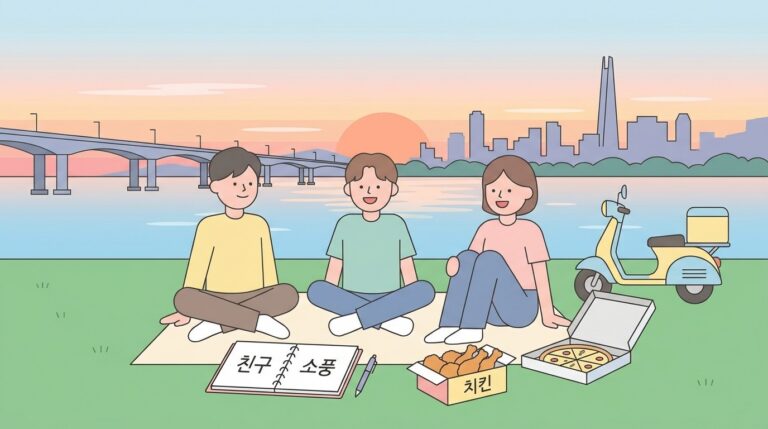
Master Hangang Park Delivery Zones: Pick Up Chicken & Pizza Like a Seoul Local
Phase 1: Empathy (Story-Immersive Opening)
안녕하세요! (Hello!) I am your Daily Hangul editor and your personal Seoul culture navigator. Imagine this: It is a breezy Saturday evening at Yeouido Hangang Park. The orange sun is dipping below the horizon, soft acoustic music drifts from a busker nearby, and you have just set up your picnic mat on the grass. You followed the ultimate Seoul travel ritual and ordered crispy seasoned fried chicken and piping hot pizza through an app. Ten minutes later, your phone buzzes with a text: “배달존 2번 앞입니다!” (I am in front of Delivery Zone 2!).
You jump up eagerly, but as you approach the delivery zone, your eyes widen. There are twenty delivery scooters parked in a row, a dozen riders wearing helmets carrying identical insulated thermal bags, and fifty hungry picnickers all staring at their phones looking just as bewildered as you. Which rider has your fried chicken? How do you ask without freezing up?
If this scenario makes your palms sweat, take a deep breath. At Daily Hangul, dozens of our beginner learners tell us that their first solo pickup at a Hangang delivery zone felt like an intense treasure hunt. But here is the secret: you do not need complicated grammar. With just three beginner-friendly phrases and a sprinkle of Korean street etiquette, you will walk into that crowd, claim your dinner with calm confidence, and stroll back to your picnic mat like a seasoned Seoulite. Let us dive in!
Phase 2: Core 3 Expressions Deep Dive
1. 배달존 2번에 있어요. (Baedaljon ibeone isseoyo.)
- Pronunciation: [Bae-dal-jon i-beon-e it-seo-yo] (Sounds like: bay-dahl-zone ee-bun-eh ee-so-yo — imagine saying “bay dull zone” smoothly).
- Meaning:
- Literal: “Delivery zone number 2 at am/exist.”
- Real Nuance: “I am standing at Delivery Zone 2 right now.”
- K-Culture Moment: You will see this scene constantly in K-dramas like Hospital Playlist or lifestyle vlogs: characters texting or calling the delivery rider while looking around the park entrance.
- Editor’s Insight: In Hangang parks, you cannot order food directly to your picnic mat on the lawn because the park is too massive! Seoul city created designated numbered spots called 배달존 (Baedal Zone). Telling the rider which number zone you are standing next to prevents endless wandering.
- Situation Spectrum: Casual: ⚠️ (drop ‘요’ only with friends) | Semi-formal: ✅ (
배달존 2번에 있어요) | Formal: ✅ (배달존 2번에 있습니다) - 🤔 Think About It: In English, we often say “I’ll meet you by the gate.” In Korean, using the location particle ~에 (e) highlights your presence in a shared physical space. How does pinpointing a communal landmark change the way people coordinate in busy cities?
2. 치킨 시켰어요. (Chikin sikyeosseoyo.)
- Pronunciation: [Chi-kin si-kyeot-seo-yo] (Sounds like: chee-keen she-kyut-so-yo — rhythm matches “chicken, see cute saw yo”).
- Meaning:
- Literal: “Chicken ordered.”
- Real Nuance: “I ordered the chicken! / I am the one who ordered chicken.”
- K-Culture Moment: Picture a hungry K-pop idol running toward the food delivery van during an outdoor reality show shouting happily to signal their order.
- Editor’s Insight: When riders arrive, they are holding boxes from different brands (BHC, Kyochon, BBQ). You don’t need a full sentence like “I am the customer who placed the order for pizza and fried chicken.” Just stating the food name with 시켰어요 (sikyeosseoyo – ordered) instantly narrows down who the driver is looking for.
- Situation Spectrum: Casual: ⚠️ | Semi-formal: ✅ | Formal: ✅
- 🤔 Think About It: Notice how Korean easily drops the subject “I” (저는). Why do you think Korean communication focuses more on the shared action (ordering food) rather than emphasizing the individual “I”?
3. 뒷자리 1234 맞아요? (Dwitjari il-i-sam-sa majayo?)
- Pronunciation: [Dwit-ja-ri il-i-sam-sa ma-ja-yo?] (Sounds like: dweet-jah-ree eel-ee-sahm-sah mah-jah-yo?).
- Meaning:
- Literal: “Back seats/digits 1234, is that correct?”
- Real Nuance: “Are the last 4 digits of your order 1234? / Is this for number 1234?”
- K-Culture Moment: Delivery riders in Korea verify orders by matching the last 4 digits of your phone number printed on the receipt sticker. It is the universal safety handshake.
- Editor’s Insight: 뒷자리 (dwitjari) literally means “rear digits.” Instead of reciting your whole 11-digit phone number in Korean under pressure, you only need to know your last four digits!
- Situation Spectrum: Casual: ⚠️ | Semi-formal: ✅ | Formal: ✅
- 🤔 Think About It: Using last digits preserves customer privacy while maintaining quick speed in high-density urban areas. How does your home country balance speed and customer identification during pickups?
Phase 3: Textbook Korean vs. Real Korean
Situation 1: Spotting the delivery driver in the crowd
- 📖 Textbook Korean:
- 실례지만, 제가 주문한 음식이 도착했습니까? (Sillyejiman, jega jumunhan eumsigi dochakhaesseumnikka?) — “Excuse me, has the food that I ordered arrived?”
- 🗣️ Real Korean:
- 저 혹시 치킨 맞으세요? (Jeo hoksi chikin majeuseyo?) — “Excuse me, are you the chicken delivery?”
- 💡 Why is it different? Textbook phrases sound like an official business inquiry. At a fast-paced delivery zone where riders are in a hurry, locals use a gentle conversational hedge **저 혹시… (Jeo hoksi… / Excuse me, by chance…)* followed directly by the item name.
Situation 2: Receiving the food and saying goodbye
- 📖 Textbook Korean:
- 배달해 주셔서 대단히 감사합니다. (Baedalhae jusyeoseo daedanhi gamsahamnida.) — “Thank you very much for delivering this.”
- 🗣️ Real Korean:
- 감사합니다! 맛있게 먹을게요! (Gamsahamnida! Masitge meogeulgeyo!) — “Thank you! I will enjoy eating this!”
- 💡 Why is it different? In Korea, wishing to enjoy the meal (맛있게 먹을게요) is the warmest and most natural compliment you can give to anyone who brings or prepares food for you.
Phase 4: K-Culture Deep Dive & Non-Verbal Manners
4-1. Nunchi (눈치) & Gestures at the Delivery Zone
When you step into a Hangang delivery zone, quick non-verbal observation (눈치 – nunchi) is key:
1. Screen Forward: Hold your smartphone in one hand with the delivery app screen visible, showing the order number or restaurant name. Riders are scanning the crowd for people looking specifically for their brand.
2. The Two-Handed Handover: When the rider passes you the plastic bag or pizza box, always accept it with both hands (or support your right forearm with your left hand) along with a slight head nod (목례). Even though it is quick street delivery, this gesture conveys deep mutual respect.
3. Step Aside Promptly: As soon as you receive your package, step clear of the pedestrian and bike lanes. Hangang delivery zones border busy riverside bicycle paths.
4-2. Cultural Code: The Art of Hangang “Chimaek” (치맥)
Why is delivery at Hangang such a legendary phenomenon? In Korea, eating 치맥 (Chimaek – Chicken + Maekju/Beer) or piping hot pizza on a picnic mat while watching the Banpo Bridge Rainbow Fountain is considered one of the happiest, budget-friendly luxuries in Seoul. The delivery infrastructure is so precise that riders navigate parks larger than several sports stadiums combined. To preserve green lawns and prevent motorbike accidents on walking trails, the city established designated pickup shelters labeled 배달존 (Baedal Zone). Embracing this system means experiencing modern Korean civic convenience at its finest.
Phase 5: Real-Life Roleplay Scenario
- Setting: Yeouido Hangang Park, Delivery Zone 2, 7:15 PM. Neon lights reflect on the river.
- Characters:
- Alex: A beginner Korean traveler craving fried chicken.
- Rider Park: A speedy, friendly delivery driver wearing a neon yellow helmet and holding a warm paper bag.
- Turn 1 (Alex):
- 🎭 Action: Approaching a rider who just pulled up with a chicken logo on his box, waving slightly.
- 저기요, 혹시 치킨 맞으세요? (Jeogiyo, hoksi chikin majeuseyo?)
- “Excuse me, is this chicken by chance?”
- Turn 2 (Rider Park):
- 🎭 Action: Glancing at the receipt stapled to the bag.
- 네, 반반치킨 맞아요. 주문하신 분이세요? (Ne, banbanchikin majayo. Jumunhasin bun-iseyo?)
- “Yes, half-and-half chicken. Are you the one who ordered?”
- Turn 3 (Alex):
- 🎭 Action: Nodding smilingly and pointing to oneself.
- 네, 제가 시켰어요! (Ne, jega sikyeosseoyo!)
- “Yes, I ordered it!”
- Turn 4 (Rider Park):
- 🎭 Action: Pointing to the phone number on the receipt slip.
- 전화번호 뒷자리 어떻게 되세요? (Jeonhwabeonho dwitjari eotteoke doeseyo?)
- “What are the last 4 digits of your phone number?”
- Turn 5 (Alex):
- 🎭 Action: Showing screen and speaking clearly.
- 5678(오-육-칠-팔)이에요! (O-yuk-chil-pal-ieyo!)
- “It’s 5-6-7-8!”
- Turn 6 (Rider Park):
- 🎭 Action: Checking the slip and handing over the warm, fragrant box.
- 네, 5678 맞으시네요. 여기 치킨하고 콜라 있습니다. (Ne, o-yuk-chil-pal majeusineyo. Yeogi chikinhago kolla itseumnida.)
- “Yes, 5678 is correct. Here is your chicken and cola.”
- Turn 7 (Alex):
- 🎭 Action: Bowing upper body slightly and taking the bag with both hands.
- 와, 감사합니다! 맛있게 먹을게요! (Wa, gamsahamnida! Masitge meogeulgeyo!)
- “Wow, thank you! I will enjoy eating this!”
- Turn 8 (Rider Park):
- 🎭 Action: Giving a thumb-up before fastening his helmet strap.
- 네, 좋은 저녁 보내세요! (Ne, joeun jeonyeok bonaeseyo!)
- “Yes, have a wonderful evening!”
🔀 Interactive Decision Point
When Rider Park asks for verification (“전화번호 뒷자리 어떻게 되세요?”), what do you do?
- Option A: Say the 4 numbers clearly in Sino-Korean numbers (e.g., “오-육-칠-팔이에요!”) while showing your phone screen.
- Feedback: [BEST] Rider Park verifies you in 2 seconds, smiles at your Korean, and hands you steaming food without delay!
- Option B: Say nothing, reach out your hands immediately, and try to take the box.
- Feedback: [BAD] The rider will pull the bag back with a startled expression. In crowded zones, food theft or accidental mix-ups happen, so drivers must confirm the digits.
- Option C: Shout your entire 11-digit overseas phone number in fast English.
- Feedback: [RISK] The driver only sees the last 4 digits generated on the Korean delivery slip. Hearing a full international number will cause confusion and delay.
Phase 6: 10-Second Emotion Shadowing Drill
Practice these lines out loud with feeling! Follow the rhythm pauses marked by /.
[👀 차분하고 정중하게 / Calm & Inquiring]- 저기요, / 혹시 치킨 맞으세요?
- (Jeogiyo, / hoksi chikin majeuseyo?)
[😊 명확하고 자신감 있게 / Confident & Clear]- 네! / 뒷자리 / 5678(오-육-칠-팔)이에요.
- (Ne! / dwitjari / o-yuk-chil-pal-ieyo.)
[🎉 신나고 감사의 마음을 담아 / Bright & Grateful]- 감사합니다! / 맛있게 먹을게요!
- (Gamsahamnida! / Masitge meogeulgeyo!)
Phase 7: K-Culture Mini Dictionary
- 배달존 (Baedaljon) | Delivery Zone
- Designated numbered meeting points inside major Hangang riverfront parks where delivery motorbikes are permitted to meet customers on foot.
- 치맥 (Chimaek) | Chicken & Beer
- The iconic Korean portmanteau pairing fried chicken (chikin) and beer (maekju), quintessential to Han River picnics.
- 돗자리 (Dotjari) | Picnic Mat
- The essential waterproof ground mat rented or purchased near park subway exits. Without a dotjari, your picnic hasn’t truly begun.
- 한강라면 (Hangang Ramyeon) | Han River Instant Ramyeon
- Instant ramen prepared in aluminum foil bowls using automated induction cookers at riverside convenience stores, often eaten alongside delivery pizza and chicken.
Phase 8: Traveler’s Survival Kit
Top 3 Survival Expressions
- 여기 배달존 몇 번이에요? (Yeogi baedaljon myeot beon-ieyo?)
- Romanization: [Yeo-gi bae-dal-jon myeot beon-i-e-yo?]
- Pro Tip: If you are lost in the park, ask any park ranger or passerby this phrase to find out which delivery booth you are closest to.
- 피자 주문자예요. (Pija jumunjayeyo.)
- Romanization: [Pi-ja ju-mun-ja-ye-yo.]
- Pro Tip: Means “I am the pizza customer.” Short, sharp, and easy to pronounce when a motorcycle pulls up.
- 조심히 가세요! (Josimhi gaseyo!)
- Romanization: [Jo-sim-hi ga-se-yo!]
- Pro Tip: Means “Ride safely!” Saying this to a busy rider as they head out into traffic marks you as a thoughtful, courteous local.
Editor’s Travel Note
- Essential Apps: If you do not have a domestic Korean credit card, apps like Shuttle Delivery or ordering directly through English-supported kiosks near major subway exits can be lifesavers. Use the official Naver Map app navigation guide to pinpoint your exact walking route to “Yeouido Hangang Park Delivery Zone 2” or “Ttukseom Delivery Zone 1”.
- Trash Manners (분리수거 – Bunrisugeo): Hangang Park has massive recycling drop-off stations near delivery zones. Remember to empty food leftovers into designated bins and flatten your pizza boxes before tossing them!
Phase 9: “Going One Step Deeper”
Korea’s delivery ecosystem is famed for 빨리빨리 (Ppalli-ppalli)—the cultural spirit of extreme speed and efficiency. Yet what makes the Han River delivery zone fascinating is how speed balances with mutual social trust. Without physical addresses, thousands of people safely receive fresh meals based simply on a spot number and the last four digits of a phone number. It reflects a society that values community cooperation in shared public spaces.
💬 Your Turn: What is the food delivery culture like in your home country? Would a public park delivery zone work in your city? Tell us in the comments below!
Phase 10: FAQ & Misconception Prevention
Q: Can delivery drivers bring food directly to my picnic tent or mat?
A: No. Motor vehicles and motorbikes are strictly prohibited from driving across the pedestrian footpaths and grass lawns inside Hangang parks for safety reasons. You must walk to one of the numbered designated 배달존 (Delivery Zones) to collect your order.
Q: How do I know which Delivery Zone to choose when ordering?
A: Check your location on your map app first. For example, Yeouido Hangang Park has Delivery Zones 1, 2, and 3. Zone 2 is closest to Yeouinaru Station Exit 2. Select the zone nearest to your mat before placing the order.
Q: What if I can’t speak Korean when the driver calls my phone?
A: Don’t panic! Most drivers simply call to announce: “도착했습니다!” (I have arrived!). Reply simply: “배달존 2번 가고 있어요!” (Going to Delivery Zone 2!) and head over immediately with your phone ready.
🚨 Common Mistakes Warning Board
- ❌ Mistake 1: Waiting at your picnic mat until the driver calls asking where you are.
- 👉 Correct Action: Walk to the delivery zone 3 to 5 minutes before the estimated arrival time so the rider does not have to wait in traffic.
- ❌ Mistake 2: Reading out your foreign telephone country code and 10 numbers.
- 👉 Correct Action: Only state or display the final 4 digits of the phone number linked to the app.
- ❌ Mistake 3: Leaving packaging and chicken bones in the delivery zone area.
- 👉 Correct Action: Carry your meals back to your mat, and dispose of trash at the park’s designated waste sorting stations.
Phase 11: Action Mission & Engagement
- 🥉 Bronze Mission (Solo Practice): Read the numbers of your phone’s last 4 digits aloud in Korean Sino-numbers (일, 이, 삼, 사, 오, 육, 칠, 팔, 구, 영) three times until you can say them smoothly in under two seconds.
- 🥈 Silver Mission (Social Share): Snap a photo of a delicious meal you’re eating today, upload it to Instagram or X, and write: “오늘 치킨 시켰어요! 맛있게 먹을게요! #DailyHangul”.
- 🥇 Gold Mission (Real-World Master): Next time you visit Seoul, order at least one meal to a Hangang Park Delivery Zone, complete the pickup dialogue in Korean, and enjoy your Chimaek riverside!
🎮 K-Culture Mission: Watch an episode of a Korean variety show like Hangout with Yoo or a Han River picnic scene in a K-drama. Notice how characters coordinate meeting up at park landmarks! Can you spot the blue or yellow delivery zone signs in the background?
Phase 12: Interactive Quiz Challenge
Test your knowledge before heading out to the Han River!
1. Situation Judgment: You ordered a pepperoni pizza at Ttukseom Hangang Park. The rider pulls up and asks: “어떤 거 주문하셨어요?” (What did you order?) What is your best response?
* (A) 배달존 2번에 가세요. (Go to Delivery Zone 2.)
* (B) 피자 시켰어요! 뒷자리 4321이에요. (I ordered pizza! Last digits are 4321.)
* (C) 안녕히 가세요! (Goodbye!)
2. Fill-in-the-Blank: Complete the polite gratitude phrase when taking your chicken bag:
* “감사합니다! _________ 먹을게요!” (Thank you! I will enjoy the food!)
3. True or False: In Hangang Park, delivery drivers are allowed to ride their scooters onto the grass lawn to find your picnic blanket.
* (True / False)
👉 Click to reveal answers & explanations!
- Answer: (B)
- Explanation: Stating your food category (피자 시켰어요) and verifying with your 4 digits (뒷자리 4321이에요) is the quickest, most accurate way to confirm your order.
- Answer: 맛있게 (Masitge)
- Explanation: “맛있게 먹을게요!” (Literally: “I will eat deliciously!”) is the quintessential Korean phrase showing warmth and gratitude to the food provider.
- Answer: False
- Explanation: Scooters cannot enter picnic and lawn areas. All deliveries must be collected at designated 배달존 (Delivery Zones).
- Explanation: Scooters cannot enter picnic and lawn areas. All deliveries must be collected at designated 배달존 (Delivery Zones).







