

The Secret Behind Korea’s 7 AM Deliveries: Speak Like a Local with ‘Bullet Shipping’
Phase 1: Empathy (Real-Life Opening)
안녕하세요! Welcome back to Daily Hangul! It’s your friendly neighborhood Seoul navigator here. Picture this: It is 11:45 PM on a freezing Thursday night in Seoul. You realize you completely ran out of laundry detergent, your phone charger cable is broken, and you desperately need a cold vitamin drink for an early morning job interview. In most places around the world, you would sigh, accept defeat, and run to a convenience store or wait three days for standard shipping.
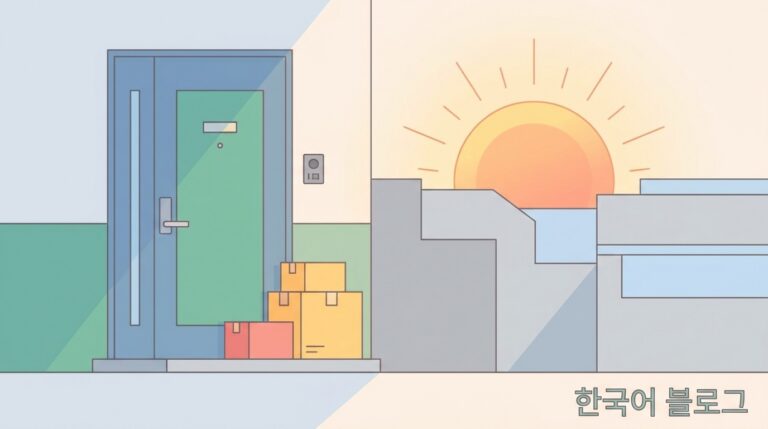
Not in South Korea. With just three taps on your smartphone, you place an order. You wake up at 6:30 AM, open your front door in pajamas, and there it is—a pristine cardboard box sitting safely on your welcome mat. Welcome to the world of Chong-al Baesong (총알 배송, Bullet Delivery) and Saebyeok Baesong (새벽 배송, Dawn Delivery)!
For many expats, foreign students, and travelers, Korea’s ultra-fast logistics feel like actual magic. But navigating the delivery apps, decoding text messages from the delivery courier (taekbae gisa-nim), and explaining your apartment’s front-gate passcode can feel overwhelming. Many B1-level learners tell me, “I can order food at restaurants, but whenever I need to leave a shipping memo or text the courier about my missing package, my Korean suddenly freezes!”
Don’t worry—you don’t need a master’s degree in Korean business administration to conquer Korean online shopping. By mastering just a few authentic phrases and understanding the cultural rhythm behind the famous Ppal-li Ppal-li (빨리빨리, Hurry-Hurry) mindset, you will unlock convenience like never before.
Phase 2: Core Expressions Deep Dive
1. 문 앞에 놓아 주세요 (Mun ape noa juseyo)
- Pronunciation: [Mun a-pe no-a ju-se-yo] (Think of Moon + Ah-peh + No-ah + Joo-seh-yo)
- Meaning: “Please leave it in front of the door.” (Literal: Door + front + at + put down + please do)
- K-Culture Moment: You will see this phrase pre-selected on every single Korean e-commerce checkout screen, from Coupang to Market Kurly. It is the golden standard of modern contactless apartment living.
- Editor’s Insight: Notice that Koreans rarely say “집 안에 넣어 주세요” (Please put it inside my house) because privacy and personal boundaries are strictly observed. Even if you are home, couriers prefer leaving it outside the door and sending a quick SMS photo.
- Situation Spectrum: Casual: ⚠️ (Say to friends: 문 앞에 둬 / Mun ape dwo) | Semi-formal: ✅ (문 앞에 놓아 주세요 / Mun ape noa juseyo) | Formal: ✅ (문 앞에 놓아 주시기 바랍니다 / Mun ape noa jusigi baramnida)
- 🤔 Think About It: In many countries, leaving an expensive laptop outside your front door unattended would invite package theft. Why do Koreans trust “doorstep delivery” without a second thought?
2. 오늘 주문하면 언제쯤 도착할까요? (Oneul jumunhamyeon eonjejjeum dochakhalkkayo?)
- Pronunciation: [O-neul ju-mun-ha-myeon eon-je-jjeum do-chak-hal-kka-yo?]
- Meaning: “If I order today, around when might it arrive?”
- K-Culture Moment: Used constantly when shopping at independent online boutiques (smart stores) or messaging sellers on second-hand apps like Danggeun Market (당근마켓) when you need an item before the weekend.
- Editor’s Insight: The ending ~쯤 (~jjeum, around/approximately) and ~할까요? (~halkkayo?, do you think it will…?) softens the question. Korean Ppal-li Ppal-li culture loves speed, but demanding “언제 와요?” (When is it coming?) sounds impatient or accusatory.
- Situation Spectrum: Casual: ⚠️ (오늘 시키면 언제 와? / Oneul sikimyeon eonje wa?) | Semi-formal: ✅ | Formal: ✅ (오늘 주문 시 예상 수령일이 언제입니까? / Oneul jumun si yesang suryeong-iri eonje-imnikka?)
- 🤔 Think About It: How does adding hedge words like ~쯤 help balance urgency with politeness in Korean social interactions?
3. 공동현관 비밀번호 알려드릴게요 (Gongdong-hyeongwan bimilbeonho allyeodeurilgeyo)
- Pronunciation: [Gong-dong-hyeon-gwan bi-mil-beon-ho al-lyeo-deu-ril-ge-yo]
- Meaning: “I will let you know the building main entrance passcode.”
- K-Culture Moment: If you live in an apartment complex (apateu) or studio villa (wonrum), the biggest hurdle for night-time couriers is the locked ground-floor glass door. Providing this passcode saves your courier a frustrating 2 AM phone call.
- Editor’s Insight: In Korea, building keypad codes often require a specific sequence, like
#+1234+*or종(bell)+1234. Learning to write this clearly in your delivery instructions ensures your breakfast actually reaches your floor. - Situation Spectrum: Casual: ⚠️ (현관 비번 알려줄게 / Hyeongwan bibeon allyeojulge) | Semi-formal: ✅ | Formal: ✅ (공동현관 출입번호를 전달해 드립니다 / Gongdong-hyeongwan churipbeonhoreul jeondalhae deurimnida)
- 🤔 Think About It: Notice the humble verb 드리다 (deurida, to offer/give honorifically). Why is it customary to use respectful service language even when you are the paying customer?
Phase 3: Textbook Korean vs. Real-Life Korean
Situation A: Asking if the item has been shipped yet
- 📖 교과서 한국어 (Textbook): 저의 물품이 발송되었습니까? (Jeoui mulpumi balsongdoe-eossseumnikka? – Has my merchandise been dispatched?)
- 🗣️ 진짜 한국어 (Real-Life): 사장님, 오늘 출고되었나요? (Sajangnim, oneul chulgodoeeonnayo? – Boss/Seller, did it ship out from the warehouse today?)
- 💡 왜 다를까? Textbook Korean uses rigid Sino-Korean words like 물품 (goods) and stiff formal conjugations. Real native speakers call online boutique owners 사장님 (boss/shopkeeper) and ask if the item 출고 (cleared out of the warehouse) today with a warm, conversational intonation.
Situation B: Telling the courier where to drop your package
- 📖 교과서 한국어 (Textbook): 화물을 집 현관문 앞에 적재해 주십시오. (Hwamureul jip hyeongwanmun ape jeokjaehae jusipsio. – Please stack the freight in front of the residence entrance door.)
- 🗣️ 진짜 한국어 (Real-Life): 기사님, 문 앞 배송 부탁드려요~ (Gisanim, mun ap baesong butakdeuryeoyo~ – Courier sir, doorstep delivery please~)
- 💡 왜 다를까? Nobody calls their online shopping parcel 화물 (heavy freight) in daily life! Calling the courier 기사님 (driver/technician master) paired with the cheerful tilde
~shows immediate warmth, efficiency, and natural fluency.
Phase 4: K-Culture Deep Dive & Non-Verbal Manners
4-1. Nunchi (눈치) & Courier Courtesy
Korean delivery drivers are among the hardest working individuals in the country, often climbing stairs and carrying heavy crates during twilight hours. Displaying subtle Nunchi (tactful situational awareness) makes you an exceptional resident:
1. Text over Calls: Unless it is an urgent emergency, never call a delivery driver directly while they are driving or sorting parcels. Always reply via SMS or the app’s internal chat.
2. The Vitamin Drink Miracle: In midsummer or freezing winter, many Korean households hang a small plastic bag on their door knob containing an energy drink (like Bacchus or Vita500) and a tiny sticky note: “기사님, 날씨가 더운데 수고 많으십니다! 시원하게 드세요 (Courier sir, you are working so hard in this heat! Please enjoy this cold drink).” This small act of warmth creates genuine human connection amidst the fast-paced concrete jungle.
4-2. The ‘Dawn Delivery’ Phenomenon
Ever watched a modern K-Drama where a busy corporate executive wakes up at 7:00 AM, opens the door to freshly harvested organic salad kits, and brews drip coffee before heading to Gangnam? That isn’t television fantasy—that is modern Korea. The rise of Saebyeok Baesong (Dawn Delivery) revolutionized Korean food culture. You can order fresh hanwoo beef or meal kits until 11:00 PM, and it is refrigerated at your door before sunrise. It showcases Korea’s infrastructure: high-speed connectivity, precise logistics networks, and incredible neighborhood safety.
Phase 5: Real-Life Roleplay Scenario
Setting: Maya (a foreign exchange student living in a Seoul officetel) wakes up to a delivery confirmation photo on her phone, but when she opens the door, her package isn’t there! She texts the courier politely.
- Turn 1 (Maya): 기사님, 안녕하세요! 502호 주문자 마야입니다.
(Gisanim, annyeohaseyo! Obaek-i-ho jumunja Maya-imnida.)
“Hello courier sir! I’m Maya, the resident from unit 502.”
🎭 Checking her order receipt on her phone carefully -
Turn 2 (Courier): 네 고객님, 아침 6시에 문 앞에 배달 완료했습니다. 사진 확인 부탁드립니다.
(Ne gogaeknim, achim yeoseot-sie mun ape baedal wanryohae-sseumnida. Sajin hwag-in butakdeurimnida.)
“Yes customer, I completed the delivery at your door at 6:00 AM. Please check the photo.”
🎭 Sending a quick auto-text response while on his next route -
Turn 3 (Maya): 사진을 확인했는데요, 저희 집 현관 매트 색깔이 다른 것 같아요.
(Sajineul hwagin-haenneundeyo, jeohui jip hyeongwan maeteu saekkkari dareun geot gat-ayo.)
“I checked the photo, but the color of our front door doormat looks different.”
🎭 Looking down at her gray mat while inspecting the blue mat in the photo -
Turn 4 (Courier): 아, 그래요? 혹시 건물 층수를 잘못 놓았을 수도 있습니다. 4층이나 6층 확인 가능하실까요?
(A, geuraeyo? Hoksi geonmul cheungseureul jalmot no-asseul sudo isseumnida. Sa-cheung-ina yuk-cheung hwagin ganeunghasilkkayo?)
“Oh, really? Perhaps I might have left it on the wrong floor. Would you mind checking the 4th or 6th floor?”
🎭 Speaking in an apologetic, hurried tone -
Turn 5 (Maya): 네, 지금 계단으로 내려가서 확인해 볼게요! 잠시만요.
(Ne, jigeum gyedaneuro naeryeogaseo hwaginhae bolgeyo! Jamsimanyo.)
“Yes, I’ll walk down the stairs right now and check! One moment please.”
🎭 Slipping on slippers and quietly walking down to the 4th floor -
Turn 6 (Maya): 기사님! 402호 문 앞에 제 택배가 있었어요! 제가 가지고 올라갈게요.
(Gisanim! Sabaek-i-ho mun ape je taekbaega isseosseoyo! Jega gajigo ollagalgeyo.)
“Courier sir! My package was right in front of door 402! I’ll take it upstairs myself.”
🎭 Relieved, picking up the box with a smile -
Turn 7 (Courier): 아이고, 아침부터 번거롭게 해드려 정말 죄송합니다, 고객님! 찾아주셔서 감사합니다.
(Aigo, achimbuteo beongeoropge haedeuryeo jeongmal joesonghamnida, gogaeknim! Chajajusyeoseo gamsahamnida.)
“Oh goodness, I’m truly sorry for inconveniencing you so early in the morning, customer! Thank you so much for finding it.”
🎭 Bowing respectfully even through the phone call -
Turn 8 (Maya): 아니에요, 아침 일찍 배달해 주셔서 늘 감사해요. 좋은 하루 보내세요!
(Anieyo, achim iljjik baedalhae jusyeoseo neul gamsahaeyo. Joeun haru bonaeseyo!)
“Not at all, thank you always for delivering so early in the morning. Have a wonderful day!”
🎭 Typing a friendly closing message with a warm smile
🔀 Interactive Decision Point
If the courier had mistakenly left the parcel at the wrong building entirely, how would you respond?
- Option A: “야! 배달 똑바로 안 해요? 당장 환불해 주세요!” (Ya! Baedal ttokbaro an haeyo? Dangjang hwanbulhae juseyo! – Hey! Don’t you deliver properly? Refund me immediately!)
- Feedback (Bad): Extremely rude. Using banmal (ya) will immediately create conflict and might cause the courier company to report you as an abusive customer.
- Option B: “기사님, 확인해 보니 다른 건물인 것 같습니다. 바쁘시겠지만 확인 후 연락 부탁드립니다.” (Gisanim, hwaginhae boni dareun geonmurin geot gatseumnida. Bappeusigettjiman hwagin hu yeollak butakdeurimnida. – Courier sir, I checked and it seems to be a different building. I know you are busy, but please check and contact me.)
- Feedback (Best!): Professional, understanding of their busy schedule (바쁘시겠지만), and politely prompts a swift re-delivery without anger.
- Option C: (Says nothing, writes a 1-star review on the seller’s website immediately).
- Feedback (Risk): The seller might not know the courier made a mistake, delaying your actual resolution by days.
Phase 6: 10-Second Emotional Shadowing Drill
Practice these lines with rhythm, pauses (/), and natural emotion!
[🙏 공손하고 정중하게 / Polite and respectful]
택배는 / 문 앞에 놓아 주시고 / 문자 부탁드립니다.
(Taekbaeneun / mun ape no-a jusigo / munja butakdeurimnida.)
“As for the parcel / please leave it at the door / and send me a text message.”-
[⚡ 다급하지만 친절하게 / Urgent yet friendly]
기사님! / 오늘 오후 2시 전까지 / 받을 수 있을까요?
(Gisanim! / oneul ohu du-si jeon-kkaji / badeul su isseulkkayo?)
“Courier sir! / before 2 PM today / do you think I can receive it?” -
[😊 감사와 배려를 담아 / Filled with gratitude and warmth]
추운 날씨에 / 고생 많으십니다! / 안전 운전하세요!
(Chu-un nalssie / gosaeng maneusimnida! / Anjeon unjeonhaseyo!)
“In this cold weather / you are working so hard! / Please drive safely!”
Phase 7: K-Culture Mini Dictionary
- 총알 배송 (Chong-al Baesong) | Bullet Delivery
An ultra-fast shipping service where an order placed during business hours arrives the same day or early the following morning. Originally coined as slang, it is now an official industry marketing term. - 새벽 배송 (Saebyeok Baesong) | Dawn Delivery / Early Morning Delivery
Delivery between midnight and 7:00 AM. Popularized by grocery apps, it allows Koreans to prepare fresh breakfast meals with ingredients packed mere hours prior. - 공동현관 (Gongdong-hyeongwan) | Building Main Entrance
The secured main glass doors of Korean apartment complexes or multi-family villas that require an RF card, password, or interphone buzz to enter. - 송장 번호 (Songjang Beonho) / 운송장 번호 (Unsongjang Beonho) | Waybill / Tracking Number
The 10 to 12 digit tracking code assigned to your parcel. You plug this number into search engines or messaging bots to pinpoint your item’s real-time hub location.
Phase 8: Survival Kit for Travelers & Expats
Top 3 Survival Phrases
- 1. 배송 조회는 어디서 해요?
(Baesong johoeneun eodiseo haeyo?)
Pro Tip: Use this when asking a Korean friend or seller how to track your package status on their website. - 2. 부재 시 경비실에 맡겨 주세요.
(Bujae si gyeongbisire matgyeo juseyo.)
Pro Tip: “If I am not home, please leave it with the security office.” Extremely useful if you live in a large complex with a 24-hour guard booth. - 3. 택배 상자가 파손되어 도착했어요.
(Taekbae sangjaga pason-doeeo dochakhaesseoyo.)
Pro Tip: “The parcel box arrived damaged.” Take photos immediately before opening the box to ensure an effortless refund or exchange.
Editor’s Travel Note: Living Like a Local
To enjoy Korean e-commerce, download the 쿠팡(Coupang) 공식 웹사이트 바로가기 or explore food delivery using the 배달의민족 공식 앱 다운로드. Foreign travelers without an Alien Registration Card (ARC) or domestic credit card can use international concierge delivery services like Trazy or Shuttle Delivery, or ask their hotel front desk to accept parcels on their behalf using their hotel room number!
Phase 9: “One Step Deeper” (Reflective Essay)
Korea’s “Bullet Delivery” is not merely an achievement of logistics software and robotic sorting warehouses. At its foundation lies a deep, unspoken social contract built upon high societal trust and low opportunistic crime. Millions of unattended packages sit in open hallways every single night, virtually untouched until their owners pick them up.
When combined with the collective psychological drive of Ppal-li Ppal-li—a post-war determination to build, innovate, and connect faster than anyone else—Korea has created a world where time is respected as the ultimate luxury. Yet, this convenience relies entirely on the unseen labor of couriers moving in the quiet dark. Learning to speak to them with honorifics, patience, and warmth is the truest expression of modern Korean community values.
💬 Your Turn: Have you ever received a same-day delivery in your home country, or did Korea’s dawn delivery surprise you? Share your experience in the comments below!
Phase 10: FAQ & Common Mistakes
Q: Can foreign tourists order Coupang Rocket Delivery to an Airbnb?
A: Yes, but with conditions! Most Korean e-commerce platforms require real-name mobile verification linked to an Alien Registration Card (ARC) or Korean domestic bank payment. If you are a short-term tourist, consider asking your Airbnb host for assistance or using international-friendly order concierge services.
Q: What should I type in the “배송 요청사항” (Delivery Request Memo) field?
A: The most standard and polite default phrase is: 문 앞에 두고 문자 주세요 (Mun ape dugo munja juseyo – Please leave it in front of the door and send me a text message). If your building has a gate code, write: 공동현관 비번: #1234#.
Q: What if my parcel says “배송 완료” (Delivery Complete) but nothing is at my door?
A: First, check your text messages! Couriers almost always attach a photo showing where they left it. Frequently, it is on the floor above, the floor below, or placed safely inside the building’s Mu-in Taekbae-ham (무인 택배함, Automated Parcel Locker).
🚨 Common Mistakes Alert!
- Mistake 1: Leaving the building passcode blank.
Result: Couriers cannot enter the building at 4:00 AM, leaving your package outside on the street sidewalk where it may get wet in the rain.
Correct Action: Always include your entrance passcode in the delivery notes. - Mistake 2: Writing your name in English on domestic Korean couriers without a phone number.
Result: Delivery systems occasionally glitch when sorting foreign Romanized names without a matching Korean phone number.
Correct Action: Use your registered Korean mobile number and, if possible, write your name in both Korean and English. - Mistake 3: Forgetting to verify the unit number (호수).
Result: In Korean villas,101호andB01호(basement) are totally different. Double-check your door plaque before typing!
Phase 11: Action Missions
- 🥉 Bronze Mission (Solo Shadowing): Read Phase 6’s Shadowing sentences out loud 3 times. Record yourself on your phone and check if your intonation on 부탁드립니다 sounds polite and melodic.
- 🥈 Silver Mission (Social Media): Take a photo of a unique delivery box, bicycle delivery cart, or parcel locker in Korea (or from a K-Drama) and share it with the caption: “문 앞에 놓아 주세요! #DailyHangul #Ppal-liPpal-li”.
- 🥇 Gold Mission (Real Life Execution): The next time you order delivery or write to an online seller, write: “기사님, 문 앞 배송 부탁드립니다. 감사합니다!” and experience the thrill of real-life Korean communication!
- 🎮 K-Culture Mission: Watch an episode of a modern slice-of-life drama (like Hospital Playlist or Run On) and spot how characters receive deliveries or unpack grocery boxes. Listen for the sound of the keypad unlocking!
Phase 12: Interactive Quiz Challenge
Test your real-world B1 shipping Korean skills below!
1. Situational Judgment:
You live on the 3rd floor of an apartment. You want the courier to leave the package right outside your door and text you after leaving. Which memo is the most natural and polite?
– A) 야, 문 앞에 버리고 가라.
– B) 문 앞에 놓아 주시고 문자 남겨 주세요.
– C) 물건을 무조건 손에 직접 쥐어 주십시오.
2. Fill in the Blank:
“혹시 오늘 주문하면 내일 아침에 받을 수 있는 ________ 배송인가요?”
(Hint: The type of delivery that arrives before sunrise!)
3. True or False:
In Korea, it is considered rude and risky to ask the delivery driver to leave packages in front of your front door without ringing the doorbell.
– True / False
👉 Click to reveal answers & explanations!
-
Answer: B
Explanation: B uses standard polite honorifics (놓아 주시고 문자 남겨 주세요). Option A is extremely rude banmal, and Option C is an unrealistic formal demand to place it into your hands directly. -
Answer: 새벽 (Saebyeok)
Explanation: 새벽 배송 (Saebyeok Baesong) is the standard term for overnight dawn delivery arriving before morning. -
Answer: False
Explanation: In fact, it is the exact opposite! Most Koreans specifically prefer contactless doorstep delivery (비대면 문 앞 배송) to avoid noise and unexpected bell ringing, especially during dawn or late evening deliveries.







