

Phase 1: Empathy & Story Opening
안녕하세요! 매일한글 에디터입니다! (Hello! It’s your Daily Hangul editor here!)
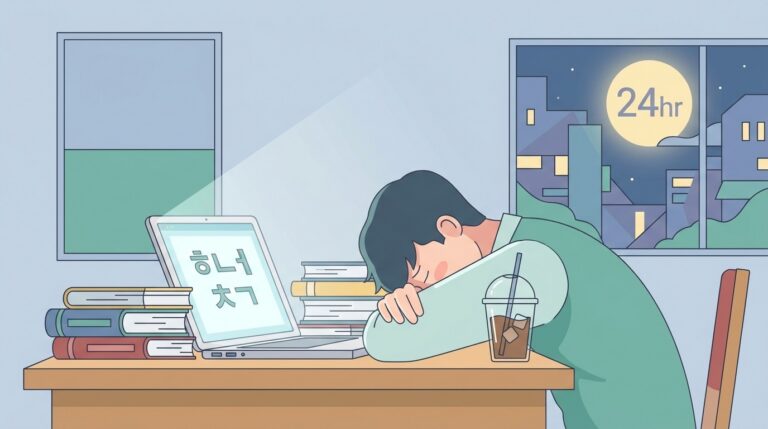
Picture this: It is 2:30 AM at a 24-hour study cafe in Sinchon, Seoul. Your desk is buried under a mountain of handouts, an empty tall cup of iced Americano sweating on your notes, and your laptop screen glowing with 14 open tabs of PDF lecture slides. You open your university portal to check the syllabus, and you suddenly freeze in sheer disbelief: Professor Kim didn’t just assign chapters 1 through 4… the exam covers all 18 chapters, including the guest lecture handouts you didn’t even know existed.
Your eyes glaze over, your heart sinks, and that little voice in your head screams: “I’m done. I want to give up right now.”
If you have ever watched K-dramas like Cheese in the Trap or Weightlifting Fairy Kim Bok-joo, you know this exact scene. Exam season in Korea is practically an Olympic sport of mental endurance. When international students study in Korea, one of their biggest cultural shocks isn’t just the sheer volume of study material—it’s knowing how to vent about it without sounding like a robotic textbook.
Saying “공부할 양이 많아서 힘듭니다” (It is difficult because there is much to study) sounds like a formal corporate report. Today, we’re diving into real campus slang and witty coping phrases that real Korean college students use to survive finals week. Let’s make sure you can bond with your classmates in total solidarity instead of suffering in silence!
Phase 2: Top 3 Core Expressions for Finals Breakdown
1. 이번 시험 범위 실화냐? (Ibeon siheom beomwi silhwanya?)
- Pronunciation: [I-beon si-heom beom-wi sil-hwa-nya?] (Sounds like: ee-beon she-hum bum-wee seal-hwa-nya)
- Meaning: Literal: “Is this exam range a true story?” | Real Nuance: “Is this exam scope for real? Are you kidding me right now?”
- K-Culture Moment: Seen in campus webtoons and dramas whenever the professor casually announces: “The exam includes everything from week 1 to week 15, plus the unreleased footnotes.”
- Editor’s Insight: 실화 (silhwa) literally means a true historical story or real-life event. Adding -냐 turns it into an edgy, incredulous question used by youth when an absurd reality hits them.
- Situation Spectrum: Casual ✅ | Semi-formal ⚠️ | Formal 🚫
- 🤔 Think About It: In English, we often say “Are you serious?” or “Is this a joke?” Why do you think Korean youth framed disbelief around the concept of “real-life truth” (실화)?
2. 진짜 멘붕 왔어, 다 때려치우고 싶다 (Jinjja menbung wasseo, da ttaeryeochiugo sipda)
- Pronunciation: [Jinjja men-bung was-seo, da ttae-ryeo-chi-u-go sip-da] (Sounds like: jeen-jja men-boong wah-ssuh, da ttae-ryuh-chee-oo-go sheep-da)
- Meaning: Literal: “Mental breakdown has arrived, I want to strike and clear it all.” | Real Nuance: “My brain is completely fried, I just want to rage-quit everything.”
- K-Culture Moment: When a group of college friends gathers on the grass of the university quad at midnight, eating ramyeon and staring blankly into space.
- Editor’s Insight: 멘붕 is a classic compound slang for 멘탈 붕괴 (mental breakdown). Combined with the punchy verb 때려치우다 (to toss aside/quit impulsively), this is the ultimate cathartic cry for stressed students.
- Situation Spectrum: Casual ✅ | Semi-formal ⚠️ | Formal 🚫
- 🤔 Think About It: Notice how Korean uses physical action verbs like 때려치우다 (literally hitting/striking something out of the way) to express emotional exhaustion.
3. 포기하면 편해, 근데 F는 안 편해 (Pogihamyeon pyeonhae, geunde ep-eu-neun an pyeonhae)
- Pronunciation: [Po-gi-ha-myeon pyeon-hae, geun-de ep-eu-neun an pyeon-hae] (Sounds like: po-gee-hah-myun pyun-hae, goon-deh eff-noon ahn pyun-hae)
- Meaning: Literal: “If you give up, it’s comfortable, but an ‘F’ is not comfortable.” | Real Nuance: “Giving up brings peace of mind… until you realize you’ll fail the class!”
- K-Culture Moment: An iconic university meme plastered on exam study planners and university community apps like Everytime (에브리타임).
- Editor’s Insight: This phrase plays on the famous Japanese sports manga quote “포기하면 편해” (Giving up is easier). Korean university students added the harsh punchline about getting an ‘F’ grade to shock themselves back to studying.
- Situation Spectrum: Casual ✅ | Semi-formal ⚠️ | Formal 🚫
- 🤔 Think About It: Why do students joke about catastrophic failures when they are under maximum pressure? Does self-deprecating humor relieve academic stress in your culture too?
Phase 3: Textbook Korean vs. Real Korean
Situation 1: Realizing you can’t cover all the material
- 📖 교과서 한국어 (Textbook): 시험 범위가 너무 넓어서 전부 공부하기 어렵습니다. (Siheom beomwiga neomu neolbeoseo jeonbu gongbuhagi eoryeopseumnida. / “Because the exam scope is so broad, it is difficult to study all of it.”)
- 🗣️ 진짜 한국어 (Real-life): 이거 벼락치기로 절대 감당 안 돼. (Igeo byeorakchigiro jeoldae gamdang an dwae. / “There is zero chance I can handle this through cramming.”)
- 💡 왜 다를까? (Why the difference?): Textbooks use neutral adjectives like 어렵다 (difficult). Real Korean students immediately bring up 벼락치기 (lightning-strike cramming) and 감당 안 돼 (unmanageable/beyond my mental capacity) to capture urgent panic.
Situation 2: Wanting to ditch studying and run away
- 📖 교과서 한국어 (Textbook): 저는 이번 시험을 포기하고 싶습니다. (Jeoneun ibeon siheomeul pogihago sipseumnida. / “I wish to give up on this examination.”)
- 🗣️ 진짜 한국어 (Real-life): 나 그냥 시험 탈주할래, 다음 학기에 재수강각이다. (Na geunyang siheom taljuhallae, daeum hakgie jaesuganggak-ida. / “I’m just gonna bail on this exam; I can already smell a retake next semester.”)
- 💡 왜 다를까? (Why the difference?): Real Korean campus slang borrows gaming terms like 탈주 (desertion/quitting a match) and the suffix -각 (a high likelihood/vibe of something happening).
Phase 4: K-Culture Deep Dive & Non-Verbal Manners
4-1. Nunchi & Gestures: The Exam Season Slump
- The Forehead Drop (이마 짚기): When sitting with classmates at a cafe, placing your forehead flat onto your open notebook with a hollow groan (하아…) is the universally accepted non-verbal cue that your brain has hit 100% capacity.
- The “Ah-Ah” Salute: Holding an extra-large Iced Americano (아아) with both hands like an oxygen mask while staring vacantly at your phone screen signifies communal suffering.
- Nunchi Rule with Professors: Never tell a professor or a TA (조교님) “범위 너무 많아요, 포기하고 싶어요” directly! To superiors, frame it as: “교수님, 이번 시험 준비 분량이 많아서 학생들이 다들 긴장하고 있습니다” (Professor, because of the heavy volume of study materials, students are feeling quite nervous).
4-2. Culture Code: “Relative Grading” (상대평가) and 24-Hour Study Cafes
In many Western universities, if everyone scores above 90%, everyone gets an ‘A’ (Absolute Grading / 절대평가). However, most Korean universities use 상대평가 (Relative Grading / Curving). Only the top 30% of students can physically receive an ‘A’. This creates intense tension, driving students into futuristic 24-hour 스터디카페 (Study Cafes with private cubicles, white noise generators, and free coffee bars) for week-long cram marathons.
Phase 5: Real-Life Roleplay Scenario
Setting: 3:00 AM inside an automated study cafe near Sinchon station. Stacks of printed lecture slides litter the desk. Empty energy drink cans stand like miniature pillars.
Characters:
* Min-woo (민우): Your Korean classmate who is surviving purely on caffeine, anxiety, and sheer willpower.
* You: An exchange student drowning in Korean technical terminology.
- 민우: (마른세수를 하며) 야, 진짜 12단원 내용 뭔 소린지 하나도 모르겠다. (Ya, jinjja sibidan-won naeyong mwon sorinji hanado moreugetda. / 🎭 Rubbing dry face with both hands / “Hey, I seriously don’t understand a single word of chapter 12.”)
- You: 나도 그래. 시험 범위가 책 한 권 통째인 게 실화냐? (Nado geurae. Siheom beomwiga chaek han gwon tongjjaein ge silhwanya? / 🎭 Groaning while pointing at the 400-page book / “Same here. Is having the entire textbook as the exam scope for real?”)
- 민우: 교수님이 중간고사 때 평균 높다고 기말고사는 피바다 만들 거래. (Gyosunim-i jung-gan-gosa ttae pyeong-gyun nopdago gimalgosaneun pibada mandeul georae. / 🎭 Shivering with dread / “The professor said because the midterm average was high, the final exam is going to be a bloodbath.”)
- You: 멘붕 와서 글자가 눈에 안 들어와. 다 때려치우고 집 갈래. (Menbung waseo geuljaga nune an deureowa. Da ttaeryeochiugo jip gallae. / 🎭 Slumping back into the chair / “My brain is fried, the words aren’t even registering. I just want to rage-quit and go home.”)
- 민우: 야, 포기하면 편하긴 한데… 우리 학점 F 나오면 계절학기 들어야 돼. (Ya, pogihamyeon pyeonhagin hande… uri hakjeom ep-eu naomyeon gyejeol-hakgi deureoya dwae. / 🎭 Laughing bitterly while shaking head / “Hey, giving up is peaceful, but if we get an F, we have to take summer school.”)
- You: 계절학기는 진짜 악몽이야. 편의점 가서 핫식스 하나 마시고 올까? (Gyejeol-hakgineun jinjja angmong-iya. Pyeon-uijeom gaseo hatsikseu hana masigo olkka? / 🎭 Pulling out wallet / “Summer school is a literal nightmare. Should we go to the convenience store and grab a Hot6 energy drink?”)
- 민우: 그래, 바람 좀 쐬고 족보 다시 분석해 보자. (Geurae, baram jom ssoego jokbo dasi bunseokhae boja. / 🎭 Standing up to stretch / “Yeah, let’s get some fresh air and analyze the past exam sheets again.”)
- You: 딱 10분만 쉬고 밤샘 달리는 거다! (Ttak sipbunman swigo bamsaem dallineun geoda! / 🎭 Clenching fist with grim determination / “Just a 10-minute break, then we pull an all-nighter!”)
🔀 Interactive Choice Point
At turn 4, Min-woo looks like he is about to pack his bag and walk out. What do you say?
* Option A: “민우야, 그냥 도서관 나가서 치맥이나 때리자. F 받으면 어때!” (Minwoo, let’s just leave and grab chicken and beer. Who cares if we get an F!)
* Option B: “민우야, 멘붕 오지? 우리 딱 커피 한 잔 마시고 족보 요약본만 집중하자.” (Minwoo, mind feeling fried? Let’s just grab a coffee and focus purely on the past exam summary.)
* Option C: “교수님께 이메일 보내서 시험 범위 줄여달라고 항의하자.” (Let’s send an email to the professor demanding to reduce the exam scope.)
- Choice Feedback:
- Option A [Bad]: You will sabotage your friend’s GPA! While tempting, peer-pressuring a Korean student to intentionally fail will make them panic with regret tomorrow.
- Option B [Best]: Empathetic, culturally perfect, and supportive! Acknowledging the 멘붕 while focusing on the high-yield 족보 (past exam cheat sheets) is the true Korean college way.
- Option C [High Risk]: Challenging a professor’s syllabus scope directly via email is considered disrespectful and could permanently harm your relationship with the department.
Phase 6: 10-Second Emotion Shadowing Drill
Practice these natural rhythm pauses (/) with the designated emotions!
[😱 Pure shock & panic]- 이번 시험 범위가 / 책 전체인 게 / 진짜 실화냐고! / (Ibeon siheom beomwiga / chaek jeonchein ge / jinjja silhwanyago! / “Are you seriously telling me / the entire book / is on the test?!”)
[😮💨 Heavy, soul-draining sigh]- 머리가 터질 것 같아… / 다 때려치우고 / 그냥 자고 싶다. / (Meoriga teojil geot gata… / da ttaeryeochiugo / geunyang jago sipda. / “My head feels like it’s exploding… / I just want to drop everything / and sleep.”)
[😂 Bitter self-deprecating laughter]- 포기하면 편한데… / 재수강 등록금 낼 돈이 / 없다, 없어. / (Pogihamyeon pyeonhande… / jaesugang deungnokgeum nael doni / eopda, eopseo. / “Giving up is peaceful… / but I don’t have the money / to pay tuition to retake this course!”)
Phase 7: K-Culture Mini Dictionary
- 벼락치기 (Byeorakchigi)
- Definition: Cramming right before an exam.
- Usage: From 벼락 (lightning strike). Used constantly: “나 오늘 밤 벼락치기 해야 돼” (I have to cram overnight tonight).
- 족보 (Jokbo)
- Definition: Past exam questions, professor lecture tendencies, and study notes handed down from upperclassmen.
- Usage: Originally meaning “family genealogy book.” Having the course’s 족보 is the greatest treasure in Korean universities.
- 학점 폭망 (Hakjeom Pongmang)
- Definition: Completely ruined GPA / disastrous grades.
- Usage: 폭망 combines 폭탄 (bomb) and 망하다 (to fail). Used whenever students walk out of a difficult exam room.
- 종강 (Jong-gang)
- Definition: The official end of the semester lectures.
- Usage: The holy grail of college life. Students chant: “빨리 종강했으면 좋겠다!” (I wish the semester would just end already!).
Phase 8: Student & Traveler Survival Kit
Survival Expressions TOP 3
- 밤샘 공부할 수 있는 카페 어디예요? (Bamsaem gongbuhal su inneun kape eodiyeyo?)
- Pro Tip: Useful when regular cafes close at 10 PM. Use this to find nearby 24-hour study spaces.
- 샷 추가해 주세요, 진하게 마셔야 돼요. (Syat chugahae juseyo, jinhage masyeoya dwaeyo.)
- Pro Tip: “Please add an extra shot of espresso, I need it strong.” Essential for surviving all-nighters.
- 이 프린트물 양면으로 인쇄해 주세요. (I peurinteumul yangmyeon-euro inswehae juseyo.)
- Pro Tip: “Please print these handouts double-sided.” At print shops near campus gates (복사실), this saves you precious won.
Editor’s Campus Life Note
- Must-Have Apps: When studying in Korea, don’t rely on Google Maps. Download the Naver Map app (네이버 지도 앱) to search for “스터디카페” (Study Cafe) or “무인프린트” (24hr automated printing shops).
- Energy Kit: Head to the nearest convenience store (CU or GS25) and look for the student survival combo: 박카스 (Bacchus energy tonic) poured into an iced cup with a bottle of 포카리스웨트 (Pocari Sweat)—known among students as the “exam recovery potion!”
Phase 9: Deep Cultural Reflection: “Camaraderie in Misery”
In many Western cultures, academic study is seen as an individualistic, private pursuit. You quietly go to the library, study your own notes, and keep your stress to yourself. But in South Korea, misery loves company—and transforms into powerful social solidarity.
When Korean students gather together to loudly proclaim “나 진짜 망했다” (I’m totally doomed) and “다 때려치우고 싶다” (I want to quit everything), it is rarely a genuine declaration of surrender. Rather, it is a vocal social ritual called 공감대 형성 (building emotional empathy). By sharing vulnerability and mutual dread, students relieve the suffocating societal pressure to succeed. When your study buddy sighs “멘붕 왔어”, they aren’t asking for a lecture on time management; they are asking you to nod and say, “나도 그래, 우리 힘내자” (Me too, let’s hang in there).
💬 Your Turn: How do students or professionals in your home country handle intense deadline stress? Do you complain together over coffee, or do you prefer to keep your stress private? Drop your thoughts in the comments below!
Phase 10: FAQ & Common Mistakes
Q: Can I use the word “멘붕” with my Korean professor or boss?
A: Absolutely not! 멘붕 is casual internet and youth slang. If you tell your professor “저 멘붕 왔어요”, it sounds immature and unprofessional. Instead, say “내용 이해에 조금 어려움을 겪고 있습니다” (I am having some difficulty understanding the material).
Q: What is the exact difference between “포기하다” and “때려치우다”?
A: 포기하다 is a neutral, standard verb meaning “to give up” or “to abandon an objective.” 때려치우다 is an emotionally charged, colloquial verb meaning “to quit/toss aside angrily,” similar to “rage-quitting” your job or studies.
Q: Why do Korean students say “F는 안 편해” instead of just “F 받기 싫어”?
A: It stems from a popular cynical phrase “포기하면 마음이 편하다” (If you give up, your mind is at peace). The humorous twist reminds you that the immediate emotional relief of quitting will disappear the moment your permanent GPA transcript arrives!
🚨 Common Mistakes Alert (흔한 실수)
- ❌ Mistake 1: Translating “I failed the test” as “나 시험 떨어졌어요” for university exams.
- Correct Action: In college courses, you say “시험 망쳤어요” (I ruined the test) or “F 맞았어요” (I received an F). 떨어지다 is typically reserved for certification exams or job interviews.
- ❌ Mistake 2: Saying “실화입니까?” politely to a senior or superior.
- Correct Action: 실화냐 is inherently casual slang. Do not try to conjugate it into formal polite Korean (실화입니까?); it sounds awkward. Use “정말입니까?” or “사실인가요?” instead.
- ❌ Mistake 3: Assuming someone who says “나 공부 하나도 안 했어” actually didn’t study.
- Correct Action: Beware! The classic Korean student humble-trap: Classmates often say they haven’t studied at all (공부 1도 안 했어), yet they spent the entire night reviewing. Don’t be fooled into putting your own books away!
Phase 11: Action Missions
- 🥉 Bronze Mission (Solo Vocal Drill): Stand in front of your mirror, furrow your brow dramatically, and recite “이번 시험 범위 실화냐? 멘붕 왔어!” three times with authentic despair.
- 🥈 Silver Mission (Social Connection): The next time you feel overwhelmed by schoolwork or tasks, text a classmate or Korean study buddy: “공부 다 때려치우고 싶다… 벼락치기 같이 할래?”
- 🥇 Gold Mission (Real-World Application): Visit a local Korean cafe or university library, order an extra-shot coffee, and practice saying “밤샘 공부하느라 너무 졸려요” (I’m so sleepy from pulling an all-nighter) to the friendly barista.
- 🎮 K-Culture Media Mission: Watch Episode 3 or 4 of any Korean college campus drama (e.g., Weightlifting Fairy Kim Bok-joo or My ID is Gangnam Beauty). Listen closely during exam week scenes and spot the words 벼락치기 or 망했다!
Phase 12: Interactive Quiz Challenge
Quiz 1. Situational Judgment
Your Korean classmate slumps down onto the desk at 4 AM and groans: “진짜 멘붕 왔어. 시험 범위 실화냐?” What is the most empathetic, natural response?
1. “네, 교수님이 공지사항에 사실이라고 적으셨습니다.” (Yes, the professor wrote in the notice that it is fact.)
2. “그치? 범위 너무 넓어서 미쳤어. 커피 한 캔 마시고 힘내자!” (Right? The scope is insanely wide. Let’s drink a can of coffee and hang in there!)
3. “학생의 본분은 공부입니다. 불평하지 마세요.” (A student’s duty is to study. Do not complain.)
Quiz 2. Fill in the Blank
Complete the iconic Korean cramming idiom:
* “내일이 시험인데 하나도 못 봤어. 오늘 무조건 [ ________ ] 해야 돼!”
(Tomorrow is the exam and I haven’t seen anything. I definitely have to [ cram like a lightning bolt ] tonight!)
Quiz 3. Cultural True or False
- Statement: In Korean universities, 족보 (Jokbo) refers to a special food students eat before taking tests to avoid bad luck.
- (True / False)
👉 Click to reveal answers & explanations!
- Quiz 1 Answer: 2!
- Explanation: Option 1 takes the slang 실화 too literally. Option 3 sounds like a harsh school principal! Option 2 validates their feeling while offering friendly encouragement.
- Quiz 2 Answer: 벼락치기 (Byeorakchigi)
- Explanation: 벼락 means lightning bolt, and 치기 means hitting. Cramming right before an exam is metaphorically striking down like lightning!
- Quiz 3 Answer: False!
- Explanation: While 족보 historically means family ancestry records, in university slang it refers to past exam questions and course cheat sheets passed down by upperclassmen!
- Explanation: While 족보 historically means family ancestry records, in university slang it refers to past exam questions and course cheat sheets passed down by upperclassmen!







