

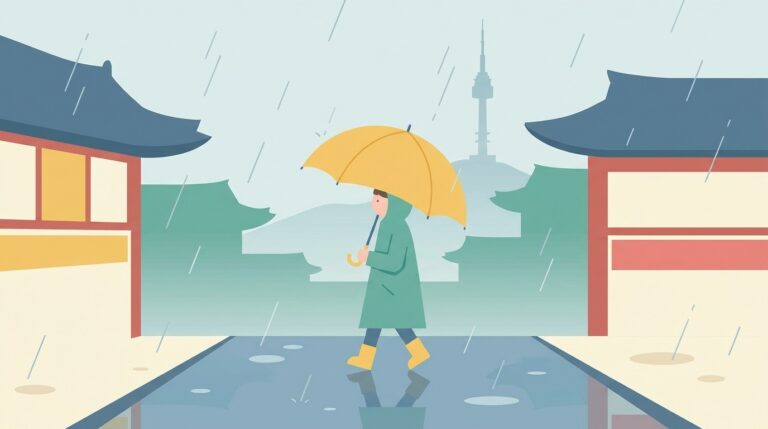
Phase 1: 공감 (Opening)
안녕하세요! 매일한글 에디터입니다. Have you ever stepped out of your cozy Airbnb in Hongdae wearing a cute denim jacket because the morning sunshine looked deceptive, only to be struck by an icy Seoul wind that made you shiver all the way to the subway? Or maybe you watched a K-drama where the male lead miraculously appears with an umbrella during a sudden shower, and you wondered, “Why didn’t anyone check the morning forecast?!” Checking the weather in Korea is practically a national sport. From sudden summer downpours (sonagi) to the deceptive spring cold snap (kkot-saem-chu-ui), knowing how to ask about and understand the forecast keeps your travel plans alive and saves you from buying your fifth emergency plastic umbrella from a convenience store. Today, based on real feedback from our hundreds of A2 learners, we’ll master the daily art of decoding Korean weather together!
Phase 2: 핵심 표현 3선 심층 분석
1. 오늘 날씨 어때요? (Oneul nalssi eottaeyo?)
- Pronunciation: [Oh-neul nal-shee uh-tteh-yo?]
- Sound Analogy: Oneul sounds like “oh-null” (saying “oh” then “null” softly), nalssi sounds like a sharp “nahl-shee”, and eottaeyo flows like “uh-tteh-yo”.
- Meaning: Literal: “Today weather how is it?” | Real Nuance: “How’s the weather today?”
- K-Culture Moment: You’ll hear this casually in the morning of almost every reality show like I Live Alone when a cast member opens their curtains and talks to their smart speaker or looks outside.
- Editor’s Insight: This is the ultimate conversation starter in Korea. Even if Koreans already know the weather, asking this breaks the awkward silence in elevators or office pantries.
- Situation Spectrum: Casual (⚠️ 오늘 날씨 어때? – only to close friends) / Semi-formal (✅ 오늘 날씨 어때요?) / Formal (✅ 오늘 날씨는 어떻습니까?)
- 🤔 Think About It: In English, we often comment “Nice day, isn’t it?” assuming agreement. Korean often asks open-endedly: “How is it?” inviting the listener to share their physical feeling.
2. 비 올 것 같아요 (Bi ol geot gat-ayo)
- Pronunciation: [Bee ohl got gah-tah-yo]
- Sound Analogy: Bi sounds like “bee”, ol like “all”, and gat-ayo sounds like “got-ah-yo”.
- Meaning: Literal: “Rain coming thing seems like.” | Real Nuance: “I think it’s going to rain” or “It looks like rain.”
- K-Culture Moment: Whenever the sky turns gray before a dramatic encounter in K-dramas, a character looks up at the sky, taps their phone, and says this line right before running for shelter.
- Editor’s Insight: Koreans rarely say “It will definitely rain” unless reading a scientific sensor. Using
~것 같아요(~geot gat-ayo, “it seems like”) softens your statement, which is a key hallmark of polite Korean speech.- Situation Spectrum: Casual (✅ 비 올 것 같아) / Semi-formal (✅ 비 올 것 같아요) / Formal (✅ 비가 올 것 같습니다)
- 🤔 Think About It: Why are Koreans so hesitant to speak in absolutes? Politeness in Korea is closely tied to humility and leaving room for other possibilities.
3. 일교차가 심해요 (Ilgyochaga simhaeyo)
- Pronunciation: [Eel-gyo-chah-gah sheem-hae-yo]
- Sound Analogy: Il-gyo-cha sounds like “eel-gyo-cha”, simhaeyo sounds like “seem-hae-yo”.
- Meaning: Literal: “The daily temperature range is severe.” | Real Nuance: “There is a huge difference between day and night temperatures.”
- K-Culture Moment: Weather anchors on Korean morning news shows say this phrase almost every day during spring and autumn, followed by advice to bring an extra cardigan.
- Editor’s Insight: While textbook learners memorize “It’s hot” (deowoyo) or “It’s cold” (chuwoyo), locals use this single word (ilgyocha) to explain why they are carrying both short sleeves and a padded jacket in April.
- Situation Spectrum: Casual (✅ 일교차 심해) / Semi-formal (✅ 일교차가 심해요) / Formal (✅ 일교차가 심합니다)
- 🤔 Think About It: Notice how Korean weather vocabulary often packs complex climatic concepts into concise Sino-Korean compounds (Il = day, Gyo = intersect/compare, Cha = difference).
Phase 3: 교과서 한국어 vs 진짜 한국어
Situation 1: Asking what the weather forecast says
- 📖 교과서 한국어: 일기예보가 무엇을 말합니까? (Ilgiyeboga mueoseul malhamnikka? – “What does the weather forecast say?”)
- 🗣️ 진짜 한국어: 오늘 날씨 어플에서 뭐래요? (Oneul nalssi eopeull-eseo mworaeyo? – “What does the weather app say today?”)
- 💡 왜 다를까?: Nobody asks what the weather forecast “speaks” like an entity. In modern Korea, people rely on smartphone apps (eopeul) or say “일기예보에서 비 온대요?” (“Does the forecast say it’s raining?”).
Situation 2: Remarking that it’s slightly chilly in the morning
- 📖 교과서 한국어: 아침 기온이 매우 낮습니다. (Achim gioni maeu natseumnida. – “The morning temperature is very low.”)
- 🗣️ 진짜 한국어: 아침에 바람이 꽤 쌀쌀해요. (Achime barami kkwae ssalssalhaeyo. – “The wind is pretty chilly this morning.”)
- 💡 왜 다를까?: Native speakers favor sensory feeling words like 쌀쌀하다 (ssalssalhada, crisp/chilly) over dry data statements like “the temperature is low.”
Phase 4: K-Culture 딥다이브 & 비언어적 매너
4-1. 눈치 (Nunchi) & Weather Gestures
When stepping out into a hotel or subway lobby on a rainy morning, don’t just stare blankly at the sky. Observe others’ umbrellas! In Korea, using the communal vinyl umbrella dryer or wrapping station (usan binil) at building entrances is essential etiquette. If you enter a cafe dripping water everywhere, you’ll feel people’s disapproving nunchi. Look around, wrap your umbrella in the plastic sleeve provided, and gently shake off excess drops outside first.
4-2. Culture Code: Rainy Day Food Traditions
Why do Koreans immediately crave 파전 (pajeon – scallion pancake) and 막걸리 (makgeolli – rice wine) the second raindrops hit the pavement? There are two main theories: the sizzling sound of frying batter closely mimics the sound of raindrops hitting the roof, and the flour and fermented rice help boost serotonin on gloomy days! Don’t be surprised if your Korean friends text you: “비 오는데 파전 먹으러 갈래?” (Bi oneunde pajeon meogeureo gallae? – “It’s raining, want to get pajeon?”).
Phase 5: 실전 롤플레이 시나리오
Setting: You are in the lounge of a boutique guesthouse in Bukchon Hanok Village. You are getting ready to head out for a day of walking around Gyeongbokgung Palace, and the host, Min-jun, is sipping barley tea behind the wooden counter.
- Min-jun: 좋은 아침이에요! 오늘 어디 가세요? (Joeun achim-ieyo! Oneul eodi gaseyo? – “Good morning! Where are you heading today?”)
- You: 🎭 Looking up from your phone thoughtfully / 경복궁에 가려고요. 오늘 날씨 어때요? (Gyeongbokgunge garyeogoyo. Oneul nalssi eottaeyo? – “I’m planning to go to Gyeongbokgung Palace. How is the weather today?”)
- Min-jun: 🎭 Gesturing toward the overcast sky through the courtyard window / 지금은 맑은데, 오후에 비 올 것 같아요. (Jigeumeun malgeunde, ohue bi ol geot gat-ayo. – “It’s clear right now, but it looks like it’ll rain in the afternoon.”)
- You: 🎭 Looking surprised, tilting head / 정말요? 우산 챙겨야겠네요. (Jeongmalyo? Usan chaenggyeoyagetneyo. – “Really? I should pack an umbrella then.”)
- Min-jun: 🎭 Nodding with a warm smile / 네, 접이식 우산 하나 챙기세요. 일교차도 심해요. (Ne, jeobisik usan hana chaenggiseyo. Ilgyochado simhaeyo. – “Yes, grab a folding umbrella. The temperature difference today is big, too.”)
- You: 🎭 Touching your thin cardigan jacket / 겉옷을 하나 더 입을까요? (Geot-oseul hana deo ibeulkkayo? – “Should I wear another outer layer?”)
- Min-jun: 🎭 Reaching under the counter to hand you a small guest umbrella / 네, 저녁에는 쌀쌀하니까 가디건 챙기세요. 우산 빌려드릴게요! (Ne, jeonyeogeneun ssalssalhanikka gadigeon chaenggiseyo. Usan billyeodeurilgeyo! – “Yes, it gets chilly in the evening, so take a cardigan. I’ll lend you an umbrella!”)
- You: 🎭 Bowing lightly with two hands receiving the umbrella / 와, 정말 감사합니다! 잘 다녀올게요. (Wa, jeongmal gamsahamnida! Jal danyeoolgeyo. – “Wow, thank you so much! I’ll have a great day.”)
🔀 Interactive Branch Point:
Min-jun notices you glancing at your weather app, which displays a 40% rain icon. What do you say?
- Choice A: “비 안 올 것 같으니까 그냥 갈게요!” (Bi an ol geot gateunikka geunyang galgeyo! – “I don’t think it’ll rain, so I’ll just go!”)
- Feedback (Risk): Brave, but risky! Seoul’s sudden afternoon showers can be intense. You’ll likely end up soaked or buying another plastic umbrella.
- Choice B: “우산 챙길게요. 일교차도 조심할게요!” (Usan chaenggilgeyo. Ilgyochado josimhalgeyo! – “I’ll pack an umbrella. I’ll also watch out for the temperature swing!”)
- Feedback (Best): Perfect! You acknowledged his advice, used the cultural context of ilgyocha, and showed gratefulness.
- Choice C: “비 오면 그냥 집에 있을래요.” (Bi omyeon geunyang jibe isseullaeyo. – “If it rains, I’ll just stay inside the house.”)
- Feedback (Bad): A bit blunt and overly dramatic for a vacation day! A lighter response keeps the conversation pleasant.
Phase 6: 10초 감정 섀도잉 드릴
Read these aloud, pausing at / and channeling the emotion in the brackets:
[☀️ 상쾌하고 호기심 가득하게 / Fresh & Curious]
오늘 날씨 어때요? / 하늘이 정말 맑네요!
(Oneul nalssi eottaeyo? / Haneuri jeongmal malgneyo!)
“How is the weather today? / The sky is so clear!”-
[🌧️ 약간 걱정스럽고 조심스럽게 / Slightly Worried & Hesitant]
오후에 비 올 것 같아요. / 우산 꼭 챙기세요.
(Ohue bi ol geot gat-ayo. / Usan kkok chaenggiseyo.)
“I think it’s going to rain in the afternoon. / Make sure to pack an umbrella.” -
[🥶 으슬으슬 떨며 실감나게 / Shivering & Expressive]
바람이 불어서 / 생각보다 너무 쌀쌀해요!
(Barami bureoseo / saenggakboda neomu ssalssalhaeyo!)
“Because the wind is blowing / it’s way chillier than I thought!”
Phase 7: K-Culture 미니 사전 (핵심 키워드 4개)
- 꽃샘추위 (Kkot-saem-chu-ui)
- Literal Translation: “Cold that is jealous of the flowers blooming.”
- Real Usage: The sudden late-winter cold snap in March and April. When cherry blossoms pop up, this icy freeze comes out of nowhere!
- 장마철 (Jangma-cheol)
- Literal Translation: Monsoon season / rainy spell.
- Real Usage: Typically late June through late July. Constant torrential rain and 95% humidity where shoes never dry without a machine dryer.
- 일교차 (Ilgyocha)
- Literal Translation: Daily temperature gap.
- Real Usage: Daily small-talk phrase in transitional seasons. High ilgyocha means cool mornings, sunny warm afternoons, and freezing evenings.
- 미세먼지 (Misemeonji)
- Literal Translation: Fine particulate matter (micro-dust).
- Real Usage: Checked alongside temperature every morning. If the app shows “나쁨” (Bad), locals wear KF94 masks outdoors.
Phase 8: 여행자를 위한 생존 키트
Survival Expressions TOP 3:
- 우산 어디에 있어요? (Usan eodie isseoyo?)
- Romanization: [Oo-sahn uh-dee-eh eess-uh-yo?]
- Pro Tip: At convenience stores, clear umbrellas are near the door or behind the register.
- 오늘 최고 기온이 몇 도예요? (Oneul choego gioni myeot do-yeyo?)
- Romanization: [Oh-neul chweh-go gee-ohn-ee myut doh-yeh-yo?]
- Pro Tip: Korea uses Celsius (°C). If they say “이십오도” (25 degrees), it’s pleasant t-shirt weather!
- 갑자기 비가 와요! (Gapjagi biga wayo!)
- Romanization: [Gahp-jah-ghee bee-gah wah-yo!]
- Pro Tip: Use this when caught in an unexpected shower and asking for a taxi or ducking into a store.
Editor’s Travel Note:
Never rely purely on global pre-installed phone weather apps in Korea—they often miss localized mountain downdrafts in Seoul. Open the app store and complete your 네이버 지도 앱 다운로드 to get ultra-precise, neighborhood-by-neighborhood micro-forecasts. Also, subway stations frequently have emergency umbrella vending machines or convenience stores right by the turnstiles!
Phase 9: “한 발 더 깊이” (생각 질문)
In Korean culture, asking about the weather is almost never just about meteorology. When a Korean asks, “오늘 춥지 않아요?” (Isn’t it cold today?) or tells you “옷 따뜻하게 입어요” (Dress warmly), it functions as an everyday emotional check-in. It reflects an underlying collectivist empathy: I care about your comfort and your physical state today. In this sense, checking the weather together is one of the simplest, warmest ways Koreans bond.
💬 Your Turn: In your home country, do people talk about the weather just to kill time, or does it carry a feeling of caring for each other? Drop your thoughts below!
Phase 10: FAQ & 오해 방지
Q: Can I use “비 와요” (Bi wayo) to say “It is going to rain”?
A: Not quite! “비 와요” strictly means “It is raining right now.” If you want to say it will rain later, use future anticipation: “비 올 거예요” (It will rain) or “비 올 것 같아요” (It seems like it will rain).
Q: What does “비가 그쳤어요” (Biga geucheosseoyo) mean?
A: It means “The rain has stopped!” You will hear this joyous phrase when the sky clears up and everyone folds their umbrellas.
Q: How do Koreans say humidity?
A: The noun is 습도 (seupdo – humidity level), but in daily conversation people usually say “오늘 너무 습해요!” (Oneul neomu seuphaeyo! – “It’s so humid today!”).
🚨 흔한 실수 (Common Mistakes) Warning Board
- Mistake: Saying “날씨가 더워요 있어요” to say “The weather is being hot.”
- Correct Action: Just say “날씨가 더워요” (The weather is hot). Korean adjectives include the “to be” concept naturally.
- Mistake: Confusing “눈” (Snow) and “눈” (Eye).
- Correct Action: Both are written as 눈 (nun). In context, “눈 와요” always means “It’s snowing,” not “Eyes are coming!”
- Mistake: Forgetting to specify Celsius.
- Correct Action: If you say “It’s 75 degrees” in Korea without converting, people will think you mean boiling water! 75°F is roughly 24°C.
Phase 11: 액션 미션 & 참여 유도
- 🥉 Bronze Mission (Solo): Look out your window right now, take a deep breath, and say out loud in Korean: “오늘 날씨 어때요? 비 올 것 같아요!”
- 🥈 Silver Mission (Social): Post a photo of today’s sky on Instagram Story with the caption: “오늘 날씨 맑음 ☀️” (Today’s weather: Clear) and tag your study buddies.
- 🥇 Gold Mission (Real Life): Next time you meet a Korean speaker or tutor, open the conversation using “오늘 날씨가 꽤 쌀쌀하죠?” (Pretty chilly today, right?).
- 🎮 K-Culture Mission: Watch an episode of a recent K-drama and spot a scene where someone mentions bringing an umbrella or complains about the sudden rain.
Phase 12: 인터랙티브 퀴즈 챌린지
1. Situational Judgment
You are leaving your hotel in Myeongdong. The sky is dark gray, and you feel tiny drops on your arm. What is the most natural sentence to say to your friend?
* (A) 오늘 눈 와요.
* (B) 비 올 것 같아요. 우산 챙겨요!
* (C) 일교차가 아주 좋습니다.
2. Fill-in-the-Blank
Fill in the missing syllable: “아침과 저녁에 기온 차이가 심한 것을 [ ]교차라고 해요.”
3. Cultural True or False
True or False: Koreans traditionally eat hot Samgyetang (chicken ginseng soup) when it rains because of the sound of water drops.
👉 Click here to reveal the answers and explanations!
- Answer: (B) (B) means “It looks like it will rain. Take an umbrella!” (A is about snow, and C says the temperature swing is good, which makes no sense).
- Answer: 일 (Il). The full word is 일교차 (Ilgyocha – daily temperature range).
- Answer: False. Koreans traditionally eat 파전 (pajeon) and drink 막걸리 (makgeolli) on rainy days! Samgyetang is traditional for Sambok (the hottest dog days of summer).






