

The Ultimate Guide to Korea’s Suneung: Understanding the Parents’ 100-Day Prayer
Phase 1: Empathy (A Story-Driven Opening)
안녕하세요! 매일한글 에디터입니다. (Hello! It’s your Daily Hangul editor.)
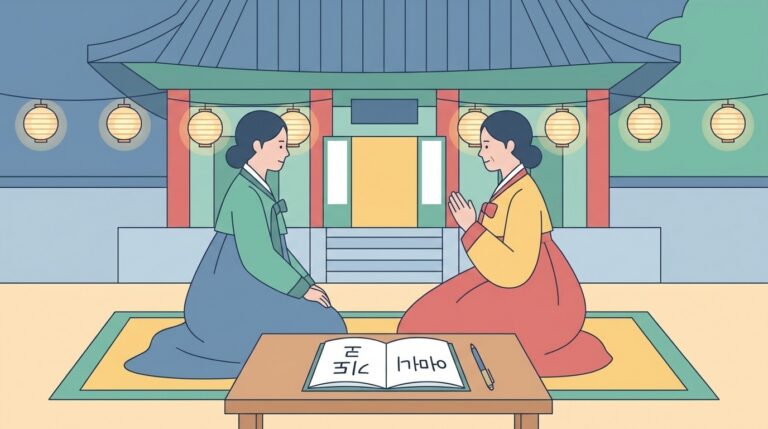
Imagine walking past Jogyesa Temple in downtown Seoul on a crisp, early autumn morning at 5:00 AM. While the rest of the city sleeps, hundreds of warm candle flames flicker through the incense smoke. Inside, dozens of mothers and fathers are bowing down to the wooden floor repeatedly, their foreheads touching the mats, tears glistening in their eyes. They aren’t praying for wealth or health—they are counting down the final 100 days until 수능 (Suneung), Korea’s notorious College Scholastic Ability Test.
Many of my international students tell me: “Editor, I watched K-dramas like Sky Castle and Reply 1988, and I saw parents praying desperately at temples or churches before test day. Why 100 days? And what do Koreans actually say to support each other during this intense season?”
Understanding 부모님의 100일 기도 (Parents’ 100-Day Prayer) isn’t just about an exam; it is your golden key to understanding Korean family bonds, parental sacrifice, and emotional vocabulary at an intermediate (B1) level. In this guide, grounded in real learner feedback, you will learn the exact phrases locals use to express dedication, offer heartfelt encouragement, and respectfully navigate one of Korea’s most sacred cultural rituals.
Phase 2: Core Expressions Breakdown
Here are three foundational expressions connected to effort, prayers, and exam success.
1. 정성을 들이다 (Jeongseong-eul deurida)
- Pronunciation: [Jeong-seong-eul deu-ri-da] (Sounds like: “jung-sung-ool dew-ree-da”)
- Meaning: Literal: “To offer genuine sincerity” | Actual Nuance: “To pour one’s heart, soul, and utmost care into something.”
- K-Culture Moment: Seen frequently in period and modern K-dramas when a mother prepares special food or goes up a mountain shrine every single dawn for her child’s future.
- Editor’s Insight: 정성 (Jeongseong) cannot be bought with money. It means pure personal devotion. When someone says they do something with 정성, you know they did not cut any corners.
- Situation Spectrum: Casual ⚠️ | Semi-formal ✅ | Formal ✅
- 🤔 Think About It: In your culture, do you have a single word that combines love, time, emotional investment, and ritual sincerity the way 정성 does?
2. 찰떡같이 붙다 (Chaltteokgachi butda)
- Pronunciation: [Chal-tteok-ga-chi but-da] (Sounds like: “chahl-tuck-gah-chee boot-dah”)
- Meaning: Literal: “To stick tight like a sticky glutinous rice cake” | Actual Nuance: “To pass an exam with flying colors / To get accepted without fail.”
- K-Culture Moment: Friends and family gifting sticky rice cakes (찹쌀떡) and Korean traditional taffy (엿) outside exam gates so the test taker “sticks” to their dream university.
- Editor’s Insight: Never wish an exam taker to “slip” (미끄러지다), and avoid eating slippery foods like seaweed soup (미역국) on test day! Always use sticky metaphors like 찰떡!
- Situation Spectrum: Casual ✅ | Semi-formal ✅ | Formal ⚠️
- 🤔 Think About It: Why do you think Korean society links the physical texture of food directly to exam outcomes?
3. 기도하고 올게요 (Gidohago olgeyo)
- Pronunciation: [Gi-do-ha-go ol-ge-yo] (Sounds like: “gee-doh-hah-goh ohl-geh-yoh”)
- Meaning: Literal: “I will pray and come back” | Actual Nuance: “I am heading out to pray for you (sending you my blessings).”
- K-Culture Moment: A parent quietly slipping on their coat before dawn, reassuring their studying child that they are sharing their struggle together.
- Editor’s Insight: In Korean culture, going to pray is often an active journey. Adding -고 올게요 (-go olgeyo, I will do X and return) shows warmth and comfort toward the listener.
- Situation Spectrum: Casual ⚠️ | Semi-formal ✅ | Formal ✅
- 🤔 Think About It: How does phrasing prayer as an ongoing communal journey change the feeling compared to just saying “I’ll pray for you”?
Phase 3: Textbook Korean vs. Real-World Korean
See how everyday Koreans actually express these exam-season sentiments.
Situation 1: Cheering for an exam taker
- 📖 교과서 한국어:
시험을 잘 치르시기를 바랍니다. (Siheom-eul jal chireusigireul baramnida.)
“I hope you take the test well.” - 🗣️ 진짜 한국어:
찰떡같이 붙어라! 찍는 것도 다 맞아라! (Chaltteokgachi buteora! Jjigneun geotdo da majara!)
“Pass without fail! May even your random guesses be right!” - 💡 왜 다를까?
Textbooks teach stiff formal wishes. Real Koreans offer funny, high-energy blessings wishing the student incredible luck, even hoping their lucky guesses (찍기) turn into correct answers!
Situation 2: Asking if a parent is dedicating prayers
- 📖 교과서 한국어:
자녀의 합격을 위해 사찰에서 기도하십니까? (Janyeoui hapgyeog-eul wihae sachareseo gidohasimnikka?)
“Are you praying at a temple for your child’s acceptance?” - 🗣️ 진짜 한국어:
이번에 백일기도 들어가셨어요? (Ibeone baek-il gido deureogasyeosseoyo?)
“Did you start the 100-day prayer this time around?” - 💡 왜 다를까?
Koreans use the verb 들어가다 (to enter) for starting intensive milestones like 100-day prayers, training camps, or meditation retreats.
Phase 4: K-Culture Deep Dive & Non-Verbal Manners
4-1. 눈치 (Nunchi) & Temple Manners During Suneung Season
If you visit famous temples like Bongeunsa or Jogyesa between August and November:
* Lower your voice to a whisper: Parents are under tremendous emotional strain. Loud tourist chatter is considered very insensitive.
* Watch the threshold (문턱): Never step on the raised wooden doorway threshold of Buddhist halls; step cleanly over it.
* Respect bowing mats: Do not walk directly in front of someone engaged in the 108 bows (108배). Walk behind them quietly.
4-2. Cultural Code: The Magic of 100 Days (백일)
Why 100 days? In Korean mythology (Dangun myth), the bear spent 100 days in a dark cave eating mugwort and garlic to transform into a human woman. The 100th day after birth (백일) celebrates an infant surviving the most fragile period. Thus, 100일 기도 is a sacred bridge of transformation and devotion, bridging human anxiety and divine blessing.
Phase 5: Real-World Roleplay Scenario
Setting: Early morning at Jogyesa Temple. You bump into Mrs. Park (Minsu’s mother), who is a close family friend, carrying a prayer mat and a warm thermos.
- You:
어머니, 안녕하세요! 여기서 뵙네요.
(Eomeoni, annyeonghaseyo! Yeogiseo boepneyo.)
“Hello, Mrs. Park! Fancy seeing you here!”
🎭 Hands politely clasping in front, bowing 30 degrees. -
Mrs. Park:
어머, 그래! 아침 일찍 웬일이니?
(Eomeo, geurae! Achim iljjik wennirini?)
“Oh my, hello! What brings you here so early in the morning?”
🎭 Surprised but smiling warmly through tired eyes. -
You:
근처 산책하다가 들렀어요. 어머니는 기도 오셨어요?
(Geuncheo sanchaeghadaga deulleosseoyo. Eomeonineun gido osyeosseoyo?)
“I was taking a walk nearby and dropped in. Did you come here to pray?”
🎭 Speaking in a quiet, considerate whisper. -
Mrs. Park:
응, 우리 민수 수능이 이제 딱 100일 남아서 백일기도 시작했거든.
(Eung, uri Minsu suneungi ije ttak baegil namaseo baek-il gido sijakhaetgeodeun.)
“Yes, Minsu has exactly 100 days left until the Suneung, so I started my 100-day prayer.”
🎭 Adjusting her prayer mat with dedicated pride. -
You:
정말 정성이 대단하세요. 민수가 든든하겠어요.
(Jeongmal jeongseongi daedanhaseyo. Minsuga deundeunhagesseoyo.)
“Your dedication is truly amazing. Minsu must feel so supported.”
🎭 Nodding with sincere empathy. -
Mrs. Park:
내가 해줄 수 있는 게 이것밖에 없잖니. 마음이라도 편해지길 바라면서.
(Naega haejul su inneun ge igeotbakke eopjanni. Maeumirado pyeonhaejigil baramyeonseo.)
“This is the only thing I can do for him. Just wishing his mind stays peaceful.”
🎭 Sighing softly with maternal tenderness. -
You:
어머니 기도 덕분에 민수가 찰떡같이 붙을 거예요! 힘내세요!
(Eomeoni gido deokbune Minsuga chaltteokgachi buteul geoyeyo! Himnaeseyo!)
“Thanks to your prayers, Minsu will surely pass with flying colors! Hang in there!”
🎭 Offering a bright, encouraging two-handed gentle fist bump. -
Mrs. Park:
고마워! 그 말 들으니 정말 힘이 난다. 얼른 따뜻한 차 한잔 마시러 가렴.
(Gomawo! Geu mal deureuni jeongmal himi nanda. Eolleun ttatteuthan cha hanjan masireo garyeom.)
“Thank you! Hearing that gives me real strength. Go grab a cup of warm tea!”
🎭 Patting your shoulder affectionately.
🔀 Interactive Choice Point
What would you say if Mrs. Park looked visibly exhausted and said: “매일 새벽마다 오려니 조금 힘들긴 하네 (Coming every dawn is a bit exhausting)”?
- Option A: “그러면 그냥 집에서 주무시는 게 낫지 않으세요?” (Then wouldn’t it be better to just sleep at home?)
- Option B: “어머니 정성이면 민수가 하늘 감동시켜서 꼭 합격할 거예요. 건강도 꼭 챙기세요!” (With your devotion, Minsu will move the heavens and surely pass. Please take care of your health too!)
- Option C: “수능이 그렇게 중요한가요? 다른 길도 많은데요.” (Is Suneung really that important? There are plenty of other paths.)
Feedback:
* Option A [Bad]: Dismisses her emotional commitment and deep maternal sacrifice. It sounds blunt and thoughtless.
* Option B [Best]: Perfectly validates her 정성 (sincerity), adds poetic cultural encouragement, and shows care for her health.
* Option C [Risk]: While logically true in modern times, saying this to a parent in the middle of a 100-day prayer is considered culturally tone-deaf and invalidating.
Phase 6: 10-Second Emotion Shadowing Drill
Practice these natural rhythm pauses (/) and emotional deliveries out loud!
[🙏 간절하고 따뜻하게 / Sincere and heartfelt]
어머니의 정성이면 / 민수가 분명 / 찰떡같이 붙을 거예요.
(Eomeoni-ui jeongseong-imyeon / Minsu-ga bunmyeong / chaltteokgachi buteul geoyeyo.)
“With your devotion / Minsu will definitely / pass with flying colors.”-
[🥺 위로하며 응원하듯 / Comforting and encouraging]
백일 동안 기도하시는 게 / 쉽지 않으실 텐데 / 건강도 꼭 챙기세요.
(Baek-il dongan gidohasineun ge / swipji aneushil tende / geongangdo kkok chaenggiseyo.)
“Praying for 100 straight days / cannot be easy / so please take care of your health too.”
Phase 7: K-Culture Mini Dictionary
- 수능 (Suneung): College Scholastic Ability Test (CSAT). Korea’s nationwide standardized university entrance exam held every November that commands national attention.
- 백일기도 (Baek-il gido): 100-Day Prayer. An intensive period of dawn prayers conducted by parents at Buddhist temples, Christian churches, or Catholic shrines.
- 찹쌀떡 (Chappssaltteok): Traditional sweet chewy rice cakes. Gifted to exam candidates with the symbolic wish that they “stick” (pass) to their choice school.
- 대박 나다 (Daebak nada): To hit the jackpot or achieve massive success. Widely used casually: 수능 대박 나세요! (Get an amazing score on Suneung!)
Phase 8: Traveler’s Survival Kit
Top 3 Survival Phrases for Sacred Sites during Exam Season
- 조용히 해야 하나요? (Joyonghi haeya hanayo?)
“Should I stay quiet?”
Pro Tip: Use this when entering a temple courtyard crowded with praying parents. - 사진 찍어도 돼요? (Sajin jjigeodo dwaeyo?)
“May I take photos?”
Pro Tip: Always ask before pointing your camera at individuals doing bows. - 소원 초 어디서 사요? (Sowon cho eodiseo sayo?)
“Where can I buy a wishing candle?”
Pro Tip: Most major temples sell candles and roof tiles (기와) where you can write your own personal prayer wish for 5,000–10,000 KRW.
Editor’s Travel Note
Before visiting mountain temples like Bongeunsa or Jogyesa during autumn, verify opening times via the official Naver Map navigation app. If you plan to buy wishing candles, carry small cash bills, as temple souvenir booths occasionally prefer cash or local bank transfers for ceremonial donations.
Phase 9: “One Step Deeper” (Cultural Reflection)
In Western cultures, exams are largely seen as an individual student’s intellectual hurdle. In Korea, however, university admission is an interconnected family project. A mother’s knees aching on cold wooden temple floors reflect the ancient Korean concept of shared burden: “If my child is suffering through 16 hours of daily study, I will endure early dawn cold and 108 bows so they do not carry the weight alone.” It is not pressure born of cruelty, but a fierce, collective love.
💬 Your Turn: How does your home culture support students facing career-defining exams? Do families share ritual practices, or is it strictly an individual challenge? Tell us in the comments below!
Phase 10: FAQ & Common Mistakes
Q: Can non-Buddhists or foreigners participate in temple prayer rituals?
A: Absolutely! Korean Buddhist temples are very welcoming. You can light a candle (소원 초) or write your wish on a roof tile (기와불사) regardless of your nationality or religion, as long as you maintain respectful silence.
Q: What gifts should I avoid giving a Korean student before Suneung?
A: Avoid anything slippery or sharp. Never give seaweed soup (미역국) or porridge (죽), as folklore says knowledge will “slip away” or your brain will become “mushy”. Stick to sticky rice cakes (찹쌀떡), chocolate, or traditional taffy (엿).
Q: Do Christian or Catholic parents also do the 100-day prayer?
A: Yes! While the tradition originated in shamanistic and Buddhist roots, many Korean churches and cathedrals host special early-morning prayer sessions (새벽기도) and novenas dedicated to high school seniors during the same 100-day window.
🚨 Common Mistakes Alert!
- Mistake 1: Wishing a student “시험에서 미끄러지지 마세요! (Don’t slip on the test!)”.
Correct Action: Never say “slip”. Say “찰떡같이 붙으세요! (Stick like rice cake!)” or “시험 잘 보세요! (Take the exam well!)”. - Mistake 2: Entering temple halls with your shoes on or walking directly across the center aisle reserved for monastics.
Correct Action: Remove shoes at the cubbies outside, enter through the side doors, and walk around the perimeter. - Mistake 3: Treating praying parents as photo props without asking.
Correct Action: Keep your phone discreet and maintain at least several meters of distance.
Phase 11: Action Missions & Engagement
- 🥉 Bronze Level: Read the two Shadowing Drill sentences aloud 3 times, paying close attention to your rhythm pauses (
/). - 🥈 Silver Level: Write a short comment below wishing someone success using either 정성을 들이다 or 찰떡같이 붙다 in a full Korean sentence.
- 🥇 Gold Level: Find a K-drama clip featuring Suneung preparations (like Reply 1988 Ep. 10 or Sky Castle) and identify the traditional gifts or prayers shown!
Phase 12: Interactive Quiz Challenge
Test your understanding of Korean exam culture!
1. Situational Judgment:
Your Korean language classmate is about to take the TOPIK exam tomorrow. Which phrase is the most natural and encouraging?
* (A) 내일 시험에서 미끄러지지 마세요!
* (B) 찰떡같이 딱 붙으세요! 힘내요!
* (C) 100일 기도 왜 안 하셨어요?
2. Fill in the Blank:
부모님은 자녀를 위해 온갖 _________을 들여 백일기도를 드리셨다. (Parents poured all their heart and soul into the 100-day prayer for their child.)
3. True or False:
Eating seaweed soup (미역국) on exam day is believed to help students retain information due to its high nutrient content.
* (A) True
* (B) False
Click to reveal answers & explanations!
-
Answer: (B)
Explanation: (A) mentions “slipping” which is a superstition taboo. (C) is inappropriate and invasive. (B) is warm and idiomatic. -
Answer: 정성 (Jeongseong)
Explanation: The set collocation for putting in genuine heart and soul is 정성을 들이다. -
Answer: (B) False
Explanation: Seaweed soup is slippery (미끄럽다), so superstitious tradition warns that exam answers will “slip away” if you eat it on test day!







