

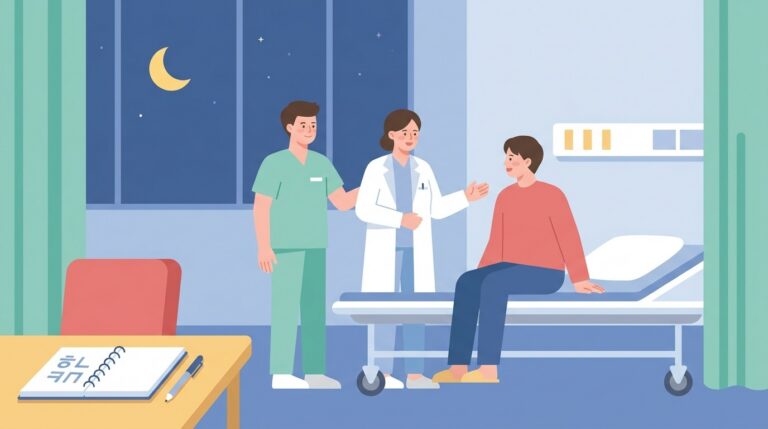
Surviving the Korean Emergency Room at 2 AM: What to Say When Your Stomach Betrays You
Phase 1: Empathy (Real-Life Opening)
안녕하세요! 매일한글 에디터입니다. (Hello! I’m your Daily Hangul editor.)
Picture this: It’s 2:15 AM in Seoul. You celebrated your first week studying or traveling in Korea with sizzling late-night spicy tteokbokki and fried chicken in Hongdae. But now, you are curled up in your bed, clutching your lower right abdomen in sheer agony. A cold sweat breaks out on your forehead. Panic sets in: Is this appendicitis? Am I going to need surgery alone in a foreign country? How do I even explain this in Korean at an emergency room?
Going to a hospital in another country is terrifying, especially in the dead of night when you are in excruciating pain. You might know basic greetings like annyeonghaseyo, but medical terms feel like an insurmountable mountain. Many of our foreign learners tell us their biggest fear is waking up sick at night and being unable to communicate with medical staff or ask for translation support.
Take a deep breath. Today, we are walking through the emergency room experience together. You will master the exact, lifesaver phrases to describe your symptoms, ask for urgent medical interpretation, and finally hear the sweet, reassuring diagnosis: 다행히 맹장염(충수염)은 아니고 급성 장염이라 약 먹고 쉬면 돼요 (Thankfully it’s not appendicitis, just acute enteritis, so medicine and rest will do). Let’s turn your panic into rock-solid confidence!
Phase 2: Core Expressions Deep Dive
1. 다행히 맹장염은 아니에요 (Dahaenghi maengjang-yeomeun anieyo)
- Pronunciation: [Da-haeng-hi maeng-jang-yeo-meun a-ni-e-yo] (Sound analogy: Start with ‘Da-haeng-hee’ like letting out an audible sigh of relief ‘ahhh’, then ‘maeng-jang-yeom’ sounding like a crisp rhythmic tap).
- Meaning:
- Literal: “Thankfully, appendicitis is not.”
- Actual Nuance: “Fortunately, it’s not appendicitis (so you can relax).”
- K-Culture Moment: In medical K-dramas like Hospital Playlist (슬기로운 의사생활), doctors gently smile at anxious patients in the emergency room right before delivering this exact comforting line to lower their heart rates.
- Editor’s Insight: The word 다행히 (dahaenghi – fortunately/thankfully) is a magical empathy marker in Korean. When doctors or nurses use it at the start of a sentence, it signals immediate relief before the diagnostic details even begin.
- Situation Spectrum: Casual: ⚠️ (Use 다행히 맹장염은 아니야 with close friends) | Semi-formal: ✅ | Formal: ✅
- 🤔 Think About It: In English, doctors often say straightforwardly, “The scan shows it’s not appendicitis.” Why do you think Korean medical staff naturally preface test results with emotional empathy words like 다행히 (fortunately)?
2. 급성 장염이라 약 먹고 쉬면 돼요 (Geupseong jang-yeomiraseo yak meokgo swimyeon dwaeyo)
- Pronunciation: [Geup-seong jang-yeo-mi-ra-seo yak meok-ko swi-myeon dwae-yo] (Sound analogy: ‘Geup’ sounds like an urgent ‘gulp’, followed by ‘jang-yeom’ matching the English word ‘yum’ with a soft j).
- Meaning:
- Literal: “Because it is acute enteritis, eating medicine and resting is enough.”
- Actual Nuance: “It’s just acute stomach flu / enteritis, so you’ll be fine with some medication and rest.”
- K-Culture Moment: The dreaded jang-yeom (장염) is practically a rite of passage in Korea! After late-night feasts of fiery street food or summer raw seafood, Koreans frequently visit neighborhood clinics saying they caught jang-yeom.
- Editor’s Insight: Notice that Koreans say 약을 먹다 (yak-eul meokda – to ‘eat’ medicine) instead of using a verb for ‘take’. The grammar pattern ~(으)면 돼요 (-(eu)myeon dwaeyo) means “all you have to do is…”—a gentle way to tell someone they do not need serious medical procedures.
- Situation Spectrum: Casual: ⚠️ | Semi-formal: ✅ | Formal: ✅
- 🤔 Think About It: Notice how the doctor groups medication and rest as a single paired action (약 먹고 쉬다). How does Korean medicine emphasize holistic bodily recovery alongside pharmacology?
3. 의료 통역 서비스 지원되나요? (Uiryo tong-yeok seobiseu jiwondoenayo?)
- Pronunciation: [Ui-ryo tong-yeok seo-bi-seu ji-won-doe-na-yo?] (Sound analogy: ‘Ui-ryo’ sounds like ‘wee-ryo’, and ‘tong-yeok’ sounds like a brisk, focused ‘talk-yak’).
- Meaning:
- Literal: “Is medical translation service supported?”
- Actual Nuance: “Do you provide medical interpretation services here?”
- K-Culture Moment: When foreign characters visit large university hospitals in modern Seoul-based dramas, reception desks connect them to on-call phone interpreters using dedicated emergency tablets.
- Editor’s Insight: Major Korean general hospitals and university medical centers have 24-hour interpretation hotlines (often linked to the Korea Health Industry Development Institute or 1339 services). Memorizing this phrase will instantly connect you with someone who speaks your language fluently.
- Situation Spectrum: Casual: 🚫 | Semi-formal: ✅ | Formal: ✅
- 🤔 Think About It: Why is specifying 의료 통역 (medical interpretation) safer than just asking for someone who speaks English (영어 할 수 있어요?) during an emergency triage?
Phase 3: Textbook Korean vs. Real Korean
Situation 1: Explaining sudden sharp abdominal pain
- 📖 교과서 한국어 (Textbook): 저는 복통이 심각하게 발생했습니다. (Jeoneun boktongi simgakhage balsaenghaetseumnida. / “Severe abdominal pain has occurred in me.”)
- 🗣️ 진짜 한국어 (Real-world): 배가 쥐어짜듯이 너무 아파요. (Baega jwieojjjadeusi neomu apayo. / “My stomach hurts so much, like it’s being twisted and squeezed.”)
- 💡 왜 다를까? (Why the difference?): Nobody uses clinical Sino-Korean words like 복통 (abdominal pain) or 발생했습니다 (has occurred) when they are bent double in agony. Using native sensory verbs like 쥐어짜다 (to twist/squeeze) paints an immediate, vivid picture for the triage nurse.
Situation 2: Asking if you need emergency surgery
- 📖 교과서 한국어 (Textbook): 저는 즉각적인 수술이 요구됩니까? (Jeoneun jeukgakjeogin susuri yogudoemnikka? / “Is immediate surgery demanded for me?”)
- 🗣️ 진짜 한국어 (Real-world): 혹시 수술해야 하나요? (Hoksi susulhaeya hanayo? / “Do I perhaps need to undergo surgery?”)
- 💡 왜 다를까? (Why the difference?): Starting questions with 혹시 (hoksi – by chance / perhaps) softens the tension and sounds infinitely more natural in modern spoken Korean.
Phase 4: K-Culture Deep Dive & Non-Verbal Manners
4-1. 눈치 (Nunchi) & Emergency Room Etiquette
Korean emergency rooms (응급실 – eung-geup-sil) operate under a strict national triage system known as KTAS (Korean Triage and Acuity Scale). Unlike daytime outpatient clinics, arriving first does not guarantee being treated first. Critical trauma and cardiac patients take priority over walking abdominal cases.
* Body Language: When you describe your pain, clearly point with your hand to the specific quadrant of your stomach. Appendicitis is located in the lower right (오른쪽 아랫배), while enteritis often feels diffuse across the center (배 전체).
* Attitude: Avoid shouting or demanding instant IV fluids; showing patience and speaking politely with standard 존댓말 (jondaetmal – polite honorifics) helps the nurses prioritize your translation needs quickly and with deep empathy.
4-2. Midnight Food Culture & Acute Enteritis
Korea has the greatest 24-hour delivery culture (배달 문화) in the world. However, eating extremely spicy dishes like yeopgi tteokbokki or greasy midnight fried pork (yasik) after drinking can easily trigger sudden gut irritation known as 급성 장염 (geupseong jang-yeom). ER doctors in Korea see dozens of travelers and young locals every weekend suffering from this exact stomach distress!
Phase 5: Real-World Roleplay Scenario
Setting: 2:30 AM. You are sitting in the triage booth of a university hospital emergency room in Sinchon, Seoul. You are speaking with Nurse Min-ji.
- 간호사 민지: 어디가 제일 불편해서 오셨어요? (Eodiga jeil bulpyeonhaeseo osyeosseoyo? / Where does it hurt the most?)
- 나 (You): 🎭 Holding lower stomach, groaning lightly 배가 쥐어짜듯이 너무 아파요. (Baega jwieojjjadeusi neomu apayo. / My stomach hurts so much, like it is being squeezed.)
- 간호사 민지: 언제부터 아프셨어요? 혹시 오른쪽 아랫배를 누르면 더 아픈가요? (Eonjebuteo apeusyeosseoyo? Hoksi oreunjjok araetbaereul nureumyeon deo apeungayo? / Since when did it hurt? Does it hurt more if you press your lower right belly?)
- 나 (You): 저녁 먹고 나서요. 혹시 의료 통역 서비스 지원되나요? (Jeonyeok meokgo naseoyo. Hoksi uiryo tong-yeok seobiseu jiwondoenayo? / Since after dinner. By any chance, is medical interpretation service available?)
- 간호사 민지: 네, 1339 통역 서비스 연결해 드릴게요. 잠시만요. (Ne, il-sam-sam-gu tong-yeok seobiseu yeongyeolhae deurilgeyo. Jamsimanyo. / Yes, I will connect you to the 1339 translation service. One moment.)
- (After physical examination and ultrasound…)
- 의사 선생님: 검사 결과 나왔습니다. 다행히 맹장염은 아니고 급성 장염이에요. (Geomsa gyeolgwa nawasseumnida. Dahaenghi maengjang-yeomeun anigo geupseong jang-yeomieyo. / The test results are out. Thankfully it’s not appendicitis, just acute enteritis.)
- 나 (You): 🎭 Sighing with deep relief 정말 다행이네요. 입원이나 수술 안 해도 돼요? (Jeongmal dahaeng-ineyo. Ibwon-ina susul an haedo dwaeyo? / What a relief. Do I not need hospitalization or surgery?)
- 의사 선생님: 네, 주사 맞고 약 먹고 며칠 쉬면 돼요. (Ne, jusa matgo yak meokgo myeochil swimyeon dwaeyo. / Yes, just get an injection, take the medicine, and rest for a few days.)
🔀 Interactive Decision Point
The doctor hands you a paper prescription slip (처방전). What do you say?
- Option A: “감사합니다. 약은 어디서 받아요?” (Gamsahamnida. Yageun eodiseo badayo? / Thank you. Where do I pick up the medicine?)
- Option B: “맹장염 수술 지금 당장 해주세요!” (Maengjang-yeom susul jigeum dangjang haejuseyo! / Please do appendicitis surgery right now!)
- Option C: “돈 없는데 그냥 가도 돼요?” (Don eomneunde geunyang gado dwaeyo? / I have no money, can I just leave?)
Feedback:
* Option A is BEST! Perfect. ERs dispense emergency medications directly at their hospital pharmacy counter at night, or direct you to the nearest night pharmacy (당번약국).
* Option B is BAD! The doctor just told you it is NOT appendicitis! Insisting on surgery will confuse the medical staff.
* Option C is RISKY! Leaving an emergency room without settling your bill (수납) can result in police reporting or visa renewal problems.
Phase 6: 10-Second Emotion Shadowing Drill
Practice reading these out loud, pausing at the / marks while matching the emotional cues!
[🥺 아프고 떨리는 목소리로]배가 / 쥐어짜듯이 / 너무 아파요. (Baega / jwieojjjadeusi / neomu apayo. / My stomach hurts so much / like it’s twisting.)[🙏 간절하고 정중하게]혹시 / 의료 통역 서비스 / 지원되나요? (Hoksi / uiryo tong-yeok seobiseu / jiwondoenayo? / By chance / is medical interpretation / supported?)[😮💨 안도하며 차분하게]다행히 / 맹장염은 아니어서 / 정말 다행이에요. (Dahaenghi / maengjang-yeomeun anieoseo / jeongmal dahaeng-ieyo. / Thankfully / because it is not appendicitis / it is such a relief.)
Phase 7: K-Culture Mini Dictionary
- 응급실 (Eung-geup-sil) | Emergency Room (ER) | The 24/7 department of general hospitals designated for urgent conditions.
- 맹장염 (Maengjang-yeom) | Appendicitis | Literally “cecum inflammation”; colloquially used for appendicitis (충수염 is the strictly medical term).
- 장염 (Jang-yeom) | Enteritis / Stomach Flu | Inflammation of the intestines, commonly caused by bacteria, spoiled food, or excessive spice.
- 처방전 (Cheobangjeon) | Medical Prescription | The paper sheet provided after discharge to purchase medicines at a pharmacy.
Phase 8: Traveler’s Survival Kit
Top 3 Emergency Phrases
- 응급실이 어디예요? (Eung-geupsiri eodiyeyo?)
- Pro Tip: Use this when arriving at the hospital lobby or asking a taxi driver to pull up to the emergency bay.
- 영어 통역 부탁드립니다. (Yeongeo tong-yeok butakdeurimnida.)
- Pro Tip: Keep this sentence typed on your phone notes app so you can flash the screen if speech is difficult.
- 영수증과 진료확인서 주세요. (Yeongsujeunggwa jinryohwagwinseo juseyo.)
- Pro Tip: You will need both the detailed receipt and medical certificate to claim reimbursement on your travel insurance!
Editor’s Travel Note
- If you are in distress and cannot find an English speaker, dial 119 (Ambulance) or 1339 (Korea Disease Control and Prevention Agency Medical Hotline). Both numbers offer free 3-way emergency interpretation for foreign tourists.
- For reliable hospital location mapping and night pharmacy hours, download the Emergency Medical Information Center 1339 Guide or use your local map applications.
Phase 9: One Step Deeper (Reflective Essay)
In many Western cultures, seeking emergency medical care is seen as an intimidating, intensely bureaucratic, and potentially bankrupting event. In South Korea, however, the medical infrastructure is built around high accessibility, speed (빨리빨리), and collective community welfare. When Korean medical staff see an anxious foreign traveler, their instinctual reaction is often grounded in 정 (jeong)—warm relational care. While their direct, fast-paced questions might feel curt to beginners, it stems from a desire to resolve your pain immediately. Embracing this cultural rhythm turns a scary ER visit into an unforgettable encounter with Korean societal kindness.
💬 Your Turn: Have you ever experienced a sudden medical problem while traveling abroad? How did you manage to communicate your symptoms?
Phase 10: FAQ & Mistake Prevention
Q: Can I just walk into any Korean hospital at night?
A: No. Small neighborhood clinics (동네 의원) close around 6:00 PM or 7:00 PM. At night, you must look specifically for hospitals with an 응급실 (Emergency Medical Center).
Q: How much does an emergency room visit cost for a foreigner without Korean National Health Insurance?
A: Triage registration, basic blood tests, and an ultrasound typically range between 150,000 KRW to 350,000 KRW (~$110 to $260 USD). Always pay by credit card and request a detailed English invoice for travel insurance claims.
Q: What is the fastest way to get an interpreter on the phone in an ER?
A: Call 1339 from your mobile phone and press the designated number for English service, or ask the triage nurse: 1339 통역 전화 연결해 주세요 (Il-sam-sam-gu tong-yeok jeonhwa yeongyeolhae juseyo).
🚨 Common Mistakes Warning Board
- ❌ Mistake 1: Calling an ambulance (119) for mild discomfort.
- Correct Action: If you can walk, hail a taxi using Kakao T to the nearest ER. Keep ambulances open for life-threatening emergencies.
- ❌ Mistake 2: Leaving without receiving a paper prescription (처방전).
- Correct Action: Emergency rooms usually give you just 1-2 doses directly; the rest must be filled at a 24-hour pharmacy using your prescription slip.
- ❌ Mistake 3: Saying “I need surgery” before tests are run.
- Correct Action: Describe your sensations (쥐어짜듯 아파요) rather than self-diagnosing, which causes unnecessary clinical confusion.
Phase 11: Action Missions
- 🥉 Bronze Mission (Solo Practice): Stand in front of your mirror and practice the 3 Shadowing sentences from Phase 6 twice with realistic facial expressions.
- 🥈 Silver Mission (Social Sharing): Save this emergency sentence (의료 통역 서비스 지원되나요?) into your phone notes or lock screen and share it with your travel companion.
- 🥇 Gold Mission (Real-world Prep): Check your current accommodation on your navigation app and locate the nearest 24-hour Emergency Room (응급실) in under 2 minutes.
- 🎮 K-Culture Mission: Watch an episode of a Korean medical drama (such as Hospital Playlist or Dr. Romantic) and spot the moment a doctor or nurse uses the word 다행히 (fortunately)!
Phase 12: Interactive Quiz Challenge
Question 1 (Situational Judgment)
You have arrived at the ER triage counter. You are in intense pain and cannot understand the nurse’s fast Korean questions. What should you say first?
* (A) 배고파요, 밥 주세요. (Baegopayo, bap juseyo.)
* (B) 의료 통역 서비스 지원되나요? (Uiryo tong-yeok seobiseu jiwondoenayo?)
* (C) 맹장염 수술해주세요. (Maengjang-yeom susulhaejuseyo.)
Question 2 (Fill in the Blank)
Fill in the missing word indicating ‘fortunately/thankfully’:
“(______) 맹장염은 아니고 급성 장염이에요.”
Question 3 (True or False)
In Korea, you should use the verb ‘to drink’ (마시다) when talking about taking oral tablet medicine.
* [True / False]
👉 Click to reveal answers & explanations!
- Answer 1: (B). Asking for medical interpretation connects you immediately with trained linguistic assistance.
- Answer 2: 다행히 (Dahaenghi). This word softens medical delivery and signals immediate relief.
- Answer 3: False. In Korean, taking medication uses the verb 먹다 (to eat), as in 약 먹다 (yak meokda).






