

Stay Safe in Seoul: How to Spot and Politely Reject Street Cults in Korea
Phase 1: Empathy (Story-Driven Opening)
안녕하세요! It’s your Daily Hangul editor here!
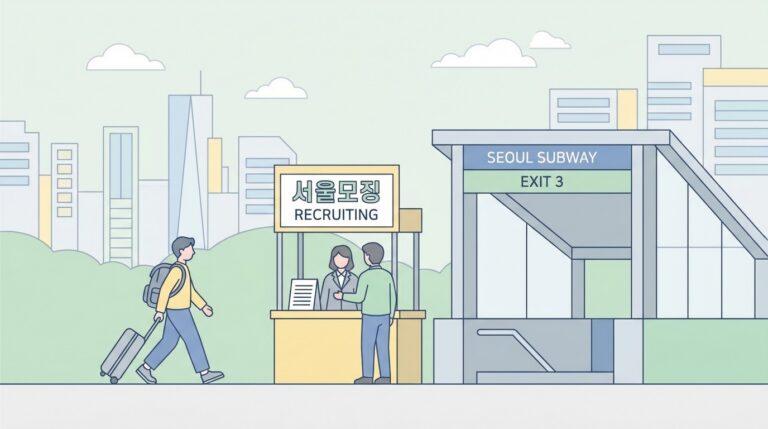
Picture this: You are happily strolling around Hongdae Exit 9, iced Americano in hand, taking in the vibrant street performances and snapping aesthetic photos. Suddenly, two polite, stylish university-aged Koreans approach you with warm smiles and clipboards. One says, “한국 문화 설문조사 중인데 1분만 시간 내주실 수 있나요?” (We’re doing a survey on Korean culture; could you spare just one minute?) followed quickly by, “인상이 참 맑으세요!” (You have such a pure, radiant aura!).
It feels flattering, doesn’t it? As someone learning Korean, your immediate instinct is excitement—“Wow, locals want to talk to me! This is my chance to practice Korean!”
Wait right there, my friend! Hit the emergency brake! 🛑
As your seasoned Korean best friend and cultural navigator, I have to let you in on an open secret: this is textbook street recruitment for pseudo-religious cults, often known locally as 사이비 종교 (sa-i-bi jong-gyo) or the infamous 도를 아십니까 (Do you know the Tao?) groups. South Korea guarantees constitutional freedom of religion, which fosters a vibrant and diverse spiritual landscape. However, this same freedom has also allowed aggressive, manipulative underground cult groups to flourish in crowded transit hubs like Gangnam, Sinchon, and Hongdae.
Falling into their trap doesn’t just waste your precious travel time—they often steer foreigners into tea houses or cultural centers under the guise of an “ancestral blessing ceremony” (제사, jesa) and then demand hefty cash donations. But do not worry! In today’s guide, tailored for B2 intermediate learners, we will break down the linguistic red flags, arm you with crisp, natural native boundary-setting phrases, and ensure you walk the streets of Seoul with unshakeable confidence.
Phase 2: Core 3 Expressions In-Depth
Here are three essential expressions you need to decode cult interactions and set ironclad boundaries like a savvy local.
1. 인상이 참 맑으시네요 (Insang-i cham malgeusineyo)
- Pronunciation: [In-sang-i cham mal-geu-si-ne-yo] (Think: “In-song” + “e” + “chahm” + “mahl-geu-she-neh-yo”)
- Meaning: Literal: “Your facial impression looks very clear/pure.” | Actual Nuance: “You look impressionable, spiritually open, and like an easy target for our group.”
- K-Culture Moment: This is the iconic opening hook used in almost every parody of street recruiters across Korean variety shows like SNL Korea and web dramas. It plays on traditional physiognomy (관상, gwansang).
- Editor’s Insight: While complimenting appearance in Korea is common, strangers on the street commenting specifically on your 인상 (facial impression) or spiritual aura is 99.9% a sign of cult recruitment. Genuine locals rarely stop strangers just to compliment their aura.
- Situation Spectrum: Casual: 🚫 | Semi-formal: 🚫 | Formal: 🚫 (Unless you are a recruiter, you should never say this!)
- 🤔 Think About It: Why do you think recruiters target people’s spiritual aura rather than just their clothes or looks? How does the Korean belief in destiny and physiognomy play a role here?
2. 관심 없으니까 그냥 가세요 (Gwansim eopseunikka geunyang gaseyo)
- Pronunciation: [Gwan-sim eop-seu-ni-kka geu-nyang ga-se-yo] (Sounds like: “Gwan-sheem” + “up-soo-knee-kkah” + “geu-nyang” + “gah-seh-yo”)
- Meaning: Literal: “I have no interest, so just go.” | Actual Nuance: “I see right through what you’re doing; walk away now.”
- K-Culture Moment: Seen frequently in K-Dramas whenever a savvy Seoulite gets stopped by shady salespeople or cult recruiters outside a subway station.
- Editor’s Insight: Intermediate learners often worry about being “rude” and end up trapped in awkward 20-minute conversations because they use overly soft phrasing like “죄송합니다…” (I’m sorry…). In Korean social etiquette, once someone invades your personal boundary with predatory intent, direct firmness (단호함) is completely appropriate and necessary.
- Situation Spectrum: Casual: ⚠️ | Semi-formal: ✅ | Formal: ✅ (Used to repel intrusive solicitations)
- 🤔 Think About It: In your native culture, do you feel obligated to apologize before saying “no” to a street solicitor? Notice how dropping 죄송하지만 (I’m sorry, but…) changes your posture completely.
3. 저 사이비 아니에요? (Jeo saibi anieyo?)
- Pronunciation: [Jeo sa-i-bi a-ni-e-yo?] (Think: “Juh” + “sah-ee-bee” + “ah-knee-eh-yo?”)
- Meaning: Literal: “Aren’t you guys a cult?” | Actual Nuance: “Don’t play dumb with me, I know exactly what your game is.”
- K-Culture Moment: The word 사이비 (saibi, pseudo/fraudulent) gained immense international awareness through hit thriller dramas like OCN’s 구해줘 (Save Me).
- Editor’s Insight: 사이비 comes from classical Hanja roots meaning “similar on the outside, but fundamentally different/fake on the inside.” Dropping this word immediately disarms recruiters because they realize you are culturally fluent and immune to manipulation.
- Situation Spectrum: Casual: ✅ | Semi-formal: ✅ | Formal: ⚠️
- 🤔 Think About It: Language shows cultural awareness. How does knowing local terminology change the power dynamic between a traveler and an opportunistic local?
Phase 3: Textbook Korean vs. Real Korean
Let’s compare stiff, classroom Korean with what native speakers actually say on the sidewalks of Seoul.
Situation 1: Declining a Street Approach
- 📖 교과서 한국어 (Textbook):
저는 지금 매우 바쁜 일이 있어서 대화할 수 없습니다.
(Jeoneun jigeum maeu bappeun iri isseoseo daehwahal su eopseumnida. / “I cannot converse because I have very busy business right now.”) - 🗣️ 진짜 한국어 (Real-life Native):
아, 저 바빠서요. 갈게요.
(A, jeo bappaseoyo. Galgeyo. / “Ah, I’m in a rush. I’m off.”) - 💡 왜 다를까? (Cultural Insight): Over-explaining your schedule (매우 바쁜 일) gives street solicitors conversational footholds to say, “It’ll only take 30 seconds!” A brief, clipped “바빠서요. 갈게요” paired with forward momentum closes the conversational door immediately.
Situation 2: Warning a Friend About a Suspicious Invitation
- 📖 교과서 한국어 (Textbook):
그 단체는 사이비 종교일 가능성이 매우 높으니 주의하십시오.
(Geu dancheneun saibi jong-gyoil ganeungseongi maeu nopeuni ju-uihasipsio. / “That organization has a high probability of being a cult, so please be cautious.”) - 🗣️ 진짜 한국어 (Real-life Native):
야, 거기 딱 봐도 사이비야. 절대 엮이지 마.
(Ya, geogi ttak bwado saibiya. Jeoldae yeokkiji ma. / “Hey, that’s obviously a cult at first glance. Don’t get tangled up with them at all.”) - 💡 왜 다를까? (Cultural Insight): The verb 엮이다 (yeokkida, to become entangled/involved with trouble) expresses the messy, sticky nature of cult relationships in modern Korean vernacular much better than formal textbook warnings.
Phase 4: K-Culture Deep Dive & Non-Verbal Manners
4-1. Nunchi (눈치) & Body Language Mechanics
In Korea, communication is deeply non-verbal. When dealing with street cult recruiters:
1. The Hand Wave “Stop”: Raise your right hand to chest level with your palm facing outward or wagging your palm slightly side-to-side. This universally signals “No thanks / Don’t approach me.”
2. Break Eye Contact Immediately: Sustained eye contact is seen as an invitation for dialogue. Keep your eyes fixed straight ahead on your path.
3. Maintain Cadence: Do not slow down your walking pace when they speak. Continue walking at a steady, brisk pace. In Seoul, breaking your walking stride is interpreted as willingness to listen.
4-2. Cultural Code Analysis: Freedom of Religion & The Darker Side
Article 20 of the Constitution of the Republic of Korea states that all citizens enjoy freedom of religion, and state and religion are strictly separated. Because of this, traditional Buddhism, Protestant Christianity, and Catholicism exist harmoniously with indigenous folk beliefs like shamanism (무속신앙).
However, this legal protection also prevents the police from easily intervening unless a direct crime (like extortion, kidnapping, or physical assault) is documented. In K-Dramas like 구해줘 (Save Me) or the global documentary phenomenon 나는 신이다 (In the Name of God: A Holy Betrayal), you can see how psychological isolation and charismatic leaders exploit people’s desire for belonging and success. Street recruiters prey particularly on foreigners who may feel lonely, curious about Korean heritage, or too polite to walk away.
Phase 5: Real-Life Roleplay Scenario
Setting: Outside Gangnam Station, Exit 11 at 4:30 PM. The street is buzzing with commuters. Two neatly dressed 20-somethings holding clipboards step directly into your walking path.
- 수진 (Sujin): 저기요, 잠시만요! 인상이 너무 선하셔서 그런데, 길 하나만 여쭤봐도 될까요?
(Jeogiyo, jamsimanyo! Insang-i neomu seonhasyeoseo geureonde, gil hanaman yeojjwobwado doelkkayo?)
“Excuse me, just a moment! You have such a kind impression—could I just ask you for directions?”
🎭 [Steps into your walking line, tilted head with an innocent smile] -
You: 아, 네. 어디 찾으시는데요?
(A, ne. Eodi chajeusineundeyo?)
“Ah, yes. Where are you looking for?”
🎭 [Pausing briefly while checking your phone] -
민호 (Minho): 아, 사실 길보다는요, 한국 전통 문화 교류 모임에서 나온 대학생들이에요. 기운이 참 맑으신데, 사주나 조상님 이야기 들어보신 적 있으세요?
(A, sasil gilbodaneunyo, Hanguk jeontong munhwa gyoryu moimeseo naon daehaksaengdeurieyo. Giuni cham malgeusinde, sajuna josangnim iyagi deureobosin jeok isseoseyo?)
“Well, actually, rather than directions, we’re university students from a traditional Korean cultural exchange club. Your energy is so clear! Have you ever heard about Saju or ancestral spirits?”
🎭 [Reveals a binder filled with traditional ink drawings] -
You: …네? 전통 문화요?
(…Ne? Jeontong munhwayo?)
“…Pardon? Traditional culture?”
🎭 [Frowning with growing suspicion] -
수진 (Sujin): 네! 지금 근처 전통 찻집에서 조상님 복을 비는 간단한 다도 체험이 있거든요. 10분이면 돼요, 같이 가실래요?
(Ne! Jigeum geuncheo jeontong chatjibeseo josangnim bogeul bineun gandanan dado cheheomi itgeodeunyo. Sipbunimyeon dwaeyo, gachi gasillaeyo?)
“Yes! We are doing a brief tea ceremony nearby to pray for ancestral blessings. It only takes 10 minutes, want to come along?”
🎭 [Gently touching your forearm to steer you toward a side alley] -
You: 아니요, 저 그런 거 관심 전혀 없어요. 손 놓으세요.
(Aniyo, jeo geureon geo gwansim jeonhyeo eopseoyo. Son nouseyo.)
“No, I have zero interest in that stuff. Please take your hand off me.”
🎭 [Pulling arm back with a sharp, firm expression] -
민호 (Minho): 에이, 외국인 친구 사귀려고 그러는 건데 너무 매정하시다… 복 많이 받으실 기회인데…
(Ei, oegukin chingu sagwillyeogo geureoneun geonde neomu maejeonghasida… Bok mani badeusil gihoeinde…)
“Aw, we’re just trying to make foreign friends, you’re being so harsh… This is a chance to receive good fortune…”
🎭 [Pouting, trying to induce guilt] -
You: 계속 이러시면 경찰 부를게요. 가세요.
(Gyesok ireosimyeon gyeongchal bureulgeyo. Gaseyo.)
“If you keep doing this, I will call the police. Walk away.”
🎭 [Holding phone up noticeably and walking briskly past them]
🔀 Interactive Decision Point
Suppose Minho steps forward again and asks: “딱 5분만 이야기 들으면 안 돼요?” (Can’t you just listen for 5 minutes?). How do you respond?
- Choice A: “죄송한데 제가 한국어를 잘 못해서요… 다음에요…” (I’m sorry, my Korean isn’t good… maybe next time…)
- Feedback (Risk): This is the worst response! Saying “maybe next time” or pleading poor Korean encourages them. They will switch to English, translate on their phones, or follow you.
- Choice B: “관심 없으니까 길 막지 마시고 비켜주세요.” (I’m not interested, so stop blocking my path and step aside.)
- Feedback (Best! ⭐): Crisp, perfectly polite grammar (-주세요), but uncompromising boundary setting. Shows that you know your rights and are totally unbothered.
- Choice C: “야! 너네 도를 아십니까 맞지? 경찰서 갈래?” (Hey! You guys are Tao recruiters, right? Want to go to the police station?)
- Feedback (Bad): While satisfying, escalating to aggressive banmal (야!) in broad daylight can cause an unnecessary public scene or personal safety dispute. Stay calm, assertive, and move on.
Phase 6: 10-Second Emotion Shadowing Drill
Practice reading these sentences aloud, matching the pause markers (/) and emotional tone cues!
[✋ 단호하고 차분하게 / Firm and cool]
괜찮으니까 / 그냥 가세요. / 저 바빠요.
(Gwaenchaneunikka / geunyang gaseyo. / Jeo bappayo.)-
[👀 의심스럽고 날카롭게 / Suspicious and sharp]
설문조사라면서 / 왜 자꾸 / 조상님 이야기를 하세요?
(Seolmunjosaramyeonseo / wae jakku / josangnim iyagireul haseyo?) -
[🚨 강력한 경고 / Strong warning]
자꾸 따라오시면 / 지금 바로 / 경찰에 신고할게요.
(Jakku ttaraosimyeon / jigeum baro / gyeongchare sin-gohalgeyo.)
Phase 7: K-Culture Mini Dictionary
-
사이비 (Sa-i-bi)
- Definition: Pseudo-religion, cult, or fraudulent sect masquerading as a genuine organization.
- Real-world Usage: Used broadly in everyday conversation to describe anything fake, scammy, or fanatical (e.g., 사이비 종교 = cult religion; 사이비 전문가 = bogus expert).
- 도를 아십니까 (Do-reul a-sip-ni-kka)
- Definition: Literally “Do you know the Tao/the Way?”
- Real-world Usage: The iconic phrase used by street solicitors from pseudo-religions since the 1990s. Nowadays, it has become synonymous with any unwanted street hustler or sketchy solicitor.
- 포섭 (Po-seop)
- Definition: Recruitment or indoctrination through subtle entrapment.
- Real-world Usage: Describing how cults gradually reel people in using friendship, cultural study circles, or emotional dependency (e.g., 외국인을 포섭하려 하다 = attempting to recruit foreigners).
- 종교의 자유 (Jong-gyo-ui ja-yu)
- Definition: Freedom of religion.
- Real-world Usage: A constitutional right in South Korea. Frequently cited in news discussions surrounding the balance between civil liberties and regulating harmful fringe cults.
Phase 8: Survival Kit for Travelers
TOP 3 Survival Phrases
- 괜찮습니다, 가세요. (Gwaenchanseumnida, gaseyo. / I’m fine, please go.)
- Pro Tip: Keep walking! Do not stop your feet while saying this.
- 따라오지 마세요. (Ttara-oji maseyo. / Do not follow me.)
- Pro Tip: Use a lower voice pitch with direct eye contact if they trail behind you.
- 경찰 부를 거예요. (Gyeongchal bureul geoyeyo. / I will call the police.)
- Pro Tip: Pull out your phone and dial 112 if they physically obstruct you.
Editor’s Travel Note
- Emergency Hotlines: Korea’s police hotline is 112. For translation and tourist help, dial the 1330 Korea Travel Hotline (available 24/7 in English, Japanese, and Chinese).
- Navigation Tip: If anyone makes you feel unsafe, open your Naver Map app navigation to the nearest police box (search for 지구대 or 파출소) and walk directly into the station. Recruiters will vanish the moment you head toward a police post.
Phase 9: “One Step Deeper” (Reflective Essay)
South Korea’s rapid modernization in the late 20th century transformed the country into an economic and technological powerhouse, but it also dissolved traditional community structures. In a hyper-competitive society driven by performance and academic pressure, many young people experience profound loneliness and spiritual fatigue. Cults skillfully exploit this vulnerability by weaponizing 정 (jeong, emotional warmth and affection) and offering pseudo-families.
Foreigners visiting Korea often arrive with open hearts, enthusiastic about experiencing local warmth and making Korean friends. Cult recruiters know this and use cultural curiosity as bait. Recognizing these tactics isn’t about becoming cynical or untrusting; rather, it’s about learning to protect yourself so you can share genuine, safe, and enriching relationships with real everyday Koreans.
💬 Your Turn: Have you ever encountered overly friendly strangers on the streets while traveling abroad or in your home country? What was your gut reaction? Drop your story in the comments below!
Phase 10: FAQ & Common Mistakes
Q: Why do street recruiters always work in pairs?
A: One person acts as the talker (말꾼) who keeps your attention occupied with questions, while the second acts as the supporter/barrier (바람잡이) who smiles, nods, blocks your line of sight, and prevents you from slipping away easily.
Q: What happens if someone accidentally follows them to a “tea ceremony”?
A: You will usually be taken to an officetel or basement building, asked to put on traditional hanbok, and guided through a ritual. Afterward, they will claim an ancestor needs blessing money (복채 or 제사비) and pressure you to withdraw cash from an ATM. If this ever happens, firmly refuse, say you must meet a friend immediately, and leave.
Q: Are all people who approach foreigners on the street cult recruiters?
A: Not 100%, but 95% of young Koreans asking for surveys about “traditional culture,” “ancestral energy,” or “personality tests” on the streets of Hongdae, Gangnam, or Sinchon are affiliated with these groups. Legitimate university clubs conduct official outreach inside campus boundaries, not through random street ambushes.
🚨 Common Mistakes Alert
- Mistake: Apologizing excessively (“죄송합니다…”)
Correct Action: Never apologize for setting boundaries. A firm “관심 없습니다” (I’m not interested) is polite enough. - Mistake: Giving your KakaoTalk ID to “be polite”
Correct Action: They will bombard you with invitations to youth summits or counseling sessions. Never share contact info with random street solicitations. - Mistake: Standing still and waiting for them to finish their pitch
Correct Action: Keep moving your feet. If your body continues moving forward, the conversation naturally dies.
Phase 11: Action Missions
- 🥉 Bronze Mission (Solo): Stand in front of the mirror, raise your palm in the “stop” gesture, and practice saying “관심 없으니까 그냥 가세요” three times with a confident, neutral facial expression.
- 🥈 Silver Mission (Social): Share this article with a friend who is currently living in or planning to travel to South Korea, and teach them what 도를 아십니까 means.
- 🥇 Gold Mission (Real-world): Next time you walk through Hongdae or Gangnam and spot people holding clipboards eyeing pedestrians, observe their posture and language from a safe distance and identify their recruitment techniques!
- 🎮 K-Culture Mission: Watch Episode 1 of the drama 구해줘 (Save Me) to witness how cult recruiters approach vulnerable individuals and observe the vocabulary they use.
Phase 12: Interactive Quiz Challenge
Test your situational instincts with this 3-question quiz!
1. Which of the following is the biggest red-flag phrase indicating a cult approach?
* A) “이 근처 맛집 추천해 주실 수 있나요?” (Could you recommend a good restaurant nearby?)
* B) “인상이 참 맑고 복이 많아 보이세요.” (You have such a clear impression and look full of fortune.)
* C) “실례지만 몇 시인지 알 수 있을까요?” (Excuse me, could you tell me what time it is?)
2. Fill in the blank:
“저 그런 거 관심 없으니까 계속 따라오시면 경찰에 __________.” (I have no interest in that, so if you keep following me, I will report it to the police.)
* A) 축하할게요 (congratulate)
* B) 설문할게요 (survey)
* C) 신고할게요 (report)
3. True or False: Cult recruiters only target native Koreans because foreigners do not speak the language well enough.
* True
* False
👉 Click to reveal answers & explanations!
- Answer: B | Commenting on someone’s 인상 (facial impression) or spiritual fortune (복) is the trademark opening line of Korean pseudo-religious street recruiters.
- Answer: C | 신고하다 means to report an incident or crime to authorities like the police (경찰에 신고하다).
- Answer: False | Foreign tourists and exchange students are actually prime targets because they tend to be hospitable, hesitant to appear rude, and easily drawn to promises of “cultural experiences.”







