

Phase 1: Empathy
안녕하세요! 매일한글 에디터입니다. (Hello! I am your Daily Hangul editor.) Have you ever stepped inside a buzzing cafe in Hongdae or Seongsu, surrounded by the aroma of freshly roasted beans, only to freeze the second the barista smiles and asks for your order? You muster up the courage to ask for an iced coffee, but when you pick up your cup, it is packed to the very brim with solid ice cubes! Three quick sips in, and your drink is practically finished. You wished you knew how to say “easy on the ice,” but the Korean words just slipped away under pressure. Don’t worry at all—over the past ten years mentoring Korean learners, this exact counter moment has been voted one of the most relatable pain points. Today, we will turn you into a confident cafe regular who orders exactly what you want, right down to the last ice cube!
Phase 2: Top 3 Core Expressions
1. 얼음 적게 주세요 (Eoleum jeokge juseyo)
- Pronunciation: [Eo-reum jeok-ge ju-se-yo] (Sounds like: Uh-reum chuck-geh joo-seh-yo)
- Meaning: Literal: “Ice little please” | Nuance: “Less ice, please.”
- K-Culture Moment: You will hear young professionals in K-dramas say this quickly while grabbing morning iced lattes before heading up to the office.
- Editor’s Insight: “적게” (jeokge) comes from the adjective “적다” (to be few/small in quantity). It is polite, concise, and immediately understood by any barista.
- Situation Spectrum: Casual: ✅ | Semi-formal: ✅ | Formal: ⚠️
- 🤔 Think About It: Why do Koreans prefer short verb combinations like “~해 주세요” rather than long polite questions when ordering in fast-paced retail spaces?
2. 얼음 빼 주세요 (Eoleum bbae juseyo)
- Pronunciation: [Eo-reum bbae ju-se-yo] (Sounds like: Uh-reum bay joo-seh-yo with a crisp, popped ‘bb’ sound)
- Meaning: Literal: “Ice take out please” | Nuance: “No ice at all, please.”
- K-Culture Moment: Often heard in winter when people want a cold brew at room temperature without freezing their fingers off.
- Editor’s Insight: The verb “빼다” (bbaeda) means to deduct or remove. Use this when you want zero ice in your beverage.
- Situation Spectrum: Casual: ✅ | Semi-formal: ✅ | Formal: ⚠️
- 🤔 Think About It: Notice how Korean uses a simple physical action verb (“remove”) instead of saying “without” like in English.
3. 샷 추가해 주세요 (Syat chugahae juseyo)
- Pronunciation: [Syat chu-ga-hae ju-se-yo] (Sounds like: Shot choo-gah-heh joo-seh-yo)
- Meaning: Literal: “Shot add please” | Nuance: “Add an extra shot of espresso, please.”
- K-Culture Moment: The ultimate survival phrase used by college students pulling all-nighters during exam season in university neighborhoods like Sinchon.
- Editor’s Insight: Korean coffee culture is serious about energy. “추가” (chuga) means “addition.” You can use “추가” for syrups and toppings too!
- Situation Spectrum: Casual: ✅ | Semi-formal: ✅ | Formal: ⚠️
- 🤔 Think About It: Isn’t it fascinating how English loanwords like “shot” blend seamlessly into Korean grammar?
Phase 3: Textbook Korean vs. Real Korean
Situation 1: Asking for less ice
- 📖 교과서 한국어: 얼음의 양을 줄여 주시겠습니까? (Eoleum-ui yangeul julyeo jusigesseumnikka?) – “Could you please reduce the quantity of ice?”
- 🗣️ 진짜 한국어: 얼음 조금만 넣어 주세요 (Eoleum jogeumman neoeo juseyo) – “Just put a little ice, please.”
- 💡 왜 다를까? Textbook grammar is often overly formal and verbose. In a busy Korean cafe with ten orders in queue, baristas appreciate short, friendly phrasing.
Situation 2: Takeout confirmation
- 📖 교과서 한국어: 포장용 컵에 담아 주십시오 (Pojangyong keobe dama jusipsio) – “Please place it inside a takeaway cup.”
- 🗣️ 진짜 한국어: 테이크아웃 잔에 주세요 (Teikeu-aut jane juseyo) / 들고 갈게요 (Deulgo galgeyo) – “In a takeout cup, please / I’ll take it to go.”
- 💡 왜 다를까? Real-life Koreans rely on natural loanwords or functional motion phrases like “들고 갈게요” (I’ll carry it and go).
Phase 4: K-Culture Deep Dive & Non-Verbal Manners
4-1. 눈치 (Nunchi) & Gestures
When ordering at a cafe counter in Korea, keep these physical cues in mind:
* The Two-Handed Handover: Always hand over your payment card or mobile phone using both hands, or support your right wrist with your left hand. It shows respect to the worker.
* The Pinch Gesture: When saying “얼음 적게” (less ice), you can gently pinch your index finger and thumb close together. It reinforces your meaning visually.
* The Eye Contact & Polite Nod: Korean customer service moves quickly. Make pleasant eye contact, give a tiny nod, and receive your receipt with two hands.
4-2. Cultural Code: The Nation of “얼죽아” (Eol-juk-ah)
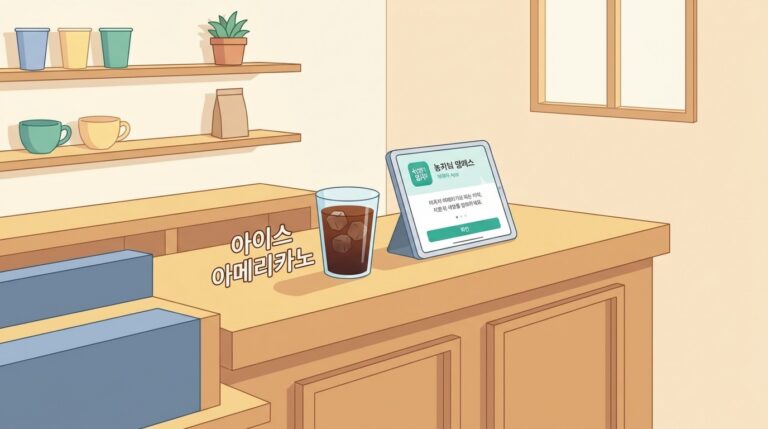
Korea has a nationwide phenomenon called 얼죽아 (Eol-juk-ah), an acronym for “얼어 죽어도 아이스 아메리카노” (Even if I freeze to death, I’ll drink Iced Americano). Even during blistering -10°C Seoul winters, you will spot locals clutching clear plastic cups packed with dark coffee and ice cubes. However, if you love cold coffee but dislike having your drink diluted within five minutes, asking for “얼음 적게” (less ice) is your golden ticket to enjoying richer, lasting flavor.
Phase 5: Real-Life Roleplay Scenario
Setting: A minimalist aesthetic cafe in Yeonnam-dong.
Characters: You (The Traveler) & Min-ho (A friendly, swift barista wearing a black apron).
- Min-ho: 안녕하세요! 주문 도와드릴까요? (Annyeonghaseyo! Jumun dowadeurilkkayo? – Hello! May I help you with your order?)
🎭 Min-ho taps the POS screen and looks up with a warm smile. - You: 네, 아이스 아메리카노 한 잔 주세요. (Ne, a-i-seu a-me-ri-ka-no han jan juseyo. – Yes, one iced Americano, please.)
🎭 You hold up one finger gently. - Min-ho: 드시고 가시나요? (Deusigo gasinayo? – Are you drinking here?)
🎭 He points toward the indoor seating tables. - You: 아니요, 테이크아웃이요. (Aniyo, te-i-keu-a-ut-i-yo. – No, takeout, please.)
🎭 You point slightly toward the exit door. - Min-ho: 네, 테이크아웃으로 준비해 드릴게요. 더 필요한 건 없으세요? (Ne, te-i-keu-a-u-seu-ro junbihae deurilgeyo. Deo piryohan geon eopseuseyo? – Sure, I will prepare it to go. Do you need anything else?)
🎭 He hovers his finger over the register keys. - You: 아, 얼음 적게 넣어 주세요! (A, eoleum jeokge neoeo juseyo! – Ah, please put less ice in it!)
🎭 You make a slight pinch gesture with your fingers. - Min-ho: 네, 얼음 적게요! 결제는 카드로 하시겠어요? (Ne, eoleum jeokgeyo! Gyeoljeneun kadeuro hasigesseoyo? – Sure, less ice! Will you be paying by card?)
🎭 He indicates the card reader terminal. - You: 네, 여기요. 감사합니다! (Ne, yeogiyo. Gamsahamnida! – Yes, here it is. Thank you!)
🎭 You hand over your travel debit card with both hands.
🔀 Interactive Decision Point
The barista suddenly asks: “얼음 적게 하시면 음료 양이 조금 적어 보일 수 있는데 괜찮으세요?” (If you get less ice, the drink might look a bit less full, is that okay?)
* Choice A: “네, 괜찮아요!” (Ne, gwaenchanayo!)
Outcome: Best! The barista nods happily and prepares your concentrated iced coffee immediately.
* Choice B: “더 많이 주세요!” (Deo mani juseyo!)
Outcome: Risk! Asking for “more drink” without paying for an extra shot or size upgrade may confuse the staff.
* Choice C: Silence with a frozen stare.
Outcome: Bad! The barista might cancel the less-ice request to avoid getting complaints later.
Phase 6: 10-Second Emotional Shadowing Drill
Read these sentences aloud, paying attention to the pause markers (/) and emotional cues:
[😊 Bright & Polite]
아이스 라떼 / 한 잔 주세요.
(A-i-seu ra-tte / han jan ju-se-yo.)
One iced latte / please.-
[🤏 Careful & Soft]
얼음은 / 적게 넣어 주세요.
(Eo-reum-eun / jeok-ge neoeo ju-se-yo.)
As for ice / please put in just a little. -
[😄 Cheerful & Grateful]
감사합니다, / 들고 갈게요!
(Gam-sa-ham-ni-da, / deul-go gal-ge-yo!)
Thank you, / I will take it to go!
Phase 7: K-Culture Mini Dictionary
- 얼죽아 (Eol-juk-ah): Abbreviation for “얼어 죽어도 아이스 아메리카노”. Used playfully among friends to describe someone dedicated to iced drinks year-round.
- 샷 추가 (Syat chuga): “Shot addition”. Essential for strong coffee lovers who need an extra boost before touring busy Korean cities.
- 텀블러 할인 (Teombeulleo hal-in): “Tumbler discount”. Most Korean cafes offer a 300 to 500 KRW discount if you bring your own reusable cup.
- 진동벨 (Jindong-bel): “Buzzer / Vibrating pager”. The small plastic device handed to you at the register that buzzes when your beverage is ready.
Phase 8: Traveler’s Survival Kit
Survival Expressions TOP 3
- 얼음 조금만요 (Eoleum jogeum-man-yo) – “Just a little ice, please.”
Pro Tip: The shortest, most foolproof shortcut phrase when you feel nervous at the counter. - 영수증 버려 주세요 (Yeongsujeung beoryeo juseyo) – “Please throw away the receipt.”
Pro Tip: Korean staff will always ask if you need paper receipts; this phrase saves paper instantly. - 빨대는 어디에 있어요? (Pbaldaeneun eodie isseoyo?) – “Where are the straws?”
Pro Tip: Many Korean cafes keep straws and napkins at a self-serve bar near the pick-up counter.
Editor’s Travel Note
- Before heading out, complete your Naver Map app download to easily check English reviews and interior photos of hidden aesthetic cafes in Seoul.
- Most independent cafes in Korea do not accept physical cash anymore. Set up your international card on your smartphone or carry a preloaded travel debit card for seamless contactless payment.
Phase 9: “One Step Deeper”
In Korean culture, the phrase “~주세요” (-juseyo) literally translates to “please give me.” In English, demanding something with “give me” might sound blunt, but in Korean, the polite suffix “-요” (-yo) transforms it into a warm, respectful request. Korean society values communal consideration and speed; concise language allows workers to fulfill your needs smoothly without awkward pleasantries. When you speak these simple words with a warm smile, you participate directly in Korea’s dynamic street-level hospitality.
💬 Your Turn: What is your go-to coffee order in your home country, and would you dare to be an “얼죽아” in freezing weather? Share your thoughts below!
Phase 10: FAQ & Misconception Buster
Q: If I ask for less ice, will the barista fill the cup with more coffee or milk?
A: Usually, no. Unless you purchase a size upgrade or an extra espresso shot, asking for less ice will leave your cup slightly less full, or the barista will simply add extra water/milk depending on store policy.
Q: Can I customize ice levels at digital self-ordering kiosks?
A: Yes! Most self-ordering kiosks in Korea offer an “얼음 적게” (Less ice) or “얼음 보통” (Regular ice) selection screen right after you choose your drink.
Q: Is it rude to say “얼음 적게요” without a full sentence?
A: Not at all! Adding the polite ending “-요” (-yo) makes it friendly and natural enough for casual coffee shops.
🚨 Common Mistakes Warning Board
- ❌ Saying “얼음 다운” (Ice down) like English slang.
Correct Action: Say 얼음 적게요 (Eoleum jeokgeyo). - ❌ Saying “얼음 없어요” (There is no ice / I don’t have ice).
Correct Action: Say 얼음 빼 주세요 (Eoleum bbae juseyo) when you want zero ice. - ❌ Handing your credit card with just one hand while looking at your phone.
Correct Action: Offer the card with both hands and make gentle eye contact.
Phase 11: Action Missions
- Bronze Mission (Solo Drill): Stand in front of your mirror and practice saying “얼음 적게 주세요!” three times in a clear, cheerful voice.
- Silver Mission (Social Share): Post a photo of your favorite iced beverage on Instagram or Threads with the caption: “얼음 적게 주세요! Today I learned how to order coffee in Korean!”
- Gold Mission (Real Life): Visit a local Korean cafe, boba shop, or order in Korean during your next trip without switching back to English.
- 🎮 K-Culture Mission: Watch an episode of a modern Korean drama (like Business Proposal or Crash Course in Romance) and see if you can spot a scene where characters grab takeout coffee together!
Phase 12: Interactive Quiz Challenge
Question 1: Situational Choice
You want an iced vanilla latte, but you want zero ice cubes inside. What should you say?
* A) 얼음 많이 주세요 (Eoleum mani juseyo)
* B) 얼음 빼 주세요 (Eoleum bbae juseyo)
* C) 얼음 적게 주세요 (Eoleum jeokge juseyo)
Question 2: Fill in the Blank
Complete the sentence to politely ask for less ice:
“아메리카노 한 잔이랑, 얼음 _______ 주세요.”
(Hint: The word starts with ‘적’)
Question 3: True or False
In Korea, the slang term “얼죽아” refers to people who only drink boiling hot coffee even during the hottest summer days. (True / False)
👉 Click here to reveal answers and explanations!
- Answer 1: B) 얼음 빼 주세요 (Eoleum bbae juseyo).
Explanation: “빼다” means to take out or exclude. Option A means “more ice,” and Option C means “less ice.” - Answer 2: 적게 (jeokge).
Explanation: “적게” means “a small amount/little.” The full sentence means: “One Americano, and please give me less ice.” - Answer 3: False.
Explanation: “얼죽아” stands for people who drink iced Americano even when freezing to death in the winter cold!







