

Phase 1: Empathy (Story-Driven Opening)
안녕하세요! 매일한글 에디터입니다. (Hello! This is your Daily Hangul editor.)
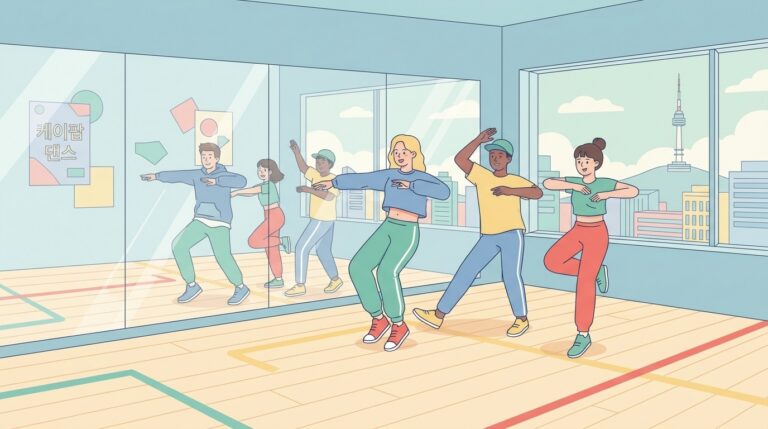
Imagine this: you’ve finally gathered the courage to visit a dance studio in the heart of Hongdae, Seoul, or maybe you are practicing in your living room, following along with the mirror-mode practice video of your favorite K-pop idols. The beat drops, the choreography starts, and everyone moves with electric precision. But then comes a complex footwork sequence! The instructor asks if everyone is ready to move on, and you freeze. Your mind races: How do I ask them to slow it down? How do I say this move is tricky without sounding rude?
Many of our global students share that dancing to K-pop is an incredible joy, but communicating in a Korean dance studio feels intimidating. Don’t worry! This guide is crafted directly from real-life dance workshop experiences in Seoul. By learning just a handful of authentic, friendly expressions, you won’t just keep up with the beat—you’ll build instant connections with fellow dancers and teachers!
Phase 2: Core Expressions (핵심 표현 3선)
1. 다시 보여주실 수 있나요? (Dasi boyeojusil su innayo?)
- Pronunciation: Dah-shee bo-yeo-joo-sheel soo een-nah-yo? (Sounds like “dah-shee” as in dash, then “boy-yo” with a gentle finish)
- Meaning: “Can you show me once more?”
- K-Culture Moment: You’ll hear idol trainees in survival shows politely asking their dance trainers to repeat a difficult key point during evaluation rehearsals.
- Editor’s Insight: The word 다시 (dasi) means “again.” Adding 수 있나요 (su innayo) softens the request into a polite question rather than an order. It shows respect to the instructor while keeping the mood light.
- Situation Spectrum: Casual: ⚠️ | Semi-formal: ✅ | Formal: ✅
- 🤔 Think About It: In English, we often just say “Once more, please!” In Korean, phrasing it as a gentle question about possibility highlights modesty and politeness.
2. 이 동작 너무 어려워요 (I dongjak neomu eoryeowoyo)
- Pronunciation: Ee dong-jak nuh-moo uh-ryuh-wo-yo (“Dong-jak” rhymes with song rock)
- Meaning: “This move is so hard!”
- K-Culture Moment: Behind-the-scenes dance practice clips often show idols laughing while wiping off sweat and saying this exact line when learning intricate chorus hand signs.
- Editor’s Insight: 동작 (dongjak) specifically refers to a dance move or body movement. Pairing it with 너무 (neomu – “so/too”) and 어려워요 (eoryeowoyo – “is hard”) invites the instructor or partner to step in and help with empathy.
- Situation Spectrum: Casual: ✅ | Semi-formal: ✅ | Formal: ⚠️
- 🤔 Think About It: Koreans love shared vulnerability; openly admitting a step is hard often creates an immediate bond among classmates!
3. 같이 맞춰봐요! (Gachi matchwobwayo!)
- Pronunciation: Gah-chee maht-chwo-bah-yo! (“Gachi” sounds like got-chee)
- Meaning: “Let’s sync up together!” / “Let’s match our moves!”
- K-Culture Moment: Dance groups yell this in the mirror room right before hitting the play button to practice synchronized formations.
- Editor’s Insight: 맞추다 (matchuda) means to align, fit, or synchronize. In K-pop culture where synchronized dance (칼군무) is key, saying 같이 맞춰봐요 shows you value teamwork and harmony.
- Situation Spectrum: Casual: ✅ | Semi-formal: ✅ | Formal: 🚫
- 🤔 Think About It: Why is “matching” emphasized over “competing” in Korean group dances? It mirrors the communal “we” spirit (우리 문화) of Korean society.
Phase 3: 교과서 한국어 vs 진짜 한국어 (Textbook vs. Real Korean)
Situation 1: Asking the dancer to repeat a sequence slowly
- 📖 교과서 한국어: 동작을 천천히 반복해 주십시오. (Dongjageul cheoncheonhi banbokhae jusipsio. – “Please repeat the movement slowly.”)
- 🗣️ 진짜 한국어: 천천히 한 번만 다시요! (Cheoncheonhi han beonman dasiyo! – “Just once more slowly, please!”)
- 💡 왜 다를까? Dance studios are energetic and fast-paced! Lengthy textbook honorifics get swallowed by the loud beat. Short, polite phrases ending in “-요 (-yo)” are much more natural.
Situation 2: Complimenting someone’s smooth dancing
- 📖 교과서 한국어: 당신의 춤은 대단히 아름답습니다. (Dangsin-ui chumeun daedanhi areumdapsumnida. – “Your dance is extremely beautiful.”)
- 🗣️ 진짜 한국어: 춤선 완전 미쳤어요! (Chumseon wanjeon michyeosseoyo! – “Your dance line is totally insane!”)
- 💡 왜 다를까? Dancers use terms like 춤선 (chumseon – the visual line and silhouette of a dancer’s body) and slang like 미쳤어요 (michyeosseoyo – crazy/insane in a good way) to give enthusiastic praise.
Phase 4: K-Culture 딥다이브 & 비언어적 매너 (Deep Dive & Non-Verbal Manners)
4-1. 눈치 (Nunchi) & Dance Studio Gestures
- Mirror Etiquette (거울 매너): In Korean dance studios, standing directly in front of someone in the mirror blocks their view. Check people’s sightlines using quick eye contact (nunchi). If you block someone accidentally, a soft head nod and saying “죄송합니다 (Joesonghamnida)” restores good vibes.
- The Clapping Rhythm: When the teacher finishes explaining a combination, everyone claps to counts: One, two, three, four—clap, clap! Joining the clap shows focus and respect.
4-2. Culture Code: 댄스 챌린지 (Dance Challenge)
K-pop short-form dance challenges on TikTok and Instagram Reels have transformed dancing into a global social language. In Korea, requesting a challenge video isn’t seen as showing off; it is the ultimate compliment to another dancer’s skill!
Phase 5: 실전 롤플레이 시나리오 (Real Role-Play Scenario)
Setting: You are attending an open K-pop dance workshop in Hongdae. During a 5-minute water break, you turn to your partner, Min-ji, to practice the upcoming chorus.
- Min-ji: 방금 후렴 부분 손동작 외우셨어요? (Bang-geum huryeom bubun sondongjak oe-usyeosseoyo? – “Did you memorize the chorus hand moves just now?”)
🎭 Checking her hand placement in the mirror - You: 조금 헷갈려요. 이 동작 너무 어려워요! (Jogeum hetgallyeoyo. I dongjak neomu eoryeowoyo! – “I’m a bit confused. This move is so hard!”)
🎭 Scratching head with a smile - Min-ji: 맞아요, 템포가 진짜 빨라요. 제가 카운트 세어 드릴까요? (Majayo, tempoga jinjja ppallayo. Jega kaunteu se-eo deurilkkayo? – “Right? The tempo is really fast. Should I count the beats for you?”)
🎭 Tapping her foot to the rhythm - You: 네, 부탁드려요! 천천히 한 번만 다시요. (Ne, butakdeuryeoyo! Cheoncheonhi han beonman dasiyo. – “Yes, please! Just once more slowly.”)
🎭 Getting into starting position - Min-ji: 좋아요! 원, 투, 쓰리, 포… 이렇게 돌리는 거예요! (Joh-ayo! Won, tu, sseuri, po… ireoke dollineun geoyeyo! – “Great! One, two, three, four… you roll it like this!”)
🎭 Demonstrating the wrist roll smoothly - You: 아, 알겠어요! 이제 같이 맞춰봐요! (A, algesseoyo! Ije gachi matchwobwayo! – “Ah, I get it now! Let’s sync up together!”)
🎭 Nodding with confidence - Min-ji: 완벽해요! 우리 호흡 진짜 잘 맞네요. (Wanbyeokhaeyo! Uri hoheup jinjja jal manneyo. – “Perfect! Our chemistry is so good.”)
🎭 High-fiving you - You: 감사해요! 민지 씨 춤선 완전 예뻐요. (Gamsahaeyo! Min-ji ssi chumseon wanjeon yeppeoyo. – “Thank you! Your dance lines are gorgeous, Min-ji.”)
🎭 Smiling warmly
🔀 인터랙티브 분기점 (Choose Your Response!)
At the end of class, Min-ji asks if you want to record the choreography video together. How do you respond?
* Choice A: “좋아요! 같이 챌린지 찍어요!” (Joh-ayo! Gachi chaellinji jjigeoyo! – “Sounds great! Let’s film a challenge together!”)
* Outcome (Best): Friendly, enthusiastic, and builds an instant dance buddy relationship!
* Choice B: “싫어요, 전 못 춰요.” (Sireoyo, jeon mot chwoyo. – “I don’t want to, I dance badly.”)
* Outcome (Bad): Too blunt; makes the atmosphere awkward and cuts off the conversation.
* Choice C: “나중에요.” (Najung-eyo. – “Later.”)
* Outcome (Risk): Without a polite reason or softening word like “다음에 (next time)”, it can sound cold and dismissive.
Phase 6: 10초 감정 섀도잉 드릴 (Emotion Shadowing Drill)
Practice these lines aloud, matching the feeling and pausing at the slashes /:
[😅 쑥스럽지만 솔직하게 / Shyly but honestly]
이 동작 / 너무 어려워요! (I dongjak / neomu eoryeowoyo!)[🔥 열정적으로 / With passion]
음악 틀고 / 같이 맞춰봐요! (Eum-ak teulgo / gachi matchwobwayo!)[👏 신나게 칭찬하며 / Excited & cheering]
와, / 춤선 완전 미쳤어요! (Wa, / chumseon wanjeon michyeosseoyo!)
Phase 7: K-Culture 미니 사전 (Mini Dictionary)
- 칼군무 (Kal-gunmu): Knife-sharp synchronized dancing where every member matches angles and timing perfectly.
- 킬링파트 (Killing Part / Kiling-pateu): The most captivating, memorable highlight move of a song that catches everyone’s attention.
- 직캠 (Jikkaem): Fan-cam or focused solo camera recording an individual idol’s performance from start to finish.
- 춤선 (Chumseon): The aesthetic lines created by a dancer’s arms, neck, and posture while in motion.
Phase 8: 여행자를 위한 생존 키트 (Traveler’s Survival Kit)
Top 3 Survival Phrases for Dance Class
- 자리 좀 바꿔도 될까요? (Jari jom bakkwodo doelkkayo?) – “Could we swap spots for a moment?”
- Pro Tip: If you’re stuck in the back corner and can’t see the mirror, ask politely before the music restarts!
- 카운트 세어주세요! (Kaunteu se-eojuseyo!) – “Please count the beats for me!”
- Pro Tip: Great for practicing without music when mastering timing.
- 영상 같이 찍으실래요? (Yeongsang gachi jjigeusillaeyo?) – “Would you like to film a video together?”
- Pro Tip: The golden ticket to making local Korean dance friends after class.
Editor’s Travel Note
When heading to famous studios like 1MILLION in Seongsu or ALiEN in Hongdae, book your drop-in passes ahead of time. Finding small basement dance studios can be tricky in Seoul’s winding alleys, so make sure you use the Naver Map app download to search class addresses directly in Korean!
Phase 9: “한 발 더 깊이” (Food for Thought)
In Western dance culture, individuality and freestyle flair are celebrated as core artistic values. While personal expression matters in K-pop too, Korean choreography places huge weight on “우리” (we/together)—harmonizing as a single organism. When you practice matching angles with a classmate, you are participating in a core cultural pillar of Korean collectivism, where connection and unity shine brighter than doing it alone.
💬 Your Turn: What is one K-pop dance choreography move that you dream of mastering perfectly? Share the song name in the comments below!
Phase 10: FAQ & 오해 방지 (FAQ Schema)
Q: Can I use “반말” (informal speech) with other dancers who are the same age as me?
A: Even if they look young or seem to be the same age, it is customary to start with “존댓말” (polite speech ending in -요) until you both agree to speak casually. Respect creates great teamwork!
Q: What is the best way to ask the teacher a question without interrupting the class?
A: Raise your hand lightly during the water break and ask: “선생님, 질문 하나 해도 될까요?” (Seonsaengnim, jilmun hana haedo doelkkayo? – “Teacher, may I ask one question?”).
Q: Does saying “너무 어려워요” sound like I am giving up?
A: Not at all! Koreans use “너무 어려워요” as an affectionate sigh of shared effort. It usually invites encouraging words like “할 수 있어요!” (You can do it!).
🚨 흔한 실수 (Common Mistakes) 경고판
- ❌ Mistake 1: Calling your instructor “당신 (dangsin)” -> ✔️ Correct Action: Always call them “선생님 (seonsaengnim)”.
- ❌ Mistake 2: Shouting “다시! (Dasi!)” alone -> ✔️ Correct Action: Say “다시 보여주세요 (Dasi boyeojuseyo)” to remain polite.
- ❌ Mistake 3: Standing frozen in the mirror without communicating -> ✔️ Correct Action: Make eye contact and use hands to gesture “먼저 하세요 (Please go first)”.
Phase 11: 액션 미션 & 참여 유도 (Action Missions)
- 🥉 Bronze Mission: Stand in front of your mirror and practice saying: “이 동작 너무 어려워요!” with dramatic facial expressions.
- 🥈 Silver Mission: Record your favorite 15-second chorus move and post it with the Korean caption: “같이 맞춰봐요! 💃✨”
- 🥇 Gold Mission: Use “천천히 한 번만 다시요!” in a live class or an online dance workshop chat room.
🎮 K-Culture Mission: Watch a “Studio Choom” behind-the-scenes video and spot how many times idols say “맞춰봐요” or “동작” during rehearsals!
Phase 12: 인터랙티브 퀴즈 챌린지 (Interactive Quiz Challenge)
- Situational Quiz: Your dance classmate seems to struggle with the rhythm. What is the warmest sentence to invite them to practice together?
- A) 저 혼자 할게요. (Jeo honja halgeyo.)
- B) 같이 맞춰봐요! (Gachi matchwobwayo!)
- C) 비켜 주세요. (Bikyeo juseyo.)
- Fill-in-the-Blank: “선생님, 천천히 한 번만 [ ______ ] 보여주실 수 있나요?”
- (Hint: means “again”)
- True or False: Calling a cool dancer’s movement “춤선 완전 미쳤어요!” is considered rude in a casual studio setting. (T / F)
👉 Click to Reveal Answers & Explanations
- Answer: B (“같이 맞춰봐요!” means “Let’s sync up together!”, which shows warm teamwork.)
- Answer: 다시 (Dasi) (Complete sentence: “선생님, 천천히 한 번만 다시 보여주실 수 있나요?”)
- Answer: False (“미쳤어요” in modern youth culture is high praise meaning “so good it’s insane!”)







