

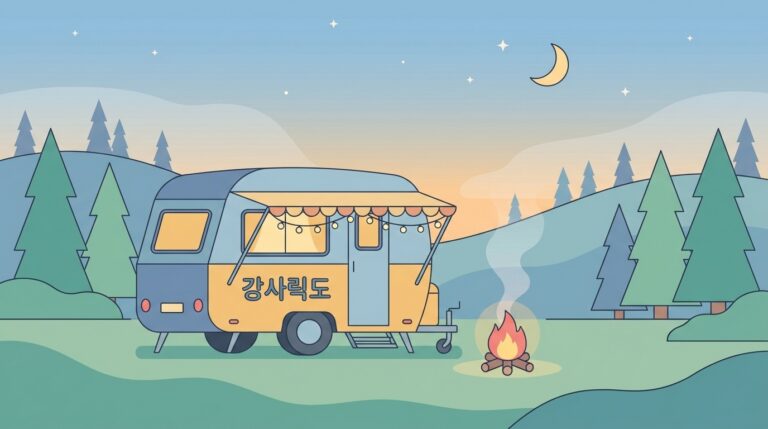
The Secret Magic of Korean Caravan Glamping: Talk Like an Insider Under the Stars
Phase 1: 공감 (Story-Immersive Opening)
안녕하세요! 매일한글 에디터입니다.
Imagine this: you’ve finally escaped Seoul’s frantic concrete jungle and arrived in the lush, pine-fringed hills of Gapyeong or the coastal cliffs of Yangyang. Parked in front of you is a sleek, retro-chic American-style airstream caravan draped in fairy lights. The air smells of pine needles and hardwood charcoal smoke. You step inside, marveling at the clever miniature ondol floor heating and tiny kitchenette. But suddenly, reality strikes. You need extra charcoal for the grill, the water pressure needs a tweak, and your campsite neighbors are setting up a glowing ambient lantern while murmuring phrases you never heard in any standard textbook.
You want to ask the campsite host (사장님) for BBQ essentials without sounding like an automated voice manual. You also want to casually bond with your camping crew over the open flame without awkward honorific blunders. Many of our advanced learners reach C1 and still freeze when navigating the hyper-niche, emotionally nuanced world of modern Korean recreational culture. This guide is crafted directly from field logs, real camper interactions, and insider community feedback to elevate your Korean beyond textbook stiffness into authentic, atmospheric fluency. Let’s turn you into that effortless companion who knows exactly what to say when the campfire sparks fly.
Phase 2: 핵심 표현 3선 심층 분석 (Key Expressions Deep Dive)
1. 감성 캠핑의 끝판왕이네요 (Gamseong kaemping-ui kkeutpanwang-ineyo)
- Pronunciation: [Gam-seong kaem-ping-ui kkeut-pan-wang-i-ne-yo] (Think: “Gahm-sung” + camping + “Kkut-pahn-wahng” like facing the final boss in an arcade game!)
- Meaning: Literal: “This is the final-stage boss of emotional camping.” | Nuance: “This is the absolute epitome of aesthetic, vibe-heavy glamping.”
- K-Culture Moment: Seen frequently on travel variety shows when cast members arrive at a meticulously decorated caravan site featuring ambient string lights, wooden milk crates, and retro drip-coffee sets.
- Editor’s Insight: The slang compound 끝판왕 (kkeutpanwang) originated in gaming culture (the “final boss”), but Koreans use it enthusiastically for anything unparalleled in its category. Paired with 감성 (gamseong)—that quintessential Korean concept of curated aesthetic melancholy and mood—this sentence instantly establishes your cultural fluency.
- Situation Spectrum: Casual ✅ | Semi-formal ✅ | Formal ⚠️ (Too colloquial for corporate reports, but completely fine when praising an elder campsite owner).
- 🤔 Think About It: Why does Korean pop-culture place such immense linguistic weight on curated “mood” (감성) compared to Western notions of rugged wilderness survival?
2. 불멍 때리면서 힐링하고 싶어요 (Bulmeong ttaerimyeonseo hillinghago sipeoyo)
- Pronunciation: [Bul-meong ttae-ri-myeon-seo hil-ling-ha-go si-peo-yo] (Rhymes with: “Bull-mung” [fire-daze] + “teh-ri” like hitting a beat + “healing”).
- Meaning: Literal: “I want to hit a fire-daze and do healing.” | Nuance: “I just want to zone out staring into the crackling fire and decompress.”
- K-Culture Moment: Protagonists in healing K-dramas sitting silently wrapped in fleece blankets, gazing transfixed into outdoor fire pits while drinking canned beer.
- Editor’s Insight: The compound noun 불멍 (bulmeong) merges 불 (fire) and 멍하니 (vacantly/dazed). Combined with the verb 때리다 (ttaerida)—slang for indulging deeply or spacing out—this phrase expresses profound mental relief through mindful sensory detachment.
- Situation Spectrum: Casual ✅ | Semi-formal ✅ | Formal 🚫 (Avoid in official business meetings unless sharing personal weekend anecdotes).
- 🤔 Think About It: How does the linguistic creation of terms like 불멍, 물멍 (water-daze), and 숲멍 (forest-daze) reflect modern Korea’s intense pursuit of micro-escapes from high-pressure urban life?
3. 바비큐 숯불 몇 시까지 피워 주실 수 있나요? (Babikyu sutbul myeot sikkaji piwo jusil su 있nayo?)
- Pronunciation: [Ba-bi-kyu sut-bul myeot si-kka-ji pi-wo ju-sil su in-na-yo?] (Think: “Soot-bool” rolling softly, followed by a gentle, rising honorific question tone).
- Meaning: Literal: “Until what time can you kindle the barbecue charcoal fire for us?” | Nuance: “What is the cutoff time for requesting grill charcoal service?”
- K-Culture Moment: Guests checking in at a caravan office, coordinating dinner plans before the owner locks up the outdoor equipment shed for the night.
- Editor’s Insight: Notice the polite auxiliary structure 피워 주실 수 있나요. In Korean caravan campsites, charcoal is rarely provided as raw supplies for guests to light alone; the management lights industrial briquettes with a high-powered torch. Using the verb 피우다 (to kindle/light up) marks your command of natural collocations.
- Situation Spectrum: Casual ⚠️ | Semi-formal ✅ | Formal ✅
- 🤔 Think About It: Notice the respectful honorific infix
-시-combined with polite request morphology. How does this soften transactional campground requests into warm, respectful community interactions?
Phase 3: 교과서 한국어 vs 진짜 한국어 (Textbook vs. Real Korean)
Situation A: Asking to adjust the caravan’s floor heating system
- 📖 교과서 한국어: 온돌 난방 장치를 켜 주시겠습니까? (Ondol nanbang jangchireul kyeo jusigesseumnikka? / “Would you please turn on the ondol heating device?”)
- 🗣️ 진짜 한국어: 바닥 보일러 좀 올려도 될까요? 방바닥이 살짝 서늘해서요. (Badak boilleo jom ollyeodo doelkkayo? Bangbadagi saljjak seoneulhaeseoyo. / “Could we turn up the floor boiler a bit? The floor feels slightly chilly.”)
- 💡 왜 다를까? Koreans rarely use mechanical jargon like “난방 장치” in leisure settings. Instead, they refer directly to the cozy tactile experience—바닥 보일러 and the sensation 서늘하다 (pleasantly cool or slightly nippy)—tempered with the softening adverb 살짝.
Situation B: Proposing to roast treats by the open flame
- 📖 교과서 한국어: 모닥불 앞에서 과자를 구워 먹읍시다. (Modakbul ap-eseo gwajareul guwo meogeupsida. / “Let us bake and eat confectionery snacks in front of the campfire.”)
- 🗣️ 진짜 진짜 한국어: 우리 마시멜로 구우면서 불멍 제대로 때리자! (Uri masimello gu-umyeonseo bulmeong jedaero ttaerija! / “Let’s roast marshmallows and properly space out by the fire!”)
- 💡 왜 다를까? The imperative “-읍시다” sounds archaic and authoritarian among peers. Contemporary C1 speakers prefer inclusive, colloquial bonding slang anchored by adverbs like 제대로 (properly/fully).
Phase 4: K-Culture 딥다이브 & 비언어적 매너 (Deep Dive & Manners)
4-1. 눈치 (Nunchi) & Caravan Etiquette
- The Footwear Transition: Korean caravans are micro-apartments. Never wear outdoor boots past the entryway step (현관 턱). Look down: you will find waterproof rubber slide sandals (삼선 슬리퍼). Wear those outside on the wooden deck, but kick them off inside.
- The 10 PM Manner Time (매너 타임): At 22:00, campsites transition into mandatory quiet hours. Lower your speaking volume to an intimate whisper, dim dazzling overhead lamps to warm amber LED lanterns, and avoid clanking metal cookware against stone surfaces.
- Two-Handed Fire Safety Gestures: When the campsite manager brings the glowing brazier (화로대), step back slightly to give them space, keep both hands visible at your sides or lightly folded in front of you, and bow your head slightly while saying “감사합니다!”.
4-2. Cultural Code: The Glamorization of “Chabak” & Emotional Escapes
Caravan camping in Korea sits at the intersection of traditional 풍류 (pungnyu)—the historical appreciation of landscape, poetry, and wine—and high-tech consumer comfort. Shows like Camping Club and Wheel on Wheels fueled an unprecedented obsession with turning automotive vehicles into miniature Scandinavian cabins. It isn’t survivalism; it is sensory preservation. Koreans camp to curate peace, sip craft makgeolli, and reclaim mental autonomy without giving up indoor plumbing.
Phase 5: 실전 롤플레이 시나리오 (Real-World Roleplay Scenario)
- Setting: Sunset at a scenic mountain caravan park in Pyeongchang. The sky is twilight violet. You are approaching the cheerful, fleece-vest-wearing campsite host, Park Sa-jang-nim.
- Characters:
- 민우 (Min-woo): You, an articulate international guest looking forward to dinner.
- 사장님 (Host): A welcoming, seasoned host carrying a fire-starter blowtorch.
민우: 🎭 (Smiling warmly, giving a respectful slight nod) 사장님, 오늘 노을이 진짜 예술이네요! 카라반 뷰가 대박이에요.
(Sajangnim, oneul no-euri jinjja yesur-ineyo! Karaban byuga daebag-ieyo. / “Boss, today’s sunset is a work of art! The caravan view is incredible!”)
사장님: 🎭 (Beaming with pride, adjusting his cap) 하하, 그렇죠? 오늘 날씨가 도와줬네요. 저녁 바비큐는 몇 시쯤 준비해 드릴까요?
(Haha, geureochyo? Oneul nalssiga dowajwotneyo. Jeonyeok babikyuneun myeot sijjeum junbihae deurilkkayo? / “Haha, right? The weather really cooperated today. Around what time shall I set up your dinner barbecue?”)
민우: 🎭 (Checking wristwatch, speaking with gentle consideration) 7시쯤 부탁드려도 될까요? 그리고 혹시 불멍용 장작도 같이 추가할 수 있나요?
(Ilgop-sijjeum butakdeuryeodo doelkkayo? Geurigo hoksi bulmeong-yong jangjakdo gachi chugahal su 있nayo? / “Could we ask for around 7:00? And by any chance, can we also add firewood for campfire zoning out?”)
사장님: 🎭 (Nodding enthusiastically) 그럼요! 오로라 가루 서비스로 하나 챙겨 드릴 테니까, 이따 불 피우고 나서 뿌려 봐요. 불꽃 색이 무지개처럼 변해요.
(Geureomyo! O-ro-ra garu seobiseuro hana chaenggyeo deuril tenikka, itta bul pi-ugo naseo ppuryeo bwayo. Bulkkot saegi mujigaecheoreom byeonhaeyo. / “Of course! I’ll throw in a complimentary pack of magical aurora powder, so scatter it after we light the fire. The flame colors shift like a rainbow!”)
민우: 🎭 (Clapping hands softly in delight) 와, 오로라 가루요? 센스 대박이시네요! 혹시 분리수거장은 어디에 있나요?
(Wa, o-ro-ra garuyo? Senseu daebag-isineyo! Hoksi bunrisugeojang-eun eodi-e 있nayo? / “Wow, aurora powder? Your thoughtfulness is amazing! By the way, where is the recycling drop-off area?”)
사장님: 🎭 (Pointing toward the wooden pavilion nearby) 관리동 바로 옆에 파란색 천막 보이죠? 거기가 분리수거장이에요. 일반 쓰레기는 카라반 안에 있는 종량제 봉투에 담아 주시고요.
(Gwallidong baro yeope paransaek cheonmak boijyo? Geogiga bunrisugeojang-ieyo. Ilban sseuregineun karaban an-e inneun jongnyangje bongtue dama jusigoyo. / “See that blue tent right next to the administration office? That’s the recycling station. Please put general waste into the government-issued standard garbage bag inside your caravan.”)
민우: 🎭 (Attentively nodding) 네, 깔끔하게 정리해 둘게요. 매너 타임은 10시부터 맞죠?
(Ne, kkalkkeumhage jeongnihae dulkeyo. Maeneo taimeun yeol-sibuteo matjyo? / “Understood, I’ll keep everything tidy. Manner Time starts at 10:00, right?”)
사장님: 🎭 (Pleased by the guest’s etiquette awareness) 네, 맞아요! 10시 이후엔 조용히 쉬시면 됩니다. 7시에 숯불 가지고 갈게요!
(Ne, majayo! Yeol-si ihuen joyonghi swisimyeon doemnida. Ilgop-sie sutbul gajigo galkeyo! / “Yes, precisely! Please rest quietly after 10:00. I’ll bring the charcoal over at 7:00!”)
🔀 인터랙티브 분기점 (Interactive Branching)
At 9:45 PM, a camper in the caravan next door starts playing loud hip-hop on a portable speaker. What do you do?
- Option A: Walk up aggressively and shout: “야! 지금 매너 타임인데 노래 꺼라!” (Hey! It’s manner time now, turn the music off!)
- ❌ Bad: Extremely confrontational. Using 반말 (informal speech) on strangers can provoke severe friction and ruin the campsite’s communal harmony.
- Option B: Silently tolerate it while seething, leave a scathing 1-star review on Naver Maps at 2:00 AM.
- ⚠️ Risk: Passive-aggressive. It spoils your peaceful night and penalizes the hardworking site host who was unaware of the disturbance.
- Option C: Send a discreet KakaoTalk message to the site host or visit the front desk: “사장님, 옆 카라반 음악 소리가 조금 커서요. 매너 타임 안내 방송 한 번만 부탁드려도 될까요?” (Boss, the caravan next door is playing music a bit loud. Could you please broadcast a reminder about Manner Time?)
- ✅ Best: Culturally immaculate. It respects campground hierarchy, avoids direct interpersonal conflict, and lets the host handle protocol gently.
Phase 6: 10초 감정 섀도잉 드릴 (Emotional Shadowing Drill)
Practice these natural cadences. Follow the pause markers (/) and embody the emotion tag!
[😊 감탄하며 / 황홀하게]
카라반 앞마당에서 / 노을 보면서 먹는 라면이 / 진짜 세상에서 제일 맛있네요.
(Karaban ammadang-eseo / no-eul bomyeonseo meongneun ramyeoni / jinjja sesang-eseo je-il masitneyo.)
“Eating ramyeon in the caravan yard / while watching the sunset / is truly the most delicious thing in the world.”-
[🔥 나른하고 / 편안하게]
아무 생각 없이 / 타닥타닥 타는 장작 소리 들으면서 / 불멍 때리니까 / 속이 다 풀려요.
(Amu saenggak eopsi / tadaktadak taneun jangjak sori deureumyeonseo / bulmeong ttaerinikka / sogi da pullyeoyo.)
“Without a single thought / listening to the crackling firewood / zoning out into the fire / all my stress just unravels.” -
[🙏 정중하고 / 배려심 넘치게]
저희 쓰레기 분리수거 다 끝냈고요, / 숯불 화로대 잔불도 / 확실하게 꺼 두었습니다.
(Jeohui sseuregi bunrisugeo da kkeunnaetgoyo, / sutbul hwarodae janbuldo / hwaksilhage kkeo dueotseumnida.)
“We finished sorting all our recycling, / and we made sure the residual charcoal embers / are completely extinguished.”
Phase 7: K-Culture 미니 사전 (Camping Mini Dictionary)
- 불멍 (Bul-meong): Camping slang referring to the therapeutic trance state achieved by gazing silently into a wood fire. Used universally across Korean social media as shorthand for mental detox.
- 차박 (Cha-bak): Overnight sleeping in modified personal cars or converted camper vans. The minimalist sibling of caravan glamping.
- 오로라 가루 (O-ro-ra Ga-ru): Copper/chemical packets tossed into campfires to produce mystical, Northern-Lights-style emerald and turquoise flames. A staple staple for Instagram-worthy “감성” nights.
- 매너 타임 (Mae-neo Ta-im): Camp regulations mandating complete outdoor quiet hours (typically 22:00 to 07:00). A cornerstone of modern Korean collective community respect.
Phase 8: 여행자를 위한 생존 키트 (Traveler’s Survival Kit)
서바이벌 표현 TOP 3
- 모기향이나 벌레 기피제 혹시 빌릴 수 있을까요?
(Mogihyang-ina beolle gipije hoksi billil su isseulkkayo?)
Pro Tip: Korean mountain campsites are prone to summer midges and mosquitoes. Hosts always keep spare spiral mosquito coils (모기향) in the office. - 카라반 온수가 갑자기 끊겼는데, 온수기 리셋 버튼이 어디 있나요?
(Karaban onsuga gapjagi kkeunkyeotneunde, onsugi riset beoteuni eodi 있nayo?)
Pro Tip: Caravan compact electric water heaters have smaller reservoir capacities (30–50 liters). If you run out of hot water, ask this phrase to reset the thermal breaker. - 체크아웃할 때 키는 테이블 위에 두고 문만 닫으면 되나요?
(Chekeu-authaltte kineun te-ibeul wie dugo munman dadeumyeon doenayo?)
Pro Tip: Many glamping sites use contactless checkout. Confirming key placement prevents unnecessary waiting.
Editor’s Travel Note
- Reservations & Navigation: Skip Google Maps for remote glamping valleys. Instead, reserve and check verified customer photo logs using the 캠핏 (Camfit) 캠핑 예약 앱 다운로드 and navigate scenic routes smoothly via 네이버 지도 길찾기 서비스.
- Local Payment Nuance: Most remote campsite convenience stores accept Apple Pay or Korean credit cards, but having 10,000 KRW cash notes ready is vital if you need to buy extra dry seasoned firewood bundles (장작 한 망) directly from local grandmothers roadside.
Phase 9: “한 발 더 깊이” (Cultural Essay)
In Korean apartment living, sensory expressions must always be restrained—floors are cushioned to avoid noise complaints (층간소음), curtains shield personal space, and ventilation quickly whisks cooking scents away. Caravan camping reverses this suppression. Within this compact, self-contained vehicle parked in open wilderness, Koreans reclaim tactile, sensory intimacy. It is a modern expression of 정 (Jeong): cooking together in cramped quarters, exchanging warm side dishes across picnic tables, and staring into the same embers without uttering a word. To camp in a Korean caravan is not to conquer nature, but to borrow a temporary sliver of quiet companionship.
💬 Your Turn: What does ideal outdoor relaxation look like in your home culture? Do you prefer rugged off-grid survivalism or cozy, aesthetic “gamseong” comfort? Share your thoughts below in Korean!
Phase 10: FAQ & 오해 방지 (FAQ Schema)
Q: Can I light my own campfire firewood using twigs gathered in the surrounding campsite forest?
A: It is strictly discouraged. Most Korean glamping grounds are located within national forest buffer zones where burning uninspected, wet pine branches causes excessive smoke and fire hazards. Always purchase kiln-dried firewood bundles (건조 장작) supplied by the campsite management.
Q: Is food included with a luxury caravan reservation in Korea?
A: Generally, no, unless you booked a specific “BBQ Meat Package” (바비큐 패키지). Caravans come equipped with refrigerators, microwave ovens, induction stoves, and cookware, but campers typically buy their groceries (pork belly 삼겹살, ramyeon, sausages, and fresh garlic) at a large mart like E-Mart or Hanaro Mart before arriving.
Q: What should I do with food scraps at the end of the night?
A: Never leave food trash or leftover meat on outdoor tables overnight. Korea’s mountain zones have active populations of raccoons, mountain cats (길고양이), and boars. Deposit food waste into the designated yellow food waste bin (음식물 쓰레기통) inside the washing station.
🚨 흔한 실수 (Common Mistakes) 경고판
- Mistake: Wearing muddy outdoor hiking shoes right into the caravan bedroom.
👉 Correct Action: Take shoes off at the tiny entrance vestibule and slip into indoor slippers immediately. - Mistake: Throwing household trash and aluminum beverage cans together in one bag.
👉 Correct Action: Separate clear plastic PET bottles, aluminum cans, and burnable waste at the recycling depot (분리수거). - Mistake: Playing acoustic guitars or bluetooth speakers past 22:00.
👉 Correct Action: Observe 매너 타임 (Manner Time) punctually to protect the tranquility of fellow campers.
Phase 11: 액션 미션 & 참여 유도 (Action Missions)
- 🥉 Bronze Mission (Solo Practice): Stand before a mirror and pronounce “불멍 때리면서 힐링하고 싶어요” with the correct pause rhythm three times.
- 🥈 Silver Mission (Social Media): Post a photo of an evening sky, candle, or campfire on Instagram and caption it: “오늘 밤은 감성 캠핑 모드! 불멍 시작 🔥”.
- 🥇 Gold Mission (Real-World Execution): Next time you visit a glamping caravan or guesthouse in Korea, ask the host: “바비큐 숯불 몇 시까지 준비해 주실 수 있나요?” with a confident bow.
- 🎮 K-Culture Mission: Watch an episode of a Korean variety show (such as House on Wheels or I Live Alone camping specials) and spot at least two instances of campers using the term 끝판왕 or 불멍.
Phase 12: 인터랙티브 퀴즈 챌린지 (Interactive Quiz)
1. 상황 판단 (Situational Judgment)
It is 19:30. You need extra charcoal for your caravan deck grill. Which expression is the most natural, polished C1-level request to the site host?
* A) 숯 더 내놔라, 고기 덜 익었다. (Sut deo naenwara, gogi deol ik-eotda.)
* B) 사장님, 바비큐 숯불 조금만 더 추가할 수 있을까요? (Sajangnim, babikyu sutbul jogeumman deo chugahal su isseulkkayo?)
* C) 불 관리 장치에 탄소 물질을 투입해 주십시오. (Bul gwalli jangchie tanso muljireul tu-iphae jusipsio.)
🔍 정답 및 해설 보기 (Click to reveal answer)
정답: B
해설: B is courteous, natural, and uses appropriate honorific request grammar. A is impolitely aggressive (반말), while C uses awkward, mechanical vocabulary that sounds absurd in conversational Korean.
2. 빈칸 채우기 (Fill in the Blank)
캠핑장에서 장작불을 멍하니 바라보며 잡생각을 비우는 행위를 가리켜 한국어로 ‘______’이라고 부릅니다.
(At a campsite, the act of vacantly watching firewood burn to clear one’s mind is called ‘______’ in Korean.)
🔍 정답 및 해설 보기 (Click to reveal answer)
정답: 불멍 (Bul-meong)
해설: 불 (fire) + 멍때리다 (to space out) forms the iconic contemporary lifestyle term ‘불멍’.
3. True / False 문화 퀴즈 (True or False)
In Korean caravan parks, 매너 타임 (Manner Time) is merely a casual suggestion; singing loudly and playing music outdoors until 1:00 AM is widely welcomed as good cheer.
🔍 정답 및 해설 보기 (Click to reveal answer)
정답: False
해설: 매너 타임 (Manner Time) is strictly maintained, usually beginning at 22:00. Failing to lower your voice and turn off loud sound equipment can result in campsite eviction or neighborhood complaints.






