

Phase 1: Empathy (Story-Driven Opening)
안녕하세요! 매일한글 에디터입니다.
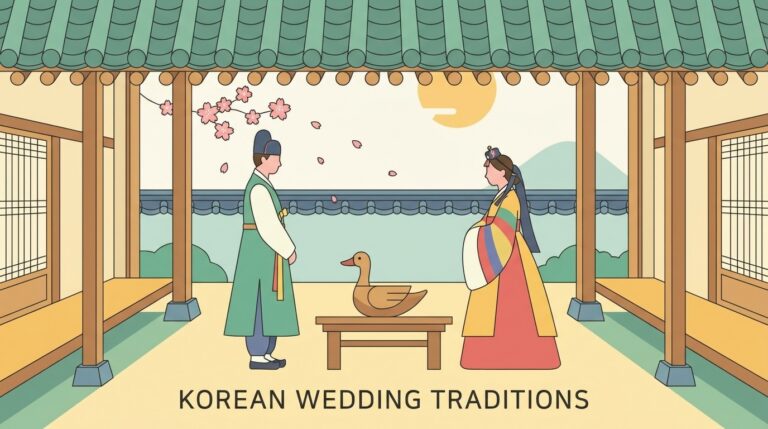
Imagine this: You are strolling through the picturesque courtyard of Namsangol Hanok Village on a crisp Saturday afternoon. Suddenly, the rhythmic clash of traditional gongs (꽹과리, kkwenggwari) echoes against stone walls. You turn the corner and see vibrant silk fabrics—deep blue and brilliant scarlet. A crowd has gathered under a wooden pavilion. Two families stand tall in gorgeous imperial-style Hanbok, surrounded by wooden geese, chestnut bowls, and ritual tables. You have just stumbled into an authentic Korean traditional wedding (전통혼례, jeontong hollye)!
Your heart races a little. It looks mesmerizing, but you hesitate. Can tourists just watch? What should I do if the bride looks my way? Is it rude to snap photos with my phone? What on earth do I say without sounding awkward?
Take a deep breath! Many of our Daily Hangul learners have experienced this exact freeze-frame moment. Today, you will learn the exact phrases, etiquette, and cultural secrets needed to enjoy a traditional Korean wedding smoothly. This guide is crafted from real traveler stories and tailored specifically for beginner (A2) speakers. By the end of this read, you won’t just be an anxious bystander—you will be a polite, confident, and welcome guest!
Phase 2: Core Expressions (Top 3)
Here are three essential expressions you need when witnessing a traditional Korean wedding ceremony.
1. 결혼 축하드립니다! (Gyeolhon chukha-deurimnida!)
- Pronunciation: [Gyeol-hon chuk-ha-deu-rim-ni-da] (Sounds like: “Gyeol-hon” + “chook-ha” as in a triumphant cheer + “dream-knee-da”)
- Meaning: Literal: “I give congratulations on your marriage.” | Real Nuance: “Heartfelt congratulations on your wedding!” (Polite & Formal)
- K-Culture Moment: You will hear this everywhere in K-Dramas whenever families meet at a wedding reception or bow to the elders.
- Editor’s Insight: Notice the ending 드립니다 (deurimnida). It comes from 드리다 (deurida), the humble form of “to give” (주다, juda). By humbling your act of giving congratulations, you show deep respect to the newlyweds and their families.
- Situation Spectrum: Casual 🚫 | Semi-formal ⚠️ | Formal ✅
- 🤔 Think About It: In English, we simply say “Congratulations!” Why do you think Korean builds respect into the very verb of giving good wishes?
2. 한복이 정말 고와요! (Hanbogi jeongmal gowayo!)
- Pronunciation: [Han-bogi jeong-mal go-wa-yo] (Sounds like: “Hahn-boh-ghee” + “jung-mahl” + “go-wah-yo”)
- Meaning: Literal: “The Hanbok is truly graceful/fine.” | Real Nuance: “Your Hanbok looks stunning and elegant!”
- K-Culture Moment: When historical drama heroines step out in royal wedding attire, family members marvel using the root 곱다 (gopda).
- Editor’s Insight: While 예뻐요 (yeppeoyo) means “pretty,” Koreans specifically use 고와요 (gowayo) for soft, exquisite, traditional elegance—especially silk clothing, colors, and gentle smiles.
- Situation Spectrum: Casual ⚠️ | Semi-formal ✅ | Formal ✅
- 🤔 Think About It: Does your language have a distinct word for “graceful beauty” that differs from everyday “cute” or “pretty”?
3. 사진 한 장 찍어도 될까요? (Sajin han jang jjigeodo doelkkayo?)
- Pronunciation: [Sa-jin han jang jji-geo-do doel-kka-yo?] (Sounds like: “Sah-jin hahn jahng” + “jee-gaw-doh” + “dwel-kkah-yoh”)
- Meaning: Literal: “May I click one sheet of photograph?” | Real Nuance: “Would it be okay if I take a photo?”
- K-Culture Moment: Spectators politely asking a wedding attendant or family member before photographing the ritual table.
- Editor’s Insight: The grammar pattern -아/어도 될까요? (-a/eodo doelkkayo?) is your magic key for polite permission across Korea. 한 장 (han jang) literally means “one sheet/shot,” which softens the request so you don’t sound intrusive.
- Situation Spectrum: Casual 🚫 | Semi-formal ✅ | Formal ✅
- 🤔 Think About It: How does asking for just “one photo” ease social pressure in different cultures?
Phase 3: Textbook Korean vs. Real-Life Korean
Let’s compare robotic book phrases with what native speakers actually say in the wedding courtyard.
Situation 1: Wishing the couple a lifetime of happiness
- 📖 Textbook Korean: 백년해로하십시오. (Baengnyeonhaerohasipsio. / Please grow old together for one hundred years.)
- 🗣️ Real-Life Korean: 행복하게 잘 사세요! (Haengbokhage jal saseyo! / Live happily and well!)
- 💡 Why is it different? The phrase Baengnyeonhaero is a classical four-character idiom (사자성어). While grand, saying it aloud at A2 level feels like an ancient scholar reciting poetry. Young and old Koreans prefer the warm, heartfelt wish: 행복하게 잘 사세요!
Situation 2: Complimenting the groom’s dignified presence
- 📖 Textbook Korean: 신랑이 대단히 늠름합니다. (Sillangi daedanhi neumneumhamnida. / The groom is extremely gallant.)
- 🗣️ Real-Life Korean: 신랑 진짜 멋있어요! (Sillang jinjja meosisseoyo! / The groom looks so cool and handsome!)
- 💡 Why is it different? Words like 늠름하다 (neumneumhada) are common in period literature. In everyday conversation, native speakers naturally exclaim 멋있어요! (meosisseoyo!) to deliver a bright, genuine compliment.
Phase 4: K-Culture Deep Dive & Non-Verbal Manners
4-1. Nunchi (눈치) & Courtyard Gestures
- Watch the Center Path: In a traditional ceremony, the central path between the courtyards is reserved for ritual offerings and the bride and groom. Even when taking photos, never step onto the ceremonial mats or block the helpers carrying wooden trays.
- Two-Hand Rule (두 손): If a family member offers you wedding rice cakes (답례떡, dangnye-tteok) or an informational leaflet, always receive it with both hands while giving a gentle 15-degree bow.
- Respectful Distance: Traditional weddings follow an ancient sacred liturgy (혼례례). Keep your camera shutter muted if possible, and avoid calling out loudly while the officiant (집례, jimnye) reads the vows.
4-2. Culture Code: The Wooden Wild Goose (기러기, Gireogi)
During the ceremony, you will notice the groom presenting a carved wooden goose (기러기) to the bride’s mother. In Korean lore, wild geese mate for life and maintain strict harmony. If one partner dies, the other mourns and does not seek another mate. By offering the wooden goose, the groom pledges eternal loyalty, trustworthiness, and devotion. It is a moment of solemn beauty that symbolizes family trust rather than mere romantic passion.
Phase 5: Real-Life Roleplay Scenario
Setting: An open courtyard at a Hanok Village. You are watching a ceremony, and an event assistant, Min-ji (wearing a modern pastel Hanbok), steps over to greet you.
- Turn 1 (Min-ji): 안녕하세요! 오늘 전통 혼례 보러 오셨어요? (Annyeonghaseyo! Oneul jeontong hollye boreo osyeosseoyo? / Hello! Did you come to watch the traditional wedding today?)
- Turn 2 (You): 네! 처음 봐서 너무 신기해요. (Ne! Cheoeum bwaseo neomu singihaeyo. / Yes! It’s my first time seeing it, so it’s really fascinating.)
- Turn 3 (Min-ji): 🎭 (Points gently toward the ritual table) 저기 나무 기러기 보이세요? 평생 함께하겠다는 약속이에요. (Jeogi namu gireogi boiseyo? Pyeongsaeng hamkkehagetdaneun yaksogieyo. / Do you see the wooden goose over there? It’s a promise to stay together for life.)
- Turn 4 (You): 🎭 (Smiling with admiration) 와, 의미가 정말 아름답네요! (Wa, uimiga jeongmal areumdapneyo! / Wow, that meaning is truly beautiful!)
- Turn 5 (Min-ji): 이제 곧 신랑 신부가 맞절을 해요. 조금 더 앞에서 보실래요? (Ije got sillang sinbuga matjeoreul haeyo. Jogeum deo ap-eseo bosillaeyo? / The bride and groom will bow to each other soon. Would you like to watch from a bit closer?)
- Turn 6 (You): 🎭 (Taking out your camera cautiously) 감사합니다! 혹시 사진 한 장 찍어도 될까요? (Gamsahamnida! Hoksi sajin han jang jjigeodo doelkkayo? / Thank you! By any chance, may I take a photo?)
- Turn 7 (Min-ji): 네, 괜찮아요! 식에 방해만 안 되면 돼요. (Ne, gwaenchanayo! Sige banghaeman an doemyeon dwaeyo. / Yes, of course! As long as it doesn’t disturb the ceremony, you’re fine.)
- Turn 8 (You): 🎭 (Bowing politely to Min-ji) 네, 조용히 찍을게요. 감사합니다! (Ne, joyonghi jjigeulgeyo. Gamsahamnida! / Yes, I’ll take it quietly. Thank you!)
🔀 Interactive Decision Point
The ceremony concludes! The newlyweds walk past spectators. What do you do?
- Option A: Shout loudly: “야! 신랑! 여기 봐!” (Ya! Sillang! Yeogi bwa! / Hey! Groom! Look here!)
- Option B: Clap politely, smile, and say: “결혼 축하드립니다! 행복하세요!” (Gyeolhon chukha-deurimnida! Haengbokhaseyo!)
- Option C: Run directly in front of their path to take a close-up selfie.
Feedback:
* Option A (Bad): Using informal pronouns (야) and casual speech in a formal family ritual will cause instant second-hand embarrassment (수치심).
* Option B (Best): Pure cultural mastery! You show etiquette, warmth, and give blessings using formal speech.
* Option C (Risk): High risk of bumping into ceremonial attendants holding heavy brass trays or tearing traditional silk robes.
Phase 6: 10-Second Emotion Shadowing Drill
Practice these emotional nuances out loud! Pause at each slash mark (/).
- [😊 Amazed and joyful]
한복 색깔이 / 진짜 고와요!
(Hanbok saekkkari / jinjja gowayo! / The Hanbok colors / are truly lovely!) -
[🥺 Respectful and cautious]
실례지만, / 사진 한 장 / 찍어도 될까요?
(Sillyejiman, / sajin han jang / jjigeodo doelkkayo? / Excuse me, but / may I / take a photo?) -
[🎉 Bright and heartfelt]
두 분, / 결혼 축하드립니다! / 행복하게 잘 사세요!
(Du bun, / gyeolhon chukha-deurimnida! / Haengbokhage jal saseyo! / To both of you, / congratulations on your marriage! / Live happily and well!)
Phase 7: K-Culture Mini Dictionary
- 신랑 / 신부 (Sillang / Sinbu) | Groom / Bride
- Everyday usage: Used at all Korean weddings. You will hear hosts announce: “신랑 입장!” (Sillang ipjang! / Groom, enter!).
- 축의금 (Chuk-uigum) | Congratulatory wedding money
- Everyday usage: Cash gifted in white envelopes to support the newlywed couple’s beginning. Guests write their names vertically on the back.
- 기러기 (Gireogi) | Wild goose (Wooden wedding goose)
- Cultural usage: A core symbol of fidelity presented by the groom to the mother-in-law during the Jeonanrye (전안례) rite.
- 폐백 (Pyebaek) | Post-ceremony family greeting
- Cultural usage: A private family ritual where the bride throws dates and chestnuts into her apron to symbolize healthy children.
Phase 8: Survival Kit for Travelers
Top 3 Survival Phrases
- 어디서 보면 돼요? (Eodiseo bomyeon dwaeyo?)
- Pronunciation: [Eo-di-seo bo-myeon dwae-yo?]
- Pro Tip: Use this to ask staff where spectators are permitted to stand without blocking the walkway.
- 식권은 어디서 받나요? (Sikgwoneun eodiseo bannayo?)
- Pronunciation: [Sik-gwo-neun eo-di-seo ban-na-yo?]
- Pro Tip: If you were officially invited by a Korean friend, ask this to get your wedding banquet meal ticket.
- 화장실이 어디예요? (Hwajangsiri eodiyeyo?)
- Pronunciation: [Hwa-jang-si-ri eo-di-ye-yo?]
- Pro Tip: Traditional courtyard venues are spacious; locate restrooms before the 40-minute ceremony starts.
Editor’s Travel Note
- Where to watch free traditional weddings: Plan a weekend trip to Namsangol Hanok Village in central Seoul. During spring (April–June) and autumn (September–October), real traditional weddings frequently take place on Saturdays at 11:00 AM and 1:00 PM.
- Navigation Tip: Always download and use the Naver Map application on your phone rather than Google Maps, as walking directions in historic sites are much more accurate.
Phase 9: “One Step Deeper” (Cultural Reflection)
In Western traditions, weddings often highlight personal romance and the individual couple. In Korea, a traditional wedding has always been a communal feast (잔치, janchi). It unites two entire family lineages (가문) and invites neighbors to share food and fortune. Even passersby who stopped to watch the ceremony were historically treated as blessed witnesses and offered warm rice cake soup (잔치국수). When you offer your warm words today, you aren’t an outsider—you become part of that shared communal celebration.
💬 Your Turn: Have you ever attended a wedding in another country? How do wedding traditions in your home culture compare to the symbolic vows of Korea? Share your story in the comments below!
Phase 10: FAQ & Common Mistakes
Q: Can foreign tourists watch a traditional Hanok wedding if they don’t know the couple?
A: Yes! Most outdoor Hanok village weddings take place in open cultural parks where spectators are welcome to watch quietly from the designated perimeter.
Q: What should I wear if I am officially invited to a Korean traditional wedding?
A: Neat semi-formal attire (a collared shirt, clean trousers, or a modest dress) is ideal. Avoid wearing all-white outfits, as white is traditionally reserved for the bride.
Q: Do I need to give an envelope of money (축의금) if I am just a passing spectator?
A: Not at all! Only officially invited family, friends, and colleagues submit monetary gifts. Enthusiastic claps and polite congratulations from spectators are more than enough.
🚨 Common Mistakes Alert
- Calling the Hanbok a Kimono: Hanbok has distinct silhouettes and cultural history. Always refer to it proudly as 한복 (Hanbok).
- Handing things with one hand: When interacting with elders or event helpers, handing an item with one hand feels dismissive. Support your right forearm with your left hand.
- Using “축하해!” (Chukhahae!): Dropping honorifics at a wedding sounds overly familiar and rude unless speaking to your childhood friend. Stick to 축하드립니다! (Chukha-deurimnida!).
Phase 11: Action Missions
- 🥉 Bronze Mission (Solo Practice): Stand in front of your mirror and practice saying: “한복이 정말 고와요!” three times with a bright, appreciative smile.
- 🥈 Silver Mission (Social Connection): The next time you see a Korean traditional wedding photo on Instagram or YouTube, leave a polite comment: “결혼 축하드립니다! 행복하세요!”
- 🥇 Gold Mission (Real-World Mastery): Visit a Hanok village or folk village during your trip to Korea and use: “사진 한 장 찍어도 될까요?” before photographing a traditional landmark or attire.
- 🎮 K-Culture Mission: Watch an episode of a historical drama (like Mr. Queen or The King’s Affection) and spot the wooden goose (기러기) or traditional headwear (사모관대) during a royal ceremony!
Phase 12: Interactive Quiz Challenge
Test what you’ve learned before you head out to the wedding pavilion!
1. Situation Quiz: The bride walks past you after the ceremony wearing a stunning crimson gown. What is the most culturally fitting compliment?
* (A) 옷이 편해 보여요! (The clothes look comfortable!)
* (B) 한복이 정말 고와요! (The Hanbok is truly lovely!)
* (C) 옷이 비싸 보여요! (The clothes look expensive!)
2. Fill-in-the-Blank:
* “사진 한 장 ________ 될까요?” (May I take a photo?)
3. True or False:
* The carved wooden goose (기러기) symbolizes wealth and gold in a Korean traditional wedding. (True / False)
👉 Click here to reveal answers & explanations!
Answers:
1. (B) 한복이 정말 고와요! — 곱다 is the most respectful and natural aesthetic compliment for Hanbok.
2. 찍어도 — The full sentence is: 사진 한 장 찍어도 될까요?
3. False — The wooden goose represents lifelong fidelity, harmony, and loyalty, not monetary wealth!






