

Phase 1: 공감 (Story Immersion Opening)
안녕하세요! 매일한글 에디터입니다.
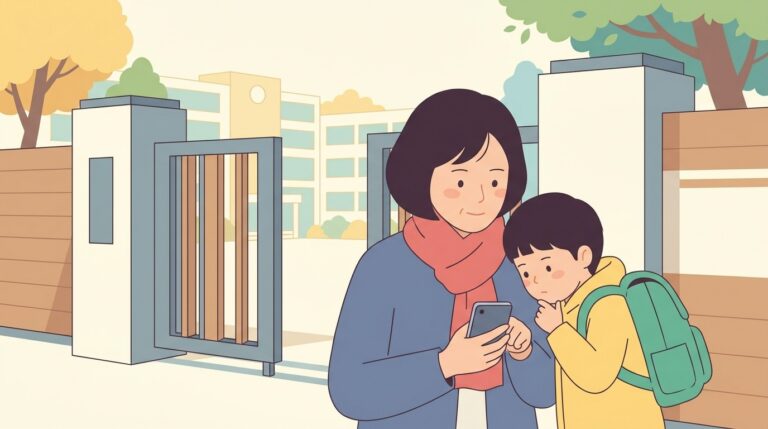
Picture this: You are sipping an iced Americano in a sunlit bakery cafe right in front of an elementary school in Bundang or Daechi-dong around 2:30 PM. The bell rings, and within minutes, the cafe and sidewalk are swarmed with lively 3rd and 4th graders carrying colorful badminton rackets and piano sheet music bags. But look closer at their hands. Almost every child is either frantically tapping away on KakaoTalk or holding a sleek device up to their ears, reporting their exact coordinates to their mothers: “엄마, 나 수학 학원 출발해!” (Mom, I’m heading out to math academy!)
Beside you, two Korean mothers are engaged in a tense, hushed debate over their half-eaten salt bread. One sighs deeply, clutching her forehead: “우리 준우, 4학년 올라가는데 아직도 폴더폰이거든요. 애들끼리 단톡방 없으면 모둠 과제도 못 낀다는데… 솔직히 쥐여주자니 스마트폰 중독될까 봐 밤마다 잠이 안 와요.” (My Jun-woo is going into 4th grade and still uses a flip phone. They say he can’t even join group study projects without group chats… But honestly, handing him a smartphone keeps me up at night worrying about screen addiction.)
If you are raising a child in Korea or navigating conversations with Korean parents, this dilemma represents a monumental cultural rite of passage. In South Korea’s hyper-connected, fast-paced educational ecosystem, a child’s first smartphone is never merely a gadget—it is an intricate intersection of hyper-vigilant safety, intense peer belonging, and digital parenting dilemmas. Today, grounded in authentic stories from our multicultural learners and local school community dynamics, we explore the nuanced, high-level vocabulary you need to discuss the universal parenting conundrum: When is the right time to give an elementary student their first smartphone?
Phase 2: 핵심 표현 3선 심층 분석
1. 스마트폰을 손에 쥐여주다 (Seumateuphoneul sone gwiyeojuda)
- Pronunciation: [Seu-ma-teu-pon-eul so-ne gwi-yeo-ju-da] (Think of gwiyeo flowing like “gwee-yuh”, smoothly blending into ju-da).
- Meaning: Literally “to place a smartphone into one’s hand,” but pragmatically loaded with the nuanced implication of relinquishing control, bestowing digital agency, or yielding to a child’s persistent requests.
- K-Culture Moment: Seen frequently in parenting documentaries like Geumjjok Gateun Nae Saekki (My Golden Kids), where stressed parents confess: “너무 일찍 쥐여준 것 같아요” (I feel like I placed it in their hands far too early).
- Editor’s Insight: While simply saying “스마트폰을 사주다” (to buy a smartphone) is transactional, “손에 쥐여주다” conveys emotional weight and potential anxiety. It frames the act as giving the child an open door to an unregulated world.
- Situation Spectrum: Casual ✅ | Semi-formal ✅ | Formal ✅
- 🤔 Think About It: In your home culture, does buying technology carry the visceral nuance of physically “surrendering” autonomy into a minor’s grasp, or is it merely viewed as upgrading household tools?
2. 친구들 사이에서 겉돌까 봐 걱정돼요 (Chingudeul saieseo geotdolkkabwa geokjeongdwaeyo)
- Pronunciation: [Chin-gu-deul sa-i-e-seo geot-dol-kka-bwa geok-jeong-dwae-yo] (Pay attention to the double consonant tension in kkabwa, sharp like the English “c” in “scout”).
- Meaning: “I worry they might hover around the outer periphery / drift aimlessly on the fringes among their friends.”
- K-Culture Moment: A hallmark phrase in Korean neighborhood Mom Cafes (맘카페), reflecting the deep-seated fear of relational exclusion when a child cannot participate in real-time gaming sessions (Brawl Stars, Roblox) or class Kakao group chats (단톡방).
- Editor’s Insight: The verb 겉돌다 captures a spinning object failing to mesh with gears—it paints an agonizing portrait of social alienation. Using this expression signals profound sociological empathy for peer-pressure mechanics in Korea.
- Situation Spectrum: Casual ✅ | Semi-formal ✅ | Formal ⚠️
- 🤔 Think About It: How does your native language describe passive social ostracization compared to deliberate bullying? Notice how 겉돌다 centers the child’s isolated trajectory.
3. 밀당을 현명하게 해야죠 (Mildangeul hyeonmyeonghage haeyajo)
- Pronunciation: [Meel-dang-eul hyeon-myeong-ha-ge hae-ya-jyo] (Flows crisply; mildang mirrors the rhythmic bounce of “meal-dahng”).
- Meaning: “We must manage the push-and-pull (negotiation/boundary setting) wisely.”
- K-Culture Moment: Originating as romantic dating slang (밀고 당기기, push-and-pull), high-proficiency Korean speakers use this ubiquitously in parenting and negotiation contexts to describe setting screen-time boundaries without provoking rebellion.
- Editor’s Insight: C2 mastery involves utilizing colloquial cultural metaphors in high-stakes discussions. Saying 밀당 humanizes the strict disciplinary rule-making process into an ongoing, dynamic dialogue.
- Situation Spectrum: Casual ✅ | Semi-formal ✅ | Formal 🚫
- 🤔 Think About It: Is boundary negotiation between parents and children treated as an adversarial struggle or a playful, relational dance (밀당) in your society?
Phase 3: 교과서 한국어 vs 진짜 한국어
Situation 1: Discussing Exclusion in Class Group Chats
- 📖 교과서 한국어 (Textbook):
스마트폰이 없으면 또래 집단과의 의사소통에서 배제될 우려가 있습니다. (Seumateuphoni eopseumyeon ttorae jipdangwaui uisasotongi baejedoel uryeoga itseumnida.)
Translation: If they do not have a smartphone, there is a risk of exclusion from communication within their peer cohort. - 🗣️ 진짜 한국어 (Real-World C2):
요즘 애들은 단톡방에 안 끼면 모둠 활동은커녕 생일파티 연락도 못 받아서 자연스레 튕겨 나가더라고요. (Yojeum aedeureun dantokbange an kkimeon modum hwaldongeonkeonyeong saeng-ilpati yeollakdo mot badaseo jayeonseure twinggyeo nagadeoragoyo.)
Translation: Nowadays, if kids aren’t in the group chat, let alone group project coordination, they don’t even get birthday party invites, so they naturally end up bouncing right out of the circle. - 💡 왜 다를까? Textbook Korean relies on rigid, clinical sociological terms (의사소통 배제), while natural native Korean deploys kinetic, everyday verbs like 끼다 (to squeeze in) and 튕겨 나가다 (to bounce/ricochet outward) alongside the connective idiom ~은/는커녕 (let alone).
Situation 2: Establishing Ground Rules Before Purchasing
- 📖 교과서 한국어 (Textbook):
스마트폰 구매 이전에 이용 규칙을 준수하도록 교육해야 합니다. (Seumateuphone gumae ijeone iyong gyuchigeul junsuhadorok gyoyukhaeya hamnida.)
Translation: Before purchasing a smartphone, one must educate them to comply with usage rules. - 🗣️ 진짜 한국어 (Real-World C2):
폰 압수 엔딩으로 얼굴 붉히기 전에, 사용 시간 잠금장치랑 규칙부터 똑부러지게 박아둬야 나중에 뒤탈이 없어요. (Pon apsu ending-euro eolgul bulkhigi jeone, sayong sigan jamgeumjangchirang gyuchikbuteo ttokbuleojige bagadwoya najunge dwitari eopseoyo.)
Translation: Before we end up with red faces over a confiscated-phone finale, you have to lock in time limits and nail down firm ground rules upfront so there are no headaches down the line. - 💡 왜 다를까? Real Korean conversations weave English loanword blends (~엔딩, ~ending), tactile colloquialisms (똑부러지게 박아두다, to nail down decisively), and cautionary idiomatic warnings (뒤탈이 없다, no lingering negative fallout).
Phase 4: K-Culture 딥다이브 & 비언어적 매너
4-1. 눈치 (Nunchi) & Non-Verbal Etiquette Among Korean Parents
When discussing children’s tech adoption in Korean social spaces—such as class parent gatherings (학부모 모임) or neighborhood academy pick-up lines—extreme nunchi is essential.
* The Humble Pivot: Never boast that your 2nd grader managed without a phone or that you immediately bought them the latest flagship iPhone. Use self-effacing sighs (“아유, 저희 애만 늦은 줄 알고 발 동동 굴렀잖아요” – Oh dear, I was stamping my feet in panic thinking only my child was lagging behind).
* Eye Contact & Sympathetic Head Tilts: Nod slowly with a lowered gaze when another parent vents about screen addiction (스몸비, smartphone zombies). Crossing your arms or offering unsolicited rigid solutions can come off as patronizing (훈계조).
4-2. The Cultural Phenomenon: The Kids Phone (키즈폰) vs. Hakwon Logistics
In South Korea, the decision to give a child a phone is fundamentally tied to urban safety and logistical precision. Korean elementary students frequently commute unassisted between elementary school and multiple after-school academies (학원)—Taekwondo, English, piano, and robotics.
Parents initially settle for a 키즈폰 (Kids Phone): a device equipped with location tracking (GPS), call controls, and minimal internet functionality. However, by 3rd or 4th grade, peer dynamics shift abruptly. Children begin to view 키즈폰 as a childish badge of helicopter parenting, demanding regular smartphones to play mobile games together and swap stickers on KakaoTalk. Thus, the smartphone transition in Korea is less about digital luxury and more about an emotional negotiation over safety, autonomy, and social acceptance.
Phase 5: 실전 롤플레이 시나리오
Setting: A modern bakery cafe in Pangyo’s tech corridor. Min-ji and Su-jin, both mothers of 3rd graders, sit down while waiting for their children’s English hagwon class to finish.
- 민지 (Min-ji): 수진 씨, 이번 주말에 지우 키즈폰 바꿀까 고민 중이에요. 슬슬 일반 폰으로 갈아타야 할 시기인가 싶어서요.
(Sujin ssi, ibeon jumare Jiu kijeupon bakkulkka gomingo-in jung-ieyo. Seulseul ilban pon-euro garataya hal sigi-inga sipeoseoyo.)
“Sujin, I’m contemplating changing Ji-woo’s Kids Phone this weekend. I’m wondering if it’s gradually time to switch to a regular smartphone.”
🎭 Looking pensively into her cup, stirring the straw with hesitation. -
수진 (Su-jin): 벌써요? 지우 아직 3학년이잖아요. 한번 손에 쥐여주면 돌이키기 힘든 거 아시죠?
(Beolsseoyo? Jiu ajik samhangnyeon-ijanh-ayo. Hanbeon sone gwiyeojumyeon dorikigi himdeun geo asijyo?)
“Already? Ji-woo is only in 3rd grade. You know that once you place it in their hands, there’s no turning back, right?”
🎭 Widening her eyes slightly, leaning across the table in conspiratorial concern. -
민지 (Min-ji): 저도 알죠. 근데 반 애들이 죄다 단톡방에서 모여 노니까, 지우만 대화에 못 끼고 겉도는 눈치더라고요.
(Jeodo aljyo. Geunde ban aedeuri joeda dantokbang-eseo moyeo nonikka, Jiuman daehwa-e mot kkigo geotdoneun nunchideoragoyo.)
“I know that too. But with all the kids in her class hanging out in group chats, I sense that only Ji-woo can’t chime in and is drifting on the perimeter.”
🎭 Letting out a soft, helpless sigh while tapping her fingers on the table. -
수진 (Su-jin): 아… 또래 집단에서 소외감 느끼는 건 또 다른 문제긴 하네요. 그 나이대엔 소외감이 제일 무섭잖아요.
(A… ttorae jipdan-eseo so-oegam neukkineun geon tto dareun munjegin haneyo. Geu nai-dae-en so-oegami je-il museopjanh-ayo.)
“Ah… feeling alienated among peers is another issue entirely. At that age, feeling left out is the absolute scariest thing.”
🎭 Her expression softening into empathetic realization with slow nods. -
민지 (Min-ji): 맞아요. 숙제 공지도 단톡방으로 주고받는다는데, 저 혼자 버티는 게 능사는 아닌 것 같아요.
(Majayo. Sukje gongjido dantokbang-euro jugobatneundaneunde, jeo honja beotineun ge neungsaneun anin geot gatayo.)
“Exactly. They even share homework notices via group chats, so digging my heels in alone doesn’t seem like the wisest answer.”
🎭 Gently furrowing her brows in genuine inner conflict. -
수진 (Su-jin): 그럼 기기만 최신형으로 사주되, 패밀리링크로 사용 앱이랑 스크린 타임은 꽉 잡아두는 건 어때요?
(Geureom gigiman choesin-hyeong-euro sajude, Paemilliringkeuro sayong aep-irang seukeurin taimeun kkwak jabaduneun geon eottaeyo?)
“Then how about buying a standard device, but locking down app permissions and screen time firmly using Family Link?”
🎭 Pointing her index finger upward decisively as a pragmatic compromise. -
민지 (Min-ji): 사전에 서약서라도 한 장 쓰고 확실하게 밀당을 시작해야겠네요. 잔소리꾼 엄마 되기 싫었는데 말이에요.
(Sajeone seoyakseorado han jang sseugo hwaksilhage mildang-eul sijakhaeyagetneyo. Jansorikkun eomma doegi silheotneunde marieyo.)
“I guess I should draft a written pledge beforehand and firmly start this push-and-pull. I really didn’t want to become a nagging mom, though.”
🎭 Laughing dryly with mixed resignation and resolve. -
수진 (Su-jin): 다들 그렇게 겪으며 크는 거죠! 주말에 지우랑 잘 담판 짓고 후기 공유해 줘요.
(Dadeul geureoke gyeokkeumyeo keuneun geojyo! Jumare Jiurang jal dampan jitgo hugi gong-yuhae jwoyo.)
“That’s how everyone grows through trial and error! Settle negotiations smoothly with Ji-woo this weekend and share your review with me.”
🎭 Patting Min-ji’s wrist with a warm, encouraging smile.
🔀 인터랙티브 분기점 (Interactive Choice)
Min-ji turns to you and asks: “선생님댁은 아이 첫 스마트폰 언제 어떻게 넘어가셨어요?” (How did your family transition to a first smartphone?) How do you respond?
- Option A: “애들 세상에선 친구가 전부니까 그냥 쿨하게 아무 제약 없이 사주고 믿고 맡기시는 게 최고예요.”
- Feedback (Risk): Culturally dissonant. Native parents will perceive this as dangerously permissive (방임). In Korean educational hubs, complete digital freedom without supervision is viewed as reckless parental neglect.
- Option B: “중학교 들어갈 때까지는 무조건 폴더폰으로 버티게 하는 게 정답입니다. 스마트폰은 독이에요.”
- Feedback (Bad): Dogmatic and insensitive. Ignoring the genuine trauma of peer isolation (소외감) in Korea’s group-oriented school culture will instantly stifle constructive empathy in the conversation.
- Option C: “아이와 사용 규칙 서약서를 작성하고, 주말에만 단톡방을 허용하는 식으로 서서히 타협점을 찾아가는 부모님들이 많더라고요.”
- Feedback (Best!): Flawless C2 sociolinguistic competence. It respects the child’s relational needs while affirming prudent parental stewardship through realistic boundaries (타협점).
Phase 6: 10초 감정 섀도잉 드릴
Sharpen your cadence, pause placements (/), and emotional inflection.
- [🥺 아쉽고 속상한 목소리로 / Pensive & Troubled]
우리 애만 / 단톡방에 못 껴서 / 친구들 사이에서 / 겉돌까 봐 / 그게 제일 마음에 걸려요.
(Uri aeman / dantokbange mot kkeoseo / chingudeul saieseo / geotdolkkabwa / geuge je-il ma-eume geollyeoyo.)
“My child alone / can’t join the group chat / so drifting on the periphery among peers / that weighs on my mind the most.” -
[🧐 단호하지만 지혜롭게 조언하며 / Firm yet Sagely Pragmatic]
한번 손에 쥐여주면 / 끝이니까, / 사용 규칙부터 / 똑부러지게 박아두고 / 시작하셔야 해요.
(Hanbeon sone gwiyeojumyeon / kkeut-inikka, / sayong gyuchikbuteo / ttokbuleojige bagadugo / sijakhasyeoya haeyo.)
“Once you place it in their hands / it’s done, / so starting with ground rules / hammered down decisively / is how you must begin.” -
[😅 너털웃음을 지으며 공감할 때 / Self-Deprecating & Relieved Chuckle]
스마트폰 때문에 / 매일 밤 벌어지는 밀당은, / 대한민국 부모라면 / 누구나 겪는 통과의례죠.
(Seumateupon ttaemune / maeil bam beoreojineun mildang-eun, / daehanminguk bumoramyeon / nuguna gyeokneun tong-gwauiryejyo.)
“The daily push-and-pull battle / over smartphones every night / is a rite of passage / that every single parent in Korea experiences.”
Phase 7: K-Culture 미니 사전
-
키즈폰 (Kijeupon / Kids Phone)
- Translation: Dedicated Child Feature-Smartphone.
- Real-World Nuance: Tailored entry-level mobile devices equipped with GPS geofencing, character designs (Kakao Friends, Pokémon), and heavy parental control filters. Usually used in grades 1–3 before children fiercely reject them as “uncool baby phones.”
- 단톡방 지옥 (Dantokbang Jiok / Group Chat Hell)
- Translation: The Nightmare of Relentless Group Chats.
- Real-World Nuance: The phenomenon where school classes establish dozens of unsupervised KakaoTalk group chats. It can quickly degenerate into exclusion, cyber-ostracism, or relentless notification fatigue for young students.
- 스몸비 (Seumombi / Smombie)
- Translation: Smartphone Zombie.
- Real-World Nuance: A blend of 스마트폰 and 좀비. Widely used by school guidance counselors and safety signs near Korean crosswalks (스쿨존, School Zones) to warn students walking with their faces buried in screens.
- 맘카페 발 정보 (Mamkape-bal Jeongbo / Intel Sourced from Mom-Cafes)
- Translation: Word-of-mouth intelligence from regional Naver Mom Cafes.
- Real-World Nuance: Hyper-localized, immensely influential community forums where Korean parents source recommendations on academy teachers, pediatrician clinics, and the precise timing of when local peer groups transition to personal smartphones.
Phase 8: 여행자를 위한 생존 키트 (Parenting & Living in Korea)
서바이벌 표현 TOP 3
- 1. 위치 추적 앱 연동되나요? (Wichi chujeok aep yeondongdoenayo?)
- “Can this phone pair with parental location tracking apps?”
- Pro Tip: Essential when visiting an electronics retailer or telecom agency (대리점) to set up a child’s mobile line.
- 2. 키즈 요금제로 추천해 주세요. (Kijeu yogeumjero chucheonhae juseyo.)
- “Please recommend a cost-effective kids’ telecom rate plan.”
- Pro Tip: Korean telecom carriers (SKT, KT, LGU+) offer dedicated micro-data tiers that automatically restrict adult content and limit high-cost micro-transactions.
- 3. 단톡방 알림은 무음으로 해 둬. (Dantokbang allimeun mueum-euro hae dwo.)
- “Keep your class group chat notifications muted.”
- Pro Tip: A crucial domestic household directive to prevent children from being distracted during study sessions.
Editor’s Travel & Living Note
For families residing in Korea, school-to-home coordination requires native digital navigation tools. Download the 네이버 지도 앱 다운로드 to track real-time bus arrivals for your child’s academy shuttles. Moreover, rather than third-party trackers that drain battery life rapidly, Korean public safety initiatives frequently recommend municipal platforms like 스마트안심드림 앱 다운로드, an official anti-cyberbullying app sponsored to monitor suspicious distress keywords on minor devices.
Phase 9: “한 발 더 깊이” (생각 질문)
South Korean society operates on a uniquely tight-knit collectivist fabric, where personal milestones are heavily benchmarked against one’s peer group. When a Korean child asks for a smartphone in 3rd grade, the request rarely stems from a desire for solitary digital entertainment; rather, it is a desperate quest for communal presence. In a society where intense after-school schedules leave very little unstructured playground time, digital chat rooms become the surrogate playground. Denying a phone in this environment is not simply preserving innocence—it unwittingly runs the risk of cutting the child off from their primary communal living room.
💬 Your Turn: What age do you consider the absolute cultural “sweet spot” for granting a child their first smartphone, and how would you establish boundaries without triggering social alienation? Share your perspectives in the comments below! (여러분의 나라에서는 보통 몇 살 때 첫 스마트폰을 사주나요?)
Phase 10: FAQ & 오해 방지
Q: Isn’t giving a child a flip phone (폴더폰) the safest moral choice to prevent screen addiction?
A: While intuitively logical, Korean child psychologists and teachers note that in upper elementary grades (4th–6th), enforcing a flip phone without child buy-in can lead to intense social friction. Children may experience “digital shame,” hide borrowed phones from classmates, or find themselves excluded from collaborative school projects managed via KakaoTalk or Google Classroom.
Q: Can foreigners sign up for child telecom plans (키즈 요금제) easily in Korea?
A: Yes, provided you have your Alien Registration Card (ARC), your child’s ARC, and a certified copy of your Family Relationship Certificate (가족관계증명서 or an officially apostilled birth certificate translated into Korean) to verify parental legal status at telecom branches.
Q: What is the most effective cultural etiquette when setting screen limits?
A: Avoid arbitrary, unilateral confiscation (무작정 뺏기). Korean educators strongly advocate the use of a tangible “Smartphone Contract” (스마트폰 서약서), signed collaboratively and posted conspicuously on the refrigerator door, establishing concrete blackout times during meals and post-9 PM.
🚨 흔한 실수 (Common Mistakes) 경고판
- Mistake: Confusing “사주다” with “쥐여주다” when expressing deep psychological dilemma.
- Correct Action: Use “스마트폰을 손에 쥐여주다” when emphasizing parental concern over relinquishing digital control.
- Mistake: Using textbook-stiff phrases like “교우 관계에서 이탈하다” in casual school parent talks.
- Correct Action: Use the vivid, empathetic native idiom “친구들 사이에서 겉돌다”.
- Mistake: Demanding instant phone confiscation in front of a child’s classmates.
- Correct Action: Maintain the child’s 체면 (face/social dignity). Handle all screen audits and disputes privately at home.
Phase 11: 액션 미션 & 참여 유도
- 🥉 Bronze Mission (Solo Shadowing): Read Phase 6’s three emotional shadowing drills aloud three times, emphasizing the natural breath pause at each
/marker. - 🥈 Silver Mission (Community Output): Leave a comment below using the core phrase “~겉돌까 봐 걱정돼요” to describe a relatable experience where you or someone you knew felt like an outsider.
- 🥇 Gold Mission (Real-World Application): When speaking with a Korean acquaintance or language exchange partner, ask their perspective on early digital exposure using: “요즘 초등학생 스마트폰 사주는 시기에 대해 어떻게 생각하세요?”
🎮 K-Culture Mission: Watch an episode of a family-themed K-Drama (such as Sky Castle or Green Mothers’ Club) and observe how mothers interact over coffee when discussing their children’s digital habits and academy routines!
Phase 12: 인터랙티브 퀴즈 챌린지
1. 상황 판단 (Situational Judgment)
You are attending a parent gathering at an elementary school in Seoul. Another mother remarks with a troubled sigh: “우리 아이가 이번에 4학년 되는데 단톡방에 안 들어가면 대화에 못 낀다고 조르네요.” What is the most culturally empathetic, natural C2 response?
* (A) 그냥 전화기를 사주지 마세요. 공부에 방해만 됩니다.
* (B) 애들 사이에서 겉돌까 봐 마음 쓰이시겠어요. 규칙을 엄격히 정하고 쥐여주는 건 어떨까요?
* (C) 스마트폰은 현대 사회의 필수품이므로 무조건 최신 기기로 즉각 사주셔야 합니다.
2. 빈칸 채우기 (Fill in the Blank)
아이에게 스마트폰을 무조건 일찍 사주기보다는, 부모와 아이 간에 적절한 [ _____ ]을/를 통해 사용 시간 규칙을 확립해야 한다. (Hint: The colloquial idiom for push-and-pull negotiation).
3. True or False 문화 퀴즈
True or False: In South Korea, “키즈폰” (Kids Phone) is warmly celebrated by 5th and 6th graders as a trendy, status-affirming device.
👉 정답 및 상세 해설 확인하기 (Click to Expand Answers)
- 상황 판단 정답: (B)
- 해설: Option B perfectly validates the parent’s unspoken fear of peer isolation (겉돌까 봐 마음 쓰이시겠어요) while gently offering a moderate, pragmatic compromise (규칙을 엄격히 정하고 쥐여주다). Option A is too curt, and Option C ignores parental oversight.
- 빈칸 채우기 정답: 밀당
- 해설: 밀당 (push-and-pull) captures the delicate, reciprocal dynamic of establishing household boundaries without provoking unnecessary emotional backlash.
- 문화 퀴즈 정답: False
- 해설: By 4th to 6th grade, Korean elementary students strongly reject 키즈폰, considering them restrictive and childish, and overwhelmingly prefer standard smartphones to access mainstream mobile applications.
- 해설: By 4th to 6th grade, Korean elementary students strongly reject 키즈폰, considering them restrictive and childish, and overwhelmingly prefer standard smartphones to access mainstream mobile applications.







