

When Accidents Happen in Korea: How to Say ‘I\’m Hurt’ Without Panicking
Phase 1: Empathy (Story Immersion Opening)
안녕하세요! (Annyeonghaseyo!) It is your Daily Hangul editor here, your 10-year local cultural navigator. Picture this: You are happily exploring the vibrant, neon-lit alleyways of Hongdae or admiring the tranquil stone walls of Deoksugung Palace. Suddenly, your foot catches the edge of an uneven cobblestone. You trip, scrape your knee, or twist your ankle. In K-dramas, this is usually the exact moment a swoon-worthy lead appears out of nowhere with a mini first-aid kit. But in real life, reality hits: You are in a foreign country, your ankle throbs, and your mind goes blank. How do I tell someone I am hurt in Korean?
Many of our beginner students tell us that their biggest fear when traveling abroad is having a medical emergency and freezing up. When adrenaline surges, flipping through thick grammar textbooks is the last thing you can do. You do not need twenty complicated medical terms; you just need three instinctive, lifesaver expressions that immediately communicate your situation to bystanders or pharmacists. This guide is crafted directly from real-life student experiences and local safety protocols. By the end of this read, you will be equipped to handle minor scrapes and unexpected sprains with total confidence.
Phase 2: Core 3 Expressions In-Depth
1. 다쳤어요 (Dacheosseoyo)
- Pronunciation: [Da-cheo-sseo-yo] (Sounds like da + chuh (rhymes with ‘touch’) + ssuh (rhymes with ‘saw’) + yo)
- Meaning: Literal: “I was injured/hurt.” / Real Nuance: “I got hurt.” (The universal, go-to statement when an accident occurs).
- K-Culture Moment: In action or survival dramas, whenever a character returns to camp limping, their friend rushes over gasping, “어디 다쳤어요?” (Eodi dacheosseoyo? / “Where did you get hurt?”).
- Editor’s Insight: This comes from the verb 다치다 (dachida – to get injured). Saying 다쳤어요 instantly alerts anyone nearby that physical trauma just took place, whether it is a twisted wrist or a scraped elbow.
- Situation Spectrum: Casual: ⚠️ 다쳤어 (Dacheosseo) / Semi-formal: ✅ 다쳤어요 (Dacheosseoyo) / Formal: ✅ 다쳤습니다 (Dacheotseumnida)
- 🤔 Think About It: In English, we often say active sentences like “I twisted my ankle” or “I bumped my head.” In Korean, stating the holistic condition “I got hurt” comes first before narrowing down details. Why do you think Korean prioritizes the state over the individual action?
2. 아파요 (Apayo)
- Pronunciation: [Ah-pa-yo] (Sounds like ah + pah (like ‘father’) + yo)
- Meaning: Literal: “It hurts / I feel pain.” / Real Nuance: “It hurts right here / I am in pain.”
- K-Culture Moment: The heartwarming scene where a mother blows cool air on a child’s scraped knee, asking gently, “많이 아파요?” (Mani apayo? / “Does it hurt a lot?”).
- Editor’s Insight: If you do not know the Korean name for a specific body part, don’t worry! Simply point to where it hurts and say 아파요. It expresses both sudden sharp aches and dull throbbing.
- Situation Spectrum: Casual: ⚠️ 아파 (Apa) / Semi-formal: ✅ 아파요 (Apayo) / Formal: ✅ 아픕니다 (Apeumnida)
- 🤔 Think About It: 아파요 can be used for physical pain as well as emotional heartache. How does your native language handle the bridge between body ache and heartbreak?
3. 도와주세요 (Dowajuseyo)
- Pronunciation: [Doh-wa-joo-seh-yo] (Sounds like doh + wah (like ‘water’) + joo (like ‘juice’) + seh-yo)
- Meaning: Literal: “Please give help.” / Real Nuance: “Please help me!”
- K-Culture Moment: The dramatic cliffhanger when a character drops their phone and reaches out toward a passerby on a rainy Seoul street.
- Editor’s Insight: Combining the verb 돕다 (dopda – to help) with 주세요 (juseyo – please give), this phrase strikes the golden balance of urgency and politeness. It summons immediate assistance without sounding rude.
- Situation Spectrum: Casual: 🚫 도와줘 (Dowajwo – never use with strangers!) / Semi-formal: ✅ 도와주세요 (Dowajuseyo) / Formal: ✅ 도와주십시오 (Dowajusipsio)
- 🤔 Think About It: In Korean society, politeness markers (-yo) remain intact even during stressful moments. How does your culture balance urgency with respect?
Phase 3: Textbook Korean vs. Real Korean
- Situation 1: Describing a bleeding cut or scrape
- 📖 교과서 한국어 (Textbook): 저는 부상을 입었습니다. (Jeoneun busangeul ibeotseumnida. – “I have sustained an injury.”)
- 🗣️ 진짜 한국어 (Real-life): 피가 나요. 살짝 긁혔어요. (Piga nayo. Saljjak geulkhyeosseoyo. – “It is bleeding. I got scratched a bit.”)
- 💡 왜 다를까? (Why the difference?): 부상 (busang) is a rigid medical noun used in news broadcasts. Real locals instantly point out the symptom: blood (피 / pi) or a scratch (긁히다 / geulkhida).
- Situation 2: Dealing with a sprained ankle
- 📖 교과서 한국어 (Textbook): 발목 관절 염좌가 발생했습니다. (Balmok gwanjeol yeomjwaga balsaenghaetseumnida. – “An ankle joint sprain has occurred.”)
- 🗣️ 진짜 한국어 (Real-life): 발목 삐었어요. (Balmok bpieosseoyo. – “I twisted my ankle.”)
- 💡 왜 다를까? (Why the difference?): Everyday Koreans rely on the concise, vivid verb 삐다 (bbida – to twist/sprain) rather than clinical anatomical jargon.
Phase 4: K-Culture Deep Dive & Non-Verbal Manners
4-1. 눈치 (Nunchi) & Body Language in an Emergency
When you are hurt in Korea, your non-verbal cues matter just as much as your spoken words. If you shout or flail wildly, locals might freeze or feel overwhelmed. Instead, establish gentle eye contact, wince visibly, clutch the painful area, and offer a slight head nod as you say 도와주세요 (Dowajuseyo). This allows bystanders to exercise their 눈치 (nunchi – intuitive social awareness) and understand that you are in genuine distress rather than causing a disturbance.
4-2. Cultural Code: The Local Pharmacy & ‘Jeong’ (정)
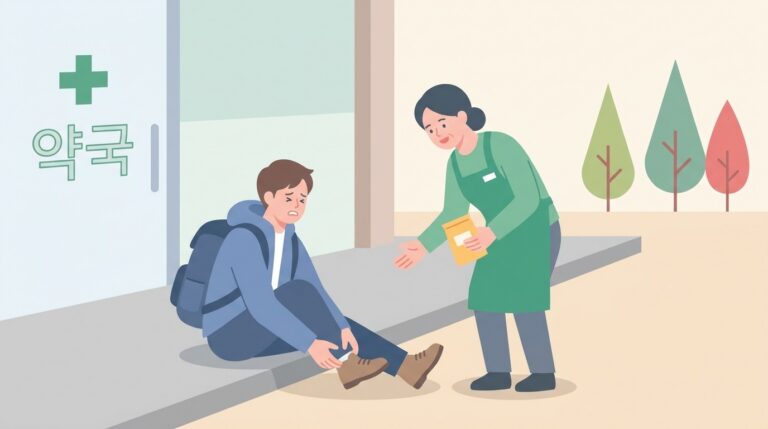
Korea has one of the world’s most accessible primary care environments. For minor injuries, you rarely need an emergency room. Look for signs with a green cross and the word 약 (Yak – Medicine). Korean pharmacists (약사님 / yaksanim) are knowledgeable neighborhood counselors who will happily look at your scrape, clean it with antiseptic spray, and hand you the right adhesive tape. Furthermore, Koreans possess a deep sense of communal empathy known as 정 (Jeong). If an older store owner (사장님 / sajangnim) sees you fall, do not be surprised if they pull out a plastic stool, bring you a cup of warm barley tea, and help you find a bandage before you can even ask.
Phase 5: Real-World Roleplay Scenario
Setting: Outside an open-air market stall in Myeongdong. You slipped on wet pavement and stumbled to the ground. A warm-hearted vendor, Mrs. Kim, steps out.
- You (Alex): 아야! (A-ya! / Ouch!) [🎭 Clutches right ankle while sitting on the ground]
- Mrs. Kim: 어머나! 학생, 괜찮아요? (Eomeona! Haksaeng, gwaenchanhayo? / Oh dear! Are you okay, dear?) [🎭 Rushes over with furrowed brows and open hands]
- You (Alex): 다쳤어요. 발목이 너무 아파요. (Dacheosseoyo. Balmogi neomu apayo. / I got hurt. My ankle hurts so much.) [🎭 Points at the ankle with a pained expression]
- Mrs. Kim: 아이고, 일어설 수 있어요? (Aigo, ireoseol su isseoyo? / Oh my, can you stand up?) [🎭 Reaches down to offer steady support]
- You (Alex): 혼자 못 일어나겠어요. 도와주세요. (Honja mot ireonagesseoyo. Dowajuseyo. / I cannot get up alone. Please help me.) [🎭 Holds her forearm politely]
- Mrs. Kim: 여기 잠깐 앉아요. 바로 앞에 약국 있어요. (Yeogi jamkkan anjayo. Baro ape yakguk isseoyo. / Sit here for a second. There is a pharmacy right across.) [🎭 Helps you onto a small plastic chair]
- You (Alex): 감사합니다. 파스나 붕대 있을까요? (Gamsahamnida. Paseuna bungdae isseulkkayo? / Thank you. Would they have pain relief patches or bandages?) [🎭 Bows head with deep gratitude]
- Mrs. Kim: 내가 약사님 불러올게요! (Naega yaksanim bulleoolgeyo! / I will go call the pharmacist over!) [🎭 Quickly heads toward the green pharmacy sign]
🔀 Interactive Decision Point
If the pharmacist asks what happened, what should you say?
* Choice A: “배가 아파요.” (Baega apayo.)
* ❌ Bad: This means “My stomach hurts!” You might end up with digestive pills instead of bandages!
* Choice B: “발목 삐었어요. 파스 주세요.” (Balmok bpieosseoyo. Paseu juseyo.)
* ✅ Best: Perfect! You state the precise problem (“I twisted my ankle”) and request a pain relief patch cleanly.
* Choice C: “야! 붕대 줘!” (Ya! Bungdae jwo!)
* ⚠️ Risk: Extremely rude banmal (informal slang) meaning “Hey! Give bandage!” It will offend the helpful pharmacist immediately.
Phase 6: 10-Second Emotion Shadowing Drill
Read these aloud while breathing life into the punctuation marks (/ represents a micro-pause):
[😣 Sharp pain & wincing]- 아야! / 다쳤어요… / 발목이 아파요. (A-ya! / Dacheosseoyo… / Balmogi apayo.)
[🥺 Urgent yet respectful plea]- 저기요… / 다쳤어요. / 도와주세요. (Jeogiyo… / Dacheosseoyo. / Dowajuseyo.)
[😮💨 Relieved and polite]- 휴… / 도와주셔서 / 감사합니다. (Hyu… / Dowajusyeoseo / Gamsahamnida.)
Phase 7: K-Culture Mini Dictionary
- 약국 (Yakguk) | Pharmacy | Found on almost every commercial block in Korea, marked by a big red or green ‘약’ letter.
- 대일밴드 (Daeil-baendeu) | Adhesive Bandage / Band-Aid | A brand name so iconic that all small adhesive bandages in Korea are colloquially called Daeil-band.
- 파스 (Paseu) | Medicated Pain Relief Patch | The quintessential Korean remedy for muscle aches, back strains, and ankle twists.
- 119 (Il-il-gu) | Emergency Ambulance / Fire Hotline | Korea’s emergency number. Dialing 119 connects you to immediate dispatch with foreign language translation support.
Phase 8: Survival Kit for Travelers
Top 3 Survival Phrases for Emergencies
- 여기 다쳤어요. (Yeogi dacheosseoyo.) – “I got hurt right here.” (Pro Tip: Point directly with your finger as you speak).
- 약국이 어디예요? (Yakgugi eodiyeyo?) – “Where is the pharmacy?” (Pro Tip: Keep this ready on your phone notes).
- 119 불러주세요. (Il-il-gu bulleojuseyo.) – “Please call 119.” (Pro Tip: Reserve this for severe accidents where an ambulance is necessary).
Editor’s Travel Note
- Essential App: Make sure to install and set up the [official Naver Map navigation tool] before your trip; searching “약국” (pharmacy) displays current open status and weekend operating hours.
- Emergency Medical Hotline: Dial 1339 (Korea Disease Control and Prevention Agency) for 24/7 English-speaking medical consultations.
- Payment Tip: Nearly all Korean pharmacies and emergency rooms accept foreign Visa and Mastercard credit cards, so cash anxiety is not an issue.
Phase 9: One Step Deeper
In Korea, asking someone “괜찮아요?” (Gwaenchanhayo? / “Are you alright?”) or offering quick assistance is rooted in collective empathy. Korea’s rapid urbanization created a culture that is famously fast (빨리빨리 / ppalli-ppalli), but when someone stumbles on the sidewalk, that speed converts into immediate action. People do not look away; they instinctively move to cushion the fall. Recognizing this helps you feel secure: you are never truly alone when navigating Korean streets.
💬 Your Turn: Have you ever experienced an unexpected minor injury while traveling in a new city? What was the hardest word to find in that moment? Share your story in the comments below!
Phase 10: FAQ & Misconception Buster
Q: Can I buy bandages and pain relievers at Korean convenience stores late at night?
A: Yes! Major 24-hour convenience stores (CU, GS25, 7-Eleven) stock basic over-the-counter medicine (안전상비의약품) such as Tylenol, digestive medicine, pain relief patches (파스), and adhesive bandages.
Q: What is the difference between 아파요 (Apayo) and 다쳤어요 (Dacheosseoyo)?
A: 다쳤어요 describes the physical event of getting hurt (external cause: falling, cutting, scraping). 아파요 describes the ongoing sensation of pain (internal or external ache: headache, stomachache, sore ankle).
Q: Do Korean emergency dispatchers speak English?
A: Yes. If you dial 119 and say “English, please,” the operator will immediately patch in a third-party interpretation service via the Korea Tourism Organization or BBB Korea.
🚨 Common Mistakes Warning Board
- ❌ Mistake 1: Shouting 도와줘! (Dowajwo!) at an elderly passerby.
- 👉 Correct Action: Always attach -yo! Say 도와주세요 (Dowajuseyo).
- ❌ Mistake 2: Memorizing only heavy medical nouns like 외상 (trauma) or 출혈 (hemorrhage).
- 👉 Correct Action: Stick to simple verb descriptions like 다쳤어요 (I got hurt) and 피가 나요 (It is bleeding).
- ❌ Mistake 3: Expecting pharmacies to be open 24 hours without checking.
- 👉 Correct Action: Search for “휴일지킴이약국” (holiday guardian pharmacy) on Naver Map or head to a local convenience store.
Phase 11: Action Missions & Practice
- 🥉 Bronze Mission (Solo Practice): Stand in front of your mirror, gently point to your wrist or knee, and repeat 다쳤어요. 아파요. three times with genuine facial emotion.
- 🥈 Silver Mission (Social Sharing): Write down 도와주세요 on your smartphone notes app, screenshot it, and share it on Instagram or your study group with the tag #DailyHangulSurvival.
- 🥇 Gold Mission (Real Application): Next time you watch a K-Drama or variety show, catch the exact timestamp where someone says 아파요 or 다쳤어요 and shadow their intonation.
- 🎮 K-Culture Mission: Search for an episode of Hospital Playlist (슬기로운 의사생활) or a medical drama and spot how doctors speak to patients in distress.
Phase 12: Interactive Quiz Challenge
1. Situation Challenge: You accidentally cut your finger while opening a souvenir package in Seoul. You walk into a pharmacy. What is the most natural thing to say?
* (A) 배가 아파요. (Baega apayo.)
* (B) 손가락 다쳤어요. 밴드 주세요. (Songarak dacheosseoyo. Baendeu juseyo.)
* (C) 119 불러주세요! (Il-il-gu bulleojuseyo!)
2. Fill-in-the-Blank: Complete the polite sentence to ask a passerby for help:
* “혼자 못 일어나겠어요. ________!” (I cannot get up alone. Please help me!)
3. True or False: In Korea, you can purchase basic pain patches (파스) and Band-Aids at convenience stores after pharmacies close.
* (True / False)
👉 Click here to check answers & explanations!
- Answer: (B) – 손가락 다쳤어요. 밴드 주세요. (“I hurt my finger. Please give me a bandage.”) (A means stomachache; C calls an ambulance for a tiny cut!)
- Answer: 도와주세요 (Dowajuseyo) – The essential polite phrase for asking help.
- Answer: True – Designated convenience stores carry essential emergency supplies (상비약) 24 hours a day!







