

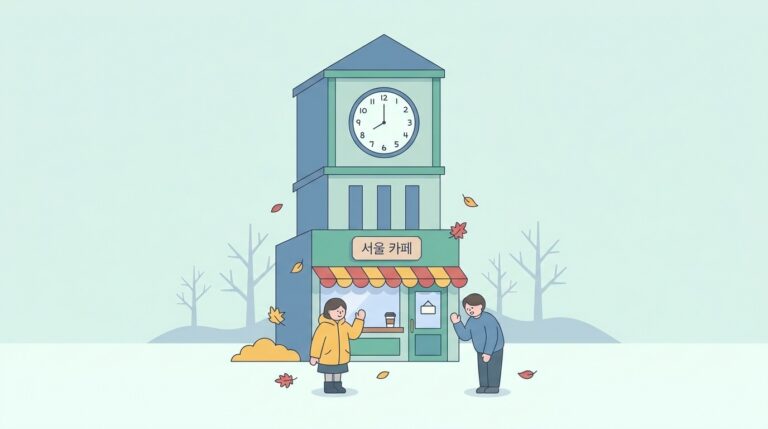
Setting Meetup Times in Korean: The Friendly Beginner’s Guide
Phase 1: Empathy & Story Opening
안녕하세요! 매일한글 에디터입니다. Have you ever felt that sudden rush of panic while watching your favorite K-drama? The male lead smiles warmly across the table, pulls out his smartphone, and gently suggests a meetup time—only for you to pause the screen, squinting at the subtitles, wondering whether they just agreed to meet at two in the afternoon or seven in the evening.
You are definitely not alone. When I first began mentoring beginner Korean learners in Seoul ten years ago, almost every student stumbled upon the exact same roadblock: setting up plans and appointments in Korean feels like deciphering an ancient mathematical puzzle. Why? Because the Korean language splits time down the middle, pairing hours with Native Korean numbers and minutes with Sino-Korean numbers! One slight slip, and instead of meeting your Korean language buddy for an afternoon iced Americano, you might accidentally propose a 2:00 AM midnight rendezvous.
This guide is built straight from hundreds of real learner experiences and classroom breakthroughs. By the end of this friendly lesson, you will know how to suggest, negotiate, and confirm meetup times with friends, colleagues, or travel buddies effortlessly and naturally. Let’s conquer Korean time expressions together!
Phase 2: Core 3 Expressions Deep Dive
1. 몇 시에 만날까요? (Myeot sie mannalkkayo?)
- Pronunciation: [Myeot si-e man-nal-kka-yo] (Sounds like: “Myut she-eh man-nal-gga-yo”, with a crisp, soft ‘myut’ like ‘mutt’ with a tiny ‘y’ glide)
- Meaning: Literal: “At what hour shall we meet?” vs Real Nuance: “What time should we meet up?” (A considerate, polite suggestion open for joint decision).
- K-Culture Moment: Picture the classic scene in a romance drama like Business Proposal, where the protagonists transition from rigid office colleagues to tentative friends, arranging their first weekend hangout outside the workplace.
- Editor’s Insight: The ending “-ㄹ까요? (-lkkayo?)” is the ultimate polite conversational tool. Rather than barking a command, it gently throws the decision into the open air, showing respect for the other person’s schedule.
- Situation Spectrum: Casual: ⚠️ (Use ‘몇 시에 만날까?’ with intimate peers) | Semi-formal: ✅ | Formal: ✅
- 🤔 Think About It: In English, we often say “When are we meeting?” which assumes the decision is already set. Why do you think Korean defaults to the questioning, collaborative “Shall we?” form?
2. 3시 어때요? (Se-si eottaeyo?)
- Pronunciation: [Se-si eo-ttae-yo] (Sounds like: “Say-she uh-tteh-yo”, with a tense, snappy double ‘tt’ like in ‘butter’)
- Meaning: Literal: “3 o’clock, how is it?” vs Real Nuance: “How does 3 o’clock sound to you?”
- K-Culture Moment: Friends texting back and forth on KakaoTalk, trying to grab a spot at a famous bakery café in Seongsu-dong before the weekend waiting line stretches down the street.
- Editor’s Insight: Remember: hours take Native Korean numbers! 하나 (1) becomes 한 시 (han si), 둘 (2) becomes 두 시 (du si), and 셋 (3) turns into 세 시 (se si). “어때요? (Eottaeyo?)” is your universal phrase whenever you want to offer a gentle suggestion without sounding bossy.
- Situation Spectrum: Casual: ⚠️ (Say ‘3시 어때?’ to close friends) | Semi-formal: ✅ | Formal: 🚫 (Use ‘3시가 괜찮으십니까?’ in corporate meetings)
- 🤔 Think About It: Proposing a specific hour as an open question softens social pressure. How does your native language negotiate meeting times without sounding pushy?
3. 그때 봐요! (Geuttae bwayo!)
- Pronunciation: [Geu-ttae bwa-yo] (Sounds like: “Goo-tteh bwah-yo”, with ‘geu’ pronounced with unrounded, smiling lips)
- Meaning: Literal: “See [you] at that time!” vs Real Nuance: “See you then!” or “Catch you then!”
- K-Culture Moment: The warm final exchange at the conclusion of a phone call or chat, right before sending a bouncy Kakao Friends celebratory sticker.
- Editor’s Insight: “그때 (Geuttae)” pinpoints the agreed-upon moment in time. Following it with “봐요 (bwayo – let’s see/look)” locks in the appointment with optimism and warmth.
- Situation Spectrum: Casual: ⚠️ (Drop ‘-yo’ to say ‘그때 봐!’ to buddies) | Semi-formal: ✅ | Formal: ⚠️ (Use ‘그때 뵙겠습니다’ for superiors or clients)
- 🤔 Think About It: In Korean social culture, concluding an appointment almost always highlights the physical act of seeing each other’s faces rather than just saying “Okay, goodbye.”
Phase 3: Textbook Korean vs Real Korean
Situation 1: Proposing a specific meeting time
- 📖 교과서 한국어: “우리 오후 세 시에 만납시다.” (Uri ohu se sie mannapsida. – “Let us meet at 3:00 in the afternoon.”)
- 🗣️ 진짜 한국어: “3시 어때요?” (Se-si eottaeyo? – “How’s 3 o’clock?”) or “3시에 볼까요?” (Se-sie bolkkayo? – “Shall we meet at 3?”)
- 💡 왜 다를까?: The textbook ending “-ㅂ시다 (-psida)” feels like an authoritative command or an announcement from an army officer. Native speakers prefer friendly, questioning endings to invite collaboration.
Situation 2: Asking if someone has free time
- 📖 교과서 한국어: “내일 시간이 있으십니까?” (Naeil sigani isseusimnikka? – “Do you possess time tomorrow?”)
- 🗣️ 진짜 한국어: “내일 시간 돼요?” (Naeil sigan dwaeyo? – “Are you free tomorrow?”)
- 💡 왜 다를까?: “시간(이) 되다 (sigan-i doeda)” literally translates to “Does time become possible?” It is the natural, universal phrase Koreans use to ask about availability without sounding stiff.
Phase 4: K-Culture Deep Dive & Non-Verbal Manners
4-1. Nunchi (눈치) & Gestures
- When proposing a time, Koreans subtly tilt their head slightly to one side while gesturing with an open palm. This shows deference and monitors the other person’s subtle reactions (Nunchi).
- If your conversational partner pauses, looks upward, and murmurs a hesitant “음… (Eum…)”, do not press forward! They are gently indicating that the time might be inconvenient. You can ease their burden immediately by adding: “아니면 다른 시간도 괜찮아요! (Animyeon dareun sigando gwaenchanayo! – Or another time is completely fine too!).”
- When double-checking your schedule on your smartphone during a conversation, hold the device with two hands or nod politely to indicate you are checking your calendar, not ignoring them for social media.
4-2. Culture Code: The Truth About “Korean Time”
Decades ago, older generations sometimes made self-deprecating jokes about “Korean Time” (arriving 10–15 minutes late). Today, modern Korean society is defined by the high-speed Palli-palli (빨리빨리 – hurry, hurry) dynamic and hyper-accurate subway systems. Arriving 5 to 10 minutes early at the café to secure a comfortable table is considered the golden standard of courtesy. If you foresee being even five minutes late due to an unexpected train transfer delay, sending a quick heads-up via message is essential social etiquette.
Phase 5: Real-Life Roleplay Scenario
Setting: A bustling Saturday afternoon outside Hongik University Station (Hongdae). You are coordinating a coffee meet-up with Min-woo (민우), your cheerful Korean language partner who knows all the coolest underground indie cafés.
- Turn 1 (Min-woo): “지수 씨, 오늘 몇 시에 만날까요?” (Jisu ssi, oneul myeot sie mannalkkayo? – “Jisu, what time shall we meet today?”)
🎭 Checking his wristwatch with an expectant smile - Turn 2 (You): “음, 오후 2시 어때요?” (Eum, ohu du-si eottaeyo? – “Um, how about 2:00 PM?”)
🎭 Checking your phone's subway timetable - Turn 3 (Min-woo): “2시 좋아요! 점심 먹고 카페 갈까요?” (Du-si joayo! Jeomsim meokgo kape galkkayo? – “2:00 is great! Shall we grab lunch and go to a café?”)
🎭 Nodding enthusiastically - Turn 4 (You): “네, 좋아요! 어디서 만나요?” (Ne, joayo! Eodiseo mannayo? – “Yes, sounds wonderful! Where shall we meet?”)
🎭 Looking across the vibrant street - Turn 5 (Min-woo): “홍대입구역 3번 출구 앞에서 봐요.” (Hongdae-ipguyeok sambeon chulgu apeseo bwayo. – “Let’s meet in front of Hongik Univ. Station Exit 3.”)
🎭 Pointing towards the subway stairs - Turn 6 (You): “알겠어요. 2시에 거기서 만나요.” (Algesseoyo. Du-sie geogiseo mannayo. – “Got it. Let’s meet there at 2:00.”)
🎭 Giving an agreeable nod - Turn 7 (Min-woo): “네! 늦지 말고 조심히 와요.” (Ne! Neutji malgo josimhi wayo. – “Yes! Don’t be late and travel safely.”)
🎭 Waving goodbye warmly - Turn 8 (You): “네, 그때 봐요!” (Ne, geuttae bwayo! – “Yes, see you then!”)
🎭 Smiling brightly with confidence
🔀 Interactive Branching Moment
Suddenly, Min-woo sends a KakaoTalk text: “미안해요! 지하철을 놓쳐서 15분 늦을 것 같아요! (Mianhaeyo! Jihacheoreul notchyeoseo sibobin neujeul geot gatayo! – I’m sorry! I missed the subway, so I think I’ll be 15 minutes late!)”
How do you reply?
* Option A: “괜찮아요! 천천히 와요. 카페에 먼저 들어갈게요.” (Gwaenchanayo! Cheoncheonhi wayo. Kape-e meonjeo deureogalke-yo. – “No problem! Take your time. I’ll head into the café first.”)
* Feedback: [Best] Top-tier Korean etiquette! You alleviate his guilt, tell him to travel safely, and take initiative to find seats.
* Option B: “왜 늦어요? 빨리 오세요!” (Wae neujeoyo? Ppalli oseyo! – “Why are you late? Come quickly!”)
* Feedback: [Bad] Excessively aggressive and accusatory for a minor subway delay. This will create awkwardness for the rest of the day.
* Option C: “그럼 오늘 약속 취소해요.” (Geureom oneul yaksok chwisohaeyo. – “Then let’s cancel today’s appointment.”)
* Feedback: [Risk] A severe overreaction that will likely sever the friendship over a standard 15-minute public transit mishap.
Phase 6: 10-Second Emotion Shadowing Drill
Practice saying these out loud, observing the rhythmic pause markers (/) and channeling the emotional stage directions!
[😊 Exciting and curious]
“몇 시에 / 만날까요?”
(Myeot sie / mannalkkayo? – “What time / shall we meet?”)-
[🥺 Gentle and considerate]
“내일 2시 / 시간 돼요?”
(Naeil du-si / sigan dwaeyo? – “Tomorrow at 2:00 / are you free?”) -
[✨ Bright and reassuring]
“좋아요, / 그때 봐요!”
(Joayo, / geuttae bwayo! – “Sounds great, / see you then!”)
Phase 7: K-Culture Mini Dictionary
- 약속 (Yak-sok) | Appointment / Social plans / Promise
- In Korean daily life, “약속” covers everything from casual dinners to formal doctor appointments. Saying “오늘 약속이 있어요 (I have plans today)” is the standard, polite way to decline an invitation without going into uncomfortable private details.
- 번개 (Beon-gae) | Lightning meetup / Spontaneous hangout
- Derived from the speed of a lightning strike, a “번개모임” or simply “번개” refers to an impromptu meetup organized on the spot via group chat (“오늘 저녁에 번개 할 사람? – Anyone down for a spontaneous dinner tonight?”).
- 막차 (Mak-cha) | Last train / Last bus
- The ultimate curfew for weekend nightlife in Korea. When someone gasps “막차 시간 다 됐어요! (It’s almost time for the last train!)”, the hangout instantly wraps up as everyone rushes toward the subway turnstiles.
- 늦참 (Neut-cham) | Joining late / Late attendance
- A popular slang compound made from 늦게 (late) + 참석 (attendance). Frequently used in university gatherings or after-work dinners when busy schedules prevent you from arriving at the start.
Phase 8: Traveler’s Survival Kit
Top 3 Survival Expressions for Travelers
- “몇 시에 열어요?” (Myeot sie yeoreoyo? – “What time do you open?”)
- Pro Tip: Use this when exploring quaint independent shops or popular cafes in neighborhood alleys that have unique opening hours.
- “얼마나 걸려요?” (Eolmana geollyeoyo? – “How long does it take?”)
- Pro Tip: Essential when asking taxi drivers or street food vendors before you commit to a line or a ride.
- “조금 늦을 것 같아요.” (Jogeum neujeul geot gatayo. – “I think I will be a little late.”)
- Pro Tip: The quintessential polite text message whenever you take the wrong station exit or experience travel delays.
Editor’s Travel Note
Navigating massive multi-level interchange subway stations like Gangnam or Hongdae can easily add 10 to 15 unexpected minutes to your journey. Don’t rely on global map applications that struggle with pedestrian walking paths in Korea; instead, make sure to execute your Naver Map application download on App Store or Google Play before departing. Keep a T-Money card loaded with at least 10,000 KRW so you never get stuck at ticket gates when hurrying to meet a friend!
Phase 9: A Step Deeper (Thinking Question)
In South Korea, acquaintances and friends frequently part ways with the phrase: “언제 밥 한 끼 해요! (Eonje bap han kki haeyo! – Let’s share a meal sometime!)”. To foreign ears, this sounds like an explicit invitation requiring an immediate calendar check. Yet within Korean social etiquette, this expression is often simply an affectionate greeting signaling warmth and fond regards. Plans only transform into an actual Yaksok when concrete temporal markers are introduced—such as specifying a day or asking “몇 시에 만날까요?”.
💬 Your Turn: Have you ever experienced a funny or confusing cultural misunderstanding regarding time, punctuality, or setting dates? Share your story in the comments below!
Phase 10: FAQ & Avoiding Misunderstandings
Q: Why does Korean use two separate number systems for time?
A: Korean uses Native Korean numbers (하나, 둘, 셋…) for the hour counter (시, si) because hours historically felt like intuitive, natural quantities. Sino-Korean numbers (일, 이, 삼…) imported from Chinese characters are reserved for the precise mathematical divisions of minutes (분, bun) and seconds (초, cho). A simple rule of thumb: “Native for the Big Hand/Hours, Sino for the Small Hand/Minutes!”
Q: Is there a shortcut for saying “half-past” the hour?
A: Yes! Instead of saying “삼십 분 (samsip-bun – 30 minutes)”, you can simply attach “반 (ban – half)” directly to the hour. For example, 2:30 is naturally spoken as “두 시 반 (du-si ban)”. It is faster, crisper, and used constantly in daily life.
Q: What is the difference between “몇 시에 만날까요?” and “몇 시에 만날래요?”?
A: Both are natural and polite! “-ㄹ까요? (-lkkayo?)” feels like “Shall we…?”, emphasizing a collaborative joint choice. “-ㄹ래요? (-llaeyo?)” leans slightly more toward asking the listener’s personal preference or will (“What time do you want to meet?”). Both work wonderfully for A1 beginners.
🚨 Common Mistakes Alert Board
- Mistake: Using Sino-Korean numbers for hours, such as saying “삼 시 (Sam-si)” instead of “세 시 (Se-si)” for 3 o’clock.
- Correct Action: Always pair the hour counter “시” with modified Native numbers: 한 시 (1), 두 시 (2), 세 시 (3), 네 시 (4).
- Mistake: Answering “시간 없어요 (I don’t have time)” with a flat tone when declining an invitation from an elder or colleague.
- Correct Action: Soften the rejection politely: “제가 오늘은 시간이 좀 안 돼요 (Unfortunately, my schedule doesn’t work out today).”
- Mistake: Forgetting to clarify AM or PM and accidentally proposing “새벽 2시 (2:00 AM)” instead of “오후 2시 (2:00 PM)”.
- Correct Action: Clarify daytime plans by prefixing “오전 (morning/AM)” or “오후 (afternoon/PM)” before the hour.
Phase 11: Action Missions
- 🥉 Bronze Mission: Stand in front of your mirror and practice saying: “2시 어때요? 그때 봐요!” three times with a bright, friendly smile.
- 🥈 Silver Mission: Leave a comment below proposing a hypothetical café meetup time to your fellow readers using Korean: “우리 [Time]에 만날까요?”.
- 🥇 Gold Mission: The next time you text a Korean tutor, exchange partner, or friend, propose your next study or chat session entirely in Korean using today’s phrases!
- 🎮 K-Culture Mission: During your next K-drama binge, keep your ears open during phone calls and street encounters. Catch the words “몇 시” or “그때 봐요” and write down the context in your notebook!
Phase 12: Interactive Quiz Challenge
1. Situational Judgment: Your Korean acquaintance asks, “내일 몇 시에 만날까요?” You want to politely suggest meeting at 4:00 PM. What is the most natural reply?
* (A) 내일 4시 만납시다.
* (B) 오후 4시 어때요?
* (C) 4시에 오세요.
2. Fill-in-the-Blank: Fill in the missing word to complete the natural phrase for confirming plans: “좋아요! 그____ 봐요!”
3. Cultural True or False: In modern Seoul social etiquette, arriving 10 minutes late is considered polite so you don’t make the host feel rushed.
* (True / False)
👉 Click to reveal answers & explanations!
- Answer: (B) 오후 4시 어때요?
- Explanation: Proposing a time with “어때요? (How about…?)” is polite, conversational, and collaborative. (A) sounds too rigid, and (C) is a blunt command.
- Answer: 때 (그때 봐요 – Geuttae bwayo)
- Explanation: “그때 (that time)” combined with “봐요 (see you)” creates the beloved daily sign-off phrase “See you then!”.
- Answer: False
- Explanation: Modern Korean etiquette heavily emphasizes punctuality due to fast-paced schedules. Arriving 5 to 10 minutes early to secure a seat at the venue is the golden standard!
- Explanation: Modern Korean etiquette heavily emphasizes punctuality due to fast-paced schedules. Arriving 5 to 10 minutes early to secure a seat at the venue is the golden standard!







