

안녕하세요! 매일한글 에디터입니다.
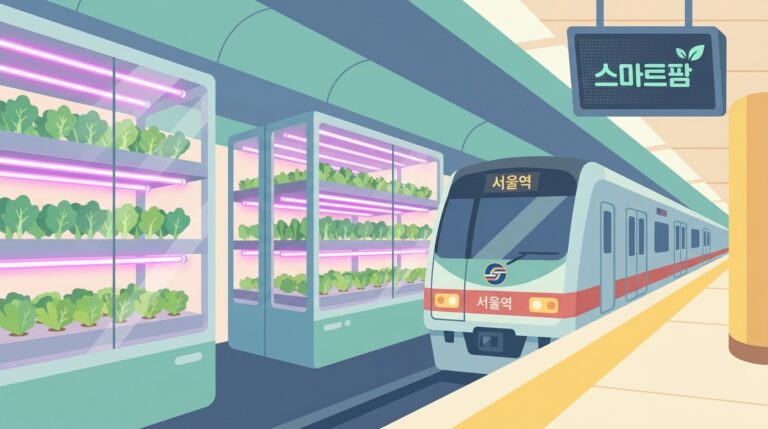
Have you ever hopped off at Sangdo Station on Seoul Subway Line 7, only to find yourself staring through floor-to-ceiling glass at lush, neon-illuminated rows of butterhead lettuce growing right beneath the bustling asphalt of Dongjak-gu? Welcome to Seoul’s “Metro Farm”—one of the world’s most tangible experiments in urban vertical farming. For advanced learners navigating Korea’s high-level business forums or sustainability symposiums, the conversation around vertical farming has rapidly shifted from a sci-fi novelty to a high-stakes debate over food security and municipal viability.
However, speaking about high-tech agriculture at a professional C2 level is a completely different ballgame than asking for pesticide-free lettuce at an eco-mart. Many of my advanced students—even those with Level 6 TOPIK certifications—confess that when engaging with Korean policymakers, agrotech founders, or urban planners, they stumble into rigid, textbook vocabulary that feels detached from contemporary industry vernacular. In this comprehensive guide, built on direct interviews with Korean agritech insiders and policy analysts, we will equip you with sophisticated idiomatic structures, analytical nuance, and socio-cultural frameworks to critique, advocate, and dissect the viability of vertical farming in megacities like Seoul.
1. 도심형 스마트팜의 채산성을 따져보다 (Doshimhyeong seumateupam-ui chaesanseong-eul ttajyeoboda)
- Pronunciation: [Doshimhyeong seumateupam-ui chaesanseong-eul ttajyeoboda] (Think: doh-shim-hyong smart-farm-ee cheh-sahn-song-ul tah-jyo-boh-da)
- Meaning: Evaluating the economic viability/profitability of urban smart farms.
- K-Culture Moment: Frequently heard in tech panel discussions on current affair shows like KBS Sisa Jikgyeok or startup documentaries featured on YouTube channel EO (EO Planet).
- Editor’s Insight: While beginners rely on
돈이 되는지 보다(seeing if it makes money), C2 speakers employ채산성(profitability/cost-effectiveness) together with따져보다(to scrutinize or weigh carefully). It conveys an analytical, prudent business mindset that Korean venture capitalists respect. - Situation Spectrum: Casual 🚫 | Semi-formal ⚠️ | Formal ✅
- 🤔 Think About It: In Korean business discourse,
따지다often carries an aggressive tone in interpersonal relations, but when paired with financial metrics like채산성or타당성, it signals intellectual rigor. How does your native language balance critique with professionalism?
2. 식량 자급률 제고가 시급한 과제다 (Singnyang jageupnyul jego-ga sigeupan gwajeda)
- Pronunciation: [Singnyang jageumnnyul jego-ga sigeupan gwajeda] (Think: sing-nyang jah-geum-nyul jeh-goh-gah she-geup-hahn gwah-jeh-dah)
- Meaning: Boosting the food self-sufficiency rate is an urgent imperative.
- K-Culture Moment: Quoted in editorial columns regarding South Korea’s vulnerable grain self-sufficiency rate, which hovers around 20%.
- Editor’s Insight:
제고(raising/enhancing) is a Sino-Korean staple in policy white papers, written as 提高. Do not confuse it with재고(stock/inventory). Pairing제고with시급한 과제highlights institutional priority without resorting to hysterical language. - Situation Spectrum: Casual 🚫 | Semi-formal ⚠️ | Formal ✅
- 🤔 Think About It: Why does South Korea frame agricultural yield in terms of “sovereignty” and “imperatives” rather than simply market supply and demand?
3. 미래 먹거리 산업으로 자리매김하다 (Mirae meokgeori saneop-euro jarimaegimhada)
- Pronunciation: [Mirae meokgeori saneob-euro jarimaegimhada] (Think: mee-reh meok-goh-ree sah-nawb-oo-roh jah-ree-meh-gim-hah-dah)
- Meaning: To establish itself as an industry that serves as a future growth engine.
- K-Culture Moment: Used by tech conglomerates announcing ESG-driven agrotech investments during executive shareholder meetings.
- Editor’s Insight:
먹거리literally means “edible food,” but metaphorically represents financial sustenance or core growth drivers for the next generation. Combined with자리매김하다(to cement one’s position), it reflects holistic socio-economic impact. - Situation Spectrum: Casual ⚠️ | Semi-formal ✅ | Formal ✅
- 🤔 Think About It: Notice how Korean uses physical, physiological sustenance (
먹거리) as an economic metaphor for futuristic tech industries.
Phase 3: 교과서 한국어 vs 진짜 한국어
Situation 1: Discussing vertical farming’s massive operational expenses
- 📖 교과서 한국어: 이 농업 방식은 효율적이지만 전기세와 시설 비용이 많이 듭니다. (I nongeop bangsik-eun hyoyuljeog-ijiman jeongkise-wa siseol biyong-i mani deumnida. / This farming method is efficient, but electricity and facility costs are high.)
- 🗣️ 진짜 한국어: 기술적 완성도에 비해 막대한 초기 설비 투자비(CAPEX)와 유지비 회수가 관건이에요. (Gisuljeok wanseongdoe bihae makdaehan chogi seolbi tujabi-wa yujibi hoesuga gwangeonieyo. / While the technological maturity is sound, the real crux lies in recouping the exorbitant initial CAPEX and ongoing operational expenses.)
- 💡 왜 다를까? Advanced professionals eschew kindergarten words like
많이 듭니다in favor of precise financial jargon likeCAPEX 회수(recouping capital expenditure) and관건(the decisive factor).
Situation 2: Emphasizing the geopolitical importance of food independence
- 📖 교과서 한국어: 우리는 기후 변화 때문에 음식을 스스로 만들어야 합니다. (Urineun gihu byeonhwa ttaemune eumsik-eul seuseuro mandeul-eoya hamnida. / Because of climate change, we must make food by ourselves.)
- 🗣️ 진짜 한국어: 기후 위기 국면에서 식량 주권을 선제적으로 확보하는 차원에서 접근해야 합니다. (Gihu wigi gukmyeon-eseo singnyang jugwon-eul seonjejeog-euro hwakbohaneun chaweon-eseo jeopgeunhaeya hamnida. / We must approach this from the perspective of preemptively securing food sovereignty amidst the climate crisis.)
- 💡 왜 다를까? Policy debates in Korea frame food not as mere “cooking ingredients” (
음식), but as “food sovereignty” (식량 주권), signaling national resilience and proactive planning (선제적 확보).
Phase 4: K-Culture 딥다이브 & 비언어적 매너
4-1. 눈치(Nunchi) & 제스처 (Non-Verbal Protocol)
When participating in high-level academic or municipal debates in Seoul, vocal intensity does not equate to persuasiveness. Korean rhetorical strategy values Jeonje (전제, softening the ground).
* The Scribe’s Posture: Hold your pen lightly with both hands or rest your fingertips on the edge of the conference table. Leaning back with crossed arms signals arrogant skepticism.
* The Deliberative Head Tilt: When refuting an agritech proponent’s overly optimistic financial model, tilt your head slightly by about 5 degrees, pause for two seconds, and open with an acknowledgment marker: 공공재로서의 가치에는 십분 공감합니다만... (While I fully empathize with its value as a public good…). This displays supreme emotional intelligence and mastery of professional Nunchi.
4-2. 문화 코드 분석 (The Underground Revolution: Subway Farm-to-Table)
Vertical farms in Korea are not merely confined to distant warehouses in Gyeonggi-do; they are public-facing urban infrastructures. Seoul Metro partnered with agricultural venture Farm8 to transform unused subway stations into automated vertical farms (Metro Farms). The cultural significance here is twofold:
1. Pesticide-Free Eco-Consciousness: South Korean urbanites exhibit a near-fanatical devotion to food safety. The promise of hyper-local, zero-dust, zero-pesticide salad greens harvested minutes before being consumed at station kiosks appeals directly to busy metropolitan commuters.
2. Urban Spatial Regeneration: In a city where real estate prices in districts like Gangnam and Mapo reach dizzying heights, vertical integration into public transit corridors represents Korea’s quintessential adaptability—turning dead subterranean space into sustainable green factories.
Phase 5: 실전 롤플레이 시나리오
Setting: A policy boardroom inside the Seoul Global Center. Dr. Min-woo Kang, a seasoned municipal agriculture consultant, is evaluating foreign smart-farm enterprise proposals.
- Turn 1 (Dr. Kang): 도심 내 유휴 부지를 활용한 수직 농장 모델은 매력적이지만, 서울의 살인적인 임대료와 전기료를 감당할 수 있을지가 의문입니다. (Doshim nae yuhu buji-reul hwalyonghan sujik nongjang model-eun maeryeokjeog-ijiman, Seoul-ui sarinjeogin imdaeryo-wa jeongkiryo-reul gamdanghal su isseuljiga uimun-imnida.)
🎭 Adjusting his glasses while pointing his laser pointer at the projected balance sheet.
Urban vertical farming using idle city spaces is enticing, but I question whether it can weather Seoul’s murderous rent and electricity tariffs. -
Turn 2 (You): 박사님의 우려대로 에너지 집약적 구조라는 한계는 분명 존재합니다. (Baksanim-ui uryeodaero eneoji jibyakjeok gujowaneun hangye-neun bunmyeong jonjaehamnida.)
🎭 Nodding thoughtfully, validating his objection without flinching.
As you astutely pointed out, Doctor, its limitation as an energy-intensive framework is undeniable. -
Turn 3 (You): 다만, 도심 분산형 모델을 통해 콜드체인 물류비를 최대 80%까지 절감할 수 있다는 점을 간과해선 안 됩니다. (Daman, doshim bunsanhyeong model-eul tonghae koldeuchein mullyubi-reul choedae palsip peosenteu-kkaji jeolgamhal su itdaneun jeom-eul ganggwaheseon an doemnida.)
🎭 Gesturing toward the logistics comparison matrix on page 4 of the handout.
However, we must not overlook the fact that a decentralized urban model can cut cold-chain logistics costs by up to 80%. -
Turn 4 (Dr. Kang): 물류비 절감분만으로 초기 설비 구축에 들어간 막대한 매몰 비용을 상쇄하기엔 역부족 아닐까요? (Mullyubi jeolgambunman-euro chogi seolbi guchuk-e deureogan makdaehan maemol biyong-eul sangswaehagien yeokbujok anilkkayo?)
🎭 Furrowing his brows slightly, leaning forward with sustained eye contact.
Isn’t logistics savings alone insufficient to offset the immense sunk costs poured into the initial facility deployment? -
Turn 5 (You): 그렇기 때문에 고부가가치 작물로의 포트폴리오 다변화가 필수적입니다. (Geureokki ttaemune gobubagachi jakmul-ro-ui poteupollio dabyeonhwa-ga pilsujeog-imnida.)
🎭 Speaking with steady, resonant cadence, projecting unshakable confidence.
That is precisely why diversifying our crop portfolio into high-value pharmaceutical and cosmetic botanicals is essential. -
Turn 6 (Dr. Kang): 단순 엽채류 재배를 넘어선 바이오 소재 원료 공급 기지로의 피보팅이라… 흥미롭군요. (Dansun yeopchaeryu jaebae-reul neomeoseon baio sojae wonryo gonggeup giji-ro-ui piboting-ira… Heungmiropgunyo.)
🎭 A subtle nod of approval breaks across his austere demeanor.
Pivoting beyond standard leafy greens into an extraction base for biotech materials… Now that is compelling. -
Turn 7 (You): 네, 서울을 단순 소비지에서 미래 애그리테크의 R&D 실증 기지로 탈바꿈시키는 청사진입니다. (Ne, Seoul-eul dansun sobiji-eseo mirae aegeuritekeu-ui R&D siljeung giji-ro talbbakkumsikineun cheongsajin-imnida.)
🎭 Firmly presenting the municipal partnership slides with an inclusive two-handed gesture.
Indeed, it is a master blueprint to transform Seoul from a mere consumer market into a living testbed for next-generation agritech R&D. -
Turn 8 (Dr. Kang): 좋습니다. 서울시와의 규제 샌드박스 연계 방안을 구체화해서 다시 논의합시다. (Jotsumnida. Seoulsi-wa-ui gyuje saendeubeokseu yeongye bangan-eul guchehwahaeseo dasi nonuihapsida.)
🎭 Closing his leather notebook, smiling as he offers a two-handed formal handshake.
Splendid. Let us flesh out the roadmap connecting this with the Seoul Metropolitan Government’s regulatory sandbox and reconvene.
🔀 인터랙티브 분기점 (Choose Your Rebuttal at Turn 3):
- Option A:
박사님 말씀도 맞지만, 저희 스마트팜은 최첨단 AI 제어 기술이 있어서 무조건 성공합니다.- Feedback (Bad): Flippant and unanalytical. Using
무조건(unconditionally/guaranteed) in Korean corporate boardrooms destroys credibility and signals amateurish bravado.
- Feedback (Bad): Flippant and unanalytical. Using
- Option B:
단순 물류비 절감뿐 아니라, 도심 유휴 공간의 탄소 배출 저감 효과와 공공 학습장으로서의 정성적 가치 또한 산정해야 합니다.- Feedback (Best): Flawless C2 strategy. Broadening the discussion from mere balance sheets to qualitative civic benefits (
정성적 가치) and decarbonization (탄소 배출 저감) demonstrates high-level policy acumen.
- Feedback (Best): Flawless C2 strategy. Broadening the discussion from mere balance sheets to qualitative civic benefits (
- Option C:
에이, 요즘 샐러드 시장이 얼마나 커졌는데요. 강남 직장인들이 매일 줄 서서 사 먹습니다.- Feedback (Risk): Too conversational. Starting with
에이sounds childish and street-level, completely undermining the decorum expected in serious feasibility discussions.
- Feedback (Risk): Too conversational. Starting with
Phase 6: 10초 감정 섀도잉 드릴
-
[🧐 진중하고 분석적으로 / Deliberate and analytical]
단순한 생산량 비교를 넘어 / 도시 단위의 에너지 자립률과의 / 상관관계를 면밀히 검토해야 합니다.
(Dansunhan saengsanryang bigyo-reul neomeo / doshi danwi-ui eneoji jarimnyul-gwa-ui / sanggwan-gwangye-reul myeonmilhi geomtohaeya hamnida.) -
[💡 확신에 찬 어조로 / Firm and authoritative]
스마트 농업은 선택의 문제가 아니라 / 식량 안보 위기에 대응하기 위한 / 필수 불가결한 생존 전략입니다.
(Seumateu nongeop-eun seontaek-ui munje-ga anira / singnyang anbo wigi-e daeeunghagi wihan / pilsu bulgagyeolhan saengjon jeonryag-imnida.) -
[🤝 유연하고 포용적인 태도로 / Conciliatory and cooperative]
기존 전통 농가와의 상생 모델을 / 구축하지 않는다면 / 도심형 수직 농장은 / 사회적 수용성을 얻기 어렵습니다.
(Gijon jeontong nongga-wa-ui sangsaeng model-eul / guchukhaji anneundamyeon / doshimhyeong sujik nongjang-eun / sahoejeok suyongseong-eul eotgi eoryeopsumnida.)
Phase 7: K-Culture 미니 사전 (핵심 키워드 4개)
-
식량 주권 (Singnyang jugwon) | Food Sovereignty
Unlike generic “food security” (식량 안보), this term underscores a nation’s sovereign right to define its agricultural policies and sustainably feed its populace without dependency on external geopolitical disruptions. -
사회적 수용성 (Sahoejeok suyongseong) | Social Acceptability / Public Consensus
Critical in South Korean policy initiatives. Even if vertical farming is technically viable, without사회적 수용성(i.e., resolving resistance from traditional rural farming collectives), projects face legislative gridlock. -
에너지 집약형 (Eneoji jibyakhyeong) | Energy-Intensive
Used to critique the heavy reliance on constant artificial LED lighting and environmental HVAC control systems in indoor aeroponic/hydroponic systems. -
규제 샌드박스 (Gyuje saendeubeokseu) | Regulatory Sandbox
South Korea’s premier policy mechanism allowing tech startups in areas like autonomous farming and metropolitan smart agritech to test their products exempt from archaic industrial zoning laws.
Phase 8: 여행자를 위한 생존 키트
서바이벌 표현 TOP 3:
- 이 채소, 도심 스마트팜에서 직송된 건가요?
(I chaeso, doshim seumateupam-eseo jiksongdoen geon-gayo? / Are these vegetables direct-shipped from an urban smart farm?)
Pro Tip: Use this at trendy salad bars in Seongsu-dong or Yeouido to instantly impress eco-conscious baristas. - 스마트팜 실증 단지 견학 일정을 문의드리고 싶습니다.
(Seumateupam siljeung danji gyeonhak iljeong-eul mui-deurigo sipsumnida. / I would like to inquire about the tour schedule for the smart-farm testbed complex.)
Pro Tip: Perfect when emailing research facilities at Seoul National University GreenBio campuses or regional agritech clusters. - 도심 농업 활성화 조례안에 대해 어떤 입장이신가요?
(Doshim nongeop hwalseonghwa joryean-e daehae eotteon ipjang-isin-gayo? / What is your stance on the municipal ordinance for revitalizing urban agriculture?)
Pro Tip: Drop this at an agrotech symposium Q&A session to sound like a native legislative researcher.
Editor’s Travel Note:
Want to see Korea’s urban vertical agritech in action? Take Subway Line 7 to Sangdo Station and visit “Farm Cafe Meet S” right inside the turnstile area. You can sip a cold-pressed kale juice while watching robotic arms transport organic greens inside climate-controlled glass chambers. To navigate Seoul’s multi-layered transit maze without missing hidden smart-farm cafes, make sure to read our curated guide on 네이버 지도 앱 다운로드 및 길찾기 가이드.
Phase 9: “한 발 더 깊이” (생각 질문)
Historically, South Korea was sustained by the philosophy of Sintoburi (신토불이 – 身土不二), meaning “the body and the native soil are inseparable.” This profound agrarian ethos instilled an almost sacred reverence for local soil and seasonal field harvesting. Today, urban vertical farming strips the “soil” from agriculture entirely, trading muddy fields for sterile LED racks and automated nutrient solutions. While this shift brilliantly counters global climate chaos and severe rural demographic collapse, it challenges the nostalgic cultural identity deeply embedded in traditional farming.
💬 Your Turn: Does high-tech, soil-less farming fulfill the spirit of Sintoburi by keeping food production within local borders, or does it detach humans from the ecological essence of nature? Let me know your thoughts in the comments below!
Phase 10: FAQ & 오해 방지 (FAQ Schema)
Q: Can I use the term 스마트팜 (Smart Farm) to refer strictly to urban vertical farms?
A: Not quite. In Korea, 스마트팜 (Smart Farm) is an overarching umbrella term that encompasses automated rural vinyl greenhouses, smart fruit orchards with drone irrigation, and livestock tracking systems. To specifically denote multi-layered indoor urban setups, native professionals explicitly use 도심형 수직 농장 (Urban Vertical Farm) or 밀폐형 식물공장 (Closed-type Plant Factory).
Q: Why do Korean experts emphasize 작물 다변화 (Crop Diversification) so fiercely in vertical farming debates?
A: Because currently, nearly 90% of commercial vertical farms in Korea only produce rapid-turnover leafy greens like lettuce and romaine. Since Korean consumers can purchase cheap field-grown greens at local traditional markets, vertical farms often face financial ruin without pivoting toward high-margin crops such as medicinal ginseng, saffron, or pharmaceutical herbs.
Q: Is traditional farmers’ opposition to urban vertical farms really a major issue in Korea?
A: Yes, it is an immense socio-political bottleneck. National agricultural cooperatives (농협 – NongHyup) wield significant political influence. If large conglomerates enter urban vertical farming at scale, rural farming communities protest against corporate encroachment on smallholder livelihoods. Hence, using nuanced phrases like 농촌 상생 모델 (rural-urban co-existence model) is critical.
🚨 흔한 실수 (Common Mistakes) 경고판:
- Saying
도시 농업when meaning수직 농장:- Wrong:
저는 도시 농업 기술을 연구하고 있습니다.(Might imply you grow cherry tomatoes in a rooftop wooden planter box as a weekend hobby). - Correct Action: Use
첨단 도심형 애그리테크(Advanced urban agritech) or수직 농장 시스템(Vertical farm system).
- Wrong:
- Confusing
수지타산with채산성in formal policy proposals:- Wrong:
이 프로젝트는 수지타산이 맞지 않습니다.(Slightly vernacular merchant tone). - Correct Action:
본 사업 모델은 중장기적 채산성 및 경제적 타당성 검토가 선행되어야 합니다.
- Wrong:
- Overusing
친환경without empirical backing:- Wrong:
수직 농장은 무조건 친환경적입니다. - Correct Action:
탄소 발자국 감축 측면에서는 유리하나, 전력 소비에 기인한 환경적 비용도 병행 분석해야 합니다.
- Wrong:
Phase 11: 액션 미션 & 참여 유도
- 🥉 Bronze Mission (Solo): Read the 3 sentences in the “Emotion Shadowing Drill” out loud 5 times, strictly observing the
/pauses and the formal analytical intonation. - 🥈 Silver Mission (SNS): Find a Korean news article regarding “스마트팜” or “수직농장” on Naver News. Leave a brief analytical comment in Korean using the phrase
식량 자급률 제고. - 🥇 Gold Mission (Real World): Visit an urban smart-farm cafe in Korea (such as Sangdo Station’s Metro Farm or Dapsimni Station) and ask the staff in person:
이곳에서 재배되는 작물의 주 소비처와 유통 방식이 어떻게 되나요?(What is the primary consumer base and distribution method for crops cultivated here?)
🎮 K-Culture Media Mission: Watch an episode of an investigative journalism program like SBS D-Talks or a YouTube tech breakdown on smart agritech, and see if you can spot how many times the panelists employ the words 공공성 (public utility) versus 수익성 (profitability)!
Phase 12: 인터랙티브 퀴즈 챌린지
1. Situational Judgment: You are presenting an urban vertical farm investment proposal to a conservative venture capital board in Yeouido. They question whether the electricity costs of 24/7 LED operations will bankrupt the business within two years. Which response demonstrates C2 mastery?
* (A) 전기세는 국가에서 보조금을 주니까 전혀 걱정하지 않으셔도 됩니다.
* (B) 심야 잉여 전력 활용 및 폐열 회수 시스템을 연계하여 전력 원가를 획기적으로 낮추는 방안을 설계했습니다.
* (C) 저희 농장은 초절전 LED를 쓰기 때문에 일반 농장보다 훨씬 전기를 적게 먹습니다.
2. Fill-in-the-Blank:
기후 위기로 인한 글로벌 공급망 불안정 속에서, 도심형 수직 농장은 단순한 비즈니스를 넘어 국가 [ ] 확보를 위한 전략 자산으로 재평가받고 있다.
3. True or False Cultural Quiz:
In South Korea, because vertical farms produce crops indoors without sunlight, they can automatically obtain the prestigious official “Organic (유기농)” certification mark under current Korean agricultural law. (True / False)
👉 Click to reveal answers & deep explanations!
1. Answer: (B)
Explanation: Option (B) demonstrates advanced technical fluency (심야 잉여 전력 – off-peak surplus electricity, 폐열 회수 시스템 – waste-heat recovery system) and directly resolves financial skepticism without making naive assumptions about government bailouts (A) or sounding childishly defensive (C).
2. Answer: 식량 주권 (or 식량 안보)
Explanation: Both 식량 주권 (Food Sovereignty) and 식량 안보 (Food Security) fit impeccably into high-level geopolitical and agricultural economic prose.
3. Answer: False
Explanation: Under current South Korean agricultural certification legislation, “Organic (유기농)” certification historically requires crops to be grown in natural soil containing living microbial ecosystems. Hydroponic and substrate-based vertical farms, despite using zero synthetic pesticides, frequently face regulatory battles in obtaining full organic certification and are usually designated as “Pesticide-Free (무농약)” instead—a vital distinction in Korean agritech law!







