

Attending a Korean Religious Ceremony: Easy Phrases and Etiquette for Beginners
Phase 1: Empathy (Story Intro)
안녕하세요! (Hello!) I am your Daily Hangul editor and cultural navigator. Have you ever walked past a historic Korean Buddhist temple nestled in a quiet mountain, or stood outside a warm community church in Seoul on a Sunday morning, desperately wanting to peek inside but freezing at the doorstep? Many of our international students tell us they feel immense hesitation during religious activities in Korea. “Do I need to take off my shoes right here?” “Am I allowed to just sit quietly at the back?” “What if I accidentally disrespect a sacred ritual?”
Just like that heartwarming scene in K-dramas where a character retreats to a peaceful temple courtyard to find mental clarity after a chaotic week, joining a religious or spiritual event in Korea can be one of the most memorable cultural experiences of your life. Whether you are participating in a weekend temple stay, visiting an iconic cathedral like Myeongdong Cathedral, or joining a friend for a local church service, you do not need complicated honorifics to be a welcomed guest. With just a handful of polite A2-level Korean phrases and basic non-verbal awareness, you will feel confident, calm, and deeply embraced by the local community. This guide is crafted directly from real learner experiences to ensure you never have to second-guess yourself again!
Phase 2: 3 Key Expressions Deep Dive
1. 저도 참여해도 돼요? (Jeodo chamyeohaedo dwaeyo?)
- Pronunciation: juh-doh chahm-yuh-hae-doh dway-yoh? (Sounds like “chahm-yuh” with an open, friendly rising tone at the end).
- Meaning: Literal: “May I also participate?” | Real Nuisance: “Is it okay for an outsider/visitor like me to join in?”
- K-Culture Moment: You will hear this humble phrase whenever travelers visit tranquil rural retreats in travel documentaries like Korean Cool or variety shows when cast members timidly ask a temple monk or church elder if they can sit in the meditation hall.
- Editor’s Insight: The ending
-해도 돼요?(-haedo dwaeyo?) is your universal key for asking permission politely in Korean. Adding저도(jeodo, “me too”) shows modesty, signaling you do not want to intrude. - Situation Spectrum: Casual: ⚠️ | Semi-formal: ✅ | Formal: ✅
- 🤔 Think About It: In many Western contexts, open doors imply anyone can just walk in. In Korea, asking explicit permission first reflects care for group harmony (harmonious community balance).
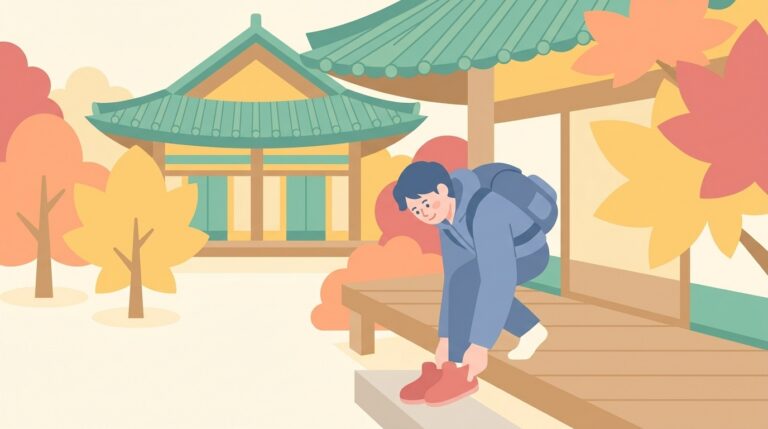
2. 신발은 어디에 벗어요? (Sinbareun eodie beoseoyo?)
- Pronunciation: sheen-bah-reun uh-dee-eh buh-suh-yoh? (Think of “shin” like your leg shin, and “buh-suh” like taking off a heavy coat).
- Meaning: Literal: “Where do I take off shoes?” | Real Nuisance: “Please show me the designated footwear area so I don’t step on clean indoor mats with dirty soles.”
- K-Culture Moment: Seen often in historical and lifestyle K-dramas when guests arrive at traditional wooden temple pavilions (Daeungjeon) or community halls.
- Editor’s Insight: Korea has a strict indoor barefoot/sock culture. Many religious halls (especially Buddhist temples and traditional prayer rooms) require bare feet or clean socks. Asking this right away saves you from an embarrassing footwear faux pas.
- Situation Spectrum: Casual: ⚠️ | Semi-formal: ✅ | Formal: ✅
- 🤔 Think About It: Why is taking off shoes sacred in Korea? It is not just about cleanliness; entering without outdoor shoes signifies leaving worldly dust and noise outside.
3. 사진 찍어도 괜찮아요? (Sajin jjigeodo gwaenchannayo?)
- Pronunciation: sah-jeen jee-guh-doh gwen-chahn-nah-yoh? (Pronounce “jjig” with a crisp, sharp initial click sound).
- Meaning: Literal: “Is taking photos okay?” | Real Nuisance: “I respect this sacred atmosphere; do you mind if I capture a picture here?”
- K-Culture Moment: Tourist programs showing foreigners admiring golden Buddha statues or historic altars always feature this polite inquiry to show cultural mindfulness.
- Editor’s Insight: Many religious venues allow photos in exterior courtyards, but ban camera shutters and flash inside main sanctums while people are praying. Always ask before holding up your smartphone.
- Situation Spectrum: Casual: ⚠️ | Semi-formal: ✅ | Formal: ✅
- 🤔 Think About It: How does your home culture treat photography inside places of worship? Asking permission honors the privacy of personal prayer.
Phase 3: Textbook Korean vs Real Korean
Situation 1: Asking how to pray or follow the ritual
- 📖 교과서 한국어 (Textbook): 어떻게 기도합니까? (Eotteoke gidohamnikka? – “How does one pray?”)
- 🗣️ 진짜 한국어 (Real-life): 어떻게 하는지 알려주실 수 있어요? (Eotteoke haneunji allyeojusil su isseoyo? – “Could you show me how it’s done?”)
- 💡 왜 다를까? (Why the difference?): The textbook version sounds overly clinical and stiff. Asking someone to gently “show or teach you” (
알려주실 수 있어요?) is much warmer and prompts friendly locals to gladly demonstrate hand gestures or bowing steps.
Situation 2: Expressing gratitude after the service/event
- 📖 교과서 한국어 (Textbook): 은혜로웠습니다. (Eunhyerowotseumnida. – “It was full of grace.”)
- 🗣️ 진짜 한국어 (Real-life): 좋은 시간이었어요, 감사합니다! (Joeun siganieosseoyo, gamsahamnida! – “It was such a wonderful time, thank you!”)
- 💡 왜 다를까? (Why the difference?): While “은혜롭다” is a specialized religious word used among seasoned churchgoers, beginners can easily come across as unnatural when trying too hard. A bright, heartfelt
좋은 시간이었어요!sounds sincere, natural, and appreciative.
Phase 4: K-Culture Deep Dive & Non-verbal Manners
4-1. 눈치 (Nunchi) & Essential Gestures
- The Two-Handed Rule: Whenever you receive a prayer booklet, incense, or a cup of warm barley tea, always accept it using both hands (or place your left hand gently under your right wrist/forearm). This indicates respect.
- Hapjang (합장 – Palms Together): In Buddhist temples, instead of a casual wave or handshake, place your palms together near your chest and bend your upper body around 30 degrees. This gesture greets the divine spirit within the other person.
- Mute Everything: Koreans maintain high Nunchi (situational situational awareness) in quiet spaces. Switch your phone to complete silent mode (not even vibration mode, as wood floors amplify buzzing sound!).
4-2. Culture Code: The Rise of Healing Temple Stays
In modern fast-paced Korea, religious events are not only for devout believers. Millions of secular Koreans and international visitors join 템플스테이 (Templestay) programs at ancient mountain temples for “healing” (힐링). You wake up before dawn, listen to resonant brass bells, eat delicious vegan temple cuisine (사찰음식), and practice silent breathing. Knowing simple, polite phrases will turn a potentially nervous encounter into a deeply soothing cultural bridge.
Phase 5: Real-World Roleplay Scenario
Setting: You are visiting Bongeunsa Temple in Seoul on a crisp autumn morning. You meet Ji-hoon, a welcoming temple staff member wearing a soft grey cotton hanbok vest.
- You: 저기요, 실례합니다. 저도 참여해도 돼요? (Jeogiyo, sillyehamnida. Jeodo chamyeohaedo dwaeyo?)
- 🎭 Action: “Excuse me. May I also participate?” (Bowing slightly with hands folded at your waist)
- Ji-hoon: 네, 물론이죠! 편하게 들어오세요. (Ne, mullon-ijyo! Pyeonhage deureo-oseyo.)
- 🎭 Action: “Yes, of course! Please feel free to come inside.” (Smiling warmly and gesturing toward the hall entrance)
- You: 감사합니다. 그런데 신발은 어디에 벗어요? (Gamsahamnida. Geureonde sinbareun eodie beoseoyo?)
- 🎭 Action: “Thank you. But where should I take off my shoes?” (Looking toward the wooden step)
- Ji-hoon: 저기 신발장에 넣으시면 됩니다. 양말은 신고 계시죠? (Jeogi sinbaljange neoeusimyeon doemnida. Yangmareun sin-go gyesijyo?)
- 🎭 Action: “You can put them in the shoe rack over there. You are wearing socks, right?” (Pointing to the shelves)
- You: 네, 신고 있어요. 사진 찍어도 괜찮아요? (Ne, sin-go isseoyo. Sajin jjigeodo gwaenchannayo?)
- 🎭 Action: “Yes, I am wearing socks. Is it okay to take photos?” (Holding phone discreetly down)
- Ji-hoon: 법당 안에서는 사진 촬영이 안 돼요. 밖에서는 얼마든지 찍으셔도 됩니다. (Beopdang aneseoneun sajin chwaryeong-i an dwaeyo. Bakkeseoneun eolmadeunji jjigeosyeodo doemnida.)
- 🎭 Action: “Photography is not allowed inside the prayer hall. Outside in the courtyard, you can take as many as you like.” (Shaking head gently with polite reassurance)
- You: 아, 알겠습니다. 어떻게 하는지 알려주실 수 있어요? (A, algessumnida. Eotteoke haneunji allyeojusil su isseoyo?)
- 🎭 Action: “Ah, I understand. Could you show me how it is done?” (Watching attentively)
- Ji-hoon: 뒤쪽 방석에 앉아서 조용히 명상하시면 돼요. (Dwijjok bangseoge anjaseo joyonghi myeongsanghasimyeon dwaeyo.)
- 🎭 Action: “Just sit on a cushion in the back row and meditate quietly.” (Guiding toward an open cushion)
🔀 Interactive Choice Point
You sit down on the floor cushion. The monk begins the chanting ritual. What do you do?
* Choice A: Cross your legs comfortably, place your palms together in your lap, and quietly close your eyes.
* 👉 Feedback [BEST]: Perfect! Even if you don’t know the exact sutras, sitting quietly and mindfully shows supreme respect for everyone around you.
* Choice B: Pull out your phone and send a quick text message on mute.
* 👉 Feedback [BAD]: Bright phone screens and finger movements break the deep focus of meditating practitioners in a dimly lit hall.
* Choice C: Stand up and immediately try to copy the deep prostrations (108 bows) in the very front row.
* 👉 Feedback [RISK]: While energetic, jumping straight into advanced bowing rituals without knowing the exact flow might disrupt the rhythm of regular devotees. It is safer to observe from the back first!
Phase 6: 10-Second Emotional Shadowing Drill
Practice these lines aloud! Follow the slashes (/) for natural rhythm and breathing pauses:
[😊 Politely & Modestly]
저도 / 참여해도 / 돼요?
(Jeodo / chamyeohaedo / dwaeyo?)-
[🤔 Curious & Mindful]
신발은 / 어디에 / 벗어요?
(Sinbareun / eodie / beoseoyo?) -
[🙏 Respectful & Inquiring]
사진 찍어도 / 괜찮아요?
(Sajin jjigeodo / gwaenchannayo?) -
[✨ Sincere & Grateful]
좋은 시간이었어요, / 정말 감사합니다!
(Joeun siganieosseoyo, / jeongmal gamsahamnida!)
Phase 7: K-Culture Mini Dictionary
- 예불 (Yebul): Buddhist ceremonial service. The rhythmic morning and evening prayer service held in Korean temples featuring tranquil wooden percussion (moktak).
- 합장 (Hapjang): Placing palms together. The universal Buddhist sign of peace, greeting, and inner respect.
- 공양 (Gongyang): Temple meal / sacred offering. Eating temple food mindfully without leaving a single grain of rice behind.
- 헌금 (Heongeum) / 보시 (Bosi): Offering or donation. Heongeum is used in Korean Christian/Catholic services, while Bosi refers to Buddhist almsgiving.
Phase 8: Traveler’s Survival Kit
Top 3 Survival Phrases
- 조용히 해야 돼요? (Joyonghi haeya dwaeyo?): “Should I be quiet here?”
- Pro Tip: Use this when entering any solemn prayer space.
- 어디에 앉으면 돼요? (Eodie anjeumyeon dwaeyo?): “Where should I sit?”
- Pro Tip: Helps you avoid sitting in seats reserved for priests, monks, or choir members.
- 화장실이 어디예요? (Hwajangsi-ri eodiyeyo?): “Where is the restroom?”
- Pro Tip: Temple and church grounds can be sprawling; knowing this saves panic!
Editor’s Travel Note
Before visiting major historical temples like Jogyesa, Bulguksa, or Haeinsa, search routes using the Naver Map navigation application. Major temples frequently offer foreign language tours, and you can pre-book serene temple stays via the Official Templestay Korea reservation portal.
Phase 9: “One Step Deeper” (Thought Provoking Question)
In contemporary Korean society, religious identity blends uniquely with shared community ethics. Whether stepping into a centuries-old Buddhist sanctuary or a bustling modern church fellowship, the Korean emphasis on Jeong (warm affection) and Baeryeo (consideration for others) remains paramount. Strangers will often share free rice cakes (tteok), fruit, or warm tea with you simply because you showed up with an open mind.
💬 Your Turn: Have you ever attended a religious ceremony in another country? How did you feel about taking off your shoes or sitting on the floor? Share your thoughts below!
Phase 10: FAQ & Common Mistakes
Q: Can non-believers join regular Sunday services or Buddhist prayer rituals?
A: Yes, absolutely! Korean churches, cathedrals, and temples are universally welcoming to visitors regardless of personal faith, as long as you maintain respectful silence and follow basic dress etiquette.
Q: What should I wear when attending a religious event in Korea?
A: Dress conservatively. Avoid sleeveless tops, extremely short skirts/shorts, and flip-flops. Clean socks are essential because walking barefoot on wooden prayer floors is considered improper.
Q: Is there an entrance fee to attend a temple ceremony or church service?
A: No, attendance is free. However, visitors who wish to offer support may voluntarily place a small cash donation (usually 1,000 KRW to 10,000 KRW) into the donation box (bosiham or heongeumham).
🚨 Common Mistakes Board
- Mistake 1: Stepping on the wooden door threshold (문턱).
- Correct Action: In traditional temple halls, never step directly onto the raised wooden threshold. Always step cleanly over it, as the threshold symbolizes the boundary between worlds.
- Mistake 2: Walking directly through the center door of a temple hall.
- Correct Action: The central doorway of a Buddhist main hall is reserved for monastics. Guests and visitors should enter and exit through the side doors.
- Mistake 3: Taking flash photography of people deep in prayer.
- Correct Action: Turn off flash and shutter sounds completely, and avoid taking close-ups of praying devotees.
Phase 11: Action Missions
- 🥉 Bronze Mission (Solo Practice): Stand in front of your mirror and practice saying: “신발은 어디에 벗어요?” with a friendly, inquisitive smile three times.
- 🥈 Silver Mission (Social Sharing): Share this guide with a travel buddy or on your social story with your favorite Korean word learned today!
- 🥇 Gold Mission (Real Life Action): Visit a local Korean temple, cultural center, or historical cathedral and politely ask the guide: “사진 찍어도 괜찮아요?”
- 🎮 K-Culture Mission: Watch an episode of a K-drama featuring a temple visit (like Crash Landing on You or My Mister) and see if you spot characters bowing in Hapjang style!
Phase 12: Interactive Quiz Challenge
1. Situational Judgment: You arrive at the entrance of a temple hall and see lots of shoes neatly lined up outside. What should you ask?
* A) 얼마예요? (Eolmayeyo?)
* B) 신발은 어디에 벗어요? (Sinbareun eodie beoseoyo?)
* C) 밥 먹었어요? (Bap meogeosseoyo?)
👉 Click here to reveal the answer!
Answer: B) 신발은 어디에 벗어요?
Explanation: Asking where to take off your shoes shows you recognize and respect the indoor footwear rules of the sacred hall.
2. Fill in the Blank: When asking permission to join an event politely, you say: “저도 _________ 돼요?” (May I also participate?)
👉 Click here to reveal the answer!
Answer: 참여해도 (chamyeohaedo)
Explanation: Combined with “저도” (me too), “참여해도 돼요?” completes the natural phrase: “May I participate too?”
3. True or False: In Korean traditional temple halls, it is considered polite to step right on top of the wooden door threshold.
👉 Click here to reveal the answer!
Answer: False
Explanation: You should always step over the threshold, never onto it, to avoid showing disrespect to traditional architecture and spiritual symbolism.







