

Phase 1: 공감 (Story Opening)
안녕하세요! 매일한글 에디터입니다.
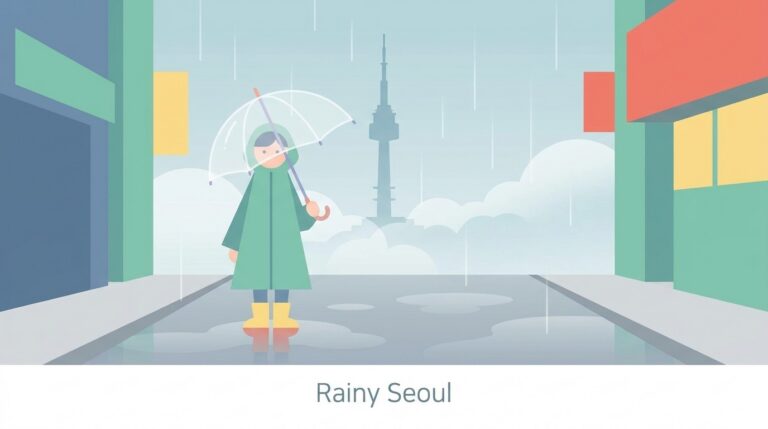
Picture this: You wake up in your Seoul Airbnb, swipe open your phone, and the weather app cheerfully displays a bright sun icon with a comfortable 22°C. Delighted, you style your hair, put on your favorite pastel knit cardigan, and step out in clean canvas sneakers for an aesthetic cafe crawl through Yeonnam-dong. But barely twenty minutes into your stroll, ominous steel-gray clouds swallow the sky. Out of nowhere, massive rain droplets start pelting down—a classic Korean guerrilla shower (게릴라성 호우). Within seconds, you are sprinting under the neon awning of a CU convenience store, shivering, holding an emergency 5,000 KRW transparent umbrella, while locals around you sigh and roll their eyes at the sky.
Sound familiar? In Korea, comparing the official weather forecast with capricious outdoor reality is practically a national pastime. Weather here changes at breakneck speed, and knowing how to comment on these sudden twists is essential for intermediate (B2) learners who want to move beyond stiff grammar. Based on real classroom feedback from intermediate students who felt stuck saying awkward phrases like “일기 예보가 틀렸습니다” (The weather forecast is incorrect), this guide equips you with authentic phrases, emotional nuances, and cultural gestures native speakers rely on daily.
Phase 2: 핵심 표현 3선 심층 분석 (3 Core Expressions)
1. 비 온다더니 날씨만 좋네 (Bi ondadeoni nalssiman jonne)
- Pronunciation: [Bi on-da-deo-ni nal-ssi-man jon-ne] (Sounds like bee on-dah-duh-nee nal-shee-man jone-nay, where jon-ne rhymes smoothly with Sunday).
- Meaning: Literal: “They said it would rain, but only the weather is nice.” / Nuance: “They swore it was going to rain, but the weather turned out to be gorgeous!”
- K-Culture Moment: In slice-of-life K-Dramas like Our Beloved Summer, characters cancel outdoor shooting plans due to a storm warning, only to step outside into dazzling sunshine and grumble this line with an ironic smile.
- Editor’s Insight: The connective ending
-다더니is an intermediate grammatical contraction of-다고 하더니(recalling an indirect quotation or rumor). Combining it with-만(only) highlights the sharp, slightly absurd contrast between the official report and reality. - Situation Spectrum: Casual (✅) / Semi-formal (✅ with polite ending: 비 온다더니 날씨만 좋네요) / Formal (🚫 – too colloquial for news anchors or business presentations).
- 🤔 Think About It: In English, we might say “So much for the rain forecast!” Notice how the Korean grammar
-다더니embeds the quoted authority directly into the clause, subtly nudging the blame toward the forecaster.
2. 예보랑 완전 딴판이야 (Yeborang wanjeon ttanpaniya)
- Pronunciation: [Ye-bo-rang wan-jeon ttan-pan-i-ya] (Sounds like yea-bo-rahng wahn-jun ttahn-pahn-ee-yah with crisp tension on ttan).
- Meaning: Literal: “It’s a completely different board from the forecast.” / Nuance: “It’s night and day compared to the forecast!”
- K-Culture Moment: Travel vloggers hiking Jeju Island who packed heavy down jackets because of a cold-snap warning, only to strip down to t-shirts under intense humidity, shouting this directly at their selfie cameras.
- Editor’s Insight: The word
딴판(ttanpan) originates from changing the layout or board in traditional games. It expresses a complete 180-degree reversal. It sounds far more idiomatic and colorful than simply saying완전 달라요(wanjeon dallayo). - Situation Spectrum: Casual (✅) / Semi-formal (⚠️ – add polite copula: 예보랑 완전 딴판이에요) / Formal (🚫 – use
기상 예보와 완전히 상이합니다). - 🤔 Think About It: Why do you think Korean uses physical metaphors like “flipping the board” (
판) to express unexpected shifts in circumstances?
3. 갑자기 비가 쏟아지네 (Gapjagi biga ssodajine)
- Pronunciation: [Gap-ja-gi bi-ga sso-da-ji-ne] (Put dramatic weight on the doubled sso sound to mimic water splashing violently).
- Meaning: Literal: “Suddenly rain is spilling down.” / Nuance: “It’s pouring out of nowhere!”
- K-Culture Moment: The iconic romantic K-Drama scene where the leads race into a bus shelter, shaking wet umbrellas, breathless as one marvels at the sudden deluge.
- Editor’s Insight:
쏟아지다means to spill over or dump out (like knocking over a full bucket). When describing sudden heavy showers in summer, Koreans instinctively choose this verb over the plain내리다(to fall). - Situation Spectrum: Casual (✅) / Semi-formal (✅ with polite ending: 갑자기 비가 쏟아지네요) / Formal (⚠️ – prefer
갑작스러운 폭우가 내리고 있습니다). - 🤔 Think About It: How does using dynamic sensory verbs like
쏟아지다change the listener’s emotional immersion compared to neutral statements?
Phase 3: 교과서 한국어 vs 진짜 한국어 (Textbook vs. Real-Life Korean)
Situation 1: The forecast missed the mark completely
- 📖 교과서 한국어: 일기 예보가 맞지 않습니다. (Ilgi yeboga matji anseumnida.) — “The weather forecast is not correct.”
- 🗣️ 진짜 한국어: 기상청 예보 또 빗나갔네. (Gisangcheong yebo tto binnagatne.) — “The Met Administration missed the mark again.”
- 💡 왜 다를까?: Real speakers rarely describe weather reports as “fitting or not fitting.” Instead, they personify the meteorological agency (기상청) and use the verb
빗나가다(to miss the target, as in archery or shooting).
Situation 2: The weather keeps shifting every hour
- 📖 교과서 한국어: 날씨가 자주 바뀝니다. (Nalssiga jaju bakkwimnida.) — “The weather changes often.”
- 🗣️ 진짜 한국어: 날씨가 아주 오락가락하네. (Nalssiga aju orakgarakhane.) — “The weather is completely back and forth today.”
- 💡 왜 다를까?:
오락가락하다(coming and going / fluctuating) captures the vivid frustration of rain stopping and starting unpredictably, turning your plans upside down.
Phase 4: K-Culture 딥다이브 & 비언어적 매너 (Deep Dive & Manners)
4-1. 눈치(Nunchi) & Gestures
When stepping outside to test the weather, Koreans don’t just look up; they extend one palm outwards at chest height, tilt their chin slightly upward, squint, and mutter to themselves (하늘 올려다보기). Furthermore, rainy day etiquette demands keen nunchi. Before entering a subway station, cafe, or boutique with a wet umbrella, look for the umbrella vinyl cover stand (우산 비닐 포장기) or the modern eco-friendly water-dryer pad (우산 빗물제거기). Walking into an establishment dripping rainwater onto hardwood floors without shaking your umbrella outside first is considered a major social faux pas.
4-2. Cultural Code: Transparent Umbrellas and Rainy Day Comforts
The moment raindrops fall in Seoul, convenience store owners immediately move stands filled with clear plastic umbrellas (비닐우산, binil-usan) right to the storefront doors. These inexpensive vinyl umbrellas have become an aesthetic staple of youth culture and street photography. More importantly, rainy days trigger a sensory food tradition: the craving for Haemul Pajeon (seafood scallion pancake) and chilled Makgeolli (rice wine). Koreans associate the sizzling sound of frying batter on a hot pan directly with the acoustic patter of heavy raindrops against windowpanes.
Phase 5: 실전 롤플레이 시나리오 (Interactive Roleplay)
- Setting: A trendy glass-fronted cafe in Seongsu-dong on a Saturday afternoon.
- Characters: You (유진) and your stylish Korean graphic designer friend, Min-woo (민우).
민우: 오늘 비 안 온다고 해서 우산 안 챙겼는데… (Oneul bi an ondago haeseo usan an chaenggyeonneunde…)
🎭 Looks up through the cafe glass at dark storm clouds and furrows his brow. / “They said it wouldn’t rain today, so I didn’t bring an umbrella…”
You: 그러게요, 아침에 예보 확인할 땐 맑음이었잖아요. (Geureogeyo, achime yebo hwaginhwal ttaen malgeum-ieotjannayo.)
🎭 Shows your smartphone weather screen with a wry smile. / “Right? When I checked the app this morning, it said clear skies.”
민우: 맞아요. 기상청 예보랑 날씨가 완전 딴판이네요. (Majayo. Gisangcheong yeborang nalssiga wanjeon ttanpan-ineyoyo.)
🎭 Sighs softly and takes a sip of his iced americano. / “Exactly. The weather is completely night and day from the forecast.”
You: 어? 저기 보세요! 갑자기 비가 쏟아지기 시작해요. (Eo? Jeogi boseyo! Gapjagi biga ssodajigi sijakhaeyo.)
🎭 Points toward the window as thick raindrops hammer the glass. / “Uh-oh, look out there! It’s suddenly pouring down.”
민우: 와, 장난 아니다. 날씨가 진짜 오락가락하네. (Wa, jangnan anida. Nalssiga jinjja orakgarakhane.)
🎭 Shakes his head in disbelief watching pedestrians run for cover. / “Whoa, no joke. The weather is seriously erratic today.”
You: 비 그칠 때까지 여기서 조금 더 이야기하다 갈까요? (Bi geuchil ttaekkaji yeogiseo jogeum deo iyagihada galkkayo.)
🎭 Picks up the drink menu again with an easygoing grin. / “Shall we stay and chat a bit longer until the rain lets up?”
민우: 좋은 생각이에요! 아니면 바로 앞 편의점에서 비닐우산 하나 살까요? (Joeun saenggak-ieyo! Animyeon baro ap pyeon-uijeom-eseo binil-usan hana salkkayo?)
🎭 Glances across the road toward the green sign of a convenience store. / “Great idea! Or should we just grab a cheap vinyl umbrella across the street?”
You: 좋아요, 우산 사고 저녁으로 파전에 막걸리 어때요? (Joayo, usan sago jeonyeogeuro pajeone makgeolli eottaeyo.)
🎭 Grins enthusiastically, nudging Min-woo’s elbow. / “Sounds great! Let’s get an umbrella and hit a pajeon and makgeolli spot for dinner!”
🔀 Interactive Branching Point
If the rain turns into a localized flash storm, how will you respond to Min-woo’s suggestion?
- Choice A: “비 그치기는커녕 더 쏟아질 것 같으니 바로 우산 사러 가요!” (Bi geuchigineunkeonyeong deo ssodajil geot gateuni baro usan sareo gayo!)
- Feedback: BEST. Uses the advanced B2 grammar pattern
-기는커녕(far from doing X) and solves the problem proactively with native-level fluency.
- Feedback: BEST. Uses the advanced B2 grammar pattern
- Choice B: “기상청 고객센터에 전화해서 공식적으로 항의해야겠습니다.” (Gisangcheong gogaekseenteoe jeonhwahaeseo gongsikjeogeuro hang-uihaeyagetseumnida.)
- Feedback: BAD. Far too stiff and litigious. Complaining to customer service over rain ruins the relaxed social mood.
- Choice C: “드라마처럼 그냥 비 맞으면서 지하철역까지 뛰어갈까요?” (Deuramacheoreom geunyang bi majeumyeonseo jihacheol-yeokkaji ttwieogalkkayo?)
- Feedback: RISK. Looks romantic in K-Dramas, but Seoul urban rain will ruin your friend’s styling and give them a cold, making them visibly uncomfortable.
Phase 6: 10초 감정 섀도잉 드릴 (10-Second Emotional Shadowing)
Practice these lines with appropriate breath pauses (/) and authentic vocal attitude:
- [😤 Mildly annoyed and ironic]
“비 온다더니… / 날씨만 / 엄청 맑네?”
(Bi ondadeoni… / nalssiman / eomcheong malgne?) -
[😲 Shocked and urgent]
“어? / 하늘 보니까 / 갑자기 비가 막 쏟아지네!”
(Eo? / haneul bonikka / gapjagi biga mak ssodajine!) -
[🌧️ Resigned chuckle]
“오늘 일기 예보랑 / 실제 날씨가 / 아주 그냥 딴판이야.”
(Oneul ilgi yeborang / silje nalssiga / aju geunyang ttanpaniya.)
Phase 7: K-Culture 미니 사전 (4 Essential Keywords)
- 구라청 (Guracheong)
- Meaning: “Lying Met Administration”
- Context: A viral internet slang portmanteau blending ‘구라’ (slang for a lie/bluff) with ‘기상청’ (KMA). Used among netizens when rain ruins weekend plans despite a sunny forecast.
- 일교차 (Ilgyocha)
- Meaning: Diurnal temperature range
- Context: Essential seasonal vocabulary during spring and autumn when mornings are 8°C and afternoons jump to 24°C. You will constantly hear: “일교차가 심하니까 겉옷 챙기세요” (Take an outer layer because the daily range is huge).
- 게릴라성 호우 (Gerillaseong hou)
- Meaning: Guerrilla flash rain / localized downpour
- Context: Summer torrential rain concentrated heavily over a single neighborhood for 30–60 minutes, bypassing broader regional forecasts.
- 비상 우산 (Bisang usan)
- Meaning: Emergency backup umbrella
- Context: The folding umbrella Koreans keep permanently stashed in their office locker or backpack bottom specifically for inaccurate forecast days.
Phase 8: 여행자를 위한 생존 키트 (Traveler Survival Kit)
Survival Expressions TOP 3
- 혹시 남는 우산 있어요? (Hoksi namneun usan isseoyo?)
- Pro Tip: Perfect when stuck in a guesthouse, cafe, or boutique and looking for a lost-and-found umbrella to borrow.
- 우산 비닐 어디에 버려요? (Usan binil eodie beoryeoyo?)
- Pro Tip: Use this when entering a building holding a disposable umbrella sleeve to maintain pristine public manners.
- 오늘 비 올 확률이 몇 프로예요? (Oneul bi ol hwangnyuri myeot peuroyeyo?)
- Pro Tip: “What’s the rain probability today?” Great conversation starter with hotel concierges or tour guides.
Editor’s Travel Note
For the most accurate localized radar reports, do not rely on standard global phone apps. Check the official 기상청 날씨누리 웹사이트 or open the 네이버 지도 앱 다운로드 page to activate the real-time weather radar overlay before boarding outdoor tourist buses.
Phase 9: “한 발 더 깊이” (Cultural Essay)
In Korean society, weather commentary is rarely superficial small talk. In an interdependent culture steeped in Jeong (정, emotional affection), checking the forecast on behalf of someone else functions as a proxy for personal care. When a Korean asks you, “우산 챙기셨어요?” (Did you pack an umbrella?) or notes that “예보랑 다르게 쌀쌀하네요” (It’s unexpectedly chilly despite the forecast), they are not just filling silence. They are demonstrating concern for your physical comfort and wellbeing.
💬 Your Turn: In your home country, is pointing out an inaccurate weather forecast considered brief elevator chit-chat, or does it trigger communal rituals like running to a pub or cooking specific rainy-day dishes? Tell us your stories in the comments!
Phase 10: FAQ & 오해 방지 (FAQ & Common Mistakes)
Q: Can I use the slang word ‘구라청’ in casual business settings?
A: Absolutely not. While ‘구라청’ is common in internet comments and among college friends, ‘구라’ is coarse slang. In professional or semi-formal contexts, express your disagreement gracefully by saying: “예보가 생각보다 잘 안 맞네요” (The forecast isn’t matching up as well as expected).
Q: What is the grammatical difference between ‘비가 오다’ and ‘비가 쏟아지다’?
A: ‘비가 오다’ is a neutral, factual statement that rain is falling. ‘비가 쏟아지다’ focuses on velocity, volume, and sensory impact—indicating a sudden, heavy downpour that resembles a bucket tipping over.
Q: How do I tell someone to bring an outer layer because the forecast might be wrong?
A: Use the compound phrase: “예보랑 다를 수 있으니까 겉옷 하나 챙겨 가세요” (Take a light jacket with you since it might differ from the forecast).
🚨 Common Mistakes Alert
- Mistake: Translating “The weather forecast lied” directly as “날씨 예보가 거짓말했어요.”
- Correct Action: Weather doesn’t intentionally lie! Say “예보가 빗나갔어요” (The forecast missed) or “예보가 안 맞아요” (The forecast doesn’t match).
- Mistake: Using written terms like “강우” (precipitation) in speech.
- Correct Action: Keep it natural with “비” (e.g., 비가 많이 와요 instead of 강우량이 많습니다).
- Mistake: Forgetting honorifics when showing concern.
- Correct Action: When asking an elder or colleague, say “우산 챙기셨어요?” rather than the casual “우산 챙겼어?”.
Phase 11: 액션 미션 & 참여 유도 (Action Missions)
- 🥉 Bronze Level: Stand in front of your window, observe the clouds, and record a 5-second voice memo saying: “비 온다더니 날씨만 좋네!”
- 🥈 Silver Level: Take a photo of today’s sky, post it on Instagram Stories or Threads, and caption it with: “오늘 날씨 예보랑 완전 딴판! #DailyHangul”
- 🥇 Gold Level: During your next Korean tutoring session or conversation exchange, spontaneously ask your partner: “오늘 비 올 확률이 몇 프로예요?”
- 🎮 K-Culture Mission: Watch any episode of a contemporary K-Drama (like Business Proposal or Crash Landing on You) and spot a scene where unexpected rain prompts someone to buy a transparent convenience store umbrella.
Phase 12: 인터랙티브 퀴즈 챌린지 (Interactive Quiz)
Q1. Situation Judgment: You stepped out wearing a T-shirt because the morning forecast promised clear, warm skies, but a sharp freezing wind has picked up. Which intermediate phrase fits best?
* A) 비가 쏟아져서 참 좋습니다.
* B) 예보랑 완전 딴판으로 너무 쌀쌀하네요.
* C) 일기 예보가 아주 정직합니다.
Q2. Fill-in-the-Blank: Complete the sentence with the correct quotation ending:
* “오후에 눈이 [ _____ ] 날씨만 따뜻하네.” (They said it would snow in the afternoon, but the weather is just warm.)
Q3. True or False: In Korea, entering a subway station with a soaking wet umbrella without shaking it or covering it in a protective sleeve is considered standard, unproblematic behavior.
* (True / False)
👉 Click to reveal answers & explanations!
- Q1 Answer: B. 예보랑 완전 딴판으로 너무 쌀쌀하네요 correctly highlights that the actual cold wind is completely different (딴판) from the warm forecast.
- Q2 Answer: 온다더니 (onda-deoni). The contraction of 온다고 하더니 expresses the retrospective quote about the snow forecast contrasted with the warm reality.
- Q3 Answer: False. Korean subway stations have strict safety manners; dripping wet umbrellas create slip hazards, so commuters must use the vinyl covers or water-dryer pads provided at the gate.







