

Phase 1: 공감 (Story-driven Opening)
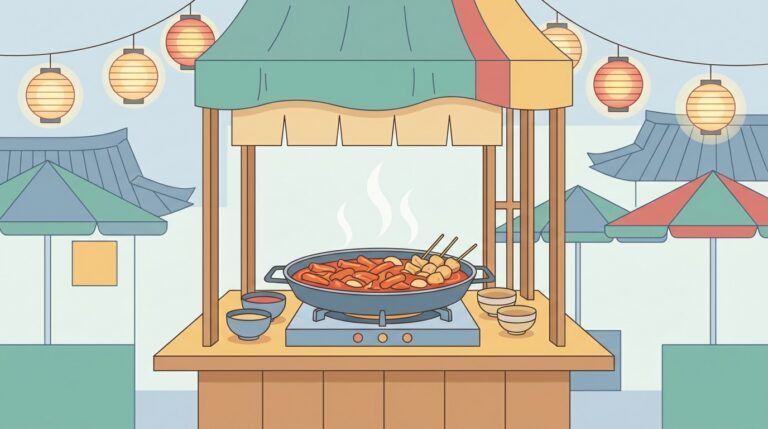
안녕하세요! 매일한글 에디터입니다. Have you ever stepped into a buzzing Korean traditional market like Gwangjang or Mangwon, drawn by the intoxicating scent of spicy gochujang and simmering broth, only to freeze when the busy market owner looks right at you and shouts, “What can I getcha?” You see the glorious pan of glistening, bright-red rice cakes, but your mind turns completely blank. Many of our beginner learners tell us that street food stalls feel far more intimidating than modern cafes because there are no touch-screen kiosks or English menus. But don’t worry! Based on real student trials, this step-by-step field guide will give you the exact words, rhythm, and insider manners to order tteokbokki like a true local.
Phase 2: 핵심 표현 3선 심층 분석 (Top 3 Core Expressions)
1. 떡볶이 1인분 주세요 (Tteokbokki il-inbun juseyo)
- Pronunciation: [Tteok-bbok-kki il-in-bun ju-se-yo] (Think: “Tteok-poh-key eel-een-boon joo-seh-yo”)
- Meaning: Literal: “Please give me 1 serving of tteokbokki” | Nuance: “I’d like one order of tteokbokki, please.”
- K-Culture Moment: In countless K-Dramas like Weightlifting Fairy Kim Bok-joo, characters huddle around steaming street carts in cold weather and shout this sentence before grabbing their skewers.
- Editor’s Insight: ‘인분’ (inbun) specifies servings. In traditional stalls, portions are generous, so starting with ‘1인분’ (il-inbun) for two light eaters or a solo traveler is totally normal!
- Situation Spectrum: Casual ✅ | Semi-formal ✅ | Formal ⚠️
- 🤔 Think About It: Why does Korean count food by “person-servings” (인분) rather than “plates” or “bowls”? It reflects a culture centered on people dining together.
2. 여기서 먹고 갈게요 (Yeogiseo meokgo galgeyo)
- Pronunciation: [Yeo-gi-seo meok-gko gal-kke-yo] (Think: “Yaw-gee-saw mawk-goh gahl-geh-yo”)
- Meaning: Literal: “I will eat here and go” | Nuance: “For here, please.”
- K-Culture Moment: Heard across street carts from Hongdae to Dongdaemun whenever customers choose to stand at the stall rather than taking their food in a plastic bag.
- Editor’s Insight: In Korean street stalls, you usually stand while eating. Saying this lets the owner hand you a plate covered in a clean plastic sheet immediately.
- Situation Spectrum: Casual ✅ | Semi-formal ✅ | Formal ⚠️
- 🤔 Think About It: In English, you simply say “For here,” but Korean specifies the action of leaving (“and go”). Notice how Korean often chains verbs to describe the full sequence of events.
3. 국물 좀 주세요 (Gungmul jom juseyo)
- Pronunciation: [Gung-mul jom ju-se-yo] (Think: “Goong-mool johm joo-seh-yo”)
- Meaning: Literal: “Please give me a little broth” | Nuance: “Could I have some fish cake soup, please?”
- K-Culture Moment: Seen in Reply 1988 where neighbors sip hot odeng broth from paper cups to warm up on snowy evenings.
- Editor’s Insight: The word ‘좀’ (jom) literally means “a little,” but functionally it works as a magic softener like “could you kindly”. Market vendors provide savory fish cake broth for free—all you have to do is ask nicely!
- Situation Spectrum: Casual ✅ | Semi-formal ✅ | Formal ⚠️
- 🤔 Think About It: Why is broth offered for free with dry or spicy snacks? It shows ‘정’ (Jeong)—warm hospitality that nurtures the customer.
Phase 3: 교과서 한국어 vs 진짜 한국어 (Textbook vs. Real-Life Korean)
Situation 1: Ordering your food at the cart
- 📖 교과서 한국어: 떡볶이를 주문하고 싶습니다. (Tteokbokkireul jumunhago sipseumnida.) — “I would like to order tteokbokki.”
- 🗣️ 진짜 한국어: 이모, 떡볶이 1인분만 주세요! (Imo, tteokbokki il-inbun-man juseyo!) — “Auntie, just one portion of tteokbokki, please!”
- 💡 왜 다를까?: Traditional markets are casual and warm. Textbook grammar sounds overly robotic and stiff. Calling the vendor ‘이모’ (Imo) instantly creates friendly rapport.
Situation 2: Asking for a cup of warm broth
- 📖 교과서 한국어: 어묵 국물을 마셔도 됩니까? (Eomuk gungmureul masyeodo doemnikka?) — “Am I permitted to drink fish cake broth?”
- 🗣️ 진짜 한국어: 국물 좀 종이컵에 떠 먹어도 돼요? (Gungmul jom jong-ikeobe tteo meogeodo dwaeyo?) — “May I scoop some broth into a paper cup?”
- 💡 왜 다를까?: Street stalls encourage self-service for broth. Rather than asking permission like a school child, locals make a gentle, collaborative request.
Phase 4: K-Culture 딥다이브 & 비언어적 매너 (Deep Dive & Stall Etiquette)
4-1. 눈치 (Nunchi) & Gestures
- Grab your own skewer: Look for the container of long wooden toothpicks or skewers sitting on the counter. Don’t wait to be handed one; take one yourself.
- Broth Etiquette: Pick up an empty paper cup, use the communal ladle to pour fish cake soup into your cup, and step slightly back so other customers can reach.
- Two-Hand Payment: Always hand over cash or credit cards with both hands or with your right hand supported by your left wrist.
4-2. Cultural Code Analysis: The Magic of “Imo”
Calling female stall owners ‘아줌마’ (Ajumma) can occasionally feel distant or blunt. Instead, use ‘이모’ (Imo), which literally means “maternal aunt.” It implies, “You feed me with the unconditional care of family!” In Korean food culture, this single word can earn you extra fish cakes or an extra scoop of sauce.
Phase 5: 실전 롤플레이 시나리오 (Real-World Roleplay Scenario)
- Location: A bustling corner stall in Tongin Market filled with steam and clattering dishes.
- Character: Imo (Friendly, energetic street food vendor in a floral apron).
-
Imo: 학생, 뭐 줄까? 떡볶이 방금 만들어서 맛있어! (Haksaeng, mwo julkka? Tteokbokki banggeum mandeureoseo masisseo!)
🎭 Stirs the bubbling red pan with a giant spatula and smiles warmly.
“What can I get you, dear? The tteokbokki is freshly made and delicious!” -
You: 안녕하세요! 떡볶이 1인분 주세요. (Annyeonghaseyo! Tteokbokki il-inbun juseyo.)
🎭 Smiles politely and makes eye contact.
“Hello! One serving of tteokbokki, please.” -
Imo: 여기서 먹고 갈 거지? 순대나 튀김은 안 필요해? (Yeogiseo meokgo gal geoji? Sundaena twigimeun an piryohae?)
🎭 Pulls out a flat plate lined with plastic wrap.
“Eating here, right? Don’t you want blood sausage or fried fritters too?” -
You: 네, 여기서 먹고 갈게요. 튀김도 1인분 같이 주세요! (Ne, yeogiseo meokgo galgeyo. Twigimdo il-inbun gachi juseyo!)
🎭 Nods head gently while pointing toward the crispy fried dumplings.
“Yes, I will eat here. Please give me an order of fried fritters too!” -
Imo: 튀김은 떡볶이 국물에 버무려 줄까? (Twigimeun tteokbokki gungmure beomuryeo julkka?)
🎭 Tongs poised over crispy squid and sweet potato fritters.
“Should I smother the fried snacks in tteokbokki sauce?” -
You: 네, 국물에 묻혀 주세요! (Ne, gungmure muthyeo juseyo!)
🎭 Gives an enthusiastic nod.
“Yes, please dip them in the sauce!” -
Imo: 자, 여기 있어. 어묵 국물은 종이컵에 셀프로 떠 마셔! (Ja, yeogi isseo. Eomuk gungmureun jong-ikeobe selpeuro tteo masyeo!)
🎭 Slides the heaping plate forward alongside two wooden skewers.
“Here you go. Help yourself to fish cake soup using a paper cup!” -
You: 감사합니다, 이모! 잘 먹겠습니다. (Gamsahamnida, imo! Jal meokgetseumnida.)
🎭 Receives the plate with both hands and bows slightly.
“Thank you, auntie! I will eat well.”
🔀 Interactive Decision Point
Your tteokbokki is quite spicy and your mouth is burning! What do you say?
* Option A: “저기요, 물 좀 주세요.” (Jeogiyo, mul jom juseyo. – Excuse me, please give me water.)
* Option B: “이모, 국물 좀 더 마셔도 돼요?” (Imo, gungmul jom deo masyeodo dwaeyo? – Auntie, can I have more soup?)
* Option C: “너무 매워요! 환불해 주세요.” (Neomu maewoyo! Hwanbulhae juseyo. – It’s too spicy! Give me a refund.)
- Option Feedback:
- Option A (Good / Neutral): Clear and functional, though most street stalls keep a water purifier at the back where you serve yourself.
- Option B (Best): Perfect! Fish cake broth soothes the spice immediately and keeps the conversation warm and natural.
- Option C (Risk / Rude): Asking for a refund because street tteokbokki is spicy violates local norms and will create awkward tension.
Phase 6: 10초 감정 섀도잉 드릴 (10-Second Emotion Shadowing Drill)
Practice reading these out loud with rhythm and native feeling:
[😊 Energetic & Polite]
이모! / 떡볶이 1인분만 / 주세요!
(Imo! / Tteokbokki il-inbun-man / juseyo!)-
[😋 Anticipating & Delighted]
튀김도 / 국물에 / 묻혀 주세요!
(Twigim-do / gungmul-e / muthyeo juseyo!) -
[🙏 Grateful & Satisfied]
국물 / 조금만 더 / 마셔도 돼요?
(Gungmul / jogeum-man deo / masyeodo dwaeyo?)
Phase 7: K-Culture 미니 사전 (Mini Dictionary)
- 1인분 (il-inbun): One portion/serving. Essential for ordering any street food or barbecue. (e.g., 2인분 = i-inbun, 3인분 = sam-inbun).
- 이모 (imo): Literally “maternal aunt,” used affectionately toward middle-aged female restaurant or street stall owners.
- 떡튀순 (tteok-twi-sun): An iconic portmanteau for the Holy Trinity of street food: Tteokbokki (떡볶이), Twigim (튀김 – fried fritters), and Sundae (순대 – blood sausage).
- 서서 먹다 (seoseo meokda): To eat while standing up. The authentic, casual way Koreans enjoy snacks at market stalls.
Phase 8: 여행자를 위한 생존 키트 (Traveler’s Survival Kit)
Top 3 Survival Phrases
- 포장해 주세요 (Pojanghae juseyo) — “Please pack it to go.”
Pro Tip: Perfect if you want to eat your snack in your hotel room or at a scenic bench. - 카드 돼요? (Kadeu dwaeyo?) — “Do you take credit cards?”
Pro Tip: Most stalls accept cards today, but carrying small cash bills (1,000 KRW and 5,000 KRW) is polite and appreciated. - 덜 맵게 해 주세요 (Deol maepge hae juseyo) — “Please make it less spicy.”
Pro Tip: At pre-simmered stalls, they cannot change the sauce, but the vendor might mix in extra un-spiced fish cakes or broth for you!
Editor’s Travel Note
- Navigate alleys effortlessly: Use the [Naver Map app download for English navigation] rather than Google Maps, which lacks walking route accuracy in traditional markets.
- Keep cash accessible: While modern terminals exist, some small vendors prefer cash or account transfers. Keep 10,000 KRW in paper currency ready.
Phase 9: “한 발 더 깊이” (Cultural Reflection)
In western fast food restaurants, transactions are purely functional: you order at a terminal, take a receipt, and leave. But in a Korean traditional market, ordering tteokbokki is an exchange of human warmth known as ‘정’ (Jeong). Standing shoulder-to-shoulder with strangers, sipping steaming broth from a shared cart, and calling the cook ‘이모’ strips away formal social hierarchies. Food here is not just fuel; it is shared neighborhood comfort.
💬 Your Turn: Does your home culture have street stalls where customers stand and eat together? How do you address the vendors there? Share your story in the comments below!
Phase 10: FAQ & 흔한 실수 (FAQ & Mistakes)
Q: Can I sit down if there are no chairs at the stall?
A: Most tteokbokki stalls are designed for standing (‘서서 먹는 포장마차’). Simply stand close to the rim of the cart, keep your personal bag tucked close to your body, and eat right there!
Q: Is the fish cake soup really free?
A: Yes! When you order any food item like tteokbokki or fried snacks, the warm fish cake broth is complimentary. You can scoop it into a paper cup using the ladle provided.
Q: What should I do with my skewers and napkins when I finish?
A: Look beneath the cart counter or near your feet. There are almost always small trash bins marked for wooden skewers and paper cups. Do not leave used skewers lying on the food tray.
🚨 흔한 실수 (Common Mistakes Top 3)
- Mistake: Calling the vendor ‘아줌마’ (Ajumma) loudly.
Correct Action: Use ‘이모’ (Imo) or ‘사장님’ (Sajangnim – boss/owner) to sound polite and endearing. - Mistake: Dipping eaten food back into communal sauce trays.
Correct Action: Never double-dip skewers into communal soy sauce dishes. Use the pastry brush provided to brush sauce onto your snack. - Mistake: Handing over money with one hand while looking away.
Correct Action: Pay with both hands, look at the vendor, and say “감사합니다” (Gamsahamnida).
Phase 11: 액션 미션 & 참여 유도 (Action Missions)
- 🥉 Bronze Mission (Solo): Practice saying “떡볶이 1인분 여기서 먹고 갈게요!” in front of your mirror 5 times in under 15 seconds.
- 🥈 Silver Mission (Social): Take a photo of your favorite Korean snack or textbook study setup, post it on Instagram, and tag our community with #DailyHangulTteokbokki.
- 🥇 Gold Mission (Real Life): Visit a local Korean market or pojangmacha restaurant and order exclusively in Korean without looking at an English menu.
- 🎮 K-Culture Mission: Watch an episode of any slice-of-life K-drama (like Hospital Playlist) and spot whether characters eat tteokbokki standing up or seated.
Phase 12: 인터랙티브 퀴즈 챌린지 (Interactive Quiz)
1. Situational Decision: You want to order 1 portion of tteokbokki and eat it at the market stall. Which phrase should you choose?
* (A) 떡볶이 1인분 포장해 주세요.
* (B) 떡볶이 1인분 여기서 먹고 갈게요.
* (C) 떡볶이 1인분 버려 주세요.
2. Fill-in-the-blank: When asking for free fish cake soup, fill in the missing word:
“이모, [ ______ ] 좀 종이컵에 마셔도 돼요?”
3. True or False: It is considered offensive in Korean markets to call an older female stall owner ‘이모’ (Imo).
* True / False
👉 Click to reveal answers & explanations!
-
Answer: (B)
(A) means ‘Please pack it to go,’ and (C) means ‘Please throw it away.’ (B) is the correct expression for eating right there! -
Answer: 국물 (Gungmul – broth/soup)
Asking for ‘국물’ (broth) politely in a paper cup is the standard market etiquette. -
Answer: False
Calling the owner ‘이모’ (auntie) is actually friendly and endearing, making the vendor feel respected and close!







