

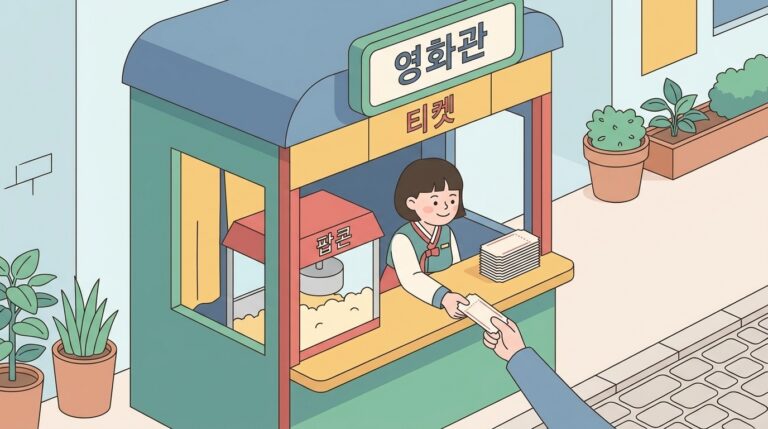
Phase 1: Empathy (Story-driven Opening)
안녕하세요! 매일한글 에디터입니다. (Hello! I’m your Daily Hangul editor!)
Picture this: You just stepped into the bustling neon atrium of CGV Yongsan in Seoul. The sweet, buttery aroma of caramel popcorn fills the air, movie posters of your favorite K-drama stars line the walls, and the ticketing screen glows above with titles like Exhuma or the latest Bong Joon-ho masterpiece. You’re holding your smartphone, your heart racing. The digital kiosk is buzzing in rapid Korean, and the counter clerk looks over with a warm smile. You glance at your watch. You know your movie starts soon, but is it at 7:10 PM or 7:40 PM? You try to remember the number words, but your mind goes completely blank.
Asking about time in a new language feels intimidating—especially when native Korean uses two entirely different number systems! You don’t want to accidentally walk into the theater halfway through the plot. Over the past ten years coaching hundreds of beginners, I’ve seen students sweat bullets over simple time questions. But here is the secret: you don’t need a dictionary full of grammar to ask for movie times like a pro. With just two or three friendly, bite-sized sentence patterns, you will navigate Korean movie theaters with calm confidence. Let’s master the exact phrases you need today!
Phase 2: Core Expressions Deep Dive
1. 영화 몇 시에 시작해요? (Yeonghwa myeot sie sijakaeyo?)
- Pronunciation: [Yeong-hwa myeot si-e si-jak-hae-yo?] (Think: Young-hwa, then myut like ‘mutt’, see-eh, see-jahk-hae-yo)
- Meaning: Literal: “Movie what hour at start?” / Nuance: “What time does the movie start?”
- K-Culture Moment: You will hear this constantly outside cinema doors or between friends sitting in a café before heading over to Megabox.
- Editor’s Insight: Notice the particle ‘에’ (e). It acts like ‘at’ in English. Pairing ‘몇 시’ (what hour) with ‘에’ pinpoints the exact kick-off time.
- Situation Spectrum: Casual: ⚠️ (Use ‘시작해?’ with close friends) | Semi-formal: ✅ (Perfect for clerks and new friends) | Formal: ✅
- 🤔 Think About It: In English, we ask “What time does it start?” using general ‘time’. Why do you think Korean asks specifically for the ‘hour’ (시)?
2. 지금 몇 시예요? (Jigeum myeot siyeyo?)
- Pronunciation: [Ji-geum myeot si-ye-yo?] (Think: Gee-geum like ‘give’, myut, see-yeh-yo)
- Meaning: Literal: “Now what hour is it?” / Nuance: “What time is it now?”
- K-Culture Moment: Often gasped in K-dramas when the main lead wakes up late and scrambles across Seoul to catch their date.
- Editor’s Insight: If you lose track of time while choosing between Sweet Popcorn and Onion Popcorn at the concession stand, this is your golden ticket sentence.
- Situation Spectrum: Casual: ⚠️ | Semi-formal: ✅ | Formal: ✅
- 🤔 Think About It: Notice how Korean puts the time word ‘지금’ (now) at the very front of the sentence. What does this tell you about how Koreans prioritize context?
3. 몇 시 영화예요? (Myeot si yeonghwayeyo?)
- Pronunciation: [Myeot si yeong-hwa-ye-yo?] (Sounds like: Myut see young-hwa-yeh-yo)
- Meaning: Literal: “What hour movie is it?” / Nuance: “Which showing is your movie? / What time is the movie?”
- K-Culture Moment: The classic line exchange when meeting a date at the station exit before strolling into the theater together.
- Editor’s Insight: This is a mega-shortcut! Instead of forming a long verb sentence, you simply slap ‘영화예요?’ onto ‘몇 시’. Native speakers love efficiency.
- Situation Spectrum: Casual: ⚠️ (Change to ‘영화야?’) | Semi-formal: ✅ | Formal: ✅
- 🤔 Think About It: How does shortening sentences help build casual warmth in fast-paced city life?
Phase 3: Textbook Korean vs. Real Korean
Situation 1: Asking the box office clerk when the next screening is
- 📖 교과서 한국어: “다음 상영 시각이 언제입니까?” (Daeum sang-yeong sigag-i eonje-imnikka? – When is the next screening time?)
- 🗣️ 진짜 한국어: “다음 영화 몇 시에 있어요?” (Daeum yeonghwa myeot sie isseoyo? – What time is the next movie?)
- 💡 왜 다를까? Textbooks teach formal Sino-Korean nouns like ‘상영 시각’ (screening hour), but real Koreans prefer conversational verbal phrasing using everyday verbs like ‘있어요’ (is there / exists).
Situation 2: Checking what showing a friend booked
- 📖 교과서 한국어: “몇 시 상영작을 예매하셨습니까?” (Myeot si sang-yeongjageul yemaehasyeossseumnikka? – Which screening production did you reserve?)
- 🗣️ 진짜 한국어: “몇 시 영화 예매했어?” (Myeot si yeonghwa yemaehaesseo? – What time movie did you book?)
- 💡 왜 다를까? Real-life Korean cuts out the bureaucratic fluff and jumps straight to the point: time + movie + action.
Phase 4: K-Culture Deep Dive & Non-Verbal Manners
4-1. 눈치 (Nunchi) & Cinema Manners
When asking cinema staff about movie times, your body language speaks volumes. Always approach the counter with a slight head nod (a subtle 15-degree bow). Never point your index finger directly at the staff’s face or screen; instead, gesture toward the digital display with an open palm facing upward. When paying or receiving your physical paper ticket, use both hands—or support your right wrist lightly with your left hand. This gesture instantly marks you as culturally thoughtful and polite!
4-2. The 10-Minute Ad Rule (에티켓 타임)
In Korea, cinema culture has a unique custom: the “10-minute commercial window.” If your ticket says the movie starts at 2:00 PM, the lights will dim, but the feature film won’t actually begin until 2:10 PM. Those ten minutes are reserved for trailers and public safety announcements. Locals use this buffer to grab wet wipes, put on jackets, and silence their phones. So don’t panic if you are running five minutes late—Korean theaters have your back!
Phase 5: Real-Life Roleplay Scenario
Setting: The ticketing desk at CGV Hongdae on a Friday evening.
Characters:
* Minji (민지): Friendly theater crew member wearing a clean black CGV vest and headset.
* Alex (알렉스): You, an eager movie fan ready to catch a screening.
Turn 1
Alex: 저기요, 영화 몇 시에 시작해요? (Jeogiyo, yeonghwa myeot sie sijakaeyo?)
English: “Excuse me, what time does the movie start?”
🎭 행동 지문: Alex taps the counter softly and smiles politely.
Turn 2
Minji: 어떤 영화 보시겠어요? (Eotteon yeonghwa bosigesseoyo?)
English: “Which movie would you like to watch?”
🎭 행동 지문: Minji taps the digital screen facing Alex.
Turn 3
Alex: 파묘(Exhuma) 보고 싶어요. (Pamyo bogo sipeoyo.)
English: “I want to watch Exhuma.”
🎭 행동 지문: Alex points to the poster with an open hand.
Turn 4
Minji: 다음 영화는 일곱 시 십 분에 있어요. (Daeum yeonghwaneun ilgop si sip bune isseoyo.)
English: “The next movie is at 7:10.”
🎭 행동 지문: Minji highlights the 19:10 slot on the screen.
Turn 5
Alex: 지금 몇 시예요? (Jigeum myeot siyeyo?)
English: “What time is it right now?”
🎭 행동 지문: Alex tilts his head, glancing at his bare wrist.
Turn 6
Minji: 지금 일곱 시예요. 십 분 남았어요! (Jigeum ilgop siyeyo. Sip bun namasseoyo!)
English: “It is 7:00 now. Ten minutes left!”
🎭 행동 지문: Minji points toward the theater escalator.
Turn 7
Alex: 티켓 한 장 주세요! (Tiket han jang juseyo!)
English: “One ticket, please!”
🎭 행동 지문: Alex hands over his payment card with two hands.
Turn 8
Minji: 네, 즐겁게 보세요! (Ne, jeulgeopge boseyo!)
English: “Here you go, enjoy the show!”
🎭 행동 지문: Minji bows and hands the receipt with both hands.
🔀 Interactive Choice Point
You realize the movie starts in 10 minutes, but you are craving popcorn. What do you do?
* Option A: Say “팝콘 빨리 주세요!” (Give me popcorn fast!) directly to Minji at the ticket booth.
Feedback (Bad): The ticketing counter and the concession stand are separate! Demanding fast service can sound blunt.
* Option B: Say “상영관 어디예요?” (Where is the screening hall?) and rush straight to your seat to avoid being late.
Feedback (Risk): Safe, but remember the 10-minute commercial rule! You actually had time to order popcorn at the snack bar.
* Option C: Say “매점 어디예요? 팝콘 살게요!” (Where is the snack bar? I will buy popcorn!) and head to the snack bar.
Feedback (Best): Perfect! You know there’s a 10-minute buffer, so you have plenty of time to grab popcorn before the main title card rolls.
Phase 6: 10-Second Emotion Shadowing Drill
Read these aloud while mimicking the emotional tone and natural pauses (/ marks pauses):
[😊 Curiously and brightly]
저기요, / 영화 몇 시에 / 시작해요?
(Jeogiyo, / yeonghwa myeot sie / sijakaeyo?)-
[⚡ Slightly hurried but polite]
지금 / 몇 시예요? / 늦었어요?
(Jigeum / myeot siyeyo? / neujeosseoyo?) -
[🎉 Relieved and cheerful]
일곱 시 십 분 영화 / 한 장 주세요!
(Ilgop si sip bun yeonghwa / han jang juseyo!)
Phase 7: K-Culture Mini Dictionary
-
상영 시간 (Sang-yeong sigan)
Translation: Screening time / Runtime
Everyday Usage: The exact schedule listed on theater boards. You’ll see this labeled above timetable columns in CGV, Lotte Cinema, and Megabox. -
조조할인 (Jojo-harin)
Translation: Early morning matinee discount
Everyday Usage: Screenings before 10:00 AM receive big discounts (often 30-40% cheaper). College students and retirees love the ‘조조’ slot! -
예매 (Yemae)
Translation: Advance booking / Reservation
Everyday Usage: Koreans rarely buy tickets at the counter on weekends; they do ‘예매’ through apps hours or days ahead. -
좌석 (Jwaseok)
Translation: Seat
Everyday Usage: When ordering at the kiosk, you will pick your ‘좌석’. Look out for ‘명당 좌석’ (sweet spot seats) usually located in rows F to H.
Phase 8: Traveler’s Survival Kit
TOP 3 Survival Cinema Phrases
- 티켓 한 장 주세요. (Tiket han jang juseyo.) – “One ticket, please.”
Pro Tip: Swap ‘한 장’ (one sheet) for ‘두 장’ (du jang) if you are watching with a friend. - 몇 관이에요? (Myeot gwan-ieyo?) – “Which theater hall is it?”
Pro Tip: Large multiplexes have up to 20 halls. This phrase saves you from wandering into the wrong screen. - 팝콘 콤보 주세요. (Pap-kon kombo juseyo.) – “Please give me a popcorn combo.”
Pro Tip: This gets you a large popcorn and two drinks at a bundle price.
Editor’s Travel Note
Before heading out, download the Naver Map navigation app to find your closest multiplex. Avoid busy weekend queues by setting up the CGV Official Cinema App where you can check live seat availability. Korean cinemas do not accept foreign cash at automated kiosks, so keep your overseas travel credit card or cash ready for the staffed counter.
Phase 9: Going One Step Deeper (Reflection)
In Korean society, time is deeply collaborative. The word ‘우리’ (we/our) often precedes plans, meaning being on time is an expression of social care and respect for the group’s harmony. When you ask “영화 몇 시에 시작해요?”, you aren’t just checking numbers—you are syncing your pace with everyone around you. In an ultra-punctual society like Korea, showing care for shared minutes is one of the highest forms of polite consideration.
💬 Your Turn: What is the cinema etiquette in your home country? Do people arrive early, or do trailers allow everyone to stroll in casually? Drop your thoughts in the comments below!
Phase 10: FAQ & Avoiding Misunderstandings
Q: Which number system do I use for cinema times in Korean?
A: Korean uses Native Korean numbers for the hour (한 시, 두 시, 세 시…) and Sino-Korean numbers for the minutes (십 분, 이십 분, 삼십 분…). For example, 7:10 is ‘일곱 시 십 분’ (Ilgop si sip bun).
Q: Can I just ask “몇 시예요?” without saying the word for movie?
A: Yes! If you are already pointing at a movie poster, simply saying “몇 시에 시작해요?” (What time does it start?) is completely natural and understood.
Q: Do Korean movie theaters have English subtitles for Korean films?
A: Generally, standard screenings do not have English subtitles. However, major flagship theaters like CGV Yongsan I-Park Mall or Megabox COEX periodically offer special screenings with English subtitles for major Korean blockbusters.
🚨 Common Mistakes Warning Board
- Mixing up Hours and Minutes: Saying Sino-Korean numbers for hours (e.g., ‘칠 시’ ❌ instead of ‘일곱 시’ ⭕).
Correct Action: Memorize Native numbers 1 through 12 strictly for hours! - Forgetting the Time Marker ‘에’: Saying ‘일곱 시 시작해요’ instead of ‘일곱 시에 시작해요’.
Correct Action: Always glue ‘에’ to the time word when an action begins. - Panicking over the 24-hour clock: Screens often show 19:30 instead of 7:30 PM.
Correct Action: Subtract 12 in your head, then speak using ‘오후 일곱 시 삼십 분’ (Afternoon 7:30).
Phase 11: Action Mission
- 🥉 Bronze Level: Stand in front of your mirror and practice saying “영화 몇 시에 시작해요?” smoothly three times in under 10 seconds.
- 🥈 Silver Level: Check out a trailer for an upcoming Korean film on YouTube, write the sentence “이 영화 몇 시에 시작해요?” in the comments, and share it on Instagram or X tagging @DailyHangul.
- 🥇 Gold Level: Next time you visit Korea (or your local Korean market/cinema), walk up to the counter and ask for the time or movie schedule purely in Korean!
🎮 K-Culture Mission: Watch any episode of a contemporary K-drama (like Business Proposal or Queen of Tears). Listen closely for the word “몇 시” (myeot si) whenever two characters arrange a date. Comment the timestamp once you spot it!
Phase 12: Interactive Quiz Challenge
1. Situational Judgment:
You want to ask the ticket agent what time the movie Parasite begins. Which sentence is the most natural for an A1 speaker?
a) 기생충 영화 상영 개시 시각을 알리세요.
b) 기생충 영화 몇 시에 시작해요?
c) 지금 기생충 영화 시간 있어요?
2. Fill in the Blank:
“지금 일곱 시 _____ 분이에요.” (It is 7:15 right now. What is 15 in Sino-Korean minutes?)
[ 빈칸: ________________ ]
3. True or False:
In Korean movie theaters, the main movie always begins the exact minute printed on your ticket without any advertisements.
Reveal Answer & Detailed Explanation
1. Correct Answer: b) 기생충 영화 몇 시에 시작해요?
Explanation: Option (a) is robotic and command-heavy. Option (c) awkwardly asks if the movie has time. Option (b) is polite, friendly, and 100% natural.
2. Correct Answer: 십오 (sibo)
Explanation: Minutes use Sino-Korean numbers. 10 (십) + 5 (오) = 십오 (sibo). So the sentence is “일곱 시 십오 분이에요.”
3. Correct Answer: False (F)
Explanation: Korean cinemas have a standard 10-minute commercial buffer window (에티켓 타임) before the actual feature presentation starts!







