

Phase 1: 공감 (스토리 몰입형 오프닝)
안녕하세요! 매일한글 에디터입니다.
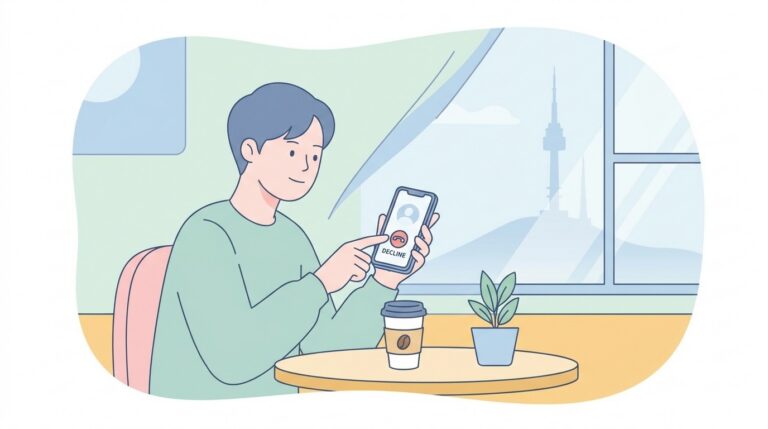
Picture this: You are sitting in a sunlit cafe in Yeonnam-dong, sipping an iced Americano and eagerly awaiting your 배달 (baedal – food delivery) to your Airbnb. Suddenly, your phone vibrates. The screen flashes an unfamiliar number starting with 02 or 070. Your heart races—could this be the delivery rider? Or maybe your bank verifying your card? You swipe to answer and politely greet them: “여보세요? (Yeoboseyo?)”
Instantly, a fast-talking voice launches into a five-minute monologue about credit loan approvals or financial investments. You freeze. In your native culture, you might just abruptly hang up, but in Korea, where politeness and respect reign supreme, you feel paralyzed. Can I just cut the line? Will I sound incredibly rude if I hang up? How do I say ‘stop calling me’ without sounding like a drama villain?
Don’t worry! Every single Korean resident deals with this daily spam dilemma. Based on feedback from hundreds of our intermediate learners, navigating unsolicited calls is one of the highest-anxiety moments in Korean daily life. Today, let’s transform that anxiety into smooth, culturally savvy confidence!
Phase 2: 핵심 표현 3선 심층 분석
1. 괜찮습니다, 끊겠습니다. (Gwaenchanseumnida, kkeunkketsumnida.)
- Pronunciation: [Gwaen-chan-seum-ni-da, kkeun-ket-sum-ni-da] (Think of it like saying: Gwen-chahn-seum-nee-dah, kkoon-ket-soom-nee-dah)
- Meaning: Literal: “It is fine, I will hang up.” | Actual Nuance: “No thank you, I am ending this call now.”
- K-Culture Moment: You’ll see this in countless K-dramas when a character at an office desk swiftly dismisses an unwanted telemarketer without losing professional composure.
- Editor’s Insight: The ending ‘-겠습니다’ (-getseumnida) indicates firm personal intention while retaining high formal politeness. It acts as an iron-clad boundary wrapped in velvet.
- Situation Spectrum: Casual 🚫 | Semi-formal ⚠️ | Formal ✅
- 🤔 Think About It: Notice how “괜찮습니다” (I am okay) is used to reject something rather than “싫습니다” (I hate it / No). Why does Korean culture favor stating personal satisfaction rather than explicit refusal?
2. 바빠서 통화하기 어렵습니다. (Bappaseo tonghwahagi eoryeopseumnida.)
- Pronunciation: [Bah-pah-seo tong-hwa-hah-gi eo-ryeop-seum-ni-da] (Pronounced like: Bah-pah-suh tohng-hwah-hah-gee uh-ryup-soom-nee-dah)
- Meaning: Literal: “Because I’m busy, calling is difficult.” | Actual Nuance: “I’m busy right now, so I can’t talk.”
- K-Culture Moment: When a protagonist is rushing through subway turnstiles to meet someone and receives an ad call, this is the classic excuse to break away guilt-free.
- Editor’s Insight: By framing the rejection around situational difficulty (“어렵습니다” – it is difficult) rather than personal distaste, you avoid confronting the telemarketer directly.
- Situation Spectrum: Casual ⚠️ | Semi-formal ✅ | Formal ✅
- 🤔 Think About It: How does your native language handle polite excuses? Do you also use external factors like ‘busyness’ to soften the blow?
3. 다시 전화하지 말아 주세요. (Dasi jeonhwahaji mara juseyo.)
- Pronunciation: [Da-si jeon-hwa-ha-ji ma-ra ju-se-yo] (Sounds like: Dah-shee jun-hwah-hah-jee mah-rah joo-seh-yo)
- Meaning: Literal: “Please do not call again.” | Actual Nuance: “Take me off your call list, please.”
- K-Culture Moment: Used by characters dealing with persistent, borderline fraudulent callers or aggressive sales tactics.
- Editor’s Insight: While still using the polite imperative “-주세요” (-juseyo), this sentence sets a strict legal boundary against repeated harassment.
- Situation Spectrum: Casual 🚫 | Semi-formal ✅ | Formal ✅
- 🤔 Think About It: When does excessive politeness become counterproductive when protecting your personal boundaries?
Phase 3: 교과서 한국어 vs 진짜 한국어
Situation 1: Cutting off a persistent sales pitch
- 📖 교과서 한국어: “저는 그 상품에 관심이 전혀 없으니 전화를 끊겠습니다.” (Jeoneun geu sangpume gwansimi jeonhyeo eopseuni jeonhwareul kkeunkketsumnida. – I have no interest in that product at all, so I will hang up.)
- 🗣️ 진짜 한국어: “아, 됐습니다~ (뚝)” (Ah, dwaesseumnida~ [Click]) or “지금 바빠서요, 끊을게요!” (Jigeum bappaseoyo, kkeuneulgeyo!)
- 💡 왜 다를까?: In real phone interactions, explaining your lack of interest creates an opening for trained agents to counter. A crisp “됐습니다” (That’s quite enough) followed by an immediate hang-up is standard, accepted Korean etiquette for spam.
Situation 2: Informing that you will block the number
- 📖 교과서 한국어: “앞으로 귀하의 발신 번호를 차단 조치하도록 하겠습니다.” (Apeuro gwihaui balsin beonhoreul chadan jochihadorok hagetseumnida. – Henceforth, I will take measures to block your esteemed number.)
- 🗣️ 진짜 한국어: “수신 거부할게요.” (Susin geobuhalkeyo. – I will reject future calls.) or simply saying nothing and hitting ‘차단’ (block) on the smartphone.
- 💡 왜 다를까?: Words like ‘귀하’ (esteemed you) and ‘조치’ belong to legal contracts, not spoken conversation. Real Koreans prioritize efficiency and privacy tools.
Phase 4: K-Culture 딥다이브 & 비언어적 매너
4-1. 눈치(Nunchi) & Phone Etiquette Gestures
When an unknown number pops up, Korean nunchi starts before you even touch the screen:
* Number Prefix Check: If it starts with 070 (VoIP/Internet lines), locals immediately sigh and let it ring or hit reject. If it begins with 02 (Seoul landline) or 1588/1577 (customer centers), it is 90% likely to be an automated telemarketer.
* Volume-Button Silence: If you are in a quiet cafe or subway, do not reject the call with a loud red button tap if it vibrates loudly. Instead, press the side volume button once to mute the ringer instantly without letting the caller know the line is actively being monitored.
4-2. Culture Code: The ‘Voice Phishing’ (보이스피싱) Alert
In South Korea, spam is not merely an annoyance; it is a serious social topic tied to sophisticated financial fraud known as 보이스피싱 (Voice Phishing). Because criminal syndicates sometimes impersonate the prosecution (검찰) or the Financial Supervisory Service (금융감독원), Korean society has developed a culture of intense vigilance. Therefore, cutting off unsolicited sales calls isn’t viewed as rude—it is considered smart, essential digital self-defense!
Phase 5: 실전 롤플레이 시나리오
Setting: You are working on your laptop at a quiet cafe in Hongdae. Your phone rings from an unknown 02 number. You pick up, unsure if it’s an urgent call regarding your bank card.
Characters: You (B1 Learner) vs. Agent Park (Tenacious Telemarketer from a life insurance agency).
- Agent Park: 여보세요? 고객님, 이번에 특별 프로모션 암보험 상품 안내차 연락드렸습니다. (Yeoboseyo? Gogaeknim, ibeone teukbyeol peulomosyeon amboheom sangpum annaecha yeollakdeulyeossseumnida. – Hello? Valued customer, I am calling to introduce our special promotion cancer insurance product.)
- You: 🎭 (Hesitant and caught off guard) 아, 저기… 저는 외국인인데요… (Ah, jeogi… jeoneun oegugininde-yo… – Ah, excuse me… I am a foreigner…)
- Agent Park: 🎭 (Speaking even faster without skipping a beat) 네! 외국인등록증 소지자분들도 동일하게 가입 가능하신 파격적인 혜택입니다! (Ne! Oegugindeungrokjeung sojijabundeuldo dong-ilhage ga-ip ganeunghasin pagyeokjeogin hetaek-imnida! – Yes! Even Alien Registration Card holders are eligible for these unprecedented benefits!)
- You: 🎭 (Taking a deep breath to sound firm) 아, 지금 일하는 중이라 바쁩니다. (Ah, jigeum ilhaneun jung-ira bappeumnida. – Ah, I am currently working so I am busy.)
- Agent Park: 🎭 (Persistently trying to hold the line) 딱 1분만 시간 내주시면 핵심만 간단히 설명해 드릴게요! (Ttak il-bun-man sigan naejusimyeon haeksim-man gandani seolmyeonghae deurilgeyo! – If you give me just 1 minute, I’ll explain the key points very briefly!)
- You: 🎭 (Polite yet unwavering) 죄송하지만 관심 없습니다. 끊겠습니다. (Joesonghajiman gwansim eopseumnida. Kkeunkketsumnida. – I am sorry, but I am not interested. I am hanging up now.)
- Agent Park: 🎭 (Sensing the firm wall) 아… 그러신가요? 알겠습니다. 좋은 하루 보내세요. (Ah… geureosingayo? Algetseumnida. Joeun haru bonaeseyo. – Ah… is that so? Understood. Have a good day.)
- You: 🎭 (Quickly finishing before pressing end) 네, 수고하세요. (Ne, sugohaseyo. – Yes, take care.) (Tap! Call ended)
🔀 인터랙티브 분기점 (What should you say next?)
Imagine the agent still doesn’t stop and starts talking about an alternative offer:
* Choice A: “야! 너 누구야? 장난쳐?” (Ya! Neo nuguya? Jangnanchyeo? – Hey! Who are you? Are you joking with me?)
* Choice B: “괜찮습니다. 다시 전화하지 말아 주세요.” (Gwaenchanseumnida. Dasi jeonhwahaji mara juseyo. – No thank you. Please do not call me again.)
* Choice C: “어… 한국말 잘 몰라요… 죄송해요…” (Eo… hangukmal jal mollayo… joesonghaeyo… – Uh… I don’t know Korean well… I’m sorry…)
Feedback:
* Choice A (Bad): Using informal banmal (“야”, “너”) escalates tension unnecessarily and marks you as an aggressive conversationalist.
* Choice B (Best!): Professional, firm, and leaves zero conversational wiggle room. Perfect Korean boundary setting!
* Choice C (Risk): Saying you don’t speak Korean well invites scammers to try again later or treat your number as active for spam databases.
Phase 6: 10초 감정 섀도잉 드릴
Practice these natural cadences. The slash / indicates a brief micro-pause!
[😐 담담하고 명확하게 - Neutral & Crisp]
“괜찮습니다, / 끊겠습니다.”
(Gwaenchanseumnida, / kkeunkketsumnida.)-
[🛑 단호하고 차분하게 - Firm & Unshakable]
“관심 없으니까 / 다시 전화하지 마세요.”
(Gwansim eopseunikka / dasi jeonhwahaji maseyo.) -
[💼 예의 바르지만 빠른 마무리 - Polite wrap-up]
“지금 통화하기 어려워요, / 끊을게요!”
(Jigeum tonghwahagi eoryeowoyo, / kkeuneulgeyo!)
Phase 7: K-Culture 미니 사전 (핵심 키워드 4개)
- 보이스피싱 (Bo-i-seu-pi-sing) | Voice Phishing / Phone Fraud
- Originates from “Voice + Phishing”. Used in official news and daily speech to describe deceptive phone scams aiming to extract bank transfers.
- 수신 차단 (Su-sin cha-dan) | Call Blocking / Number Blocking
- The built-in mobile feature to prevent specific numbers from contacting you. Highly utilized among Koreans.
- 070 번호 (Gong-chil-gong beon-ho) | VoIP Telephone Prefix
- Internet telephone numbers primarily designated for call centers, outbound marketing, and telemarketers.
- 두낫콜 (Du-nat-kol) | Do-Not-Call Registry Service
- The official Korean government service that registers consumer phone numbers to legally bar financial and sales telemarketing.
Phase 8: 여행자를 위한 생존 키트
Survival Phrases TOP 3
- “스팸 번호 차단해 주세요.” (Seupaem beonho chadanhae juseyo.)
- Meaning: Please block this spam number.
- Pro Tip: If you rent a pocket Wi-Fi or Korean USIM at Incheon Airport and get bombarded with marketing calls, show this phrase to customer service agents.
- “제가 주문한 배달인가요?” (Jega jumunhan baedaringayo?)
- Meaning: Are you the delivery driver for my order?
- Pro Tip: When an unknown 010 number calls while waiting for food, ask this first to clarify the caller’s identity immediately.
- “잘못 걸었습니다.” (Jalmot georeotseumnida.)
- Meaning: You dialed the wrong number.
- Pro Tip: If the caller is looking for someone else (common with recycled prepaid SIMs), use this polite line.
Editor’s Travel Note
Before stepping foot outside your hotel, download spam-filtering applications like [안드로이드 후후(WhoWho) 스팸 차단 앱 설치] or configure [아이폰 T전화 발신자 정보 설정하기] on your mobile settings. In Korea, these caller-ID apps automatically display crowd-sourced tags such as “대출 권유” (Loan offer) or “설문조사” (Survey) directly on the incoming call screen. If you reside in Korea long-term, register your phone with the [두낫콜(Do-Not-Call) 스팸 전화 수신거부 등록 서비스] to legally prevent financial promotional calls!
Phase 9: “한 발 더 깊이” (생각 질문)
In Korean culture, speech levels (존댓말 – honorifics) reflect social harmony and mutual respect. However, telemarketing capitalizes on this cultural reflex: because agents speak in ultra-honorific language (“고객님”, “안내해 드리겠습니다”), foreigners and young Koreans often feel a psychological barrier against interrupting them. True fluency in Korean means recognizing that politeness never requires you to sacrifice your time and peace of mind. Drawing a clean line with “괜찮습니다, 끊겠습니다” is an act of mature communication, not disrespect.
💬 Your Turn: How does phone spam culture work in your country? Do people answer unknown calls, or do you leave them ringing? Share your thoughts below!
Phase 10: FAQ & 오해 방지 (FAQ Schema)
Q: Is it considered extremely rude to just hang up without saying anything in Korea?
A: With unsolicited telemarketers and robocalls, simply hanging up is a standard everyday reaction among locals. However, saying a brief “괜찮습니다, 끊겠습니다” (No thank you, I will hang up) right before pressing the red button keeps your personal etiquette intact.
Q: What should I do if the caller claims to be from the Korean Police or Prosecution?
A: Real Korean law enforcement will never ask you to transfer funds, withdraw cash, or download third-party security apps over the phone. If someone claims to be an investigator, say “다시 연락하겠습니다” (I will contact you back), immediately hang up, and dial the police hotline at 112.
Q: Why do telemarketers keep calling me even after I said no?
A: Call centers use automatic dialing systems. Stating a vague excuse like “I’m a foreigner” often keeps your number labeled as “callback candidate.” Using firm phrasing like “다시 전화하지 말아 주세요” (Please do not call again) triggers your removal from sales lists.
🚨 흔한 실수 (Common Mistakes) 경고판
- Mistake 1: Apologizing profusely with “너무 죄송합니다” (I am so sorry).
- Correct Action: You have nothing to apologize for! Use “괜찮습니다” (No thank you) instead of over-apologizing.
- Mistake 2: Engaging in small talk trying to practice Korean with telemarketers.
- Correct Action: Telemarketers will log your line as an active responder, causing your number to be sold across secondary ad networks. Keep conversations under 5 seconds.
- Mistake 3: Shouting angry insults in English or Korean.
- Correct Action: Escalating aggression is unnecessary. Deliver a calm, assertive refusal and immediately block the caller.
Phase 11: 액션 미션 & 참여 유도
- 🥉 Bronze Level: Stand in front of your mirror and practice saying: “괜찮습니다, 끊겠습니다.” three times with a steady, relaxed voice.
- 🥈 Silver Level: Share in the comments below your favorite excuse you use in your own native language when dealing with phone solicitors!
- 🥇 Gold Level: The next time an unexpected marketing call hits your phone in Korea, execute our 2-step dismissal without panicking: “지금 바빠서요, 끊을게요!” and hit the red button.
- 🎮 K-Culture Mission: Watch an episode of a workplace drama (such as Misaeng or Agency) and count how many times employees quickly answer and terminate phone calls using professional closing formulas.
Phase 12: 인터랙티브 퀴즈 챌린지
1. Situation Decision:
You receive a call from an 070 number during lunchtime promoting a new gym membership. Which response is the most natural and polite dismissal?
* A) 꺼져! (Kkeojyeo!)
* B) 괜찮습니다, 끊겠습니다. (Gwaenchanseumnida, kkeunkketsumnida.)
* C) 저는 당신을 사랑하지 않습니다. (Jeoneun dangsineul saranghaji anseumnida.)
2. Fill in the Blank:
Complete the phrase to say “Please do not call again”:
“다시 전화하지 ________.” (mara juseyo)
3. True or False:
In Korea, telephone numbers beginning with ‘070’ are commonly associated with telemarketing and automated sales calls.
* (True / False)
👉 Click to reveal answers & explanations!
- Answer: B – “괜찮습니다, 끊겠습니다.” is the optimal balance of formal courtesy and definitive termination. (A is an offensive slur; C means ‘I do not love you’!).
- Answer: 말아 주세요 (mara juseyo) – Formed by the negative imperative verb ‘말다’ combined with ‘-아/어 주세요’.
- Answer: True – 070 numbers are standard VoIP lines utilized extensively by customer acquisition centers.







