

Phase 1: 공감 (Empathy & The Evolving Table)
안녕하세요! 매일한글 에디터입니다. (Annyeonghaseyo! It’s your Daily Hangul editor.)
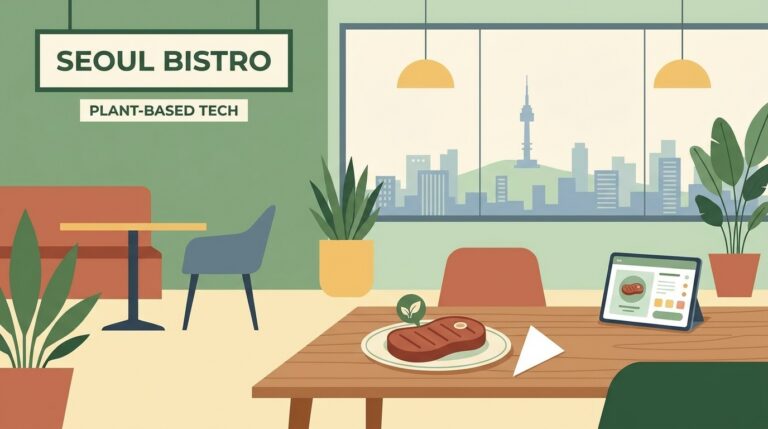
Picture this: You are walking down the vibrant red-brick alleys of Seongsu-dong, often called the Brooklyn of Seoul. You step into a sleek, minimalist restaurant advertising cutting-edge gastronomic creations. Looking around, you notice the sizzling sound of marinated short ribs on tabletop grills—except the digital signage displays words like 배양육 (cultured meat) and 대체육 (plant-based alternative meat). You want to know if their signature galbi uses soy isolate or mushroom mycelium, whether the broth is 100% plant-derived, and how the texture mirrors the marbling of Hanwoo beef.
Suddenly, the standard textbook phrases you practiced—“고기 빼주세요” (Please remove the meat)—feel shockingly inadequate. In modern Korea, food tech is exploding. From automated robotic frying stations in Gangnam to Michelin-starred chefs collaborating with biotech startups, the culinary landscape is shifting fast. If you are an advanced learner aiming for C1 fluency, navigating dining is no longer just about dietary restrictions; it is about discussing culinary textures, technological innovations, and ethical gastronomy with sophistication.
Today’s guide is crafted directly from our advanced learners’ real field experiences in Seoul’s hippest food-tech bistros. By the end of this lesson, you will comfortably discuss food textures, place precise custom orders, and speak about Korea’s food-tech revolution like a true culinary connoisseur.
Phase 2: 핵심 표현 3선 심층 분석 (Core Expressions Deep Dive)
1. 혹시 패티를 식물성 대체육으로 변경할 수 있나요?
- Pronunciation: Hoksi paetireul singmulseong daecheyugeuro byeongyeonghal su innayo? (Sounds like: hoke-shee patty-reul sing-mool-seong day-che-yook-eu-ro byun-gyung-hal soo een-nah-yo)
- Meaning: Literal: By any chance, can I change the patty to plant-based alternative meat? | Nuance: A polite, polished, and contemporary way to request food-tech substitutions at modern cafes and upscale burger lounges without sounding demanding.
- K-Culture Moment: Seen in trendsetting lifestyle programs and food vlogs set in Hannam-dong or Seongsu, where influencers inquire about eco-friendly culinary alternatives.
- Editor’s Insight: Using 혹시 (by any chance) softens the request instantly. Notice the term 식물성 대체육 (plant-based alternative meat)—it specifies modern food-tech proteins rather than traditional Buddhist temple ingredients like 콩고기 (soy meat).
- Situation Spectrum: Casual (⚠️ slightly overly polite) | Semi-formal (✅ perfect for hip restaurants) | Formal (✅)
- 🤔 Think About It: In your native language, do you specify “plant-based” or simply ask for a “veggie burger”? Notice how Korean incorporates technical descriptors (식물성, 대체육) seamlessly into polite conversational requests.
2. 식감이 실제 육류랑 거의 구별이 안 갈 정도로 정교하네요.
- Pronunciation: Sikgami silje yungnyurang geoui gubyeori an gal jeongdoro jeonggyohaneyo. (Sounds like: sheek-gahm-ee sheel-jeh yoong-nyoo-rang guh-wee goo-byul-ee ahn gal jung-doh-roh jung-gyoh-hah-neh-yo)
- Meaning: Literal: The mouthfeel is so sophisticated that it’s almost indistinguishable from real meat. | Nuance: High-level culinary praise acknowledging the advanced food-tech texture and culinary artistry of the chef.
- K-Culture Moment: Frequently heard on gourmet evaluation shows like Wednesday Food Talk or culinary documentaries when judges marvel at next-gen culinary precision.
- Editor’s Insight: 식감 (mouthfeel/texture) is the single most important metric in Korean gastronomy. Pairing it with 정교하다 (elaborate/exquisite/sophisticated) elevates your commentary to a professional food critic level.
- Situation Spectrum: Casual (⚠️ sounds like a documentary host) | Semi-formal (✅ ideal when complimenting the chef/owner) | Formal (✅)
- 🤔 Think About It: How does your culture evaluate meat substitutes? In Korea, texture (쫄깃함, 육즙) is often prioritized even higher than primary flavor notes.
3. 요즘 푸드테크 트렌드를 반영한 메뉴 구성이 돋보이네요.
- Pronunciation: Yojeum pudeutekeu teurendeureul banyeonghan menyu guseongi dotboineyyo. (Sounds like: yo-jeum food-teh-kuh teu-ren-deu-reul bahn-young-hahn meh-nyoo goo-sung-ee dote-boh-ee-neh-yo)
- Meaning: Literal: The menu composition reflecting recent food-tech trends really stands out. | Nuance: A sophisticated observation commending a venue’s innovation, sustainability efforts, and culinary curation.
- K-Culture Moment: Common in business-casual dinners, startup mixers in Teheran-ro, or networking events over innovative dining.
- Editor’s Insight: 돋보이다 (to stand out positively) is a subtle compliment. It highlights conscious curation rather than merely saying 메뉴가 좋아요 (the menu is nice).
- Situation Spectrum: Casual (🚫 too analytical) | Semi-formal (✅) | Formal (✅)
- 🤔 Think About It: Using loanwords like 푸드테크 (food-tech) in Korean reflects industry-forward sophistication. Reflect on how your native language adopts tech terminology in everyday dining.
Phase 3: 교과서 한국어 vs 진짜 한국어 (Textbook vs. Real Korean)
Situation 1: Asking if a dish contains hidden animal ingredients
- 📖 교과서 한국어: 이 음식에 고기나 동물성 기름이 들어있습니까? (I eumsige gogina dongmulseong gireumi deureoisseumnikka? – Is there meat or animal fat in this food?)
- 🗣️ 진짜 한국어: 혹시 육수나 소스 베이스에도 동물성 성분은 완전히 배제된 건가요? (Hoksi yuksuna soseu beiseuedo dongmulseong seongbuneun wanjeonhi baejedoen geongayo? – By any chance, are animal ingredients completely excluded from the broth and sauce base as well?)
- 💡 왜 다를까? In Korean cooking, animal fat or anchovy stock (육수) is omnipresent even in vegetable dishes. C1 speakers know that simply asking “고기 있어요?” misses hidden broths. Using 완전히 배제되다 (completely excluded) clarifies dietary boundaries with precision and elegance.
Situation 2: Commenting on the juicy texture of cultured/alternative meat
- 📖 교과서 한국어: 가짜 고기인데 진짜 고기처럼 육즙이 많고 맛있습니다. (Gajja gogiinde jinjja gogicheoreom yukjeubi manko masitseumnida. – It is fake meat, but like real meat, it has a lot of juice and is delicious.)
- 🗣️ 진짜 한국어: 대체육 특유의 퍽퍽함이 전혀 없고, 육즙을 완벽하게 구현했네요. (Daecheyuk teuyuuui peokpeokhami jeonhyeo eopgo, yukjeubeul wanbyeokhage guhyeonhaenneyo. – It doesn’t have the typical dryness of alternative meats at all, and it reconstructs the juiciness perfectly.)
- 💡 왜 다를까? Native speakers rarely say 가짜 고기 (fake meat) in modern settings because it sounds derogatory. Instead, using terms like 구현하다 (to realize/reconstruct) and 퍽퍽함 (dryness/chalkiness) demonstrates refined palate awareness.
Phase 4: K-Culture 딥다이브 & 비언어적 매너 (Deep Dive & Non-Verbal Manners)
4-1. 눈치 (Nunchi) & Smart Gesturing in Tech-Driven Restaurants
In modern Korean food-tech restaurants, ordering often occurs via table tablets or kiosks. However, when inquiring about customized alternative ingredients:
* The Delicate Hand Angle: When asking staff about ingredient substitutions, avoid pointing directly at the menu tablet. Instead, place an open hand, palm facing slightly upward at a 45-degree angle toward the screen, while slightly tilting your head to signal respect.
* The Nuance of “Dietary Burden”: Historically, asking for custom menu alterations was considered a disruption (민폐) to kitchen rhythm. To maintain excellent nunchi, frame your question not as an inconvenience to the chef, but as curiosity about their creations: “혹시 대체육 옵션도 준비되어 있을까요?” (Could alternative meat options perhaps be available?)
4-2. The Cultural Convergence: Temple Food Meets Silicon Valley
Korea’s alternative protein boom is uniquely anchored by its 1,700-year-old Buddhist temple cuisine (사찰음식). While Western alternative proteins focus heavily on laboratory molecular isolates, Korean food tech merges modern biotechnology with traditional fermentation techniques like 장류 (fermented pastes) and mushroom processing. Today’s youth visit pop-up bistros that bridge 정관스님 (Jeong Kwan Sunim)-style philosophical gastronomy with cellular agriculture. Expressing appreciation for both heritage and innovation is the ultimate mark of an educated diner in Seoul.
Phase 5: 실전 롤플레이 시나리오 (Roleplay: Lab-to-Table Bistro)
- Setting: “Bistronomy Tech,” an avant-garde dining room in Seongsu-dong.
- Character: Chef-Manager Min-ho (민호), a sharp culinary technologist wearing a minimalist denim apron.
민호: 어서 오세요! 오늘 저희 팝업 코스는 세포 배양육과 버섯 균사체 스테이크를 중심으로 구성되어 있습니다.
(Eoseo oseyo! Oneul jeohui papeop koseuneun sepo baeyangyukgwa beoseot gyunsache seuteikeureul jungsimeuro guseongdoe-eo itseumnida.)
(Welcome! Today’s pop-up course is centered on cell-cultured meat and mushroom mycelium steak.)
🎭 두 손을 모으고 태블릿 메뉴판의 코스 구성을 부드럽게 가리키며
You: 반갑습니다. 메뉴 콘셉트가 무척 신선하네요. 혹시 메인 디시의 소스에도 동물성 버터나 육수가 사용되나요?
(Bangapseumnida. Menyu konsepteuga mucheok sinseonhaneyo. Hoksi mein disiui soseuedo dongmulseong beoteona yuksuga sayongdoenayo?)
(Nice to meet you. The menu concept is very fresh. By any chance, are animal butter or broths used in the main dish sauce?)
🎭 고개를 살짝 끄덕이며 진지한 호기심을 담은 눈빛으로
민호: 아, 저희 소스는 전부 발효 콩 단백질과 오트 밀크 베이스라 완전 비건 지향 손님도 안심하고 드실 수 있습니다.
(A, jeohui soseuneun jeonbu balhyo kong danbaekjilgwa oteu milkeu beiseura wanjeon bigeon jihyang sonnimdo ansimhago deusil su itseumnida.)
(Ah, our sauces are entirely based on fermented soy protein and oat milk, so even guests strictly pursuing vegan dining can enjoy them with peace of mind.)
🎭 친절한 미소와 함께 태블릿의 성분표 화면을 터치하여 보여주며
You: 다행이네요! 그럼 메인 요리는 균사체 스테이크로 선택할게요. 굽기 조절도 가능한가요?
(Dahaeng-ineyyo! Geureom mein yorineun gyunsache seuteikeuro seontaekhalkeyo. Gupgi jojeoldo ganeunghangayo?)
(What a relief! Then I will choose the mycelium steak for my main dish. Is it possible to adjust the doneness?)
🎭 메뉴판을 미소로 확인하며 부드러운 어조로
민호: 균사체 패티는 수분 유지 기술이 핵심이라 미디엄 웰던 템포로 조리할 때 가장 식감이 풍부합니다.
(Gyunsache paetineun subun yuji gisuri haeksimira midieom weldeon tempouro jorihal ttae gajang sikgami pungbuhamnida.)
(Moisture retention technology is key for mycelium patties, so the mouthfeel is richest when cooked to a medium-well tempo.)
🎭 손바닥을 살짝 들어 풍부한 식감을 묘사하듯 제스처를 취하며
You: 전문가 추천대로 미디엄 웰던으로 부탁드립니다. 식감이 얼마나 정교하게 구현되었을지 기대되네요.
(Jeonmunga chucheondaero midieom weldeoneuro butakdeurimnida. Sikgami eolmana jeonggyohage guhyeondwoesseulji gidaedoeneyyo.)
(Please prepare it medium-well as the expert recommends. I look forward to seeing how sophisticated the texture reconstruction is.)
🎭 기대에 찬 눈빛으로 가볍게 목례하며
민호: 후회하지 않으실 겁니다. 첫 코스로 3D 프린팅 식물성 아뮤즈부쉬부터 바로 준비해 드리겠습니다.
(Huhoehaji aneusil geomnida. Cheot koseuro sseuridi peurinting singmulseong amyujeubuswibuteo baro jumbihye deurigetseumnida.)
(You won’t regret it. We will serve the 3D-printed plant-based amuse-bouche right away as your first course.)
🎭 정중하게 인사하며 주방으로 향한다
You: 감사합니다. 천천히 준비해 주세요.
(Gamsahamnida. Cheoncheonhi jumbihae juseyo.)
(Thank you. Please take your time.)
🎭 밝은 표정으로 식탁을 정리하며
🔀 Interactive Choice Point
The server returns and asks: “식사는 입에 맞으셨나요?” (Did the meal suit your palate?)
- Choice A: “진짜 고기랑 똑같아서 깜짝 놀랐어요! 대체육 특유의 잡내도 전혀 안 나네요.”
- Choice B: “콩고기 맛이 많이 나는데 기술이 아직 부족한 것 같아요.”
- Choice C: “배양육 연구 개발에 투자 많이 하셔야겠어요.”
Feedback:
* Choice A (Best): Compliments the technological achievement (잡내가 안 난다 – no off-odor) warmly while maintaining polite gourmet vocabulary. Perfect score!
* Choice B (Bad): Using 콩고기 dismissively and bluntly criticizing cutting-edge efforts breaches Korean dining etiquette.
* Choice C (Risk): Presumptuous. Lecturing a restaurant team on R&D investment (투자 많이 하셔야겠어요) sounds overly patronizing unless you are their lead venture capitalist.
Phase 6: 10초 감정 섀도잉 드릴 (Shadowing Drill)
Practice reading these out loud by matching the emotional tags and pauses marked by /.
[🧐 진지하고 세련되게]
“혹시 / 육수 베이스에도 / 동물성 성분은 / 완전히 배제된 건가요?”
(Hoksi / yuksu beiseuedo / dongmulseong seongbuneun / wanjeonhi baejedoen geongayo?)-
[🤩 감탄하며 눈을 반짝이며]
“대체육 특유의 퍽퍽함이 전혀 없고, / 육즙을 / 완벽하게 구현했네요!”
(Daecheyuk teuyuuui peokpeokhami jeonhyeo eopgo, / yukjeubeul / wanbyeokhage guhyeonhaenneyo!) -
[😊 차분하고 신뢰감 넘치게]
“푸드테크 트렌드를 반영한 / 메뉴 구성이 / 무척 돋보입니다.”
(Pudeutekeu teurendeureul banyeonghan / menyu guseongi / mucheok dotboimnida.)
Phase 7: K-Culture 미니 사전 (Mini Dictionary)
- 대체육 (Dae-che-yuk) | Alternative Meat | A broad term encompassing plant-based proteins, mycelium products, and cell-cultured meat. Used across media and modern menus instead of outdated terms.
- 푸드테크 (Poo-deu-te-keu) | Food-Tech | Refers to the intersection of biotechnology, AI, and culinary production. Widely used in industry conversations, menus, and culinary startup events.
- 비건 지향 (Bi-geon Ji-hyang) | Vegan-Oriented / Pursuing Veganism | A nuanced Korean phrase for practicing plant-based dining flexibly. It signals mindfulness rather than strict dogma.
- 미식 경험 (Mi-sik Gyeong-heom) | Gastronomic Experience | Describes culinary experiences focused on sensory discovery, ambiance, and innovation rather than just satisfying hunger.
Phase 8: 여행자를 위한 생존 키트 (Traveler’s Survival Kit)
Survival Expressions TOP 3
- “비건 인증 메뉴가 따로 표기되어 있나요?” (Bigeon injeung menyuga ttaro pyogidoeeo innayo?)
- Pro Tip: Ask this at airport dining zones or modern food courts to quickly find certified items without scanning micro-text.
- “유제품이나 계란 알레르기가 있어서 그런데, 대체 옵션이 있을까요?” (Yujepumina gyeran allereugiga isseoseo geureonde, daeche opsyeoni isseulkkayo?)
- Pro Tip: Mentioning allergies (알레르기) ensures Korean kitchen staff double-check secondary emulsifiers and hidden binders.
- “대체육 단품으로 추가 가능한가요?” (Daecheyuk dampumeuro chuga ganeunghangayo?)
- Pro Tip: In salad chains and fast-casual dining spots, this allows you to add alternative protein patties to any bowl.
Editor’s Travel Note
When venturing through Seoul’s culinary startup landscape, standard map filters often fall short. Utilize the 캐치테이블 앱 다운로드 가이드 to filter by “비건/대체육 레스토랑” (Vegan / Alternative Meat Bistros) and secure real-time reservations. When navigating transit toward culinary districts like Seongsu or Mullae, bookmark transit routes via the 네이버 지도 대중교통 길찾기 가이드, which highlights station exits equipped with elevators and modern dining arcades. Note that most avant-garde pop-up bistros are strictly cashless (카드 전용 or Apple/Samsung Pay only).
Phase 9: “한 발 더 깊이” (Cultural Essay & Prompt)
Traditional Korean culinary culture is fundamentally communal, embodied by the sizzling barbecue grill around which coworkers build solidarity during 회식 (company dinners). For decades, opting out of meat was often perceived as stepping away from group cohesion. However, the rise of food tech is radically reframing this dynamic: choosing alternative proteins is no longer viewed as non-conformity, but as an embrace of high-tech innovation, sustainability, and personal wellness. Technology has granted Korean diners individual dietary agency without sacrificing the shared social joy of grilling together.
💬 Your Turn: In your home culture, is alternative meat seen as an environmental choice, a health necessity, or culinary tech innovation? Share your perspective in the comments below using the phrase: “제 생각에는 푸드테크가…” (In my opinion, food-tech…)
Phase 10: FAQ & 오해 방지 (FAQ Schema)
Q: Does asking for “비건” (vegan) guarantee zero seafood broth in Korea?
A: Not always in traditional restaurants. Traditional chefs often classify dried anchovy stock (멸치 육수) or fish sauce (액젓) as seasonings rather than animal meat. Always specify: “해산물 육수나 액젓도 들어가지 않나요?” (Is there no seafood broth or fish sauce included either?).
Q: How do locals differentiate traditional “콩고기” from modern “대체육”?
A: 콩고기 (soy meat) typically evokes memories of gluten-heavy textured vegetable protein from 1990s Buddhist buffets. 대체육 (alternative meat) or 식물성 대체육 implies modern high-moisture extrusion, cell cultivation, and contemporary food-tech products.
Q: Can I find food-tech meat alternatives in everyday convenience stores?
A: Yes! Major convenience chains (CU, GS25, 7-Eleven) carry alternative-protein 삼각김밥 (triangle kimbap) and plant-based 불고기 lunchboxes, usually branded under labels like 지구식단 or 베지든든.
🚨 Common Mistakes Board
- Mistake 1: Calling high-tech alternative meat 가짜 고기 (fake meat) in front of the chef.
- Correct Action: Use 대체육 (alternative meat) or 식물성 단백질 패티 (plant protein patty).
- Mistake 2: Assuming 야채 김밥 (vegetable kimbap) is vegan.
- Correct Action: Traditional vegetable kimbap often contains imitation crab (맛살), ham, and egg. Clarify: “햄이랑 계란, 맛살은 빼주실 수 있나요?”
- Mistake 3: Believing “글루텐 프리” (gluten-free) equals vegan alternative meat.
- Correct Action: Many gluten-free items still contain animal-derived binders or egg whites. Double check: “동물성 유래 성분이 없는 비건 제품인가요?”
Phase 11: 액션 미션 & 참여 유도 (Action Missions)
- 🥉 Bronze Mission: Stand before a mirror and pronounce “혹시 패티를 식물성 대체육으로 변경할 수 있나요?” three times with natural intonation.
- 🥈 Silver Mission: Take a photo of an alternative protein or eco-friendly food product at a store, upload it to your Instagram story, and caption it: “오늘의 푸드테크 탐방! 식감이 정말 정교해요.” Tag @DailyHangul!
- 🥇 Gold Mission: Visit a hip cafe or bistro in Seoul (or order via a Korean delivery app) and successfully customize your order using today’s C1 phrasing.
🎮 K-Culture Mission: Watch a recent episode of a Korean food travel show or startup documentary and spot the moment they say 식감 (mouthfeel) or 육즙 (juiciness). Write down the adjective they pair with it!
Phase 12: 인터랙티브 퀴즈 챌린지 (Quiz Challenge)
1. Situational Judgment
You are dining at an innovative food-tech bistro in Gangnam. You want to praise the chef for how closely their cell-cultured pork replicates traditional pork belly without sounding rude. Which phrase is best?
* A) 가짜 고기치고는 냄새가 덜 나네요.
* B) 세포 배양육의 식감과 풍미가 실제 육류와 구별이 안 갈 만큼 정교하네요.
* C) 삼겹살보다 맛없지만 기술은 신기하네요.
👉 정답 및 해설 보기 (Click to view answer)
정답: B
해설: Option B represents true C1 elegance, praising both texture (식감) and flavor nuance (풍미) through sophisticated terminology. Option A uses derogatory terms (가짜 고기), while Option C is bluntly insulting.
2. Fill-in-the-Blank
대체육 특유의 [ ]함이 전혀 없고, 육즙이 풍부해서 놀라웠어요.
(Hint: The Korean word for the dry, chalky texture often found in poor-quality patties)
👉 정답 및 해설 보기 (Click to view answer)
정답: 퍽퍽 (퍽퍽함)
해설: 퍽퍽하다 describes dry, crumbly, or moisture-lacking textures (like chicken breast without sauce). High-tech alternative meats strive to eliminate this 퍽퍽함.
3. Cultural True or False
Statement: In Korean dining culture, inquiring about alternative food ingredients or asking detailed questions about food technology is universally considered rude and uncooperative.
👉 정답 및 해설 보기 (Click to view answer)
정답: False
해설: While traditional establishments might find sudden menu overhaul requests challenging during peak hours, modern food-tech venues, specialty bistros, and trendy districts celebrate these educated inquiries as signs of gastronomic appreciation when asked politely (혹시…).







