

Phase 1: Empathy & Storytelling
안녕하세요! 매일한글 에디터입니다.
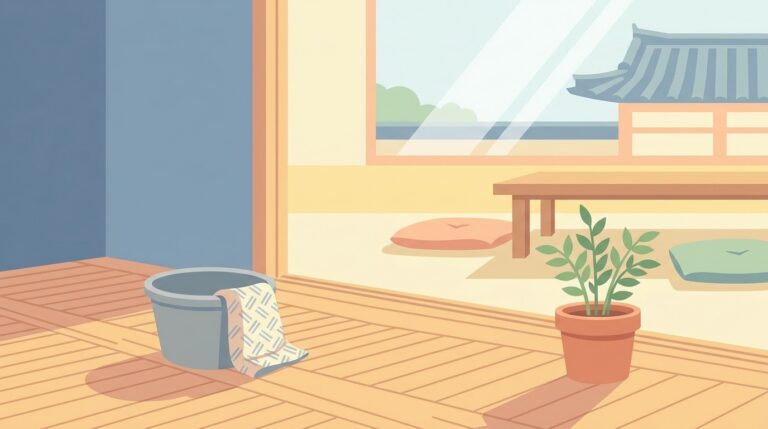
Have you ever watched a Korean drama or variety show and noticed something curious about how characters clean their homes? Instead of casually strolling around with a long-handled mop like in many Western apartments, you frequently see Korean moms, students, or tired roommates down on their hands and knees, vigorously rubbing the floor with a folded damp cloth. In Korea, this dedicated art form is known as 손걸레질 (son-geolle-jil)—hand-mopping.
If you have ever shared a share-house in Sinchon, stayed in a cozy Airbnb in Hongdae, or lived with a Korean host family, you might have felt that split-second panic when a bowl of spicy Shin Ramyun soup splatters across the warm wooden floor. You stand there frozen, wondering: Wait, how do I ask for a cleaning cloth without sounding rude? Is a floor rag called a towel? What is the difference between sweeping and wiping?
Many of our beginner learners tell us: “Teacher, I memorized the formal verb 청소하다 (cheongsohada – to clean), but when I dropped sauce on the floor, saying 방을 청소하겠습니다 (I will clean the room) felt way too dramatic and unnatural!” You are not alone. Knowing the natural, everyday phrases for wiping the floor will not only save your rugs and deposit money, but it will also show your Korean roommates or hosts that you truly respect their home. This lesson is built on real situations from learners just like you—let’s master how to talk about mopping and wiping the floor with effortless A2 Korean!
Phase 2: Core Expressions Deep Dive
1. 바닥 좀 닦아 줄래? (Badak jom dakka jullae?)
- Pronunciation: [Badak jom dakka jullae?] (Sound analogy: Say “Bah-dak johm dock-kah jool-lae”)
- Meaning: Literal: “Can you wipe the floor a little?” | Actual Nuance: “Could you wipe the floor, please?”
- K-Culture Moment: You will hear this in almost every family K-drama on weekend television. The mom is stirring stew in the kitchen, notices water drops near the sink, and gently nudges her son or daughter lounging on the sofa to wipe up the floor.
- Editor’s Insight: Notice that tiny magical word 좀 (jom)! Literally meaning “a little,” it acts like English “please” by softening the request so you do not sound bossy.
- Situation Spectrum:
- Casual (Close friends, roommates): ✅ 바닥 좀 닦아 줄래? (Badak jom dakka jullae?)
- Semi-formal (Polite everyday speech): ✅ 바닥 좀 닦아 주실래요? (Badak jom dakka jusillaeyo?)
- Formal (Service or high elders): ⚠️ 바닥을 닦아 주시겠습니까? (Badageul dakka jusigesseumnikka?)
- 🤔 Think About It: In English, we often specify the tool (“Can you mop?” or “Can you wipe?”). In Korean, the action verb 닦다 (dakda – to wipe/polish) is versatile and used for floors, tables, and even brushing teeth! Why do you think Korean emphasizes the surface being cleaned rather than the gadget?
2. 걸레 어디에 있어? (Geolle eodie isseo?)
- Pronunciation: [Geolle eodie isseo?] (Sound analogy: Say “Guhl-leh uh-di-eh ee-ssuh”)
- Meaning: Literal: “Where is the rag?” | Actual Nuance: “Where do you keep the floor cloth / cleaning rag?”
- K-Culture Moment: Picture a reality show like I Live Alone (나 혼자 산다). An idol accidentally knocks over a glass of iced Americano while dancing in their living room. Their eyes go wide, and they frantically mumble to the camera, “걸레 어디 있지?! (Geolle eodi itji?! – Where is the rag?!)”
- Editor’s Insight: Be careful not to confuse 수건 (sugeon – bath/face towel) with 걸레 (geolle – cleaning rag). Calling someone’s bath towel a 걸레 might cause a small household tragedy!
- Situation Spectrum:
- Casual: ✅ 걸레 어디에 있어? (Geolle eodie isseo?)
- Semi-formal: ✅ 걸레 어디에 있어요? (Geolle eodie isseoyo?)
- Formal: 🚫 Rarely used in formal business; in an office you would ask for 청소 도구 (cleaning tools).
- 🤔 Think About It: In Korea, old bath towels often get downgraded to become a 걸레. Does your culture repurpose old textiles for housework, or do you always buy disposable single-use wipes?
3. 물걸레질 다 했어! (Mulgeollejil da haesseo!)
- Pronunciation: [Mul-geol-le-jil da haet-seo!] (Sound analogy: Say “Mool-guhl-leh-jeel dah haet-ssuh”)
- Meaning: Literal: “Did all the wet-ragging!” | Actual Nuance: “I’m done wet-mopping the floor!”
- K-Culture Moment: After a shared Saturday apartment deep-clean, your flatmate drops onto the couch and announces this proudly, signaling it is time to order fried chicken as a reward.
- Editor’s Insight: Breaking down the compound word: 물 (mul – water) + 걸레 (geolle – rag) + 질 (jil – repeated action/work) = 물걸레질 (wet floor mopping). Adding 다 (da – all/completely) before the past verb shows you have completed the chore.
- Situation Spectrum:
- Casual: ✅ 물걸레질 다 했어! (Mulgeollejil da haesseo!)
- Semi-formal: ✅ 물걸레질 다 했어요! (Mulgeollejil da haesseoyo!)
- Formal: ⚠️ 바닥 물걸레 청소를 마쳤습니다. (Badak mulgeolle cheongsoreul machyeotseumnida.)
- 🤔 Think About It: Why does Korean have a dedicated single word for “wet mopping” (물걸레질) versus “dry wiping” (마른걸레질)? Because Korean homes prioritize barefoot floor cleanliness!
Phase 3: Textbook Korean vs. Real-Life Korean
Situation 1: Asking someone to wipe up a small spill
- 📖 교과서 한국어 (Textbook): 바닥의 오염을 닦으십시오. (Badagui oyeomeul dakkeusipsio. – “Please wipe the contamination off the floor.”)
- 🗣️ 진짜 한국어 (Real Life): 바닥 한 번만 쓱 닦아줘. (Badak han beonman sseuk dakka-jwo. – “Just give the floor a quick wipe, please.”)
- 💡 왜 다를까? (Why is it different?): Textbook phrases can sound like an industrial health inspector manual. Native speakers love mimetic words like 쓱 (sseuk), which mimics a fast, smooth gliding motion. Adding 한 번만 (“just once”) makes the favor feel light and stress-free.
Situation 2: Asking where cleaning supplies are
- 📖 교과서 한국어 (Textbook): 청소용 걸레가 어디에 위치합니까? (Cheongsoyong geollega eodie wichi-hamnikka? – “Where is the cleaning cloth located?”)
- 🗣️ 진짜 한국어 (Real Life): 밀대걸레나 물티슈 어디 있어? (Mil-dae-geol-le-na mul-ti-syu eodi isseo? – “Where is the stick mop or wet wipes?”)
- 💡 왜 다를까? (Why is it different?): In contemporary Korean studios, heavy traditional rags are often swapped out for a 밀대걸레 (flat swivel mop) or thick 물티슈 (wet wipes) designed specifically for quick floor fixes.
Phase 4: K-Culture Deep Dive & Non-Verbal Etiquette
4-1. Nunchi (눈치) & Body Language while Mopping
- The Barefoot Safety Dance: If someone is mopping, do not step onto the damp floor with socks or bare feet right away. Walk along the dry perimeter on your tiptoes. Stepping across someone’s freshly mopped floor right in front of them without looking down shows a serious lack of Nunchi (social awareness).
- The Towel Hand-Off: When handing a damp rag or floor wipe to an elder or your flatmate, always pass it using both hands or with your right hand supported lightly at the wrist by your left forearm.
4-2. The Cultural Code: Ondol (온돌) & Floor-Living Culture
Why is floor cleaning taken so seriously in Korea compared to chair-and-carpet cultures? The answer lies in Korea’s traditional floor-heating system, 온돌 (Ondol). For centuries, Koreans have sat, eaten, studied, played board games, and slept on the floor. Even in modern high-rise apartments with fancy designer sofas, you will often find family members sitting directly on the warm wooden floor with their backs resting against the sofa! Because the floor doubles as a bed and a chair, keeping it spotless with 물걸레질 is not just about aesthetics—it is essential personal hygiene.
Phase 5: Real-Life Roleplay Scenario
Setting: A neat officetel in Mapo-gu, Seoul. You and your Korean flatmate, Minji (민지), just finished eating spicy tteokbokki. A drop of red sauce accidentally fell onto the light wood floor.
- 민지 (Minji): 어? 바닥에 떡볶이 국물 묻었다! (Eo? Badage tteokbokki gungmul mudeotda! – “Oh? Tteokbokki sauce got on the floor!”)
- You: 🎭 Quickly grabbing a paper napkin \ 아, 진짜요? 제가 닦을게요! (A, jinjjayo? Jega dakkeulgeyo! – “Oh, really? I’ll wipe it up!”)
- 민지 (Minji): 휴지로는 기름기 안 지워져. 싱크대 밑에 걸레 있어. (Hyujironeun gireumgi an jiwojyeo. Singkeudae mite geolle isseo. – “Tissue won’t remove the grease. There is a rag under the sink.”)
- You: 🎭 Opening the sink cabinet and looking inside \ 파란색 걸레 쓰면 돼? (Paransaek geolle sseumyeon dwae? – “Can I use the blue cloth?”)
- 민지 (Minji): 응, 그거 바닥용이야. 물에 살짝 적셔서 닦아줘. (Eung, geugeo badagyong-iya. Mure saljjak jeoksyeoseo dakka-jwo. – “Yeah, that one’s for the floor. Wet it slightly and wipe it.”)
- You: 🎭 Rinsing the rag, wringing it out, and thoroughly scrubbing the sauce \ 자, 깨끗하게 다 닦았어! (Ja, kkaekkeuthage da dakkasseo! – “Here, I wiped it completely clean!”)
- 민지 (Minji): 와, 고마워! 엄청 깨끗해졌다. (Wa, gomawo! Eomcheong kkaekkeut-haejyeotda. – “Wow, thank you! It became super clean.”)
- You: 🎭 Hanging the rinsed rag on the drying rack \ 별말씀을요! 이제 쉬자. (Byeolmalsseumeullyo! Ije swija. – “Don’t mention it! Let’s rest now.”)
🔀 Interactive Decision Point
After wiping the floor, Minji says she will do the dishes. How do you respond?
* Option A: “내가 밀대걸레로 거실도 한 번 밀어줄까? (Naega mildaegeollero geosildo han beon mireojulkka? – Shall I run the flat mop over the living room too?)”
* Feedback (Best): Perfect roommate etiquette! Offering to do the living room while she washes dishes cements a great flatmate bond.
* Option B: “어, 알았어. 난 방에 들어갈게. (Eo, arasseo. Nan bange deureogalke. – Yeah, okay. I’m going to my room.)”
* Feedback (Risk): Grammatically fine, but a bit blunt. In Korean communal living, hanging around for 30 seconds to make sure tasks are divided shows better warmth.
* Option C: “식기를 정돈하십시오. (Sikgireul jeongdonhasipsio. – Please arrange the tableware.)”
* Feedback (Bad): Too robotic and overly imperative! Never use stiff textbook commands with flatmates.
Phase 6: 10-Second Emotion Shadowing Drill
Practice these with natural rhythm! Pauses are marked with /.
[😰 Worried & apologetic]- 아이고, / 바닥에 흘렸어요! / 제가 얼른 닦을게요. (Aigo, / badage heullyeosseoyo! / jega eolleun dakkeulgeyo.)
- “Oh dear, / I spilled on the floor! / I will wipe it right up.”
[🙋 Confident & helpful]- 걸레 빨아서 / 바닥 싹 닦아 놓을게! (Geolle pparaseo / badak ssak dakka noheulge!)
- “I will wash the rag / and wipe down the floor completely!”
[😮💨 Relieved & satisfied]- 휴, / 물걸레질 끝나니까 / 방이 진짜 뽀송뽀송하다! (Hyu, / mulgeollejil kkeutnanikka / bang-i jinjja bbobsong-bbosonghada!)
- “Phew, / now that wet mopping is done, / the room feels so fresh and dry!”
Phase 7: K-Culture Mini Dictionary
- 걸레 (Geolle) | Cleaning rag / floor cloth
- Everyday usage: Used for cloths dedicated strictly to wiping down floors, balconies, or shoe racks. (Slang note: Never direct this word playfully at a person, as it carries an offensive slang meaning outside cleaning!).
- 밀대걸레 (Mil-dae-geol-le) | Flat stick mop / Swivel mop
- Everyday usage: The savior of modern apartments! In small studios, people attach disposable wet sheets (물걸레 청소포) onto the swivel head so they don’t have to wash rags.
- 물티슈 (Mul-ti-syu) | Wet wipes
- Everyday usage: Konglish for wet tissues. In Korea, wet wipes are ubiquitous—people use them for sticky fingers, quick spills, desk sanitizing, and fast floor spot-cleaning.
- 바닥 (Badak) | Floor / Ground
- Everyday usage: Unlike English where you might say “clean the apartment,” Koreans specify the surface: 바닥 닦다 (badak dakda – wipe the floor).
Phase 8: Traveler’s Survival Kit
Survival Expressions TOP 3
- 행주 어디 있어요? (Haengju eodi isseoyo?)
- Romanization: Haengju eodi isseoyo?
- Pro Tip: If you are cleaning a dining table or kitchen counter in an Airbnb, ask for a 행주 (haengju – dishcloth/counter cloth), NOT a 걸레! Using a floor rag on a dining table is a big cultural faux pas.
- 휴지 좀 주세요. (Hyuji jom juseyo.)
- Romanization: Hyuji jom juseyo.
- Pro Tip: For instant dry spills at cafes or guesthouses, ask for tissues/napkins using this phrase.
- 바닥 미끄러워요, 조심하세요! (Badak mikkeureowoyo, josimhaseyo!)
- Romanization: Badak mikkeureowoyo, josimhaseyo!
- Pro Tip: If you just mopped or spilled water in the bathroom, give this polite heads-up to your travel buddy.
Editor’s Travel Note
- Daiso to the Rescue: If your Airbnb or long-term studio runs out of cleaning gear, do not panic. Search for the nearest Daiso Korea Store Locator on your smartphone. Daiso sells 100-pack floor wet wipes (바닥 청소용 물티슈) and lightweight stick mops for just 2,000 to 5,000 KRW!
Phase 9: One Step Deeper (Reflection)
In many Western cultures, a mop with a bucket is seen as standard equipment, keeping the body upright and detached from the dirty ground. In Korea, however, kneeling to wipe the floor by hand has historically been viewed as a form of sincere devotion (정성) to the household’s well-being. Keeping the floor clean is an act of care because that is where the family gathers to rest. When you clean the floor in a shared Korean space, you aren’t just doing a chore—you are actively creating a clean haven for everyone who walks in barefoot.
💬 Your Turn: In your home country, do people walk indoors with shoes on or barefoot? And how do you usually clean your floors? Share your thoughts below in the comments!
Phase 10: FAQ & Avoiding Misunderstandings
Q: Can I use the word “걸레” to ask for a napkin at a restaurant?
A: Absolutely not! A 걸레 (geolle) is strictly a dirty floor rag. At a restaurant or dining table, always ask for 물티슈 (multisyu – wet wipes) or 휴지 (hyuji – napkins/tissues). Asking a restaurant owner for a 걸레 might make them think you want to wipe the dining floor, not your hands!
Q: What is the difference between 쓸다 (sseulda) and 닦다 (dakda)?
A: 쓸다 (sseulda) means to sweep using a broom or brush (dry sweeping dust and crumbs). 닦다 (dakda) means to wipe or mop using friction and usually moisture. In Korea, routine cleaning always follows this exact sequence: first 쓸다 (or vacuum), then 닦다.
Q: Can I say “걸레질하다” to my workplace manager?
A: It sounds a bit informal. If you are cleaning an office floor, use the semi-formal noun phrase 바닥 청소하다 (badak cheongsohada – to clean the floor): “제가 바닥 청소하겠습니다 (Jega badak cheongsohagetseumnida – I will clean the floor).”
🚨 Common Mistakes (흔한 실수) Warning Board
- Calling a kitchen dishcloth a 걸레:
- Error: Using a floor rag on the dining table.
- Correct Action: Keep them strictly separated! Kitchen counter = 행주 (haengju), Floor = 걸레 (geolle).
- Forgetting “좀 (jom)” when asking for help:
- Error: “바닥 닦아! (Badak dakka!)” sounds bossy like an order.
- Correct Action: Add 좀: “바닥 좀 닦아줘 (Badak jom dakka-jwo)” for friendly, gentle politeness.
- Mopping before sweeping:
- Error: Wet wiping while hair and dust are still on the floor turns the dust into sticky mud.
- Correct Action: Always sweep or vacuum first (청소기 돌리고), then mop (물걸레질하기)!
Phase 11: Action Missions
- 🥉 Bronze Mission (Solo Drill): Stand in your room right now. Point to your floor and say aloud three times: “바닥 좀 닦아야겠다! (Badak jom dakk-ayagetda! – I need to wipe the floor!)”
- 🥈 Silver Mission (Social Drill): Next time you clean your desk or floor, take a snap, post it to your study Instagram story, and caption it: “오늘의 미션: 물걸레질 완료! (Today’s mission: Wet mopping complete!)”
- 🥇 Gold Mission (Real-life Practice): Next time you spill a drop of water or coffee in front of a Korean friend, don’t say sorry in English—say: “걸레 어디 있어요? 제가 닦을게요! (Geolle eodi isseoyo? Jega dakkeulgeyo!)”
🎮 K-Culture Bonus Mission: In the famous drama Reply 1988 (응답하라 1988) or Hospital Playlist, watch closely for characters wiping floors with cloth rags while having deep heart-to-heart conversations. Notice how natural and rhythmic their mopping is!
Phase 12: Interactive Quiz Challenge
Q1. Situation Judgment
You accidentally spilled water on the living room floor while visiting your Korean friend’s parents. Which expression is the most polite and natural?
1. 바닥을 청소해라! (Badageul cheongsohaera!)
2. 걸레 어디에 있어요? 제가 닦을게요. (Geolle eodie isseoyo? Jega dakkeulgeyo.)
3. 행주로 바닥을 닦으십시오. (Haengjuro badageul dakkeusipsio.)
Q2. Fill-in-the-Blank
Complete the sentence for “Can you please wipe the floor?”:
바닥 ____ 닦아 줄래? (Badak ____ dakka jullae?)
Q3. Cultural True or False
Statement: In Korean households, it is totally acceptable to clean dining tables using a “걸레 (geolle)”. [ True / False ]
👉 Click to reveal answers & explanations!
- Q1 Answer: 2번 (걸레 어디에 있어요? 제가 닦을게요.)
- Explanation: Asking where the rag is and offering to wipe it yourself using polite 해요체 is respectful and proactive. Option 1 is an impolite command, and Option 3 inappropriately tells the parents to wipe the floor with a kitchen cloth!
- Q2 Answer: 좀 (jom)
- Explanation: 좀 softens requests, making “바닥 좀 닦아 줄래?” sound friendly and natural.
- Q3 Answer: False
- Explanation: Tables must always be cleaned with a 행주 (haengju). A 걸레 (geolle) is strictly reserved for floors and dirty surfaces!
- Explanation: Tables must always be cleaned with a 행주 (haengju). A 걸레 (geolle) is strictly reserved for floors and dirty surfaces!







