

Transforming Compact Spaces: The Master-Level Korean Guide to Interior Storage
Phase 1: Empathy (Story-Driven Opening)
안녕하세요! 매일한글 에디터입니다. (Annyeonghaseyo! It’s your Daily Hangul editor.)
Picture this: You’ve just signed the lease on your dream studio apartment in Mapo-gu, Seoul. It’s a charming 6-pyeong (about 20 square meters) officetel with floor-to-ceiling windows. Inspired by aesthetic room-tour vlogs on YouTube and chic apartments featured on I Live Alone (나 혼자 산다), you envision an airy haven of Scandinavian minimalism. But reality hits the moment your moving boxes arrive. Your winter long padded coats (롱패딩) swallow the entire built-in wardrobe, kitchen appliances cluster over the counter like dominoes, and your landlord reminds you with a stern smile: “벽에 못 박으시면 안 돼요!” (You cannot drive nails into the walls!).
Suddenly, you find yourself staring at an overwhelming clutter crisis. At a C2 mastery level, surviving this reality requires much more than elementary words like 방이 좁아요 (The room is small) or 정리해요 (I clean up). You need the sophisticated, native-tier terminology to navigate urban spatial aesthetics, negotiate leases, consult interior designers, and curate storage solutions that turn cramped quarters into architectural masterpieces. Curated from over a decade of navigating Seoul’s micro-living culture and mentoring expatriates who have mastered Korean living, this guide equips you with the native nuance, high-register vocabulary, and cultural nunchi needed to conquer small space storage like a true Seoulite.
Phase 2: Core Expressions Deep Dive
1. 데드스페이스를 살리다 (Dedeuseupeiseureul sallida)
- Pronunciation: [De-deu-seu-pei-seu-reul sal-li-da] (Think of the English word ‘dead space’ followed by ‘sal-lee-da’, where ‘sal’ sounds like ‘salad’ without the ‘ad’)
- Meaning: Literally “To revive dead space.” Figuratively: To unlock the hidden functional value of unutilized, neglected architectural corners or narrow gaps.
- K-Culture Moment: Ubiquitous in high-end lifestyle makeover programs such as The House Detox (신박한 정리), where spatial consultants transform awkward gaps next to refrigerators into slide-out pantry towers.
- Editor’s Insight: In Korean architectural discourse, spaces aren’t merely “used” (쓰다); they are “brought to life” (살리다). Using this phrasing communicates an elevated designer’s mindset rather than a mere chore.
- Situation Spectrum: Casual ✅ | Semi-formal ✅ | Formal ✅
- 🤔 Think About It: Why does Korean culture conceptualize unused physical space as something that is “dead” and requires “resuscitation,” reflecting the ultra-high valuation of every square centimeter in metropolitan cities?
2. 비움의 미학을 실천하다 (Biumui mihageul silcheonhada)
- Pronunciation: [Bi-um-ui mi-ha-geul sil-cheon-ha-da] (Pronounce ‘Bi-um’ like ‘bee-oom’, ‘mi-hak’ like ‘me-huck’, and ‘sil-cheon’ like ‘seal-chun’)
- Meaning: Literally “To practice the aesthetics of emptying.” Figuratively: To consciously embrace intentional decluttering and spatial minimalism as a refined philosophical lifestyle.
- K-Culture Moment: Often featured in contemporary Korean architectural essays, interior design magazines (House Living), and serene YouTube lifestyle documentaries capturing tranquil Hanok aesthetics adapted for urban apartments.
- Editor’s Insight: This expression transcends simplistic minimalism (미니멀리즘). It carries deep roots in traditional Korean aesthetics (여백의 미—the beauty of negative space), suggesting emotional discipline and elegance.
- Situation Spectrum: Casual ⚠️ | Semi-formal ✅ | Formal ✅
- 🤔 Think About It: In contrast to consumerist storage solutions that encourage buying more plastic containers, how does the cultural ideal of 비움 (emptying) shift the definition of luxury in hyper-dense urban Korea?
3. 수납력을 극대화하다 (Sunamnyeogeul geukdaehwahada)
- Pronunciation: [Su-nam-nyeog-eul geuk-dae-hwa-ha-da] (Sound out ‘Soo-nam-nyuk-eul’ followed by ‘geuk-day-hwa-ha-da’)
- Meaning: Literally “To maximize holding/storage power.” Figuratively: To engineer, furnish, or organize an environment so its capacity to store belongings invisibly and efficiently reaches its absolute peak.
- K-Culture Moment: The holy grail metric in Korean home shopping broadcasts when hosts showcase hydraulic lift-up beds or modular wardrobe systems designed for one-room flats.
- Editor’s Insight: The suffix -력 (力 – power/capacity) elevates ordinary storage (수납) into an engineered performance metric. When consulting real estate agents or reviewing furniture on Today’s House (오늘의집), this term instantly signals discerning, professional-grade standards.
- Situation Spectrum: Casual ⚠️ | Semi-formal ✅ | Formal ✅
- 🤔 Think About It: Notice how Korean compound nouns attach 력 (power) to domestic functions (수납력, 세척력, 보습력). What does this reveal about efficiency-driven modern Korean consumer standards?
Phase 3: Textbook Korean vs. Real Native Korean
Situation 1: Expressing that your space is cluttered and needs structural organization
- 📖 교과서 한국어 (Textbook Korean): 방이 좁아서 물건들을 정리해야 합니다. (Bangi jobaseo mulgeondeureul jeongnihaeya hamnida.) — “Because the room is narrow, I must organize my items.”
- 🗣️ 진짜 한국어 (Real Native Korean): 짐이 완전 포화 상태라, 펜트리 수납함으로 각 잡고 싹 털어내야겠어요. (Jimi wanjeon pohwa sangtaera, penteuri sunamhameuro gak japgo ssak teoreonaeyagesseoyo.) — “My belongings have reached complete saturation; I need to line up pantry bins neatly and purge the excess entirely.”
- 💡 왜 다를까? (Why the difference?): Advanced native speakers employ vivid idiomatic constructs like 포화 상태 (saturation point), 각 잡다 (to align with military precision), and dynamic verbs like 털어내다 (to shake out/purge), conveying nuance and sensory texture.
Situation 2: Proposing hanging storage solutions under rental lease restrictions
- 📖 교과서 한국어 (Textbook Korean): 벽에 선반을 설치해서 공간을 절약합시다. (Byeoge seonbaneul seolchihaeseo gongganeul jeoryakhapsida.) — “Let us install shelves on the wall to save space.”
- 🗣️ 진짜 한국어 (Real Native Korean): 전셋집이라 못질은 무리고, 무타공 압축봉으로 틈새 수납 짜보려고요. (Jeonsetjibira motjireun murigo, mutagong apchukbongeuro teumsae sunap jjaboryeogoyo.) — “Since it’s a Jeonse rental, hammering nails is out of the question; I’m planning to rig up nook storage using no-drill tension rods.”
- 💡 왜 다를까? (Why the difference?): Korea’s unique Jeonse / Wolse leasing contracts mandate strict 원상복구 (restoration to original condition). Real natives casually wield specialized consumer vocabulary like 못질 (nailing) and 무타공 (no-drill installation).
Phase 4: K-Culture Deep Dive & Non-Verbal Manners
4-1. Nunchi (눈치) & Spatial Etiquette
When invited to a Korean acquaintance’s studio or compact apartment, exceptional spatial nunchi is essential.
* The Gaze Rule: Never let your eyes dart immediately toward uncurtained utility nooks, laundry drying racks, or under-bed storage valances. Koreans often feel vulnerable about the visibility of their utilitarian domestic realities in compact studios.
* The Verbal Compliment: Avoid backhanded phrases like “방이 참 아담하네요” (Your room is so petite), which can carry an undertone of crampedness. Instead, praise their spatial mastery: “공간 분리를 감각적으로 하셔서 집이 훨씬 넓어 보여요!” (You’ve partitioned the space so tastefully that the home feels much more expansive!).
* Body Posture: Keep your physical footprint compact. Sit neatly with limbs collected, and always place your shoes neatly facing the exit at the hyeon-gwan (entryway) to prevent cluttering the focal threshold of the home.
4-2. Cultural Code Analysis: The Today’s House (오늘의집) Revolution
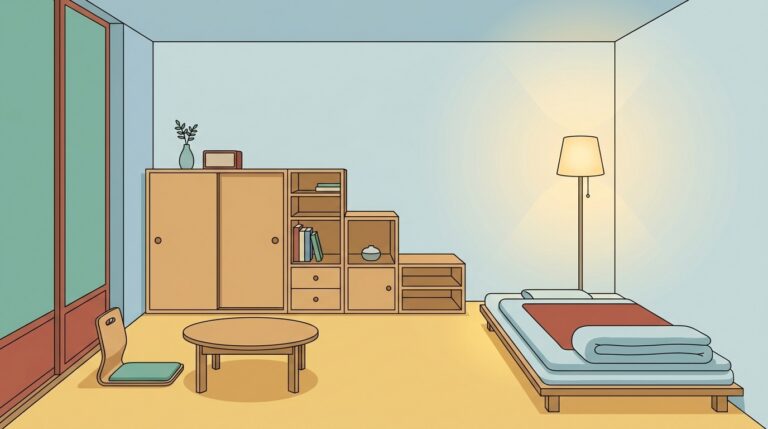
In Seoul, where skyrocketing housing prices mean that young professionals and creatives spend their twenties and thirties in studios (원룸) or officetels, interior decorating is no longer seen as a luxury for homeowners—it is a critical form of mental health therapy and personal agency. The explosive rise of the platform 오늘의집 (Today’s House) birthed the cultural phenomenon of 집꾸미기 (home beautification). Rather than waiting to buy a spacious house, millennials and Gen Z master micro-zoning (공간 분리), utilizing open-backed shelving units, translucent fabric partitions, and warm indirect lighting (간접조명) to delineate psychological boundaries between work, rest, and cooking within just 20 square meters.
Phase 5: Real-Life Roleplay Scenario
Setting: You are consulting Min-jun (민준), a sought-after interior stylist and avid minimalist friend, at your newly leased officetel in Sinchon.
Characters:
* Min-jun (민준): A sharp-eyed spatial styling expert who treats micro-apartments like geometric puzzles.
* You: An ambitious design enthusiast aiming to transform a crowded studio into an airy sanctuary.
- Turn 1 (Min-jun):
“실측해보니까 전용 면적이 생각보다 더 타이트하네요. 짐 배치를 완전히 다시 짜야겠어요.”
(Silcheukhaebonikka jeonyong myeonjeogi saenggakboda deo taiteuhaneyo. Jim baechireul wanjeonhi dasi jjayagesseoyo.)
“Now that I’ve measured the actual usable floor area, it’s tighter than expected. We need to overhaul your entire furniture layout.”
🎭 Examining floor blueprints with a laser measure, tapping chin thoughtfully. -
Turn 2 (You):
“맞아요. 무엇보다 계절 옷이랑 잡화 때문에 수납력을 극대화하는 게 시급해요.”
(Majayo. Mueotboda gyejeol osirang japhwa ttaemune sunamnyeogeul geukdaehwahaneun ge sigeuphaeyo.)
“Exactly. Above all, maximizing storage capacity is urgent because of seasonal clothing and miscellaneous items.”
🎭 Gesturing towards stacked storage crates while holding a notebook. -
Turn 3 (Min-jun):
“침대 프레임을 하부 수납형으로 가고, 저기 기둥 옆 데드스페이스를 살리는 건 어때요?”
(Chimdae peureimeul habu sunaphyeongeuro gago, jeogi gidung yeop dedeuseupeiseureul sallineun geon eottaeyo.)
“How about getting an under-bed storage frame and reviving the dead space next to that pillar?”
🎭 Pointing his laser pointer toward an awkward, shadow-filled alcove. -
Turn 4 (You):
“좋은 생각이에요! 저 틈새에 슬라이딩 수납장을 짜 넣으면 딱이겠네요.”
(Joeun saenggagieyo! Jeo teumsaee seullaiding sunamjangeul jja neoeumyeon ttagigenneyo.)
“Brilliant idea! Installing a sliding nook rack right into that gap would be perfect.”
🎭 Smiling widely, sketching a vertical slide-out cabinet on the floor plan. -
Turn 5 (Min-jun):
“그런데 집주인분이 벽 타공은 절대 안 된다고 못 박으셨죠? 선반은 어떻게 할까요?”
(Geureonde jipjuinbuni byeok tagongeun jeoldae an doendago mot bageusyeotjyo? Seonbaneun eotteoke halkkayo.)
“By the way, your landlord firmly stated that wall drilling is strictly off-limits, right? What should we do about shelving?”
🎭 Tilting his head with a cautious, questioning expression. -
Turn 6 (You):
“무타공 압축 선반이랑 조절식 파티션을 활용해서 벽 손상 없이 공간 분리를 해볼게요.”
(Mutagong apchuk seonbanirang jojeolsik patisyeoneul hwalyonghaeseo byeok sonsang eopsi gonggan bunrireul haebolgeyo.)
“I’ll use no-drill tension shelving and adjustable partitions to zone the space without damaging the walls.”
🎭 Showing catalog images of sleek floor-to-ceiling tension poles on a tablet. -
Turn 7 (Min-jun):
“완벽하네요! 다만 가구를 채우기 전에 불필요한 물건부터 덜어내는 비움의 미학이 선행돼야 해요.”
(Wanbyeokhaneyo! Daman gagureul chaeugi jeone bulpiryohan mulgeonbuteo deoreonaeneun biumui mihagi seonhaengdwaeya haeyo.)
“Flawless! However, before bringing furniture in, practicing the aesthetic of emptying by clearing unnecessary items must come first.”
🎭 Nodding in deep aesthetic agreement, hands folded neatly. -
Turn 8 (You):
“동감이에요. 이번 기회에 미니멀 라이프를 제대로 실천해 볼게요!”
(Donggamieyo. Ibeon gihoee minimeol ripeureul jedaero silcheonhae bolgeyo!)
“I completely agree. I’ll seize this opportunity to truly embrace a minimal lifestyle!”
🎭 Clenching a fist in playful, determined resolution.
🔀 Interactive Branching Point
Min-jun points to your extensive collection of hardback books and designer figurines sitting in open cartons:
“이 책들이랑 피규어 장식장도 원룸 한가운데에 같이 둘 건가요?” (Are you planning to place these books and figurine display cases in the middle of the studio too?)
- Option A: “시각적 개방감을 해치니까, 불투명 수납함에 넣어서 침대 밑으로 숨길게요.”
(Sigakjeok gaebanggameul haechinikka, bultumyeong sunamhame neoeoseo chimdae miteuro sumgilgeyo.) - Option B: “어차피 제 집인데 보이는 벽마다 전부 선반을 가득 달아서 진열할래요.”
(Eochapi je jibinde boineun byeokmada jeonbu seonbaneul gadeuk daraseo jinyeolhallaeyo.) - Option C: “그냥 바닥 구석에 대충 쌓아두고 러그로 덮어두면 안 될까요?”
(Geunyang badak guseoge daechung ssahadugo reogeuro deopeodumyeon an doelkkayo.)
Detailed Branching Feedback:
- Selection A (Best Choice 🌟): Exemplary spatial intelligence! Recognizing that visual openness (시각적 개방감) requires concealing busy visual clutter inside opaque storage under the bed demonstrates master-tier understanding of Korean micro-living principles.
- Selection B (Risk / Inappropriate ⚠️): Culturally and practically risky. First, drilling multiple wall shelves breaches standard Korean rental agreements (임대차 계약), risking loss of your security deposit. Second, wall-to-wall open display in a small room introduces severe visual fatigue.
- Selection C (Bad Choice ❌): Unacceptable aesthetic retreat. Stacking items haphazardly on the floor creates safety hazards, fosters dust accumulation, and completely contradicts the core philosophy of intentional storage (수납).
Phase 6: 10-Second Emotion Shadowing Drill
Sharpen your cadence, emotional intonation, and breath control using these native rhythm markers (/ = brief pause for breath and emphasis).
- Drill 1 [💡 With sudden inspiration and confident problem-solving energy]:
“좁은 틈새라도 / 무타공 수납장만 잘 활용하면 / 얼마든지 데드스페이스를 살릴 수 있어요!”
(Jobeun teumsaerado / mutagong sunamjangman jal hwalyonghamyeon / eolmพิdeunji dedeuseupeiseureul sallil su isseoyo!)
“Even in a narrow gap, / as long as you make smart use of no-drill cabinetry, / you can revive dead space effortlessly!” -
Drill 2 [😌 With calm, grounded aesthetic conviction and sophistication]:
“단순히 가구를 채우기보다 / 비움의 미학을 먼저 실천해야 / 공간에 여백의 미가 생기죠.”
(Dansunhi gagureul chaeugiboda / biumui mihageul meonjeo silcheonhaeya / gonggane yeobaegui miga saenggijo.)
“Rather than merely packing in furniture, / one must first practice the aesthetics of emptying / for the beauty of negative space to breathe life into the room.” -
Drill 3 [✨ In an excited, persuasive consultant cadence]:
“침대 하부 공간에 모듈 수납함을 매치하면 / 시각적 개방감과 수납력을 / 동시에 챙길 수 있답니다!”
(Chimdae habu gonggane modyul sunamhameul maechihamyeon / sigakjeok gaebanggamgwa sunamnyeogeul / dongsie chaenggil su itdapnida!)
“If you match modular storage boxes to the under-bed area, / you capture visual spaciousness and storage efficiency / all at once!”
Phase 7: K-Culture Mini Dictionary
-
틈새장 (Teumsaejang)
Translation: Nook/Gap Cabinet
Usage: Ultra-slim vertical shelving units (typically 12cm–20cm wide) specifically manufactured to slide effortlessly between refrigerators and kitchen countertops, or beside washing machines. -
무타공 (Mutagong)
Translation: No-Drill / Non-Invasive Installation
Usage: A mandatory keyword when shopping for hardware in Korea. Refers to tension rods, heavy-duty suction adhesives, and door hooks engineered to mount fixtures firmly without puncturing residential drywall or tile. -
공간 분리 (Gonggan Bunli)
Translation: Spatial Zoning / Micro-Partitioning
Usage: The strategic architectural technique of using area rugs, open bookcases, folding screens, or sheer drapes to carve out separate “bedroom,” “lounge,” and “office” zones within an open single-room floor plan. -
원상복구 (Wonsangbokgu)
Translation: Obligation of Restoration to Original Condition
Usage: The paramount legal and financial clause in Korean lease contracts (전월세 계약서). Tenants must return the premises in their original state when moving out, making non-destructive storage adaptations paramount.
Phase 8: Living & Travel Survival Kit
Survival Expressions TOP 3
-
혹시 벽에 타공 안 하고 설치할 수 있는 제품인가요?
(Hoksi byeoge tagong an hago seolchihal su inneun jepumingayo?)
Meaning: By any chance, is this a product that can be installed without drilling into the wall?
Pro Tip: Essential when consulting sales associates at IKEA Gwangmyeong or local home furnishing boutiques. -
침대 밑에 들어갈 만한 저상형 수납 박스를 찾고 있어요.
(Chimdae mite deureogal manhan jeosanghyeong sunap bakseureul chatgo isseoyo.)
Meaning: I am looking for low-profile under-bed storage boxes.
Pro Tip: 저상형 (low-profile / low-chassis) is the exact industry jargon required to pinpoint bins that clear tight under-frame clearances. -
시각적으로 덜 답답해 보이게 반투명 재질로 추천해 주실래요?
(Sigakjeogeuro deol dapdaphae boige bantumyeong jaejillo chucheonhae jusillaeyo?)
Meaning: Could you recommend translucent material so it appears visually less suffocating?
Pro Tip: Korean design philosophy values lightness; solid dark boxes in compact rooms make spaces feel claustrophobic (답답하다).
Editor’s Living & Travel Note
- Essential App Guide: Before purchasing bulky furniture, download the 오늘의집 (Today’s House) 앱 다운로드 to inspect user-submitted 3D room simulations that mirror your exact apartment layout. If you need hyper-local, budget-friendly modular storage pieces, search the 당근 (Karrot) 마켓 앱 다운로드 to acquire gently used designer furniture from neighbors in your immediate precinct.
- Transport Logistics: If you purchase pre-assembled storage units, hail a local mini-freight van using 다마스 용달 (Damas compact freight service) via the Kakao T app under the Quick delivery / freight section rather than wrestling large containers onto the Seoul Subway.
Phase 9: “Going One Step Deeper”
To master Korean spatial vocabulary at a C2 proficiency, one must grasp how traditional aesthetics shape contemporary urban survival. In traditional Korean architecture (한옥 – Hanok), rooms were not defined by rigid, permanent functional furniture; a single room served as a study during the morning, a dining salon at noon, and a bedchamber at night through the rhythmic deployment and folding away of portable furnishings. Moreover, the concept of 차경 (Chagyeong)—”borrowing scenery from nature through an open window”—placed supreme importance on uninterrupted sightlines.
Modern Seoulites living in 20-square-meter apartments carry this ancestral spatial DNA: compact living is not viewed as impoverishment, but as the artful orchestration of void and presence. By mastering terms like 비움의 미학 and 시각적 개방감, you are participating in a profound cultural lineage that values spiritual clarity over material accumulation.
💬 Your Turn: What is your culture’s philosophy on compact living? How does it differ from Korea’s focus on non-invasive modularity and negative space (여백의 미)? Share your thoughts below in advanced Korean!
Phase 10: FAQ & Avoiding Misunderstandings
Q: Why do Korean landlords react so strictly to minor nail holes compared to Western landlords?
A: In Korea, lease deposits (보증금) represent substantial capital, and the legal covenant of 원상복구 (restoration to original state) is interpreted rigorously. Korean apartment interiors often use specialty wallpapers (실크벽지), where patching a single nail hole requires replacing an entire wall panel. Consequently, tenants rely on innovative 무타공 (no-drill) tension hardware to safeguard their deposits.
Q: What is the linguistic difference between ‘정리’ and ‘수납’?
A: While 정리 (Jeongni) refers broadly to tidying, categorizing, or discarding items to maintain order, 수납 (Sunap) specifically denotes the architectural and physical act of housing items inside designated compartments, organizers, or furniture. You do 정리 to decide what to keep; you engineer 수납 to make it vanish seamlessly into the room’s infrastructure.
Q: Can I use the word ‘미니멀리즘’ instead of ‘비움의 미학’?
A: Yes, but with distinct stylistic color. 미니멀리즘 (Minimalism) is a modern loanword referring casually to design trends or lifestyle fashions. Conversely, 비움의 미학 (Aesthetics of Emptying) is an evocative, high-register socio-aesthetic term that demonstrates advanced cultural and literary eloquence.
🚨 흔한 실수 (Common Mistakes) 경고판
- Mistake: Saying “방을 크게 만들고 싶어요” (I want to make the room big).
Why it’s wrong: Sounds grammatically naive; you cannot structurally enlarge a leased room.
Correct Action: Say “시각적 개방감을 확보하고 싶어요” (I want to secure visual openness). - Mistake: Using “물건을 숨기다” (To hide things) when referring to storage.
Why it’s wrong: 숨기다 implies illicit concealment or hiding secrets.
Correct Action: Use “깔끔하게 수납하다” (To cleanly store/house items) or “시야에서 정돈하다“. - Mistake: Asking for “벽에 거는 선반” without specifying wall attachment conditions.
Why it’s wrong: Store clerks will instinctively hand you hardware requiring screw anchors.
Correct Action: Explicitly state: “벽에 구멍을 뚫지 않는 무타공 선반으로 보여주세요“.
Phase 11: Action Missions & Cultural Engagement
- Bronze Mission (Solo Mastery): Stand in the most cluttered corner of your room. Record a 30-second voice memo describing how to revive it, incorporating all three core expressions: 데드스페이스를 살리다, 수납력을 극대화하다, and 비움의 미학.
- Silver Mission (Social Engagement): Take a photo of an ingenious small-space storage solution in your home or on Pinterest. Post it on social media with a caption written in natural Korean explaining your 공간 분리 and 무타공 techniques, tagging
#매일한글 #원룸인테리어. - Gold Mission (Real-World Application): Open the Today’s House (오늘의집) app or visit an interior accessories showroom in Seoul. Approach a staff member or compose a written inquiry asking how to maximize storage using 무타공 틈새장 (no-drill nook cabinets) without puncturing walls.
- 🎮 K-Culture Mission: Watch an episode of The House Detox (신박한 정리) or an architectural YouTube channel like 무인양품 룸투어 (MUJI Room Tour Korea). Transcribe three specific adjectives the hosts use to praise effective negative space.
Phase 12: Interactive Quiz Challenge
Test your command of advanced Korean interior discourse! Check your answers below.
Question 1: Situation Judgment
You are moving into a newly built rental officetel in Yeouido. The landlord reminds you: “벽에 손상 생기면 퇴거할 때 도배비 청구됩니다.” Which response best demonstrates fluent spatial and legal mastery?
* A) “네, 걱정 마세요. 타공 없이 무타공 압축 시스템으로만 수납을 해결할게요.”
* B) “그냥 예쁜 선반을 못 박아 두고 나갈 때 모른 척할게요.”
* C) “방이 좁은데 벽도 못 쓰게 하면 저는 어디에 살라는 건가요?”
Question 2: Fill-in-the-Blank
“냉장고와 싱크대 사이의 15cm 틈새는 버려지기 쉽지만, 슬라이딩 ( )을 배치하면 숨은 ( )를 완벽하게 살려낼 수 있습니다.”
Question 3: True or False Cultural Quiz
In Korean apartment culture, using solid, dark-colored opaque storage boxes in an open one-room studio is universally recommended by interior stylists to anchor the room’s center of gravity. (True / False)
🔍 정답 및 해설 (Click to view Answers & Explanations)
Q1 Answer: A
Explanation: Option A demonstrates a respectful, professional grasp of rental obligations using the technical terms 타공 (wall drilling), 무타공 압축 시스템 (no-drill tension system), and 수납 (storage). Options B and C are legally hazardous and culturally discourteous.
Q2 Answer: 틈새장 / 데드스페이스
Full Sentence: “냉장고와 싱크대 사이의 15cm 틈새는 버려지기 쉽지만, 슬라이딩 틈새장을 배치하면 숨은 데드스페이스를 완벽하게 살려낼 수 있습니다.”
(The 15cm gap between the refrigerator and the sink is easily wasted, but by placing a sliding nook cabinet, you can perfectly revive the hidden dead space.)
Q3 Answer: False
Explanation: In compact Korean studios, large dark opaque furnishings absorb light and create visual heaviness (시각적 답답함). Stylists predominantly recommend light wood tones, whites, or translucent materials (반투명 재질) paired with indirect lighting to maximize the illusion of expansive space (시각적 개방감).







