

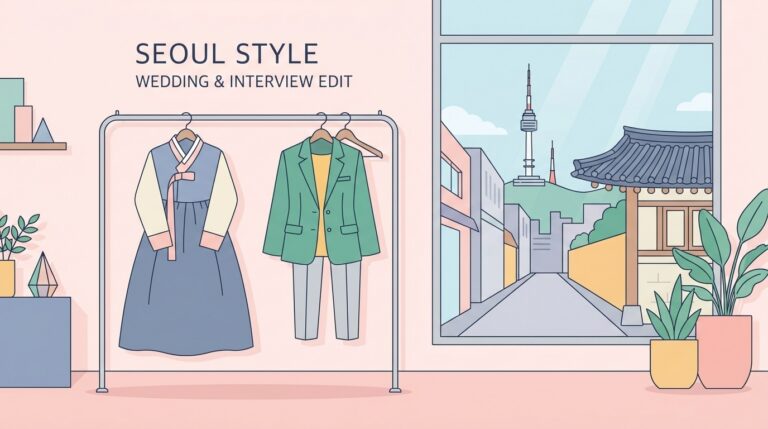
Dress to Impress: Master Korean Wedding Guest and Interview Looks Like a Local
Phase 1: Empathy & Story Opening
안녕하세요! 매일한글 에디터입니다. (Hello! This is your Daily Hangul editor.)
Imagine this scenario: you just received an elegant wedding invitation from your Korean coworker, or perhaps you landed a dream job interview in the bustling business hub of Yeouido. You open your closet and pick out a stunning white lace dress or a vibrant, avant-garde patterned suit. Stop right there! In Korea, pulling off that outfit could spark awkward whispers or an icy silence. Dressing here is governed by an intricate cultural compass known as TPO (Time, Place, Occasion). Wearing white to a wedding marks you as a minpye hagaek (a nuisance guest who steals the bride’s spotlight), while an overly flamboyant interview suit might signal that you aren’t a team player. Many intermediate learners master the grammar to talk about clothing, yet stumble over the cultural nuances of what to wear. Drawing from years of coaching expats and real feedback from Korean corporate HR managers, this guide will unlock the subtle art of dressing smartly, courteously, and authentically in Korea.
Phase 2: Core Expressions Breakdown
1. 깔끔하게 입다 (Kkal-kkeum-ha-ge ip-da)
- Pronunciation: kkal-kkeum-ha-ge ip-da (Imagine snapping your tongue on “kkal” like a sharp “call”, followed by “gum” spoken tightly with flat lips: kkal-ggum-hah-geh eep-dah).
- Meaning: Literally “to dress cleanly” vs. Actual Nuance: “to dress in a sleek, crisp, well-ironed, and uncluttered manner.”
- K-Culture Moment: In the K-drama Queen of Tears, when Baek Hyun-woo’s family meticulously checks their tailored suits before attending a formal chaebol gathering, they aim precisely for a kkalkkeumhan aesthetic.
- Editor’s Insight: Kkalkkeumhada doesn’t mean your clothes just came out of the washing machine. It implies minimalist silhouettes, lint-free fabric, neutral tones, and absence of wrinkles.
- Situation Spectrum: Casual ✅ | Semi-formal ✅ | Formal ✅
- 🤔 Think About It: In many Western cultures, individuality and bright self-expression are celebrated at social gatherings. Why does Korean culture prioritize visual neatness (kkalkkeumham) over bold individuality in shared social spaces?
2. 튀지 않게 입다 (Twi-ji an-ke ip-da)
- Pronunciation: twi-ji an-ke ip-da (“Twi” sounds like “twee” in “tweezers”, and “an-ke” sounds like “ahn-keh”: twee-jee ahn-keh eep-dah).
- Meaning: Literally “to dress without splashing” vs. Actual Nuance: “to blend in harmoniously; to dress in an understated, non-distracting manner.”
- K-Culture Moment: In office dramas like Misaeng, junior employees advise interns to dress twiji anke to demonstrate humility and cohesive teamwork.
- Editor’s Insight: The verb twida means to splash or bounce out. When applied to clothes, twineun ot refers to neon colors, excessive jewelry, or loud prints that draw all eyes away from the host or group.
- Situation Spectrum: Casual ⚠️ | Semi-formal ✅ | Formal ✅
- 🤔 Think About It: Is blending into a group considered conformist or respectful in your home country? How does the concept of collective harmony shape fashion choices?
3. 단정하게 차려입다 (Dan-jeong-ha-ge cha-ryeo-ip-da)
- Pronunciation: dan-jeong-ha-ge cha-ryeo-ip-da (“Dan” like “dawn”, “jeong” like “jung” in Carl Jung, and “cha-ryeo” like “cha-ryuh”: dahn-jung-hah-geh chah-ryuh-eep-dah).
- Meaning: Literally “to dress neatly in an orderly fashion” vs. Actual Nuance: “to be smartly groomed and formally suited up with utmost decorum.”
- K-Culture Moment: Job seekers in dramas entering big-tech interviews in Gangnam wearing immaculate navy suits with perfectly tied neckties and polished shoes.
- Editor’s Insight: Charyeo-ipda carries an intentional effort to honor the person you are meeting. It is the ultimate expression of courtesy (ye-ui) through clothing.
- Situation Spectrum: Casual 🚫 | Semi-formal ✅ | Formal ✅
- 🤔 Think About It: How does dressing up for someone else redefine clothing as a social gesture rather than personal comfort?
Phase 3: Textbook Korean vs. Real Korean
Situation 1: Choosing a Wedding Guest Outfit
- 📖 교과서 한국어 (Textbook): 결혼식에 정장을 입고 가세요. (Gyeolhonsige jeongjang-eul ipgo gaseyo. / Please wear a suit to the wedding.)
- 🗣️ 진짜 한국어 (Real-World): 신부 돋보이게 톤 다운해서 단정하게 맞춰 입으세요. (Sinbu dotboige ton daunhaeseo danjeonghage matchwo ibeuseyo. / Tone down your colors so the bride stands out, and keep it neat and tailored.)
- 💡 Why it differs: Textbook Korean gives generic advice (“wear a suit”), but real Koreans specify ton daun (toned-down colors such as navy, beige, or charcoal) to avoid upstaging the bride.
Situation 2: Asking Advice for a Job Interview
- 📖 교과서 한국어 (Textbook): 면접에 어떤 옷을 입어야 합니까? (Myeonjeobe eotteon oseul ibeoya hamnikka? / What clothes should I wear to an interview?)
- 🗣️ 진짜 한국어 (Real-World): 직무 분위기에 맞춰서 신뢰감을 주는 룩으로 가야죠. (Jingmu bunwigie matchwoseo sinroegameul juneun rugeuro gayajyo. / You should style a look that builds credibility depending on the company vibe.)
- 💡 Why it differs: Native speakers talk about sinroegam (sense of trust/credibility) and industry-specific vibes rather than just broad formalwear.
Phase 4: K-Culture Deep Dive & Non-Verbal Manners
4-1. Nunchi & Posture Manners
When wearing a tailored suit or wedding guest outfit in Korea, your posture completes the look:
* The Coat Adjustment: When greeting elders at a wedding or walking into an interview room, never keep your hands buried in your coat pockets. Always button your blazer before bowing.
* Seating Decorum: Sit with knees together. Avoid sprawling backward or crossing legs high when meeting in-laws or interview evaluators, as it breaks the danjeong silhouette.
4-2. Cultural Code: The Nuance of the “Subdued Palette”
If you look at wedding guest group photos taken in Seoul halls, you will notice an ocean of charcoal, dark navy, deep beige, and soft cream—with only one luminous figure in brilliant white: the bride. Wearing pure white, ivory, or neon colors makes you look tone-deaf to nunchi. Meanwhile, in corporate interviews, standard dark navy conveys vigor (paegi) and reliability, while stark black suits are often preserved for funerals (sangga-jip), unless paired with a crisp light blue or white inner shirt.
Phase 5: Real-World Roleplay Scenario
Setting: You are visiting a boutique in Seongsu-dong with your Korean colleague, Ji-hye, shopping for an outfit suitable for an upcoming company wedding and a concurrent internal promotion interview.
- Turn 1 (Ji-hye): 이번 주말 김 대리님 결혼식이랑 다음 주 면접 옷 보러 온 거지? (Ibeon jumal Gim daerinim gyeolhonsigirang daeum ju myeonjeop ot boreo on geoji?) [Curiously scanning the racks] – You came to find outfits for Assistant Manager Kim’s wedding this weekend and next week’s interview, right?
- Turn 2 (Learner): 응, 두 자리 다 입을 수 있게 깔끔한 스타일로 찾고 있어. (Eung, du jari da ibeul su itge kkalkkeumhan seutail-lo chatgo isseo.) [Examining a navy tailored blazer] – Yeah, I am looking for a neat style that works well for both occasions.
- Turn 3 (Ji-hye): 저기 걸린 밝은 아이보리 원피스는 어때? 핏이 예쁜데! (Jeogi geollin balgeun aibori wonpiseuneun eottae? Pisi yeppeunde!) [Pointing to an ivory dress] – How about that bright ivory one-piece over there? The fit is gorgeous!
- Turn 4 (Learner): 아이보리는 신부 드레스랑 겹치니까 튀지 않게 네이비나 차콜이 나을 것 같아. (Aiborineun sinbu deureseurang gyeopchinikka twiji anke neibina chakori naeul geot gata.) [Shaking head gently with nunchi] – Since ivory overlaps with the bridal dress, I think navy or charcoal would be better so I do not stand out too much.
- Turn 5 (Ji-hye): 오, 눈치 백단인데! 그럼 이 짙은 네이비 셋업 수트 한번 입어봐. (O, nunchi baekdan-inde! Geureom i jiteun neibi seteop suteu hanbeon ibeobwa.) [Handing over a classic two-piece suit with a proud nod] – Oh, your nunchi is top-notch! In that case, try on this deep navy two-piece suit set.
- Turn 6 (Learner): 면접 때 입어도 너무 딱딱해 보이지 않고 단정해 보일까? (Myeonjeop ttae ibeodo neomu ttaktakhae boiji anko danjeonghae boilkka?) [Inspecting the shoulder line in the mirror] – Would this look neat without feeling too stiff for the interview?
- Turn 7 (Ji-hye): 안에 이너로 심플한 실크 블라우스 받쳐 입으면 신뢰감 주기에 딱이야. (Ane ineoro simple-han silkeu beullauseu batchyeo ibeumyeon sinroegam jugie ttagiya.) [Adjusting the blazer collar for you] – If you pair it with a simple silk blouse underneath, it will project the perfect level of credibility.
- Turn 8 (Learner): 좋아, 이걸로 결정할게! 덕분에 고민 해결됐어. (Joa, igeollo gyeoljeonghalge! Deokbune gomin haegyeoldwaesseo.) [Smiling with relief at the mirror] – Great, I’ll go with this! Thanks to you, my dilemma is solved.
🔀 Interactive Decision Point
Ji-hye suddenly spots a vibrant scarlet red silk necktie/scarf on display and suggests adding it as an accent. What is your response?
- Option A: “결혼식이랑 면접 둘 다 포인트로 화려한 빨간색이 최고지!” (Gyeolhonsigirang myeonjeop dul da pointeuro hwaryeohan ppalgansaegi choegoji!)
Feedback: Bad. Bright red completely shatters the understated twiji anke principle at traditional Korean weddings and job interviews. - Option B: “빨간색은 너무 튀니까, 차분한 베이지나 스카이블루 스카프가 낫겠어.” (Ppalgansaegeun neomu twinikka, chabunhan beijina seukaibeullu seukapeuga natgesseo.)
Feedback: Best! Choosing muted tones preserves professional composure while showing respect for social etiquette. - Option C: “아무것도 안 걸치고 그냥 셔츠 단추 세 개 풀래.” (Amugeotdo an geolchigo geunyang syeocheu danchu se gae pullae.)
Feedback: Risk. Unbuttoning three buttons at an interview or wedding looks disorderly (bul-seongsil) and disrespectful.
Phase 6: 10-Second Emotional Shadowing Drill
Practice speaking with authentic intonation! Pause briefly at each slash (/).
[😊 신뢰감 있고 침착하게 - Calm and Credible]
“면접에서는 / 첫인상이 중요하니까 / 단정하고 신뢰감을 주는 스타일이 좋아요.”
(Myeonjeobeseoneun / cheot-insang-i jungyohanikka / danjeonghago sinroegameul juneun seutail-i joayo.)
“Since first impressions are vital in an interview, / a neat style that conveys trust / is best.”-
[😅 조심스럽고 배려심 넘치게 - Polite and Thoughtful]
“결혼식 갈 때는 / 신부 배려해서 / 흰색 옷은 피하고 / 톤 다운해서 입어야죠.”
(Gyeolhonsik gal ttaeneun / sinbu baeryeohaeseo / huinsaek oseun pihago / ton daunhaeseo ibeoyajyo.)
“When going to a wedding, / out of consideration for the bride, / we should avoid white / and wear toned-down shades.”
Phase 7: K-Culture Mini Dictionary
- 하객 룩 (Hagaek-ruk): Wedding Guest Look. A deliberate styling genre in Korea emphasizing understated luxury, muted tones (navy, beige, gray), and modest silhouettes to honor the newlyweds.
- 면접 룩 (Myeonjeop-ruk): Interview Look. Professional attire calibrated to company culture. In conservative sectors (finance/conglomerates), dark two-piece suits reign; in IT/startups, smart-casual jackets with dark slacks are favored.
- 톤앤매너 (Ton-aen-maeneo): “Tone and Manner.” A widely used Konglish phrase describing overall aesthetic cohesion, balance, and mood consistency in styling or design.
- 민폐 하객 (Minpye hagaek): “Nuisance wedding guest.” Refers to guests who wear white dresses, excessively casual sportswear (tracksuits/sandals), or overtly revealing clothing to a wedding.
Phase 8: Traveler & Expat Survival Kit
Top 3 Survival Phrases
- “결혼식 하객 룩으로 입을 만한 옷 추천해 주실 수 있나요?”
(Gyeolhonsik hagaengnugeuro ibeul manhan ot chucheonhae jusil su innayo?)
Pro Tip: Use this when browsing department stores or boutique racks in Seoul for instant expert curation. - “면접 볼 때 입으려고 하는데, 너무 튀지 않나요?”
(Myeonjeop bol ttae ibeuryeogo haneunde, neomu twiji annayo?)
Pro Tip: Staff will honestly tell you if a color or cut is too adventurous for corporate settings. - “바지 기장 수선하면 단정하게 떨어질까요?”
(Baji gijang suseonhamyeon danjeonghage tteoreojilkkayo?)
Pro Tip: Perfect trouser break (gijang) just touching the top of your shoes is crucial for Korean corporate sharpness.
Editor’s Travel Note
Need an emergency wedding guest or interview outfit on a budget in Seoul? Head directly to large retail hubs like SPAO or browse offline selections via the Musinsa Standard Hongdae store guide. For seamless transportation across shopping districts, download the Kakao T app download for swift taxi transit rather than walking long distances in newly bought formal leather shoes.
Phase 9: A Step Deeper (한 발 더 깊이)
In many Western cultures, personal dress is predominantly viewed as a canvas for authentic self-expression. In Korea, however, clothing is a reciprocal linguistic act. What you wear to a friend’s wedding or a job interview communicates how deeply you value the collective occasion. By wearing toned-down colors, you consciously step back so the bride can be the solitary star of her once-in-a-lifetime stage. By dressing danjeonghage for an interview, you signal respect for the interviewer’s time. Clothing in Korea is not just fabric—it is jeong (affectionate solidarity) and baeryeo (active consideration) made visible.
💬 Your Turn: What unwritten dress codes exist at weddings or job interviews in your culture? Have you ever felt overdressed or underdressed? Share your story in the comments below!
Phase 10: FAQ & Common Misconceptions
Q: Can I wear black to a Korean wedding?
A: Yes, absolutely! While all-black ensembles might feel somber in some Western weddings, dark navy and black blazers paired with soft cream shirts or elegant slacks are staples of Korean hagaek-ruk. Just avoid full-black mourning veils or strictly funeral-styled attire.
Q: Are open-toe sandals or sneakers acceptable for Korean corporate interviews?
A: No. Even if the firm boasts a liberal startup culture, sandals or bare toes are viewed as unkempt (bul-seongsil). Opt for clean leather loafers, flat dress shoes, or closed-toe low heels.
Q: Is wearing a bright pastel pink dress considered rude at a wedding?
A: Pale blush or soft dusty pink is generally fine, but steer clear of dresses that appear off-white or cream in bright flash photography. When in doubt, perform the “squint test” or choose muted pastel blue or beige.
🚨 Common Mistakes Alert Board
- Mistake: Wearing a white blazer or cream trench coat in the front row of the wedding group photo.
Correct Action: If you wear a light outer coat due to cool weather, take it off before stepping onto the photo platform. - Mistake: Wearing bright novelty socks with ankle-revealing trousers to a corporate interview.
Correct Action: Wear dark, calf-length dress socks that conceal skin when sitting down. - Mistake: Rolling up suit jacket sleeves casually during a formal meeting or interview.
Correct Action: Keep cuffs buttoned down until the formal engagement concludes.
Phase 11: Action Missions
- 🥉 Bronze Mission: Stand in front of your mirror and practice the Phrase 6 Shadowing Drill out loud twice with full emotional delivery.
- 🥈 Silver Mission: Find a photo of a Korean celebrity attending an acquaintance’s wedding. Write one sentence in Korean evaluating whether their look is kkalkkeumhada or twiji anneunda and tag @DailyHangul on Instagram.
- 🥇 Gold Mission: Next time you go clothes shopping or select your outfit, mentally classify it: is it suited for a hagaek-ruk or a myeonjeop-ruk? Use the phrases learned here to explain why in Korean to your tutor or study buddy.
- 🎮 K-Culture Mission: Watch an episode of a workplace K-drama (like Misaeng or Start-Up). Note the subtle wardrobe differences between the founders pitching to investors and corporate executives in Yeouido!
Phase 12: Interactive Quiz Challenge
1. Situational Judgment: You are attending your Korean mentor’s son’s wedding. Which outfit choice demonstrates the highest level of Korean cultural nunchi?
* A) A dazzling pure white lace midi dress.
* B) A tailored deep navy blazer paired with beige slacks and loafers.
* C) Comfortable gym sweatpants and neon running sneakers.
2. Fill in the Blank: 회사 면접에서는 신뢰감을 주기 위해 옷을 ________ 입어야 합니다. (In a company interview, you should dress ________ to give a sense of trust.)
* A) 화려하게 (hwaryeohage)
* B) 단정하게 (danjeonghage)
* C) 편안하게 (pyeon-anhage)
3. True or False: In Korea, wearing dark navy or charcoal to a wedding is considered bad luck and disrespectful.
* A) True
* B) False
Click here to reveal answers & explanations!
- Answer: B | Explanation: Pure white (A) steals the bride’s spotlight (minpye), while sportswear (C) lacks courtesy. A navy blazer with beige slacks balances respect and modern style.
- Answer: B (단정하게) | Explanation: Danjeonghage means neat, orderly, and groomed, which is essential for projecting credibility (sinroegam) in Korean job interviews.
- Answer: B (False) | Explanation: Dark navy and charcoal are the most popular and respectful colors for Korean wedding guests because they keep the focus on the bride and groom!







