

Don’t Panic at the Korean Bank Kiosk: How to Pull Your Ticket Like a Local
Phase 1: Empathy & Connection
안녕하세요! 매일한글 에디터입니다. (Hello! This is your Daily Hangul editor.)
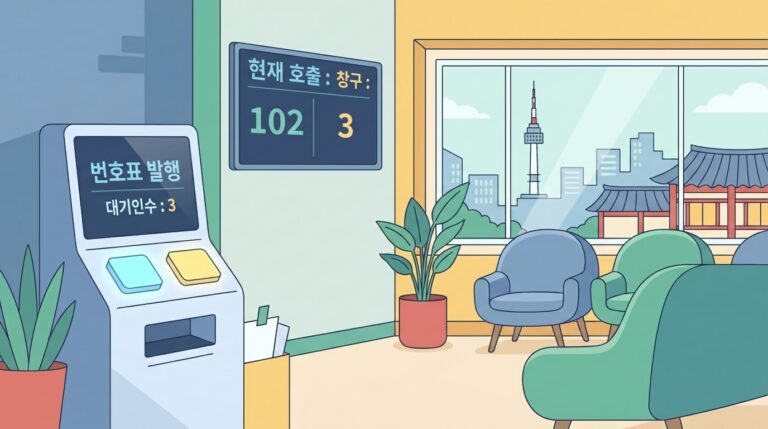
Picture this classic K-Drama scene: You walk into a spotless, sunlit bank branch in Yeouido, surrounded by busy office workers in tailored suits. The automatic glass sliding doors glide open with a brisk whoosh, followed by an instant wave of crisp air conditioning and the rhythmic chime: Ding-dong! Customer number 142, please proceed to counter 3.
You step forward with a simple mission—maybe you need to exchange travel currency, set up your Alien Registration Card banking profile, or deposit cash. But suddenly, right in front of you stands a sleek, touch-screen electronic kiosk (번호표 발권기). It displays multiple buttons glowing in Korean: 입출금 (Deposits/Withdrawals), 예금/적금 (Savings), 대출 (Loans), and 외환 (Foreign Exchange).
Your palms start sweating. You hesitate. A neatly dressed bank security guard (청원경찰) looks up and starts walking over with a polite, inquiring bow. Your inner voice panics: What if I press the wrong button and end up waiting two hours for a commercial mortgage interview?
If you have ever felt your heartbeat speed up in front of a Korean automated machine, take a deep breath. You are certainly not alone. As an editor who has coached hundreds of international students and expats across Seoul, I can tell you that the bank kiosk is the ultimate litmus test of everyday Korean. Mastering just a handful of authentic phrases will transform this nerve-wracking hurdle into a smooth, effortless routine. Let’s conquer the Korean bank lobby together!
Phase 2: Core Expressions Deep Dive
1. 번호표 뽑으셨어요? (Beonhopyo pobeusyeosseoyo?)
- Pronunciation: [beon-ho-pyo pob-eu-syeo-sseo-yo] (Think: “bun-ho-pyo” like “bun-whole-pure” + “pob-eu-syeo-sseo-yo”)
- Meaning: Literal: “Did you pull a number ticket?” | Natural: “Have you taken a queue ticket yet?”
- K-Culture Moment: You will hear this friendly question within 3 seconds of walking through the bank entrance, usually spoken by the attentive floor concierge or security guard.
- Editor’s Insight: The verb 뽑다 (ppopda) literally means “to pluck” or “to pull out” (like drawing a sword or picking a clover). In modern Korean, it is universally used for taking tickets from automated dispensers.
- Situation Spectrum:
- Casual: 🚫 (Never use with strangers or staff)
- Semi-formal: ⚠️ 번호표 뽑았어요? (Beonhopyo ppobasseoyo?)
- Formal: ✅ 번호표 뽑으셨어요? (Beonhopyo pobeusyeosseoyo?)
- 🤔 Think About It: In English, we say “take a ticket” or “get a number,” whereas Korean focuses on the physical action of plucking or drawing (뽑다). How does your native language describe queue systems?
2. 제 차례는 아직 멀었나요? (Je charyeneun ajik meoreonnayo?)
- Pronunciation: [je cha-rye-neun a-jik meo-reon-na-yo] (Sounds like: “jay cha-ryeh-noon ah-jeek mur-un-nah-yo”)
- Meaning: Literal: “Is my turn still far?” | Natural: “Is it still a long wait until my turn?”
- K-Culture Moment: A character in a slice-of-life drama nervously tapping their foot in a crowded bank lobby before rushing back to the office during lunch hour.
- Editor’s Insight: 멀다 (meolda) means “to be far” in physical distance, but Koreans routinely apply it to time and sequence. Asking this politely with a soft, upward inflection shows humility while checking the queue status.
- Situation Spectrum:
- Casual: 🚫 내 차례 아직 멀었어? (Nae charye ajik meoreosseo?)
- Semi-formal: ✅ 제 차례 아직 멀었나요? (Je charye ajik meoreonnayo?)
- Formal: ✅ 제 차례까지 대기가 많이 남았습니까? (Je charyekkaji daegiga mani namatseumnikka?)
- 🤔 Think About It: Notice how Korean spatial words like 멀다 (far) stretch into temporal concepts. Does your culture treat time as a physical road?
3. 띵동 소리 나면 창구로 가시면 돼요. (Ttingdong sori namyeon changguro gasimyeon dwaeyo.)
- Pronunciation: [tting-dong so-ri na-myeon chang-gu-ro ga-si-myeon dwae-yo]
- Meaning: Literal: “When the ding-dong sound occurs, going to the counter is fine.” | Natural: “Once the chime rings, you can just head over to the counter.”
- K-Culture Moment: The warm, reassuring advice given by a friendly neighborhood bank teller to an elderly resident or a confused newcomer.
- Editor’s Insight: 띵동 (ttingdong) is the quintessential Korean onomatopoeia for a two-tone electronic chime or doorbell. Using sound words in directions makes instructions instantly visual and reassuring.
- Situation Spectrum:
- Casual: 🚫 띵동 소리 나면 가. (Ttingdong sori namyeon ga.)
- Semi-formal: ✅ 띵동 소리 나면 창구로 가면 돼요. (Ttingdong sori namyeon changguro gamyeon dwaeyo.)
- Formal: ✅ 띵동 소리가 울리면 해당 창구로 이동해 주십시오. (Ttingdong soriga ullimyeon haedang changguro idonghae jusipsio.)
- 🤔 Think About It: Why do Koreans prefer using soft phrasing like “~시면 돼요” (~is fine / you may) instead of blunt commands like “가세요” (go)? Reflect on politeness strategies in public spaces.
Phase 3: Textbook Korean vs. Real Korean
Situation 1: Asking where to get the waiting ticket
- 📖 교과서 한국어 (Textbook Korean): 순번 대기표는 어디에서 수령합니까? (Sunbeon daegipyoneun eodieseo suryeonghamnikka? – “Where does one receive the sequential waiting ticket?”)
- 🗣️ 진짜 한국어 (Real Korean): 저기요, 번호표 어디서 뽑아요? (Jeogiyo, beonhopyo eodiseo ppobayo? – “Excuse me, where do I grab a ticket?”)
- 💡 왜 다를까? (Why is it different?): Textbook phrasing relies on stiff Hanja (Sino-Korean) vocabulary like 수령하다 (to receive/collect). In real life, native speakers use intuitive native Korean verbs like 뽑다 (to draw/pull).
Situation 2: Confirming your turn at the counter
- 📖 교과서 한국어 (Textbook Korean): 본인의 순번이 도래하였습니까? (Bonin-ui sunbeoni doraehayeotseumnikka? – “Has one’s turn arrived?”)
- 🗣️ 진짜 한국어 (Real Korean): 혹시 105번 부르셨어요? (Hoksi baeko-beon bureusyeosseoyo? – “Did you by any chance call number 105?”)
- 💡 왜 다를까? (Why is it different?): Real Koreans soften their approach with 혹시 (by any chance) and refer to the specific number called rather than abstract concepts like “my turn.”
Phase 4: K-Culture Deep Dive & Non-Verbal Manners
4-1. 눈치 (Nunchi) & Gesture Etiquette
When entering a Korean bank branch, your first ally is not the screen—it is the floor security officer (청원경찰). They are universally known as the most helpful guides in Korea.
* The Two-Handed Ticket Take: When the officer hands you a ticket from the kiosk, accept it with both hands or with your right hand supported by your left wrist. A small, polite head nod (목례) creates instant goodwill.
* Eye Contact & The Screen Glance: Do not stare intently at the teller counters while waiting; that can make customers feel rushed. Instead, take a seat in the waiting area, glance intermittently at the digital electronic board hanging from the ceiling, and listen for the chime.
4-2. Cultural Code Analysis: The Digital ‘Ppalli-Ppalli’ Ecosystem
Korean banks are masterclasses in Ppalli-Ppalli (빨리빨리, fast-paced) efficiency. Notice the small slip of paper in your hand: it tells you your ticket number (번호), the number of people waiting ahead of you (대기인수), and the exact timestamp down to the second.
In Korean culture, respecting someone’s time is the highest form of hospitality. The entire queuing infrastructure is engineered so that neither customer nor staff wastes a single second. Understanding this system allows you to appreciate why bank visits in Korea, despite the crowds, often wrap up with unbelievable speed.
Phase 5: Real-World Roleplay Scenario
Setting: A lively KB Kookmin Bank branch near Hongdae Station on a Thursday afternoon.
Characters:
* Alex: A foreign student opening a local debit account.
* Mr. Park (보안요원): A friendly, warm security guard wearing a tailored navy uniform with an KB emblem.
Alex: 저기요… 계좌 만들러 왔는데요. (Jeogiyo… gyejwa mandeulleo watneundeyo.)
“Excuse me… I came to open a bank account.”
🎭 Alex walks up to the kiosk, looking visibly hesitant.
Mr. Park: 아, 계좌 개설이요? 신분증 가지고 오셨어요? (A, gyejwa gaeseoriyo? Sinbunjeung gajigo osyeosseoyo?)
“Ah, opening an account? Did you bring your identification card?”
🎭 Mr. Park taps the main screen awake with an inviting smile.
Alex: 네, 외국인등록증 여기 있어요. (Ne, oeguk-in deungnokjeung yeogi isseoyo.)
“Yes, my Alien Registration Card is right here.”
🎭 Alex pulls his wallet out and shows the card with both hands.
Mr. Park: 좋습니다. 그러면 이쪽 ‘예금/신규’ 버튼 누르시면 돼요. (Jotsseumnida. Geureomyeon ijjok ‘yegeum/sin-gyu’ beoteon nureusimyeon dwaeyo.)
“Great. Then you can press this ‘Deposit/New Account’ button right here.”
🎭 Mr. Park points his finger toward the top-left blue touch icon.
Alex: 아, 이거요? (Ah, igeoyo?)
“Ah, this one?”
🎭 Alex touches the screen, and a clean paper ticket prints with a crisp chime.
Mr. Park: 네! 번호표 나왔습니다. 145번이시네요. 저기 소파에서 잠시 앉아서 기다려 주세요. (Ne! Beonhopyo nawasseumnida. Baek-sasi-obeon-isineyo. Jeogi sopahydroeseo jamsi anjaseo gidaryeo juseyo.)
“Yes! Here is your ticket. You are number 145. Please take a seat on that sofa over there and wait a moment.”
🎭 Mr. Park gently tears the ticket off and hands it to Alex with both hands.
Alex: 감사합니다. 제 앞에 대기가 많나요? (Gamsahamnida. Je ape daegiga mannayo?)
“Thank you. Are there many people waiting ahead of me?”
🎭 Alex glances at the ticket text.
Mr. Park: 앞에 두 분 계시니까 5분이면 될 거예요. 띵동 소리 나면 2번 창구로 가세요! (Ape du bun gyesinikka obun-imyeon doel geoyeyo. Ttingdong sori namyeon ibeon changguro gaseyo!)
“There are only two people ahead, so it will take around 5 minutes. When you hear the chime, head over to Counter 2!”
🎭 Mr. Park gives a reassuring nod.
🔀 Interactive Choice Point
You are sitting on the sofa, and suddenly the chime rings: Ding-dong! Number 145, Counter 2. What do you do?
- Choice A: Say nothing, leave your backpack on the sofa, walk casually to counter 2 while talking on your smartphone.
- Feedback (Risk): Avoid talking on your phone at bank counters. Bank tellers value focused communication, especially for identity verification.
- Choice B: Walk straight to Counter 2, hold up your ticket, and politely say: “안녕하세요! 145번입니다.” (Annyeonghaseyo! Baek-sasi-obeon-imnida.)
- Feedback (Best!): Flawless manners. Announcing your number confirms identity immediately and starts the transaction on a friendly note.
- Choice C: Stay seated to make sure they call your number twice before getting up.
- Feedback (Bad): In fast-paced Korean banks, tellers will immediately skip to the next customer if no one appears within 10 to 15 seconds!
Phase 6: 10-Second Emotional Shadowing Drill
Practice speaking these phrases with real emotion. Pay attention to the pauses (/) and intonation!
[😊 Politer & Slightly Inquiring]
저기요, / 번호표 어디서 뽑아요?
(Jeogiyo, / beonhopyo eodiseo ppobayo?)-
[🤔 Curious & Focused]
일반 예금 업무는 / 어떤 버튼 눌러야 해요?
(Ilban yegeum eommuneun / eotteon beoteon nulleoya haeyo?) -
[😌 Relieved & Courteous]
아, 3번 창구군요! / 친절하게 알려주셔서 감사합니다!
(A, sambeon changgugunyo! / Chinjeolhage allyeojusyeoseo gamsahamnida!)
Phase 7: K-Culture Mini Dictionary
- 번호표 (Beonhopyo) [bun-ho-pyo]: Waiting queue ticket. Ubiquitous across Korean institutions, hospitals, and post offices.
- 창구 (Changgu) [chang-gu]: Service counter or teller window. Banks assign numbers to counters (e.g., 1번 창구, 2번 창구).
- 대기 인원 (Daegi inwon) [dae-gi in-won]: The count of waiting people. Printed on your slip as 대기인수 (Daegi-insu).
- 신분증 (Sinbunjeung) [sin-bun-jeung]: Official identification card. At Korean banks, your passport or Alien Registration Card (외국인등록증) is mandatory.
Phase 8: Traveler’s Survival Kit
Top 3 Survival Phrases for Banks:
- 환전하러 왔어요. (Hwanjeonhareo watseoyo.)
- Meaning: “I came to exchange foreign currency.”
- Pro Tip: Use this at the kiosk to guide the security guard to select ‘외환’ (Foreign Exchange).
- 통장 만들고 싶어요. (Tongjang mandeulgo sipeoyo.)
- Meaning: “I would like to make a bankbook / bank account.”
- 제 차례 지났나요? (Je charye jinannayo?)
- Meaning: “Did my turn already pass?”
- Pro Tip: If you stepped out for fresh air and missed your chime, show your ticket and ask this politely.
Editor’s Travel Note:
- Banking Hours: Most traditional Korean bank branches open at 09:00 AM and close promptly at 04:00 PM (some digital branches close at 04:30 PM). Arriving before 03:00 PM is highly recommended.
- Digital Navigation: Use the official Naver Map Navigation App to search for “은행” (Bank) and check live congestion levels before visiting.
Phase 9: Going One Step Deeper
Korean banks display a unique balance between high-tech automation and deep human courtesy. While Korea boasts one of the most sophisticated mobile banking systems in the world (with giants like KakaoBank and Toss), physical brick-and-mortar branches preserve a traditional culture of civic warmth. Security officers at bank entrances represent Korea’s community-oriented ethos: machines do the mechanical calculations, but humans provide orientation, respect, and hospitality. Queuing here is not just waiting in line; it is an unspoken social pact of mutual order and prompt consideration.
💬 Your Turn: Have you ever visited a public office or bank in South Korea? What surprised you the most about the ticketing system? Share your story in the comments below!
Phase 10: Frequently Asked Questions (FAQ)
Q: Can I visit any counter if my number ticket is printed?
A: No. Korean banks divide counters by specific service categories (e.g., Deposit/Card vs. Loans vs. Foreign Exchange). You must proceed only to the counter number illuminated above the teller that matches the number displayed on the digital board.
Q: What should I do if I press the wrong category on the kiosk?
A: Do not worry! Simply show the printed ticket to the floor security officer and say: “버튼을 잘못 눌렀어요” (Beoteoneul jalmot nulleosseoyo – “I pressed the wrong button”). They will immediately reprint the correct slip for your specific banking needs.
Q: Do Korean bank counters have English support?
A: Major branches located in international hubs like Gangnam, Myeongdong, Itaewon, and Hongdae often have English-speaking staff. However, knowing basic terms like 계좌 (account), 신분증 (ID), and 번호표 (ticket) will ensure a stress-free process anywhere in Korea.
🚨 Common Mistakes Alert:
- Mistake 1: Throwing away the ticket immediately after looking at the number.
- Correct Action: Keep the ticket in hand! Many tellers will take the ticket slip from you to scan or shred it once your session begins.
- Mistake 2: Missing the chime and remaining seated.
- Correct Action: Tellers call the number once or twice on the speaker. If you do not stand up immediately, the counter will reset to the next customer in seconds.
- Mistake 3: Handing over your ID card with one hand casually.
- Correct Action: Always present your identification card and documents with both hands (두 손으로) as a sign of mutual respect.
Phase 11: Action Missions
- 🥉 Bronze Mission (Solo Practice): Stand in front of your mirror and practice saying: “저기요, 번호표 어디서 뽑아요?” three times with natural eye contact and polite hand gestures.
- 🥈 Silver Mission (Social Share): Save this post and share the pronunciation of ‘번호표’ (Beonhopyo) in your study group or Instagram story.
- 🥇 Gold Mission (Real World): Visit a Korean bank, post office (우체국), or subway customer center, take a ticket independently, and complete your task without switching to English!
- 🎮 K-Culture Mission: Watch an episode of a workplace K-Drama (such as Misaeng or Agency) and spot whenever characters deal with paperwork or automated queue kiosks. Listen for the word “번호표”!
Phase 12: Interactive Quiz Challenge
Test your understanding of Korean bank etiquette!
1. Situation Judgment:
You walk into a bank to send money abroad. Which button should you look for on the kiosk screen?
* (A) 입출금 (Deposits/Withdrawals)
* (B) 대출 (Loans)
* (C) 외환 (Foreign Exchange)
👉 Click here for the Answer & Explanation
Answer: (C)
‘외환’ (Oehwan) stands for Foreign Exchange / Remittance. Pressing (A) will direct you to a general domestic deposit counter that might not process international wires.
2. Fill in the Blank:
Complete the phrase: “띵동 소리 나면 ________로 가시면 돼요.” (When you hear the chime, you can head over to the counter.)
👉 Click here for the Answer & Explanation
Answer: 창구 (Changgu)
Full sentence: 띵동 소리 나면 창구로 가시면 돼요. (Ttingdong sori namyeon changguro gasimyeon dwaeyo.)
3. True or False Culture Check:
In Korean banks, security guards (청원경찰) are solely there for physical security and will not help you operate the ticket machine.
👉 Click here for the Answer & Explanation
Answer: False
Korean bank security guards are famous for their concierge-like hospitality. Helping visitors navigate the touch-screen kiosk is one of their everyday core duties!







