

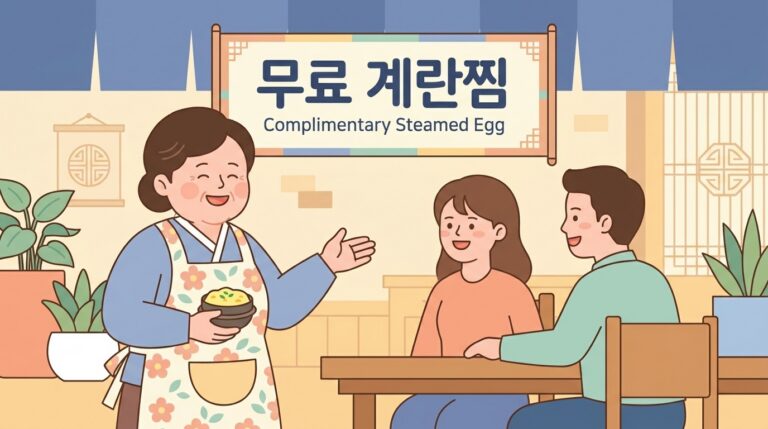
Phase 1: Empathy (A Heartfelt Table Encounter)
안녕하세요! 매일한글 에디터입니다.
Picture this: You are tucked away in a bustling, narrow alleyway near Euljiro in Seoul. Steam billows from bubbling pots of Kimchi-jjigae, metal chopsticks clatter cheerfully against stainless steel tables, and the savory aroma of sesame oil fills the air. You ordered a simple, modest lunch for yourself. Suddenly, the restaurant owner—a warm, radiant woman sporting a vibrant floral apron and a perm—walks over with a sizzling platter of freshly rolled egg omelet (Gyeran-mari) and sets it firmly right in front of you.
Your heart skips a beat. You freeze mid-bite. “Wait, did I accidentally order this? Is my Korean that terrible? Am I about to get hit with a surprise bill?” As you stammer awkwardly to explain, she waves her tongs dismissively with a beaming grin: “이거 서비스야, 학생 많이 먹어!” (This is on the house, eat up, dear student!).
Many of our intermediate learners tell us this exact moment made them panic. In many cultures, an unexpected dish feels suspicious or transactional. But in Korea, this is the magical, heartwarming manifestation of 정 (Jeong) known as 덤 (Deom) or 서비스 (Seobiseu). Navigating this moment properly separates a robotic textbook speaker from someone who truly understands the heartbeat of Korean dining culture. Today, we are unlocking the exact cultural nuance, verbal etiquette, and natural phrases you need so you never freeze up at an Imo’s generosity again!
Phase 2: Core Expressions (3-Key Deep Dive)
1. 이거 서비스예요? (Igeo seobiseu-yeyo?)
- Pronunciation: Ee-geo suh-bee-seu-ye-yo? (Think of the English word eagle without the ‘l’, followed by service pronounced with crisp, even vowels).
- Meaning: Literal: Is this service? | Actual Nuance: “Is this complimentary / on the house?”
- K-Culture Moment: You will hear this in almost every coming-of-age K-drama when broke university students gathering at a K-BBQ joint suddenly receive a free steaming bowl of Doenjang-jjigae from the sweet owner.
- Editor’s Insight: In Korea, the Konglish term 서비스 (Service) does not mean customer care or waitstaff duties; it specifically refers to free promotional items or gifts. Asking this gently with an upbeat lilt confirms the gift without sounding confrontational.
- Situation Spectrum: Casual ⚠️ | Semi-formal ✅ | Formal ⚠️
- 🤔 Think About It: How did the loanword “service” evolve from an abstract duty into a tangible physical gift in Korean society?
2. 어머, 이모님! 이렇게 많이 주시면 남는 게 있으세요? (Eomeo, imonim! Ireoke mani jusimyeon namneun ge isseuseyo?)
- Pronunciation: Uh-muh, ee-mo-nim! Ee-ruh-ke mahn-ee joo-she-myun nahm-neun geh ee-sseu-seh-yo?
- Meaning: Literal: Oh my, Auntie! If you give this much, do you have any profits left over? | Actual Nuance: “You are being overwhelmingly generous! How can you afford to give away so much?”
- K-Culture Moment: A quintessential scene in local food variety shows where charismatic celebrity hosts playfully banter with traditional market stall matrons to make them giggle.
- Editor’s Insight: This is top-tier B2 social banter (넉살, Neoksal). Rather than a stiff “thank you,” this friendly exaggeration validates the owner’s generosity and shows you recognize the scale of their kindness.
- Situation Spectrum: Casual ⚠️ | Semi-formal ✅ | Formal 🚫
- 🤔 Think About It: In many Western settings, asking a business owner about profit margins feels rude or invasive. Why is it considered the highest compliment in Korean local dining?
3. 감사히 잘 먹겠습니다! (Gamsahi jal meokgetseumnida!)
- Pronunciation: Gahm-sah-hee jahl muk-get-seum-nee-dah! (Smoothly connect gahm-sah-hee with a soft, breathy cadence).
- Meaning: Literal: I will eat thankfully and well. | Actual Nuance: “Thank you sincerely for your kindness; I will honor your treat by enjoying every bite!”
- K-Culture Moment: Seen in variety shows when an idol bows deeply with two hands before digging into a meal gifted by elder fans or neighborhood grandmothers.
- Editor’s Insight: While everyone knows 잘 먹겠습니다, adding 감사히 (gratefully) transforms it into an elevated, emotionally resonant acknowledgment that hits elders right in the heart.
- Situation Spectrum: Casual ⚠️ | Semi-formal ✅ | Formal ✅
- 🤔 Think About It: Why does the Korean language emphasize the speaker’s mindful gratitude before consuming food, rather than simply thanking the giver?
Phase 3: Textbook Korean vs. Real Korean
Situation 1: Clarifying an unexpected side dish or drink
- 📖 교과서 한국어: 이것은 무료입니까? (Igeoseun muryo-imnikka? / “Is this free of charge?”)
- 🗣️ 진짜 한국어: 어? 사장님, 이거 저희 안 시켰는데요… 혹시 서비스예요? (Eo? Sajangnim, igeo jeohi an sikyeotneundeyo… hoksi seobiseu-yeyo? / “Oh? Boss, we didn’t order this… is it on the house by any chance?”)
- 💡 왜 다를까?: “무료” sounds cold, clinical, and bureaucratic—like reading terms on an insurance contract. Native speakers express polite confusion first (안 시켰는데요) before pleasantly asking if it’s a gift (서비스).
Situation 2: Expressing appreciation and promising to return
- 📖 교과서 한국어: 음식이 맛있어서 다음에도 또 방문하겠습니다. (Eumsigi masisseoseo daeumedo tto bangmunhagetseumnida. / “Because the food is delicious, I will visit again next time.”)
- 🗣️ 진짜 한국어: 이모님 손맛이 진짜 최고예요! 저 여기 단골 할게요! (Imonim sonmati jinjja choegoyeyo! Jeo yeogi dangol halgeyo! / “Auntie, your cooking touch is legendary! I am definitely becoming a regular here!”)
- 💡 왜 다를까?: “방문하다” (to visit) is overly formal for neighborhood eateries. Mentioning 손맛 (intuitive culinary touch) and pledging to become a 단골 (regular customer) builds that warm, relational Jeong bridge instantly.
Phase 4: K-Culture Deep Dive & Non-Verbal Manners
4-1. Nunchi (눈치) & Body Language
When free food lands on your table, your body language speaks louder than your vocabulary:
* The Two-Handed Receive: Even if the dish is already placed on the table, lightly touch the edge of the plate or bowl with both hands while bowing your head slightly. It signals deep respect.
* Pleasant Surprise Face: Do not furrow your brow in suspicion. Widen your eyes in delightful surprise (눈이 똥그래지다). Korean restaurant owners give Deom because they want to witness your joy.
* The Clean Plate Courtesy: The cardinal rule of receiving Deom is effort. Even if you are bursting at the seams, eating at least half of the complimentary item is an essential courtesy. Leaving a gifted dish untouched damages the giver’s pride.
4-2. Cultural Code Analysis: The Philosophy of 덤 (Deom)
Deom originated in historical Korean agricultural markets where sellers would toss an extra fistful of grain or an additional radish into a buyer’s basket. It symbolizes the rejection of rigid, cold transactional capitalism. In Korea, feeding someone is the ultimate act of affection—stemming from a collective memory of post-war scarcity where maternal figures (Imo, Eomeoni) equated food with survival and love. When an Imo gives you a complimentary bottle of soda or a fried egg, she isn’t running a sales promotion; she is acknowledging you as family.
Phase 5: Real-Life Roleplay Scenario
- Setting: A bustling, vintage Gamjatang (Pork Bone Soup) restaurant in Jongno, Seoul on a chilly evening.
- Characters:
- Alex (알렉스): An exchange student worn out by midterm exams.
- Imo (이모님): The quick-witted, generous owner who has run the restaurant for 25 years.
- 알렉스: 사장님, 여기 볶음밥 하나만 볶아 주세요! (Sajangnim, yeogi bokkeumbap hanaman bokka juseyo! / “Boss, could you please make one fried rice for us here!”) 🎭 [Politely raising one hand with fingers together, smiling]
- 이모님: 네~ 금방 해줄게! 학생들 공부하느라 배 많이 고프지? (Ne~ geumbang haejulge! Haksaengdeul gongbuhaneura bae mani gopeuji? / “Sure thing~ coming right up! You students must be starving from studying, right?”) 🎭 [Wiping hands on her apron and briskly walking over]
- 알렉스: 네, 요즘 시험 기간이라 하루 종일 도서관에만 있었어요. (Ne, yojeum siheom gigang-ira haru jong-il doseogwane-man isseosseoyo.) 🎭 [Chuckle-sighing with tired yet polite eyes]
- 이모님: 아이고, 고생이 많네. 자, 여기 치즈 사리는 내가 서비스로 팍팍 넣었어! (Aigo, gosaeng-i manne. Ja, yeogi chijeu sarineun naega seobiseuro pakpak neoeosseo!) 🎭 [Dumping a gigantic mound of mozzarella cheese on the rice with a joyful wink]
- 알렉스: 어머, 이모님! 치즈를 이렇게 산처럼 주시면 남는 게 있으세요? (Eomeo, imonim! Chijeureul ireoke sancheoreom jusimyeon namneun ge isseuseyo?) 🎭 [Gasping theatrically with wide eyes and hands clasped]
- 이모님: 남는 건 무슨! 젊은 친구들이 씩씩하게 잘 먹는 게 내 낙이지. (Namneun geon museun! Jeolmeun chingudeuri ssikssikhage jal meongneun ge nae nagiji.) 🎭 [Waving her spatula dismissively with a booming laugh]
- 알렉스: 진짜 감동이에요… 감사히 잘 먹겠습니다! (Jinjja gamdong-ieyo… gamsahi jal meokgetseumnida!) 🎭 [Nodding respectfully and bowing slightly from the chest]
- 이모님: 그래, 바닥까지 싹싹 긁어먹고 힘내서 시험 대박 나라! (Geurae, badakkaji ssakssak geulgeomeokgo himnaeseo siheom daebak nara!) 🎭 [Giving Alex an encouraging pat on the shoulder before bustling off]
🔀 Interactive Choice Point
The Imo unexpectedly brings over a chilled bottle of Coca-Cola and sets it down with a thud. How do you respond?
* Option A: “저희 이거 안 시켰는데 돈 내야 하나요?” (Jeohi igeo an sikyeotneunde don naeya hanayo? / “We didn’t order this, do we have to pay?”)
* ❌ Feedback [Bad]: Overly blunt and defensive. It treats her generous gesture like an aggressive sales trap, instantly killing the friendly vibe.
* Option B: “헉, 이모님! 이거 서비스예요? 탄산 당겼는데 진짜 감사합니다!” (Heok, imonim! Igeo seobiseu-yeyo? Tansan danggyeotneunde jinjja gamsahamnida! / “Whoa, Auntie! Is this on the house? I was actually craving soda, thank you so much!”)
* ✅ Feedback [Best]: Perfect blend of natural reaction, appropriate validation, and vibrant gratitude. The Imo will remember you forever.
* Option C: “저희 배불러서 음료수 못 마셔요. 그냥 가져가세요.” (Jeohi baebulleoseo eumryosu mot masyeoyo. Geunyang gajyeogaseyo. / “We are full so we can’t drink soda. Just take it back.”)
* ⚠️ Feedback [Risk]: Rejecting a beverage gift flat-out feels cold and rejecting of Jeong. Even if you won’t drink it immediately, accept it politely and take it to go!
Phase 6: 10-Second Emotion Shadowing Drill
Read these out loud, observing the slash marks (/) for natural rhythm and intonation pauses:
- [😮 Pleased shock & deep touch]
- “어머, / 이모님! / 이거 서비스예요? / 진짜 감동이에요!”
(Eomeo, / imonim! / igeo seobiseu-yeyo? / jinjja gamdong-ieyo!)
- “어머, / 이모님! / 이거 서비스예요? / 진짜 감동이에요!”
- [🥰 Charming, playful banter]
- “이렇게 많이 주시면 / 사장님 남는 게 있으세요? / 저 단골 예약할게요!”
(Ireoke mani jusimyeon / sajangnim namneun ge isseuseyo? / jeo dangol yeyak-halgeyo!)
- “이렇게 많이 주시면 / 사장님 남는 게 있으세요? / 저 단골 예약할게요!”
- [🙏 Heartfelt bow & full belly gratitude]
- “배 터지게 / 너무 잘 먹었습니다! / 다음에 친구들 데리고 / 또 올게요!”
(Bae teojige / neomu jal meogeotseumnida! / daeume chingudeul derigo / tto olgeyo!)
- “배 터지게 / 너무 잘 먹었습니다! / 다음에 친구들 데리고 / 또 올게요!”
Phase 7: K-Culture Mini Dictionary
- 덤 (Deom)
- Meaning: Complimentary bonus / Extra freebie given on top of a purchase.
- Usage: Rooted in traditional street markets. Used whenever someone gives you an extra portion without asking for compensation.
- 이모님 (Imonim)
- Meaning: Maternal Aunt (Honorific Form).
- Usage: Used widely across casual dining establishments to address middle-aged female owners or servers affectionately, creating an immediate familial bond.
- 손맛 (Sonmat)
- Meaning: Culinary touch (Literally: “Hand taste”).
- Usage: Refers to that intangible, soulful cooking prowess possessed by seasoned home cooks and neighborhood grandmothers who season without measuring cups.
- 정 (情, Jeong)
- Meaning: Emotional bond / Communal affection and empathy.
- Usage: The foundational glue of Korean relationships, characterized by caring for others, sharing food, and unconditional hospitality without keeping score.
Phase 8: Traveler’s Survival Kit
Top 3 Survival Expressions
- “이거 서비스예요?” (Igeo seobiseu-yeyo?)
- Pro Tip: Keep your voice rising in a gentle, melodic question. If they nod or smile and say “응, 먹어!” (Yep, eat up!), you hit the jackpot.
- “이모님, 손맛 최고예요!” (Imonim, sonmat choegoyeyo!)
- Pro Tip: Shout this warmly towards the open kitchen when paying your bill. It is the greatest non-monetary tip you can bestow.
- “다음에 또 올게요!” (Daeume tto olgeyo!)
- Pro Tip: Combine this phrase with a light bow as you step through the sliding glass door.
Editor’s Travel Note
- Finding Authentic Jeong: Skip commercial tourist traps and search for neighborhood eateries (백반집, Gukbap spots) using the Naver Map application. Look for spots where local construction workers, taxi drivers, or university students line up.
- No Cash Tipping: Never attempt to leave cash bills on the table as a tip! It will confuse the staff, and an Imo may even sprint out into the street to return your “forgotten money.” In Korea, your genuine praise, empty plates, and hearty smiles are the currency of appreciation.
Phase 9: A Step Deeper (Reflective Humanity)
In hyper-capitalistic urban life, nearly every interaction is commodified; every gram of food has a barcode and a monetary consequence. Yet the culture of Deom stands as a quiet, stubborn rebellion against transactional existence. When an Imo slides an extra dish onto your table, she transforms a retail transaction into an intimate communal space. She sees not a customer number, but a hungry human being who deserves nourishment. It reminds us that empathy and communal care need not wait for grand occasions—they can be served on a small melamine plate on a Tuesday afternoon.
💬 Your Turn: Have you ever experienced an unexpected moment of hospitality while traveling or dining out? How did you respond, and how did it change your perspective of that culture? Let’s chat in the comments below!
Phase 10: FAQ & Common Mistakes
Q: Will the “Service” dish ever show up secretly on my bill?
A: Absolutely not. In genuine Korean casual dining culture, if a server or owner uses the word 서비스 (Service), it is 100% complimentary. It is illegal and culturally unacceptable to retroactively bill a customer for an unprompted service item.
Q: Can I call any female restaurant server “이모님 (Imonim)”?
A: Not universally! Use 이모님 (Imonim) in casual, homestyle places (K-BBQ, Gukbap, pojangmacha, traditional markets) where the servers are middle-aged women. In sleek modern cafes, fine dining, or when addressing younger waitstaff in their 20s-30s, stick to the neutral 저기요 (Jeogiyo – Excuse me) or 직원분 (Jikwon-bun – Staff member).
Q: What should I do if I am completely stuffed or have an allergy to the service item?
A: Never push it away aggressively. Express abundant verbal gratitude first: “우와, 정말 감사해요!” (Wow, thank you so much!). If you cannot finish it due to allergies or fullness, explain gently with a smile: “제가 배가 너무 불러서 다 못 먹을 것 같아요, 마음만 정말 감사히 받을게요!” (I’m so stuffed I don’t think I can finish it, but I deeply appreciate the thought!).
🚨 Common Mistakes Board
- ❌ Mistake 1: Tossing cash down on the table to “tip” for the service dish.
- 👉 Correct Action: Keep your money in your wallet; deliver an enthusiastic “너무 잘 먹었습니다!” at the counter instead.
- ❌ Mistake 2: Calling the owner “아줌마!” (Ajumma!) loudly.
- 👉 Correct Action: While technically accurate, Ajumma can sound rough or dismissive. Upgrade to the warmer, endearing 이모님 (Imonim) or respectful 사장님 (Sajangnim).
- ❌ Mistake 3: Ignoring the owner when they bring the dish and silently eating it.
- 👉 Correct Action: Make brief eye contact, pause your conversation, and acknowledge the gesture with a bright thank you.
Phase 11: Action Missions
- 🥉 Bronze Level (Solo Practice): Stand before a mirror and practice expressing the phrase “이거 서비스예요? 감동이에요!” with wide, delighted eyes and a warm smile 3 times.
- 🥈 Silver Level (Social Engagement): The next time you order Korean takeout or visit a local Korean diner, post a photo of your side dishes using the hashtag
#KoreanJeongand tag our community. - 🥇 Gold Level (Real-World Mission): When you receive extra banchan or free food at a Korean restaurant, use our Phase 2 phrase: “이모님 손맛 최고예요!” right before tapping your card to pay!
- 🎮 K-Culture Media Mission: Watch an episode of a neighborhood food drama (like Reply 1988 or Let’s Eat) and spot the exact scene where complimentary food (Deom) is offered. Pay attention to how the characters react!
Phase 12: Interactive Quiz Challenge
Test your situational mastery below! Expand the accordion toggles to check your answers.
1. Situational Judgment
You are eating Samgyeopsal with a friend. The owner brings a bowl of Steamed Egg (Gyeran-jjim) that you never ordered. What is the most culturally savvy response?
* (A) “이거 계산서에 들어가는 거 아니죠?” (This isn’t going on the bill, right?)
* (B) “어머 사장님, 저희 안 시켰는데 서비스예요? 대박!” (Oh my Boss, we didn’t order this, is it service? Amazing!)
* (C) “주문 안 했으니까 취소해 주세요.” (We didn’t order it, so please cancel it.)
🔍 Click to view the correct answer & explanation
- Correct Answer: (B)
- Explanation: (B) combines humble verification with playful excitement. Option (A) is overly skeptical and spoils the hospitality, while (C) treats a gift like an order error.
2. Fill-in-the-Blank Challenge
Complete this natural compliment that will melt any Korean restaurant owner’s heart:
* “이모님 ________이(가) 정말 최고예요! 저 여기 단골 할게요!”
🔍 Click to view the correct answer & explanation
- Correct Answer: 손맛 (Sonmat)
- Explanation: 손맛 signifies the seasoned, heartfelt culinary touch that cannot be replicated by commercial recipes. Saying 이모님 손맛 최고예요! is the ultimate praise.
3. Cultural Nuance True or False
- Statement: In Korea, if an Imo gives you free soda or food, you are expected to leave a generous cash tip at the cashier table.
🔍 Click to view the correct answer & explanation
- Correct Answer: False (X)
- Explanation: Korea does not have a tipping culture. Attempting to tip can cause awkwardness. The true repayment for Deom is finishing the food cheerfully, saying thank you warmly, and coming back as a loyal customer (단골)!







