

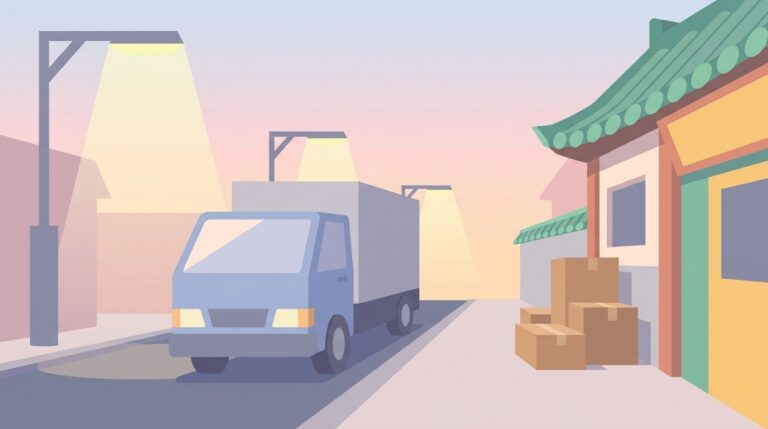
Beyond the Midnight Knock: Unpacking Korea’s Dawn Delivery Debate and the Human Cost of Hyper-Convenience
Phase 1: Empathy (Immersive Storytelling Opening)
안녕하세요! 매일한글 에디터입니다. (Annyeonghaseyo! Maeil Hangul editeo-imnida. / Hello! It’s your Daily Hangul editor.)
Picture this quintessential modern Seoul scene: It is 11:45 PM on a freezing Tuesday. You are curled up on your sofa watching your favorite K-Drama, suddenly craving fresh Jeju Hallabong tangerines and organic sourdough bread for tomorrow’s 8:00 AM breakfast. With a few taps on an app like Coupang or Market Kurly, your order is placed. You fall asleep, and by 6:30 AM, before your alarm even rings, a neat insulated cooler bag (fresh bag) is already sitting silently at your doorstep. To international observers and residents alike, South Korea’s saebyeok baesong (dawn delivery) feels like nothing short of pure logistical sorcery.
Yet, beneath this immaculate facade of modern urban luxury lies an intense, deeply polarising national discourse. Turn on the evening news or listen in on conversations at a Yeouido office cafe, and the tone changes dramatically. You will hear heated debates on algorithm-driven pacing, midnight shifts, precarious employment, and the grave concept of gwarosa (death from overwork). High-level learners of Korean frequently tell me: “Editor, I can order groceries effortlessly, but whenever my Korean colleagues debate the ethics and sustainability of midnight logistics over lunch, I feel linguistically paralyzed. I simply lack the nuanced, analytical vocabulary to express moral ambiguity and socio-economic critique at an advanced level.”
This guide was forged directly from those real-world learner frustrations. If you aspire to master Korean at a C2 proficiency level, you must be able to peel back the polished layers of hyper-convenience and articulate multifaceted socio-cultural paradoxes. Let us transition from merely enjoying Korea’s speed to understanding its hidden human cost with elegance, empathy, and surgical linguistic precision.
Phase 2: Deep Dive into 3 Core Advanced Expressions
1. 편리함의 이면 (Pyeonriham-ui imyeon)
- Pronunciation: [Pyeon-ni-ham-ui i-myeon] (Acoustic tip: Glide through pyeon-ni like the English word “puny” spoken with an ‘n’ sound, followed by hahm-we ee-myun.)
- Meaning: Literally “the backside of convenience” | Nuance: The hidden societal costs, ethical compromises, or systemic sacrifices concealed behind an outwardly convenient system.
- K-Culture Moment: Regularly featured in investigative journalism programs such as SBS’s Curious Stories Y (궁금한 이야기 Y) or KBS’s Current Affairs Tracking (시사기획 창) when investigating platform worker conditions.
- Editor’s Insight: The Hanja character 면 (面) denotes a surface or facet. When paired with 이 (裏, the inside/reverse), 이면 evokes a shadowy, unseen reality beneath a gleaming exterior. Use this whenever you want to dissect structural irony without sounding aggressive.
- Situation Spectrum: Casual ⚠️ | Semi-formal ✅ | Formal ✅
- 🤔 Think About It: Does your native language have an equivalent expression that captures the collective moral burden of consumer privilege, or is convenience framed purely as an unblemished triumph of technological progress?
2. 과로사 방지 대책 (Gwarosa bangji daechaek)
- Pronunciation: [Gwa-ro-sa bang-ji dae-chaek] (Acoustic tip: Imagine the cadence of “Gwa-roh-sah” echoing guava-raw-saw, snapping crisply into “bang-ji” and “day-check”.)
- Meaning: Literally “preventative countermeasures against death from overwork” | Nuance: Urgent institutional and legislative interventions designed to halt fatal exhaustion among logistics and delivery personnel.
- K-Culture Moment: Frequently headlined on JTBC news panels and discussed in socio-political dramas like Life or Cart, reflecting real-life negotiations between logistics unions and government task forces.
- Editor’s Insight: Gwarosa (과로사) is a recognized legal and clinical concept across East Asia. Coupling it with 방지 대책 elevates your discourse into public policy analysis, transforming a basic expression of sympathy into an informed socio-structural critique.
- Situation Spectrum: Casual 🚫 | Semi-formal ✅ | Formal ✅
- 🤔 Think About It: Notice how Korean creates compact four-to-six syllable legal and sociopolitical compounds. How does framing systemic exhaustion as a specific institutional issue alter civic accountability in Korea?
3. 지속 가능한 상생 모델 (Jisok ganeunghan sangsaeng model)
- Pronunciation: [Ji-sok ga-neung-han sang-saeng mo-del] (Acoustic tip: Stress the balanced harmony of sang-saeng, which sounds like “song-seng” with an open, rounded vowel.)
- Meaning: Literally “sustainable mutual coexistence model” | Nuance: A holistic corporate-labor equilibrium where economic efficiency does not devour human dignity or small business welfare.
- K-Culture Moment: Championed in ESG (Environmental, Social, and Governance) boardrooms, corporate press releases, and modern workplace dramas such as Misaeng (미생) when characters grapple with ethical management.
- Editor’s Insight: The philosophy of Sangsaeng (상생: living together in mutual prosperity) is the bedrock of contemporary Korean corporate ethics. Advocating for a 상생 모델 shows that you are not simply criticising capitalism, but seeking a constructively balanced alternative.
- Situation Spectrum: Casual ⚠️ | Semi-formal ✅ | Formal ✅
- 🤔 Think About It: Sangsaeng stands in direct philosophical opposition to zero-sum market logic. How does understanding this confucian-communitarian ideal change how you engage in business negotiations in Korea?
Phase 3: Textbook Korean vs. Real Korean
Scenario 1: Discussing logistics bottlenecks and worker fatigue
- 📖 교과서 한국어 (Textbook):
배송 기사님들이 밤에 일해서 너무 힘들 것 같아요. (Baesong gissanimdeuri bame ilhaeseo neomu himdeul geot gat-ayo.)
“It seems delivery drivers have a very hard time because they work at night.” - 🗣️ 진짜 한국어 (Real Native C2):
새벽 배송이 혁신인 건 분명하지만, 물류 현장의 노동 강도가 한계치에 다다랐다는 지적을 간과할 순 없죠. (Saebyeok baesong-i hyeoksin-in geon bunmyeonghajiman, mullyu hyeonjang-ui nodong gangdoga hangyechie dadaratdaneun jijeog-eul gwan-gwahal sun eopjyo.)
“While dawn delivery is undoubtedly an innovation, we cannot overlook critiques that physical labor intensity on the logistics floor has hit a breaking point.” - 💡 왜 다를까? (Why the divergence?): Textbook Korean over-relies on subjective emotion markers (힘들 것 같아요). Sophisticated native discourse balances corporate merit (혁신인 건 분명하지만) with systemic structural friction (노동 강도가 한계치에 다다랐다), demonstrating objective intellectual maturity.
Scenario 2: Expressing ethical consumer guilt
- 📖 교과서 한국어 (Textbook):
저는 밤늦게 주문하는 것을 멈춰야겠어요. (Jeoneun bamneutge jumunhaneun geoseul meomchwoyagess-eoyo.)
“I ought to stop ordering late at night.” - 🗣️ 진짜 한국어 (Real Native C2):
소비자의 편익에 길들여진 나머지, 정작 배송 노동자의 처우 문제는 외면해 온 게 아닌지 자성하게 돼요. (Sobijaui pyeon-ig-e gildeul-yeojin nameoji, jeongjak baesong nodongjaui cheou munjeneun oemyeonhae on ge aninji jaseonghage dwaeyo.)
“I find myself reflecting on whether we have become so habituated to consumer convenience that we deliberately averted our eyes from the workers’ actual conditions.” - 💡 왜 다를까? (Why the divergence?): Natural Korean intellectuals rarely frame consumer ethics as a simplistic binary switch (I will stop ordering). Instead, they frame it via introspective societal reflection (~자성하게 돼요), capturing the inescapable complicity of modern urban lifestyles.
Phase 4: K-Culture Deep Dive & Non-Verbal Manners
4-1. Nunchi (눈치) & Non-Verbal Manners in Critical Debates
Discussing labor ethics in Korea requires immense contextual tact. While younger generations champion aggressive reform and ESG compliance, older or business-oriented interlocutors may view midnight delivery as an economic miracle sustaining Korea’s competitive edge.
* The Reflective Tilt: When listening to counterarguments, avoid immediate verbal rebuttal. Tilt your head slightly (approximately 5-10 degrees), nod slowly twice, and emit a soft “그렇죠, 그 점도 일리가 있네요” (Indeed, that point also holds merit) before presenting systemic counter-perspectives.
* Tone Modulation: Lower your vocal pitch slightly when mentioning 과로사 (death from overwork) or 처우 개선 (treatment improvement). Maintaining a bright, elevated voice during tragic discussions triggers immediate social discomfort (눈치 없음).
4-2. Cultural Code Analysis: The Metamorphosis of Ppalli-Ppalli (빨리빨리)
Korea’s legendary Ppalli-Ppalli (hurry-hurry) culture was historically an engine of post-war reconstruction—a survival reflex born from scarce resources. In the 21st century, however, this cultural trait has been hyper-digitized and commodified into an ultra-competitive delivery ecosystem known colloquially as the “Delivery Republic” (배달공화국). The debate surrounding dawn delivery marks a profound psychological inflection point: Korean society is beginning to critically ask whether the cultural addiction to relentless speed is devouring human dignity. When watching contemporary films or media exploring modern urban alienation, pay attention to the contrasting imagery of peaceful, sleeping high-rise apartments and the frantic, headlight-lit vans speeding through empty pre-dawn roads.
Phase 5: Real-World Roleplay Scenario
Setting: A minimalist design cafe in Seongsu-dong, Seoul. You are having an afternoon coffee with Min-jun (민준), an ESG policy researcher at a public logistics think tank.
- 민준: 어제 밤 11시에 시킨 밀키트가 오늘 아침 6시에 문 앞에 와 있더라고요. 편리하긴 한데, 매번 마음 한편이 좀 무겁습니다. (Eoje bam yeol-han-sie sikin milkiteuga oneul achim yeoseot-sie mun ape wa itdeoragoyo. Pyeonrihagin hande, maebeon ma-eum hanpyeon-i jom mugeopseumnida.)
🎭 Looking pensively into his cold brew, gently swirling the ice.
“The meal kit I ordered at 11 PM arrived at my door by 6 AM. It’s incredibly convenient, but a part of my heart feels heavy every single time.” -
Learner: 저도 공감해요. 서비스의 효율성 뒤에 가려진 노동의 강도를 생각하면 마냥 반갑지만은 않더라고요. (Jeodo gonggamhaeyo. Seobiseu-ui hyoyulseong dwie garyeojin nodong-ui gangdoreul saenggakhamyeon manyang bangapjimaneun anteoragoyo.)
🎭 Nodding measuredly, setting down the coffee cup without making a sound.
“I completely resonate with that. When thinking about the labor intensity obscured behind the service’s sheer efficiency, I can’t just welcome it unconditionally.” -
민준: 맞아요. 특히 야간 분류 작업과 연속 심야 배송은 생체 리듬을 파괴해서 안전사고로 직결되기 십상이니까요. (Majayo. Teukhi yagan bullyu jageopgwa yeonsok simya baesong-eun saengche rideumeul pagwoehaeseo anjeonsagoro jikgyeol-doe-gi sipsang-inikkayo.)
🎭 Tapping a finger thoughtfully on the table to emphasize systemic risk.
“Exactly. Especially because night sorting work and consecutive overnight deliveries destroy biological rhythms, readily precipitating fatal accidents.” -
Learner: 결국 단순한 기업 규제를 넘어, 지속 가능한 상생 모델을 모색해야 할 시점인 것 같아요. (Gyeolguk dansunhan gieop gyujereul neomeo, jisok ganeunghan sangsaeng modeleul mosaekhaeya hal sijeom-in geot gat-ayo.)
🎭 Maintaining open eye contact, adopting a constructive, analytical posture.
“Ultimately, going beyond mere corporate regulations, it seems we have reached the moment where we must seek a sustainable model of coexistence.” -
민준: 전적으로 동의합니다. 하지만 당장 배송 속도를 늦추면 소비자들의 반발과 물류 업계의 매출 타격도 만만치 않을 텐데요. (Jeonjeog-euro dong-uihamnida. Hajiman dangjang baesong sokdoreul neuchumyeon sobijadeurui banbalgwa mullyu eopgye-ui maechul tagyeokdo manmanchi aneul tendeyo.)
🎭 Raising an eyebrow slightly, presenting the pragmatic economic paradox.
“I agree wholeheartedly. However, if delivery speeds are instantly curbed, the consumer backlash and the financial blow to the logistics sector would hardly be negligible.” -
Learner: 바로 그 지점에서 사회적 대타협이 필요한 거죠. 편리함의 대가를 소비자와 플랫폼이 함께 분담하는 구조로요. (Baro geu jijeom-eseo sahoejeok daetahyeob-i piryohan geojyo. Pyeonriham-ui daegareul sobijawa peullaetpomi hamkke bundamhaneun gujoroyo.)
🎭 Offering a subtle, reassuring smile, speaking with measured conviction.
“That exact juncture is where a grand societal compromise is warranted. A framework where the cost of convenience is shared jointly by consumers and platforms.” -
민준: ‘편리함의 대가를 분담한다’… 참 와닿는 통찰이네요. 소비자의 인식 전환이 선행되어야겠군요. (‘Pyeonriham-ui daegareul bundamhanda’… Cham wadatneun tongchari-neyo. Sobijaui insik jeonhwan-i seonhaengdoe-eoyagetgunyo.)
🎭 Nodding deeply with genuine respect, visibly impressed by your nuance.
“‘Sharing the cost of convenience’… that is a genuinely resonant insight. A paradigm shift in consumer consciousness must indeed precede it.” -
Learner: 네, 플랫폼의 혁신이 노동자의 인간다운 삶과 공존할 때 비로소 진정한 선진 물류라고 할 수 있으니까요. (Ne, peullaetpom-ui hyeoksin-i nodongjaui ingandaun samgwa gongjonhal ttae biroso jinjeonghan seonjin mullyurago hal su isseunikkayo.)
🎭 Concluding with calm, resolute composure.
“Indeed, because only when platform innovation coexists alongside workers’ fundamental human dignity can we truly designate it an advanced logistics paradigm.”
🔀 Interactive Branching Moment
Imagine Min-jun asks: “그렇다면 당장 내일부터 새벽 배송을 전면 금지하는 법안에 대해선 어떻게 생각하세요?” (What do you think about a bill outright banning dawn deliveries starting tomorrow?)
- Choice A: 무조건 전면 금지해야죠! 노동자의 목숨보다 빠른 배송이 더 중요할 순 없잖아요. (Mujogeon jeonmyeon geumjihaeyajyo! Nodongjaui moksumboda ppareun baesong-i deo jung-yohal sun eopjanayo.)
- Choice B: 전면 금지는 시장 왜곡을 부를 수 있으니, 단계적인 야간 근로 제한과 적정 휴게 시간 보장이 현실적인 대안 아닐까요? (Jeonmyeon geumjineun sijang waegog-eul bureul su isseuni, dangyejeogin yagan geunro jehangwa jeokjeong hyuge sigan bojang-i hyeonsiljeogin dae-an anilkkayo?)
- Choice C: 소비자들이 편하게 쓰고 있는데 정부가 법으로 막는 건 자유 시장 경제 원리에 안 맞죠. (Sobijadeuri pyeonhage sseugo inneunde jeongbuga beob-euro mangneun geon jayu sijang gyeongje wonrie an matjyo.)
Feedback:
* Choice A [Risk]: While morally passionate, an absolutist stance overlooks economic repercussions and can derail high-level intellectual consensus in Korean corporate or academic policy discussions.
* Choice B [Best]: Exemplary C2 response! It demonstrates analytical equilibrium, proposing gradual structural adjustments (단계적 제한) while addressing worker welfare and market stability simultaneously.
* Choice C [Bad]: Overlooks human rights and systemic labor crises, appearing tone-deaf (눈치 없음) in progressive sociological policy contexts.
Phase 6: 10-Second Emotion Shadowing Drill
Practice these cadence and pausing drills. Notice the breath marks (/) which emulate the natural respiratory pauses of high-level Korean speakers.
- [🤔 고뇌하듯 진지하게 – Pensively and gravely]
혁신의 과실을 누리는 동안, / 보이지 않는 곳에서 누군가의 희생이 / 담보되어 온 건 아닌지 / 되짚어봐야 합니다.
(Hyeoksin-ui gwasireul nurineun dongan, / boiji anneun gos-eseo nugun-gaui huisaeng-i / dambodoe-eo on geon aninji / doejip-eobwaya hamnida.)
“While relishing the fruits of innovation, / we must critically reexamine / whether someone else’s sacrifice / has been pledged as collateral in unseen places.” -
[💡 단호하고 설득력 있게 – Resolutely and persuasively]
지속 가능성을 결여한 속도전은 / 결국 사회적 비용의 폭증으로 / 귀결될 수밖에 없습니다.
(Jisok ganeungseong-eul gyeoryeohan sokdojeon-eun / gyeolguk sahoejeok biyong-ui pokjeung-euro / gwigyeoldwoel subakke eopseumnida.)
“A speed war bereft of sustainability / is inevitably bound / to culminate in an explosive surge of societal costs.” -
[🌱 따뜻하고 공감 어린 어조로 – Warmly and empathetically]
배송 기사님들의 노동 환경 개선은 / 단순한 시혜적 조치가 아니라, / 우리 사회의 건강성을 지키는 / 최소한의 안전망입니다.
(Baesong gissanimdeurui nodong hwangyeong gaeseon-eun / dansunhan sihyejeok jochiga anira, / uri sahoe-ui geon-gangseong-eul jikineun / choesohan-ui anjeonmang-imnida.)
“Improving the working environment for delivery personnel / is not a mere benevolent concession, / but the minimum safety net / preserving the holistic health of our society.”
Phase 7: K-Culture Mini Dictionary
- 새벽 배송 (Saebyeok baesong) | Dawn Delivery / Overnight Logistics
A logistics service where goods ordered before midnight (often up to 11:00 or 11:59 PM) arrive outside the customer’s front door by 7:00 AM the following morning. Originally popularized by Market Kurly for organic groceries and scaled nationwide by Coupang’s Rocket Delivery. - 특수고용직 (Teuksu goyongjik) | Specially Employed Workers (Dependent Contractors)
Gig-economy and platform logistics workers classified legally as independent contractors rather than salaried corporate employees. This technical term is central to discussions about labor law loopholes, lack of national industrial accident insurance, and collective bargaining rights. - 라스트마일 (Laseuteumail) | The Last Mile
Adopted from logistics terminology, this refers to the final step of the delivery process from the distribution hub to the consumer’s threshold. In Korean discourse, it represents the site of fiercest physical friction, extreme delivery speed competition, and human physical fatigue. - 착한 소비 (Chakhan sobi) | Ethical / Conscious Consumption
A consumer movement prioritizing ethical production, fair labor standards, and ecological responsibility over raw speed and rock-bottom prices. Frequently cited when consumers voluntarily opt for slower delivery schedules or consolidated packaging.
Phase 8: Traveler & Resident Survival Kit
Top 3 Socio-Logistics Survival Phrases
- 문 앞에 놔주시고 벨은 누르지 말아주세요.
(Mun ape nwajusigo bereun neureuji marajuseyo.)
Pro Tip: Delivery workers operate at astonishing speeds pre-dawn. Adding this note via your app avoids waking roommates or housemates while protecting the courier’s efficiency. - 기사님, 늦어도 괜찮으니 항상 안전 운전하세요!
(Gissanim, neujeodo gwaenchanheuni hangsang anjeon unjeonhaseyo.)
Pro Tip: Leave this in the delivery message box on rainy or snowy days. It provides profound emotional relief to couriers monitored by rigorous algorithm delivery quotas. - 보랭백은 문 앞에 회수용으로 내놓았습니다.
(Boraengbaeg-eun mun ape hoesuyong-euro naenoh-asseumnida.)
Pro Tip: Essential when using reusable cooler boxes like Coupang’s Fresh Bag or Kurly’s Purple Box. Failure to leave them out delays the courier’s retrieval logistics.
Editor’s Travel Note
When living in or traveling through Korea, modern logistics apps are indispensable. Make sure you complete your setup by visiting the official Naver Map Application to pinpoint your building’s exact road-name address (Doro-myeong Juso) and postal access codes, as delivery drivers navigate via hyper-precise geocoding. If residing in an officetel or villa with complex security gates, write clear access instructions (공동현관 비밀번호) in your delivery profile to prevent couriers from getting trapped outside at 3:00 AM.
Phase 9: “One Step Deeper” (Philosophical Essay)
In traditional Korean agrarian society, community survival was anchored in Pumasi (품앗이)—an egalitarian system of reciprocal communal labor where neighbors pooled sweat without direct monetary transaction. Today, urban Korea has replaced Pumasi with the extreme commercialization of time: money directly purchases the sleep and nighttime rest of another citizen. Dawn delivery is undoubtedly a triumph of computational algorithms and hyper-dense city planning, but it simultaneously challenges the foundational communitarian tenet that one human being’s convenience should never be bought at the unmitigated expense of another’s physical safety. As we enjoy the wonder of waking up to fresh morning deliveries, we are forced to ask: where does the legitimate right to corporate innovation end, and our collective responsibility for our neighbor’s physical preservation begin?
💬 Your Turn: What is your perspective on this paradox? Do you believe consumers should pay an optional “Ethical Delivery Fee” to fund nighttime worker safety, or must the burden fall entirely on corporate algorithms? Drop your thoughts in Korean below!
Phase 10: FAQ & Common Mistakes
Q: Can I use the word “과로사” (gwarosa) in casual conversation?
A: Yes, but with care. In casual social settings, Koreans often use it as lighthearted hyperbolic slang (e.g., “나 이번 주 과제 때문에 과로사할 것 같아” / I feel like I’m going to die from overwork because of this week’s assignments). However, when discussing logistics or delivery drivers, it reverts strictly to its solemn, legal-medical socio-political definition. Never use it flippantly when talking about real delivery workers.
Q: How do platform companies legally classify dawn delivery drivers?
A: Most are categorized as 특수형태근로종사자 (workers in special types of employment) or independent contractors. This allows platforms to bypass traditional standard labor contracts (근로기준법), making issues of maximum overtime, nighttime pay premiums, and sick leave deeply contested legal battlegrounds.
Q: Is opting out of dawn delivery considered a popular movement in Korea?
A: It is an emergent movement rather than an all-encompassing boycott. Rather than a total ban, civil groups and conscious consumers advocate for 휴식권 보장 (guarantee of the right to rest), such as establishing mandatory rest periods between shifts, eliminating midnight delivery on designated national holidays, or opting for “Eco-Delays” (느린 배송).
🚨 Common Mistakes Alert!
- Mistake 1: Confusing 배달 (Baedal) and 배송 (Baesong).
Incorrect: 음식 배송이 도착했어요. / 택배 배달이 늦어요.
Correction: 배달 is primarily used for immediate prepared food orders (like pizza or jajangmyeon from Baemin), whereas 배송 refers to commercial parcel/logistics shipping across distribution networks (like Coupang, Market Kurly, Amazon). - Mistake 2: Calling delivery drivers “택배 아저씨” in serious or analytical contexts.
Correction: While 택배 아저씨 (Taekbae ajeossi) is common colloquially, it sounds overly childish or dismissive in formal discourse. Always use 배송 기사님 (Baesong gissanim) or 물류 노동자 (Mullyu nodongja). - Mistake 3: Mispronouncing the assimilating nasal in 편리함 (Pyeonriham).
Correction: Do not pronounce it as [Pyeon-ri-ham]. Due to liquid nasalization rules in Korean phonology, /ㄴ/ before /ㄹ/ assimilates: pronounce it clearly as [편니함 / Pyeon-ni-ham].
Phase 11: Action Missions
- 🥉 Bronze Mission (Solo Vocal Drill): Practice reading the 3 Emotion Shadowing sentences in Phase 6 into your phone’s voice recorder. Ensure that your pronunciation of 편리함의 이면 strictly reflects the [편니함의 이면] sound assimilation.
- 🥈 Silver Mission (Social Reflection): Write a 2-3 sentence Korean critique on your social media or study journal evaluating hyper-convenience. Use at least two core expressions: 편리함의 이면 and 지속 가능한 상생 모델.
- 🥇 Gold Mission (Real-World Engagement): The next time you receive an online package or order delivery in Korea, write a thoughtful note in the customer delivery request field (요청사항): “기사님, 늘 안전 운전하시고 건강 유의하세요!” (Driver, please drive safely and take care of your health!).
- 🎮 K-Culture Media Mission: Watch an episode of a Korean current affairs analysis video on YouTube searching the terms
새벽배송 노동강도 다큐(Dawn delivery labor intensity documentary). Try to spot the terms 특수고용직, 분류 작업 (sorting work), and 과로사 used in authentic live interviews.
Phase 12: Interactive Quiz Challenge
Test your mastery of C2-level socio-logistics terminology and Korean cultural realities!
Question 1: Situational Vocabulary Application
다음 빈칸에 들어가기에 가장 적절한 고난도 어휘는 무엇일까요?
“새벽 배송 플랫폼의 급성장은 소비자의 시간을 절약해 주었지만, 그 이면에는 야간 노동자의 건강권과 안전이 위협받는 ( ) 문제를 야기했다.”
* ① 단순 노동 (Dansun nodong)
* ② 구조적 모순 (Gujojeok mosun)
* ③ 일시적 유행 (Ilsijeok yuhaeng)
🔍 정답 및 해설 보기 (Click to reveal answer)
- 정답: ② 구조적 모순 (Gujojeok mosun / Structural Contradiction)
- 해설: C2-level sociopolitical discourse requires analytical terms like 구조적 모순 (structural contradiction/paradox). Options ① (simple labor) and ③ (temporary fad) fail to capture the systemic ethical conflict discussed in the context.
Question 2: Fill in the Blank (Collocation Mastery)
“기업의 이윤 추구와 노동자의 생존권이 충돌할 때, 우리는 대립을 넘어 지속 가능한 ( ) 모델을 구축해야 한다.”
* (Hint: The Korean philosophy of living together in mutual flourishing)
🔍 정답 및 해설 보기 (Click to reveal answer)
- 정답: 상생 (Sangsaeng / Coexistence, Mutual Prosperity)
- 해설: 상생 모델 (coexistence model) forms the definitive philosophical keyword in contemporary Korean economic policy and labor ethics debates.
Question 3: Cultural True or False
Statement: In Korean media and sociological discourse, 새벽 배송 (dawn delivery) is universally praised without any ethical criticism, because consumer rights strictly supersede labor regulations in modern Seoul.
🔍 정답 및 해설 보기 (Click to reveal answer)
- 정답: False (X)
- 해설: While dawn delivery is celebrated for its unmatched logistical prowess, it is currently one of South Korea’s most fiercely contested civic topics. High-profile coverage of nighttime driver deaths (과로사), continuous union negotiations, and conscious consumption campaigns (착한 소비) have ignited widespread public soul-searching regarding its ethical sustainability.
“







