

C2 Korean: Navigating the NFT Art Revolution and Shifting Aesthetics
Phase 1: Empathy (Immersive Storytelling Opening)
안녕하세요! 매일한글 에디터입니다.
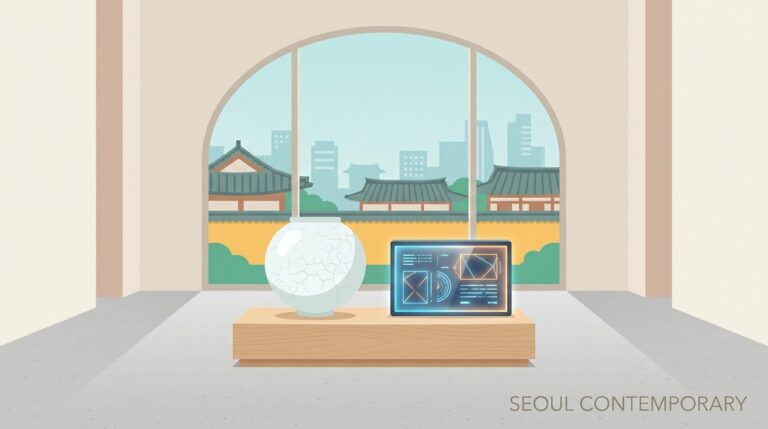
Picture this: You are standing amidst the polished concrete and subdued mood lighting of an elite gallery opening in Hannam-dong during Seoul Art Week. Around you, bespoke-suited gallerists, avant-garde digital creators, and seasoned traditional ink painters are swirling glasses of wine, locked in a fierce, sophisticated debate. Someone whispers, “NFT art has completely dismantled Walter Benjamin’s concept of the ‘aura’,” while another counters that it is nothing more than speculative tech capital dressed in pixelated clothing. You understand the philosophy completely in English, yet as you open your mouth to interject in Korean, you find yourself trapped in elementary textbook phrasing like “이 그림은 비싸고 디지털입니다” (This painting is expensive and digital).
That sudden linguistic disconnect—where your intellect operates at a master’s level while your spoken Korean feels reduced to a tourist guidebook—is the single most frustrating bottleneck for advanced Korean learners. Over the past decade as a cultural navigator, I have mentored countless graduate researchers, art curators, and cultural critics who hit this exact wall. This guide is crafted specifically from their breakthrough moments. By mastering the nuanced vocabulary of aesthetic legitimacy, authenticity, and market disruption, you will command the room at any Korean symposium, gallery salon, or VIP lounge with effortless intellectual grace.
Phase 2: Core Expressions In-Depth Analysis
1. 원본성의 탈구축 (Wonbonseong-ui talguchuk)
- Pronunciation: [Won-bon-seong-ui tal-gu-chuk] (Sound analogy: Think of “won” like won currency, “bon” like bon voyage, and “chuk” crisp like a soft chalk tap)
- Meaning: Deconstruction of original authenticity (Literal: Escape/collapse of originality structure)
- K-Culture Moment: Used by conceptual artists and curators at the Gwangju Biennale or MMCA (National Museum of Modern and Contemporary Art) when defending how blockchain tokens alter the sanctity of the physical masterpiece.
- Editor’s Insight: This phrase moves far beyond simply saying “복제품” (copy/replica). It suggests a deliberate, philosophical dismantling of the idea that an art object must be unique and physical to possess artistic legitimacy.
- Situation Spectrum: Casual 🚫 | Semi-formal ⚠️ | Formal ✅
- 🤔 Think About It: Does digital provenance truly deconstruct originality, or does it merely commodify digital scarcity? How does your native language distinguish between physical “uniqueness” and digital “authenticity”?
2. 투기적 거품인가, 패러다임의 전환인가 (Tugijeok geopuminga, paereodaim-ui jeonhwan-inga)
- Pronunciation: [Tu-gi-jeok geo-pum-in-ga, pae-reo-da-im-ui jeon-hwan-in-ga]
- Meaning: “Is it a speculative bubble, or a paradigm shift?”
- K-Culture Moment: A staple rhetorical question headline across Korean cultural columns, podcast panels, and televised debates on SBS Culture Club when analyzing sudden price spikes in generative art.
- Editor’s Insight: Combining “투기적 거품” (speculative bubble) with “패러다임의 전환” (paradigm shift) instantly establishes balanced, analytical skepticism without sounding outright dismissive or blindly enthusiastic.
- Situation Spectrum: Casual ⚠️ | Semi-formal ✅ | Formal ✅
- 🤔 Think About It: In Korean intellectual discourse, framing arguments through dichotomous balance invites collegial reflection rather than aggressive confrontation. How does this compare to intellectual debates in your home culture?
3. 소장 욕구를 자극하다 (Sojang yokgu-reul jageukhada)
- Pronunciation: [So-jang yok-gu-reul ja-geuk-ha-da]
- Meaning: To stimulate the desire for collection/ownership (Literal: To stimulate collection desire)
- K-Culture Moment: Frequently deployed in interviews by young MZ-generation Korean collectors and high-profile art influencers explaining why owning a digital token feels just as rewarding as hanging an oil painting.
- Editor’s Insight: While “사고 싶다” (I want to buy it) sounds pedestrian, “소장 욕구를 자극하다” elevates purchasing to an aesthetic, psychological urge. “소장” (keeping in one’s personal collection) carries profound cultural prestige.
- Situation Spectrum: Casual ✅ | Semi-formal ✅ | Formal ✅
- 🤔 Think About It: Why does Korean vocabulary elevate “possessing art” into a distinct term like “소장” compared to ordinary consumption verbs?
Phase 3: Textbook Korean vs. Real Korean
Situation 1: Expressing skepticism toward hype around digital assets
- 📖 교과서 한국어: 이 디지털 그림은 너무 비싸고 거품이 있는 것 같아요. (I dijiteol geurimeun neomu bissago geopumi inneun geot gatayo. / “This digital painting is too expensive and seems like a bubble.”)
- 🗣️ 진짜 한국어: 실질적인 미학적 담론보다는 시세 차익을 노린 과열 양상이 두드러지네요. (Siljiljeogin mihakjeok damnonbodaneun sise cha-igeul norin gwayeol yangsangi dudeureojineyo. / “Rather than substantive aesthetic discourse, an overheating trend driven by capital arbitrage is clearly dominant.”)
- 💡 왜 다를까?: Educated Korean speakers avoid simplistic words like “비싸다” (expensive) in professional cultural settings, opting instead for structural critiques such as “과열 양상” (overheating pattern) and “시세 차익” (capital arbitrage).
Situation 2: Acknowledging artistic expansion via new mediums
- 📖 교과서 한국어: NFT는 미술의 새로운 방법입니다. (NFTneun misurui saeroun bangbeop-imnida. / “NFT is a new method of art.”)
- 🗣️ 진짜 한국어: 매체의 물성을 초월해 창작의 외연을 한 단계 확장했다는 점은 고무적입니다. (Maeche-ui mulseong-eul chowolhae changjagui oeyeon-eul han dangye hwakjanghaetdaneun jeomeun gomu-jeogimnida. / “Transcending the physical medium to expand the horizons of creative practice is distinctly encouraging.”)
- 💡 왜 다를까?: High-level Korean aesthetic discourse frequently employs abstract spatial metaphors like “외연을 확장하다” (expand the external horizons) and “물성을 초월하다” (transcend materiality) to demonstrate philosophical depth.
Phase 4: K-Culture Deep Dive & Non-Verbal Manners
4-1. 눈치 (Nunchi) & Non-Verbal Etiquette in Elite Korean Art Spaces
In high-end Korean galleries across Samcheong-dong or Cheongdam-dong, the conversational dynamic is inherently consultative rather than combative. When critiquing a controversial medium like NFT art:
* The Tilt and Cushion: Never flatly declare that digital art lacks value. Begin with a slight head tilt, nod, and deploy a cushioning preface: “물론 작가적 실험 정신은 인정합니다만…” (Of course, I recognize the artist’s experimental spirit, but…).
* Physical Demeanor: Maintain soft eye contact, hold your exhibition booklet with both hands when listening, and gesture toward digital screens using an open palm rather than a pointed index finger.
4-2. Cultural Code: The “Art-Tech (아트테크)” Phenomenon and the MZ Collector Wave
In South Korea, art is no longer confined to cloistered chaebol boardrooms or traditional connoisseurs. Driven by hyper-connected millennials and Gen Z, the “아트테크” (Art-Tech: art + investment technology) wave has turned art fairs into sold-out pop-cultural spectacles. Celebrities like BTS’s RM have openly visited classical modern art retrospectives and avant-garde digital showcases alike, shaping a cultural consensus that appreciating traditional monochrome painting (단색화) and engaging with cutting-edge algorithmic crypto-art are natural facets of modern Korean aesthetic identity.
Phase 5: Real-World Roleplay Scenario
Setting: An intimate VIP reception terrace overlooking Mt. Namsan during an international gallery night in Hannam-dong.
NPC Character: Curator Min-seo Kang (강민서 큐레이터), senior contemporary art curator known for her sharp intellect, welcoming demeanor, and incisive critiques of digital media.
- 강민서: 이번 기획전에서 선보인 제너레이티브 NFT 연작, 어떻게 보셨어요? (Ibeon gihoekjeoneseoseonboin jeneore-itibeu NFT yeonjak, eotteoke bosyeosseoyo? / “How did you view the generative NFT series presented in this special exhibition?”)
- User: 전통적인 회화의 아우라와는 확연히 다른 지점을 건드리고 있더군요. (Jeontongjeogin hoehwa-ui aurawaneun hwagyeonhi dareun jijeomeul geondeurigo itdeogunyo. / “It certainly touches upon an entirely different dimension from traditional painting’s aura.”)
- 강민서: 맞아요. 기술적 신선함에 집중하는 시선도 많지만, 미술관 입장에서는 지속 가능성이 늘 고민이죠. (Majayo. Gisuljeok sinseonhame jipjunghaneun siseondo manjiman, misulgwan ipjang-eseoneun jisok ganeungseong-i neul gomin-ijyo. / “Exactly. While many focus on the technical novelty, from a museum’s perspective, sustainability is an ongoing concern.”)
- User: 🎭 잔을 살짝 기울이며 신중한 어조로 진본성의 증명이라는 기술적 효용이 예술적 내러티브와 얼마나 유기적으로 맞물리는지가 관건 아닐까요? (Jinbonseong-ui jeungmyeong-iraneun gisuljeok hyoyong-i yesuljeok naereotibeowa eolmana yugijeogeuro matmullineunjiga gwangeon anilkkayo? / “🎭 Tilting the glass slightly with a deliberate tone: Isn’t the crux whether the technical utility of proving authenticity interlocks organically with the artistic narrative?”)
- 강민서: 정확한 지적이세요! 투기성 자본의 유입 때문에 작품 고유의 미학적 가치가 종종 가려지곤 하니까요. (Jeonghwakhan jijeogiseyo! Tugiseong jabon-ui yu-ip ttaemune jakpum goyu-ui mihakjeok gachiga jongjong garyeojigon hanikkayo. / “An exact observation! Because the influx of speculative capital often obscures the artwork’s intrinsic aesthetic value.”)
- User: 🎭 공감하듯 고개를 끄덕이며 네, 플랫폼의 유행을 넘어 미술사적 맥락에 편입될 수 있을지는 두고 봐야 할 것 같습니다. (Ne, peullaetpom-ui yuhaeng-eul neomeo misulsajeok maengnage pyeon-ipdoel su isseuljineun dugo bwaya hal geot gatseumnida. / “🎭 Nodding empathetically: Yes, whether it can transcend platform fads and integrate into an art-historical context remains to be seen.”)
- 강민서: 동감합니다. 그런 비판적 시각이야말로 지금의 시장 과열을 건강하게 식혀줄 해독제죠. (Donggamhamnida. Geureon bipanjeok sigag-iyamallo jigeum-ui sijang gwayeor-eul geonganghage sikhyeojul haedokjejyo. / “I wholeheartedly agree. That critical perspective is the very antidote needed to temper current market overheating.”)
- User: 담론이 깊어질수록 디지털 예술의 외연도 더 성숙해지리라 믿습니다. (Damnon-i gipeojilsurok dijiteol yesul-ui oeyeondo deo seongsughaejirira mitseumnida. / “I believe that as discourse deepens, the broader scope of digital art will mature accordingly.”)
🔀 Interactive Choice Point
Curator Min-seo now asks: “그렇다면 직접 디지털 아트워크를 소장해보실 의향도 있으신가요?” (Would you have any intention of personally collecting digital artwork?)
- Option A: “단순한 유행 추종이 아니라, 작가의 철학적 담론이 블록체인 매체와 필연적으로 결합된 작업이라면 충분히 소장 가치가 있다고 봅니다.” (Dansunhan yuhaeng chujong-i anira, jakga-ui cheolhakjeok damnon-i beullokchein maechewa piryeonjeogeuro gyeolhapdoen jag-eob-iramyeon chungbunhi sojang gachiga itdago bomnida.)
- Feedback (Best): Superb C2 performance. Balances discerning critical standards with open-minded collection philosophy.
- Option B: “디지털 파일은 그냥 복사하면 되는데 굳이 돈 주고 살 이유가 없다고 생각해요.” (Dijiteol paireun geunyang boksahamyeon doeneunde guji don jugo sal iyuga eopdago saenggakhaeyo.)
- Feedback (Bad): Overly reductive and dismissal of the entire premise of digital mediums, disrupting collegiate rapport.
- Option C: “코인 가격이 많이 오를 것 같은 유명한 작가 작품이라면 무조건 투자해야죠.” (Koin gagyeogi mani oreul geot gateun yumyeonghan jakga jakpum-iramyeon mujogeon tujahaeyajo.)
- Feedback (Risk): Equates cultural stewardship purely to reckless crypto speculation, undermining your intellectual credibility.
Phase 6: 10-Second Emotional Shadowing Drill
- [🧐 지적이고 신중하게 – Deliberate & Intellectually Discerning]
단순한 기술적 과시인지, / 새로운 미학의 태동인지 / 면밀히 짚어볼 필요가 있습니다.
(Dansunhan gisuljeok gwasisinji, / saeroun mihagui taedong-inji / myeonmilhi jipeobol piryoga itseumnida.)
“Whether it is mere technical bravado / or the dawn of a new aesthetic / demands rigorous scrutiny.” -
[✨ 통찰력 있고 확신에 차서 – Insightful & Confident]
매체의 비물질성이야말로 / 현대 미술이 던지는 / 가장 도발적인 질문 아닐까요?
(Maeche-ui bimuljilseong-iyamallo / hyeondae misuri deonjineun / gajang dobaljeogin jilmun anilkkayo?)
“Isn’t the very immateriality of the medium / the most provocative question / posed by contemporary art?”
Phase 7: K-Culture Mini Dictionary
- 아트테크 (Art-Tech) | Art + FinTech investment | A portmanteau universally used in contemporary Korea to denote strategic art purchasing as both cultural appreciation and portfolio diversification.
- 진본성 (Jinbonseong) | Authenticity / Provenance | The irreproducible, verified origin of a work; a key concept contrasting physical signatures with cryptographically verified smart contracts.
- 물성 (Mulseong) | Physicality / Material properties | An essential critical term in Korean fine arts referring to the tactile weight, texture, and physical presence of physical mediums.
- 담론의 장 (Damnon-ui Jang) | Forum / Arena of Discourse | An intellectual space where critics, artists, and the public exchange high-level theoretical arguments.
Phase 8: Traveler’s Survival Kit
Top 3 Survival Expressions for Art Venues
- 도슨트 투어는 몇 시에 진행되나요? (Doseonteu tueoneun myeot sie jinhaengdoenayo?)
- “What time does the docent tour take place?”
- Pro Tip: Korean major galleries feature exceptionally articulate docents whose vocabulary provides a masterclass in C1-C2 aesthetic analysis.
- 전시 서문을 담은 도록을 구입할 수 있을까요? (Jeonsi seomuneul dameun dorog-eul gu-iphal su isseulkkayo?)
- “Can I purchase an exhibition catalog containing the curatorial preface?”
- Pro Tip: Reading the “전시 서문” (curatorial essay) provides the dense critical syntax Korean academics use.
- 작품의 매체 정보와 캡션을 확인하고 싶습니다. (Jakpum-ui maeche jeongbowa kyaepsyeoneul hwag-inhago sipseumnida.)
- “I would like to check the medium details and caption of the artwork.”
- Pro Tip: Crucial for identifying mixed-media, digital tokens, and provenance details on wall tags.
Editor’s Travel Note
When visiting Seoul’s premier art clusters, navigate efficiently between gallery enclaves by consulting the 네이버 지도 앱 다운로드. For exhibition schedules, curatorial notes, and audio guides across national venues, utilize the 스마트K 국립현대미술관 전시안내 앱. Admission to museum venues accepts Korean transit T-Money cards or global credit cards, but exclusive gallery opening lectures frequently require advance reservations via Naver Booking.
Phase 9: “One Step Deeper” (Reflective Question)
For centuries, traditional Korean aesthetics have been grounded in the philosophy of “여백의 미” (Yeobaek-ui mi)—the profound beauty and resonance found in deliberate emptiness, physical breath, and the natural impermanence of materials. In stark contrast, NFT and blockchain art operates through an indelible, immutable ledger where every pixel, timestamp, and transaction is permanently recorded and hyper-quantified. This juxtaposition raises a fascinating philosophical paradox in modern Korean culture: How does an aesthetic lineage that cherishes transient emptiness harmonize with an immutable digital ledger that never permits an erasure?
💬 Your Turn: Do you believe digital immutability enhances or diminishes the romantic transience of art? Drop your thoughts below in advanced Korean!
Phase 10: FAQ & Common Mistakes
Q: Can I use the term “코인 아트” (Coin art) in professional Korean gallery settings?
A: Avoid it. While understandable in colloquial crypto communities, professional Korean curators and critics consider “코인 아트” colloquial and intellectually reductive. Use “NFT 기반 디지털 아트” (NFT-based digital art) or “블록체인 매체 예술” (blockchain media art).
Q: How do I disagree politely with a Korean curator’s interpretation?
A: Always deploy the concessive frame: “선생님의 시각도 매우 흥미롭습니다만, 다른 한편으로는…” (Your perspective is also very intriguing, but from another perspective…). In Korean intellectual settings, overt confrontation shuts down dialogue; contextual layering expands it.
Q: What is the exact distinction between “소장” and “구매”?
A: “구매” is the commercial act of purchasing anything from milk to canvas. “소장” signifies cultural stewardship, collection conservation, and long-term appreciation. Always refer to acquiring fine artworks as “소장”.
🚨 Common Mistakes Alert
- Mistake: Using “진짜 그림” (real painting) vs “가짜 그림” (fake painting) when contrasting traditional and digital works.
- Correct Action: Use “실물 회화” (physical painting) versus “디지털/가상 매체” (digital/virtual medium).
- Mistake: Overusing “비싸다” (expensive) when discussing market valuations.
- Correct Action: Substitute with “높은 가치 평가를 받다” (receive a high valuation) or “시세가 급등하다” (market prices surge).
- Mistake: Pronouncing NFT as separate Korean letters (엔-에프-티) too fast without natural intonation.
- Correct Action: Blend the phonetics crisply: [엔에프티], placing light stress on the first syllable.
Phase 11: Action Missions
- 🥉 Bronze Mission (Solo Practice): Read an exhibition statement on a Korean digital art portal out loud, recording yourself using the Phase 6 Shadowing Drill.
- 🥈 Silver Mission (Social Share): Post a photo of your favorite digital or traditional artwork on Instagram or Threads and write a two-sentence critique in Korean using “미학적 담론” and “소장 욕구”.
- 🥇 Gold Mission (Real-World Execution): Attend a contemporary gallery or university exhibition in person (or join a Korean Twitter Space / Clubhouse art room) and ask one analytical question using “패러다임의 전환”.
🎮 K-Culture Mission: Watch an interview of a Korean contemporary artist on YouTube (such as channels by MMCA or Art in Culture) and note down three instances where they describe their medium’s “물성” (physicality).
Phase 12: Interactive Quiz Challenge
- Situational Judgment: Which response best reflects a C2-level critique of an overhyped NFT release?
- (A) 가격이 너무 비싸서 아무도 못 사요.
- (B) 내재적 예술성보다는 단기적 차익 실현에 초점이 맞춰져 있어 우려스럽습니다.
- (C) 컴퓨터 파일이라서 진짜 미술품이라고 볼 수 없어요.
- Fill in the Blank: “기술의 발전을 통해 창작의 (_____)을 넓힌 것은 사실입니다.”
- (A) 물건 | (B) 외연 | (C) 영수증
- Cultural True/False: In Korean art discourse, “소장 (Sojang)” refers solely to the retail purchase of an item for immediate resale.
- (True / False)
👉 Click to reveal answers & explanations
- Answer: (B)
- Explanation: Choice (B) elegantly identifies “내재적 예술성” (intrinsic artistic merit) versus “단기적 차익 실현” (short-term profit-taking), embodying refined critical syntax. (A) and (C) are rudimentary and culturally blunt.
- Answer: (B) 외연 (Oeyeon)
- Explanation: “외연을 넓히다/확장하다” is an idiomatic intellectual colocation meaning to expand the scope or conceptual boundary of a domain.
- Answer: False
- Explanation: “소장” embodies cultural stewardship and personal curatorial keeping, distinctly distinguished from transactional flipping or ordinary retail buying.
- Explanation: “소장” embodies cultural stewardship and personal curatorial keeping, distinctly distinguished from transactional flipping or ordinary retail buying.
With these master-level expressions and critical lenses, you are ready to engage in Seoul’s most intellectually vibrant art discussions. Keep cultivating your linguistic artform—매일한글이 언제나 응원합니다!”}






