

Phase 1: Empathy (Field Immersion & Opening)
안녕하세요! 매일한글 에디터입니다. (Hello! This is your Daily Hangul editor.)
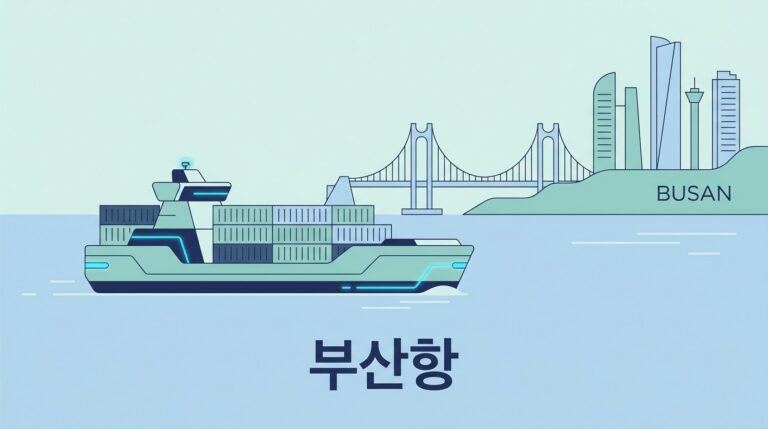
Picture this: You are standing on the wind-swept observation deck of the Busan Port Operations Center, gazing at a dock loaded with automated straddle carriers and towering container cranes. Next to you are senior marine architects from HD Hyundai and Hanwha Ocean, along with high-ranking port authority directors. They are passionately debating real-time obstacle avoidance, fleet decarbonization, and the integration of Maritime Autonomous Surface Ships (자율운항선박 – MASS). You have years of systems engineering expertise and you understand the technical schematics inside out. But when the discussion shifts to regional safety regulatory sandboxes, port clearance protocols, and fleet orchestration algorithms, you suddenly freeze.
Standard textbook Korean prepared you to order cold iced Americanos or ask where the subway station is, but it leaves you stranded when you need to articulate high-stakes technical visions like algorithmic fail-safes or digital twin integration in Korea’s world-leading maritime infrastructure. In Korean corporate and engineering environments, speaking about deep-tech disruption requires a subtle blend of hyper-specialized technical jargon, assertive strategic phrasing, and deep institutional deference.
This guide was forged through direct consultations with bilingual maritime systems researchers and international logistics directors navigating Korea’s massive shipbuilding hubs in Geoje, Ulsan, and Busan. Mastering these advanced C2 expressions will transform you from a technically competent foreign observer into an indispensable, culturally attuned engineering collaborator who commands absolute respect in the boardroom and the dry docks.
Phase 2: Core Expressions Deep Dive
Here are three high-caliber C2 expressions indispensable for high-level maritime and logistics discussions.
1. 선대 운용의 패러다임 전환을 견인하다
- Pronunciation: [Seondae un-yong-ui paereodaim jeonhwan-eul gyeon-in-hada] (Sound metaphor: Imagine saying ‘sundae’ like the Korean dish, followed by ‘un-yong-ui’, then the English loanword ‘paradigm’, and finally ‘gyun-in’ like ‘towing a car’ followed by ‘hada’.)
- Meaning: Literally “To tow/spearhead the paradigm shift of fleet operation”; Nuance: To drive a fundamental, revolutionary transformation in how global maritime vessel fleets are managed and routed.
- K-Culture Moment: Frequently heard in corporate executive boardrooms in dramas like Search: WWW or Misaeng when ambitious directors present transformative tech strategies that overhaul legacy systems.
- Editor’s Insight: The verb 견인하다 (gyeon-in-hada) literally refers to towing a vehicle, but in strategic corporate and engineering Korean, it means “to pull/propel forward as the primary locomotive engine.” Using this instead of the elementary 이끌다 (ik-keul-da) immediately signals executive-level eloquence.
- Situation Spectrum:
- Casual (사석): 🚫
- Semi-formal (팀 회의): ⚠️
- Formal (이사회 / 기술 심포지엄): ✅
- 🤔 Think About It: Why does Korean strategic discourse prefer mechanical and infrastructural metaphors like “towing” (견인) rather than individualistic leadership verbs when describing technological change?
2. 규제 샌드박스를 통한 실증 단계에 착수하다
- Pronunciation: [Gyu-je saendeu-bakseu-reul tong-han siljeung dangye-e chaksu-hada] (Sound metaphor: ‘Gyu-je’ sounds like ‘cue-jay’, ‘saendeu-bakseu’ is the phonetic loanword for sandbox, and ‘chaksu’ sounds like a sharp chop ‘chuck-soo’.)
- Meaning: Literally “To launch the empirical validation phase via a regulatory sandbox”; Nuance: To enter formal, authorized real-world pilot testing while operating under temporary legal exemptions.
- K-Culture Moment: In legal-business thrillers like Vincenzo or tech startups in Start-Up, where tech developers scramble to bypass stifling bureaucratic red tape to prove their cutting-edge prototype works.
- Editor’s Insight: 실증 (siljeung) is far more rigorous than simple 테스트 (test) or 실험 (experiment). It implies empirical, legally binding proof-of-concept testing in an operational maritime environment.
- Situation Spectrum:
- Casual: 🚫
- Semi-formal: ⚠️
- Formal: ✅
- 🤔 Think About It: In many Western business environments, engineers talk about “breaking rules and asking forgiveness”; in Korea, why is explicit reference to state-sanctioned mechanisms like “규제 샌드박스” critical for institutional buy-in?
3. 해운 물류 밸류체인의 무인화 거버넌스를 구축하다
- Pronunciation: [Hae-un mullyu baellyuchein-ui mu-inhwa geobeoneonseu-reul guchuk-hada] (Sound metaphor: ‘Hae-un’ rhymes with ‘day-sun’, ‘mullyu’ flows like ‘mool-yoo’, and ‘mu-in-hwa’ sounds like ‘moo-in-hwa’.)
- Meaning: Literally “To construct unmanned governance for the maritime logistics value chain”; Nuance: To establish comprehensive operational frameworks, safety controls, and institutional oversight for fully autonomous, crewless supply chain cycles.
- K-Culture Moment: Evokes the tech conferences seen in science fiction or high-stakes corporate power struggles where industrial titans build next-generation smart-city infrastructure.
- Editor’s Insight: Notice the pairing of 무인화 (unmanned automation) with 거버넌스 (governance). In C2-level engineering discourse, innovation is never just about code; it is about establishing systemized governance (책임성과 통제 체계).
- Situation Spectrum:
- Casual: 🚫
- Semi-formal: ⚠️
- Formal: ✅
- 🤔 Think About It: How does incorporating abstract loanwords like ‘거버넌스’ (governance) alongside Sino-Korean roots (무인화, 구축) reflect modern Korean industrial policy?
Phase 3: Textbook Korean vs Real Korean
Let’s analyze how standard textbook sentences fall short when discussing autonomous vessels, and what high-level professionals actually say.
Situation 1: Explaining collision avoidance algorithms during a sea trial
- 📖 교과서 한국어:
배에 있는 센서가 다른 장애물을 피해서 배를 혼자 운전합니다.
(Bae-e inneun senseo-ga dareun jang-ae-mul-eul pihaeseo bae-reul honja unjeon-hamnida.)
“The sensors on the boat avoid other obstacles and drive the boat by itself.” - 🗣️ 진짜 한국어 (C2 Level):
딥러닝 기반의 라이다와 레이더 센서 융합 모듈이 해상 장애물을 식별하여 충돌 회피 궤적을 능동적으로 생성합니다.
(Dimneon-ing giban-ui ra-ida-wa re-ideo senseo yunghap modyul-i haesang jang-ae-mul-eul sikbyeol-hayeo chungdol hoepi gwejeog-eul neungdongjeog-euro saengseong-hamnida.)
“The deep-learning-based LiDAR and radar sensor fusion module identifies maritime obstacles and actively generates collision-avoidance trajectories.” - 💡 왜 다를까? (Cultural & Linguistic Context):
Textbook Korean relies on colloquial verbs like “피하다” and “운전하다”, which make high-level autonomy sound like a remote-controlled toy. Professional Korean engineers use precise Sino-Korean engineering compounds (센서 융합, 식별, 능동적 궤적 생성) to communicate technical precision and reliability.
Situation 2: Discussing terminal turnaround efficiency and demurrage reduction
- 📖 교과서 한국어:
스마트 항만을 쓰면 배가 기다리는 시간이 줄어서 돈을 아낄 수 있어요.
(Seumateu hangman-eul sseumyeon bae-ga gidarineun sigan-i jureoseo don-eul akkil su isseoyo.)
“If we use smart ports, the waiting time for ships decreases so we can save money.” - 🗣️ 진짜 한국어 (C2 Level):
자율운항선박과 스마트 항만 터미널의 실시간 인터페이스 연동을 통해 선박 체선율을 획기적으로 감축시키고 물류 순환주기를 최적화할 수 있습니다.
(Jayul-unhang-seonbak-gwa seumateu hangman teomineol-ui silsigan inteope-iseu yeondong-eul tonghae seonbak cheseon-yul-eul hoekgijeog-euro gamchuk-sikigo mullyu sunhwan-jugi-reul choejeog-hwa-hal su itsseumnida.)
“Through real-time interface interlinking between autonomous vessels and smart port terminals, we can drastically reduce ship demurrage rates and optimize supply chain turnaround cycles.” - 💡 왜 다를까? (Cultural & Linguistic Context):
In senior industrial contexts, vague expressions like “돈을 아끼다” (save money) are replaced by exact financial and supply chain terminology like 체선율 감축 (demurrage reduction) and 물류 순환주기 최적화 (turnaround optimization).
Phase 4: K-Culture Deep Dive & Non-Verbal Manners
4-1. Nunchi (눈치) & Gestures in Maritime Boardrooms
Korean shipbuilding and shipping logistics are rooted in decades of heavy industrial hierarchy, where veteran shipyard executives (often former captains or master shipwrights) balance traditional maritime authority with cutting-edge software development.
* The Modest Confirmation (낮은 끄덕임): When senior naval architects or ministry directors point out potential blind spots in maritime AI testing, never dismiss them abruptly. Incline your head slightly downward, maintain steady eye contact for 2 seconds, and begin with:
“위원장님께서 우려하시는 안전 마진의 불확실성에 전적으로 공감하며…” (Wi-won-jang-nim-kkeseo u-ryeo-hasineun anjeon majin-ui bul-hwak-sil-seong-e jeon-jeog-euro gong-gam-ha-myeo… / “I completely empathize with the uncertainty regarding safety margins raised by the Committee Chair…”).
* Two-Handed Document Presentation (양손 전달): When passing system architecture diagrams or pilot telemetry data tablets to senior stakeholders, hold the device with both hands, elbows tucked close to your torso. It demonstrates procedural reverence in an industry where human safety at sea has historically depended on rigorous discipline.
4-2. Cultural Code: The Maritime Legacy of Busan and Ulsan
In Korean pop culture, port cities like Busan and Ulsan are often depicted through gritty, noir-style loyalty and sweat (seen in movies like Ode to My Father or Nameless Gangster). But underneath that cinematic grit lies the beating heart of Korea’s economic miracle: the shipyards that built the world’s biggest container ships. When discussing autonomous navigation, show genuine respect for this legacy. Acknowledge that the transition to unmanned vessels (무인 선박) is not about displacing seasoned Korean sailors and dockworkers, but about honoring and scaling their maritime prowess globally through advanced automation.
Phase 5: Real-World Roleplay Scenario
Setting: A glass-walled executive conference room overlooking Busan Port Terminal 7. Chief Systems Architect Alex (You) is meeting with Managing Director Park (박 전무), a veteran maritime executive at a major Korean logistics consortium.
Characters:
* 박 전무 (Executive Director Park): 30-year maritime industry veteran; cautious about AI safety liabilities, yet eager to beat European competitors in autonomous shipping.
* 알렉스 (Alex – You): Lead autonomous systems integration engineer presenting Phase 3 sea trials.
Dialogue:
- 박 전무: 알렉스 수석, 이번 동해안 실증 항로에서 완전 자율운항 모드의 알고리즘 신뢰도는 충분히 검증된 겁니까?
(Alex suseok, ibeon dong-hae-an siljeung hangno-eseo wanjeon jayul-unhang modeu-ui algo-rijeum sin-roe-do-neun chungbun-hi geomjeung-doen geomnikka?)
“Lead Architect Alex, has the algorithmic reliability of the fully autonomous mode been sufficiently verified on this East Sea empirical validation route?”
🎭 서류철을 검토하며 안경 너머로 날카로운 시선을 던진다. (Flips through documents, glancing sharply over his glasses.) -
알렉스: 네, 전무님. 기상 악화 시나리오를 포함한 1,200시간의 연속 운항 데이터를 통해 충돌 회피 알고리즘의 안전 마진을 입증했습니다.
(Ne, jeon-mu-nim. Gisang ak-hwa sinario-reul poham-han cheon-i-baek-sigan-ui yeonsok unhang de-iteo-reul tonghae chungdol hoepi algo-rijeum-ui anjeon majin-eul ipjeung-haetsseumnida.)
“Yes, Executive Director Park. Through 1,200 continuous hours of operational data including severe weather scenarios, we verified the safety margin of the collision-avoidance algorithm.”
🎭 태블릿의 텔레메트리 그래프를 정중히 가리키며. (Respectfully points to telemetry charts on the tablet.) -
박 전무: 하지만 협수로 통항이나 야간 안개 상황에서 육상 관제 센터(ROC)와의 지연 시간 문제는 어떻게 해결했지요?
(Hajiman hyeop-suro tong-hang-ina ya-gan an-gae sang-hwang-eseo yuk-sang gwan-je senteo-wa-ui jiyeon sigan munje-neun eotteoke hae-gyeol-haet-jiyo?)
“However, how did you resolve the latency issue with the Remote Operations Center (ROC) during narrow channel passages or nighttime fog?”
🎭 손깍지를 끼고 책상에 팔을 올리며 미간을 찌푸린다. (Interlocks his fingers, leaning forward on the desk with a furrowed brow.) -
알렉스: 위성 통신 음영 구역에 대비하여 선박 자체 에지 컴퓨팅 기반의 독립 의사결정 서브루틴을 탑재하여 5G 통신 지연을 극복했습니다.
(Wi-seong tong-sin eum-yeong gu-yeog-e daebi-hayeo seonbak jache e-ji keom-pyuting giban-ui dongnip uisa-gyeoljeong seobeu-rutin-eul tapjae-hayeo o-ji tongsin jiyeon-eul geukbok-haetsseumnida.)
“To prepare for satellite dead zones, we mounted an autonomous decision-making subroutine based on onboard edge computing to overcome 5G communication latency.”
🎭 차분하고 확신에 찬 목소리로 고개를 끄덕인다. (Nods with a calm, assured tone of voice.) -
박 전무: 흥미롭군요. 다만 해양수산부의 임시 항해 허가 기준과 선원법 관련 법적 쟁점은 여전히 남아있지 않습니까?
(Heungmi-rop-gunyo. Daman haeyang-susan-bu-ui imsi hanghae heoga gijun-gwa seon-won-beop gwanryeon beopjeok jaengjeom-eun yeojeon-hi nam-a-itji anseumnikka?)
“Intriguing. But aren’t there still legal contentions regarding temporary navigation permits from the Ministry of Oceans and Fisheries and the Seafarers’ Act?”
🎭 볼펜 끝으로 탁자를 가볍게 톡톡 두드린다. (Taps his pen lightly against the table.) -
알렉스: 맞습니다. 그래서 저희는 규제 샌드박스 패스트트랙을 신청하여 스마트 항만 도선 구역에 대한 예외 적용을 이미 타진 중입니다.
(Matseumnida. Geuraeseo jeo-hi-neun gyu-je saendeu-bakseu paeseuteu-traek-eul sincheong-hayeo seumateu hangman doseon gu-yeog-e daehan ye-oe jeogyong-eul imi tajin jung-imnida.)
“Precisely. That is why we applied for the regulatory sandbox fast-track and are already exploring exemptions for smart port pilotage zones.”
🎭 양손으로 법률 검토 보고서를 전무 쪽으로 돌려놓는다. (Turns the legal analysis dossier toward Director Park with both hands.) -
박 전무: 추진력이 대단하네요. 만약 실증이 성공하면 기존 컨테이너 선대의 벙커유 비용과 탄소 배출도 대폭 줄일 수 있겠어요.
(Chujin-ryeog-i daedan-ha-neyo. Manyak siljeung-i seong-gong-ha-myeon gijon keonte-ineo seondae-ui beongkeo-yu biyong-gwa tanso baechul-do daepok juril su itkkesseoyo.)
“Impressive drive. If this field test succeeds, we can drastically cut fuel costs and carbon emissions for our existing container fleet.”
🎭 흡족한 표정으로 옅은 미소를 짓는다. (Smiles faintly with a satisfied expression.) -
알렉스: 네, 친환경 해운 물류 밸류체인의 혁신을 선도할 수 있도록 끝까지 만전을 기하겠습니다.
(Ne, chin-hwan-gyeong hae-un mullyu baellyuchein-ui hyeoksin-eul seondo-hal su itdorok kkeutkkaji manjeon-eul gihagessseumnida.)
“Yes, we will do our utmost until the very end so that we can spearhead innovation across the eco-friendly maritime logistics value chain.”
🎭 상체를 15도 숙이며 정중한 결의를 표한다. (Bows torso 15 degrees, displaying respectful resolve.)
🔀 Interactive Branching Point
Imagine Director Park suddenly asks: “What happens if our competitors in Japan or Norway initiate mass production of 4,000 TEU autonomous feeders first? How should we respond?”
- Option A: “그쪽보다 우리가 AI 소프트웨어는 훨씬 잘 만드니까 별로 걱정 안 하셔도 됩니다.”
(Feedback: 🚨 Bad. Overly colloquial, dismissive of global competitors, and completely lacks empirical strategic basis. Makes you sound reckless.) - Option B: “경쟁국의 개발 속도에 연연하기보다는, 국내 규제 샌드박스 데이터를 기반으로 아시아-태평양 항로 표준 특허를 선점하여 기술 종속을 방어해야 합니다.”
(Feedback: 🌟 Best! Pragmatic, highly articulate C2 framing. Highlights standard patent preemption [표준 특허 선점] and prevents technological dependency [기술 종속 방어].) - Option C: “선주들이 원하면 우리도 당장 건조 일정을 앞당겨서 무조건 먼저 출시하겠다고 보고하겠습니다.”
(Feedback: ⚠️ Risk. Shows drive, but disregards international maritime safety verification [IMO regulations] and exposes the organization to massive maritime liability risks.)
Phase 6: 10-Second Emotional Shadowing Drill
Practice these lines using the emotional cues and pause markers (/) to build native executive cadence.
- Drill 1 [💼 차분하고 신뢰감 넘치게 / Confident & Authoritative]:
선박 자체 에지 컴퓨팅 모듈이 / 해상 장애물을 능동적으로 식별하여 / 충돌 위험을 원천 차단합니다.
(Seonbak jache e-ji keompyuting modyul-i / haesang jang-ae-mul-eul neungdongjeog-euro sikbyeol-hayeo / chungdol wiheom-eul woncheon chadan-hamnida.) - Drill 2 [🤝 공감하며 정중하게 설득하듯 / Empathetic & Respectfully Persuasive]:
현장 도선사 분들의 우려를 깊이 이해하며, / 시스템 이중화를 통해 / 페일세이프(Fail-Safe) 체계를 완벽히 구축하겠습니다.
(Hyeonjang doseonsa-bundeul-ui u-ryeo-reul gipi ihae-hamyeo, / siseutem i-junghwa-reul tonghae / pe-il-se-ipeu chegye-reul wanbyeok-hi guchuk-hagessseumnida.) - Drill 3 [🔥 담대하고 미래지향적으로 / Bold & Visionary]:
이번 해운 물류의 디지털 전환은 / 단순한 자동화를 넘어 / 글로벌 해상 공급망의 패러다임을 바꿀 것입니다.
(Ibeon hae-un mullyu-ui dijiteol jeonhwan-eun / dansun-han jadonghwa-reul neomeo / geullobeol haesang gong-geup-mang-ui paereodaim-eul bakkgul geosimnida.)
Phase 7: K-Culture Mini Dictionary
- 자율운항선박 (Jayul-unhang-seonbak) | Maritime Autonomous Surface Ships (MASS)
- Advanced vessels equipped with AI, IoT sensors, and autonomous decision-making software that navigate with minimal or zero onboard crew. Frequently shortened to ‘자율선박’ in engineering briefings.
- 스마트 항만 (Seumateu hangman) | Smart Port
- High-tech harbor hubs like Busan Newport that integrate automated cranes, digital twin logistics, and AI berth planning to minimize cargo turnaround friction.
- 디지털 트윈 (Dijiteol teuwin) | Digital Twin
- A virtual replica of physical ships or logistics terminals used in real-time simulation, predictive maintenance, and stress testing across Korean smart manufacturing.
- 체선율 (Cheseon-yul) | Demurrage / Port Congestion Rate
- The proportion of vessels forced to wait at sea anchorages due to congested berths. Slashing this rate is the prime commercial metric for Korean maritime logistics software.
Phase 8: Field Survival Kit for Engineers & Researchers
Top 3 Field Expressions
- 원격 제어 시스템의 통신 지연율(레이턴시)을 점검해 주십시오.
(Won-gyeok je-eo siseutem-ui tongsin jiyeon-yul-eul jeomgeom-hae jusipsio.)
“Please inspect the communication latency of the remote control system.”
💡 Pro Tip: Essential when running dry-run diagnostics between Busan Shore Operations Centers and test vessels. - 도선 구역 진입 전 수동 조타 모드로 즉시 절체 가능합니까?
(Doseon gu-yeok jin-ip jeon sudong jota modeu-ro jeuksi jeolche ganeung-hamnikka?)
“Can we immediately switch over to manual steering mode before entering the pilotage zone?”
💡 Pro Tip: ‘절체 (jeolche)’ is the specialized engineering term for switching electrical or operational controls; using it proves technical mastery. - 선급 협회(KR)의 안전 인증 심사 요건을 충족했습니다.
(Seon-geup hyeop-hoe-ui anjeon injeung simsa yo-geon-eul chungjok-haetsseumnida.)
“We have satisfied the safety certification audit requirements of the Korean Register (KR).”
💡 Pro Tip: ‘KR’ (한국선급) is Korea’s premier classification society; referencing their audits builds instant institutional credibility.
Editor’s Travel & Fieldwork Note
When conducting on-site engineering trials at the port of Busan or visiting research dockyards in Ulsan, standard transit apps can leave you confused at industrial gates. For real-time harbor traffic, gate pass approvals, and container barge tracking, download the 부산항만공사 실시간 물류정보 앱 다운로드 (BPA-NET) before your field visit. Furthermore, when entering shipyard facilities like HD Hyundai Heavy Industries, foreign nationals must present pre-approved access documentation alongside a physical passport. Always carry your company accreditation and arrive 30 minutes early to clear physical security protocols.
Phase 9: A Step Deeper (한 발 더 깊이)
In Korean corporate philosophy, breakthrough technology is rarely framed as a tool for disruptive chaos or creative destruction. Instead, it is conceptualized as an act of national infrastructural fortification (국가 기간산업의 고도화). In maritime engineering, where centuries of Confucian camaraderie, seafarer sacrifice, and collective loyalty underpin company cultures, an algorithm is not celebrated merely for being computationally clever. It is respected when it preserves human life at sea, enhances collective economic security, and harmonizes with the dedicated human workforce. Understanding this cultural commitment to collective preservation will help you advocate for autonomous systems not as a threat to tradition, but as its ultimate protective evolution.
💬 Your Turn: How does your home country’s maritime or logistics sector view the shift toward automation? Is it treated primarily as a cost-cutting venture, or as an infrastructural overhaul? Share your thoughts in the comments below!
Phase 10: FAQ & Avoiding Misunderstandings
Q: Can I use the term ‘무인선’ (unmanned ship) interchangeably with ‘자율운항선박’ in official meetings?
A: While understood colloquially, avoid using ‘무인선’ in formal strategy sessions or grant presentations. ‘무인선’ (Mu-in-seon) strictly means a completely unmanned boat (often associated with naval drone boats). ‘자율운항선박’ (MASS) is the legally precise technical term defined by the International Maritime Organization (IMO) and the Korean Ministry of Oceans and Fisheries, accommodating various operational stages from crew-assisted autonomy to fully unmanned operations.
Q: Why do Korean shipbuilders emphasize ‘친환경’ (eco-friendly) alongside ‘자율운항’ (autonomous)?
A: Because in Korean national policy, autonomous navigation and green propulsion (ammonia, methanol, LNG, hydrogen fuel cells) are fused together under the umbrella strategy known as 스마트 친환경 선박 (Smart Eco-Friendly Vessels). Positioning your technology alongside decarbonization metrics guarantees much higher institutional synergy and research subsidy alignment.
Q: When addressing a dockmaster or shipyard head, what title should I use?
A: Never address them with casual occupational suffixes like “기사님” or “선장님” unless specifically appropriate. Address shipyard division heads as 전무님 (Executive Director), 상무님 (Managing Director), or 소장님 (Dockyard/Center Director). If they hold a professional doctorate in engineering, 박사님 (Doctor) is deeply respectful.
🚨 Common Mistakes Alert
- Mistake: Calling smart ports “인터넷 항구” (Internet port).
- Correct Action: Use 스마트 항만 (Smart port) or 지능형 물류 터미널 (Intelligent logistics terminal).
- Mistake: Translating ‘fail-safe’ literally as “실패 안전” (Silpae anjeon).
- Correct Action: Use the standard Korean engineering loanword 페일세이프 or the technical phrase 고장 안전 설계.
- Mistake: Using “빨리 만들다” when describing rapid prototyping.
- Correct Action: Use high-register terms like 신속한 프로토타이핑 or 개발 주기 단축 (shortening the development cycle).
Phase 11: Action Missions
- 🥉 Bronze Mission (Solo Practice): Read Drill 1 from Phase 6 aloud five times using a stopwatch. Practice articulating the technical phrase “에지 컴퓨팅 기반의 독립 의사결정” smoothly in under 3 seconds without stumbling.
- 🥈 Silver Mission (Community Engagement): Leave a comment below introducing your current engineering focus or favorite maritime technology in Korean using the expression ~의 패러다임 전환을 견인하다.
- 🥇 Gold Mission (Real-world Execution): In your next technical sync or email exchange with Korean engineering counterparts, replace generic words like “테스트” and “검토” with 실증 단계 착수 (embarking on empirical validation) and 다각적 타진 (multilateral exploration).
- 🎮 K-Culture Mission: Watch a documentary or news report on Korea’s 부산항 신항 완전 무인 자동화 부두 (Busan Port New Port Fully Automated Terminal) on YouTube. Identify three technical vocabulary terms used by the engineers on site and write them down!
Phase 12: Interactive Quiz Challenge
Test your mastery of Korean maritime engineering discourse! Click each toggle to reveal the correct answer and detailed explanation.
Quiz 1: Situational Vocabulary
Which phrase is most appropriate for a formal technical proposal describing how AI eliminates vessel collision dangers during heavy fog?
* A) 안개 낄 때 배가 알아서 도망가도록 코딩했습니다.
* B) 농무 상황 시 레이더-라이다 센서 융합을 통한 충돌 회피 알고리즘을 능동적으로 가동합니다.
* C) 센서들이 열심히 작동해서 배가 안 부딪히게 도와줄 것입니다.
🔍 Click for Answer & Analysis
Correct Answer: B
Explanation: Option B uses high-register nautical and engineering compounds: 농무 상황 (dense fog conditions), 센서 융합 (sensor fusion), and 능동적 가동 (active operation). Options A and C contain informal and childish phrasings (“도망가도록”, “열심히 작동해서”) that undermine technical credibility.
Quiz 2: Blank Filling Challenge
Fill in the blank with the appropriate executive-level verb form:
정부의 스마트 해운 정책에 발맞추어, 우리는 차세대 자율운항 선대 운용의 패러다임 전환을 (_______) 계획입니다.
🔍 Click for Answer & Analysis
Correct Answer: 견인할 (gyeon-in-hal)
Explanation: The complete phrase is 패러다임 전환을 견인하다 (to spearhead/drive a paradigm shift). Before the noun ‘계획’ (plan), the future adnominal form is 견인할.
Quiz 3: Cultural Etiquette (True or False)
In Korean shipbuilding executive meetings, introducing radical autonomous technologies by pointing out that traditional captains and dockmasters are inefficient and prone to human error is considered an effective, modern communication tactic.
🔍 Click for Answer & Analysis
Correct Answer: False (F)
Explanation: Bluntly criticizing human professionals disregards the deep-seated respect for maritime experience in Korean dockyards. Seasoned communicators always frame automation as an advanced safety cushion (선원 및 도선사의 안전을 지원하는 이중화 체계) that supports and elevates human expertise rather than degrading it.







