

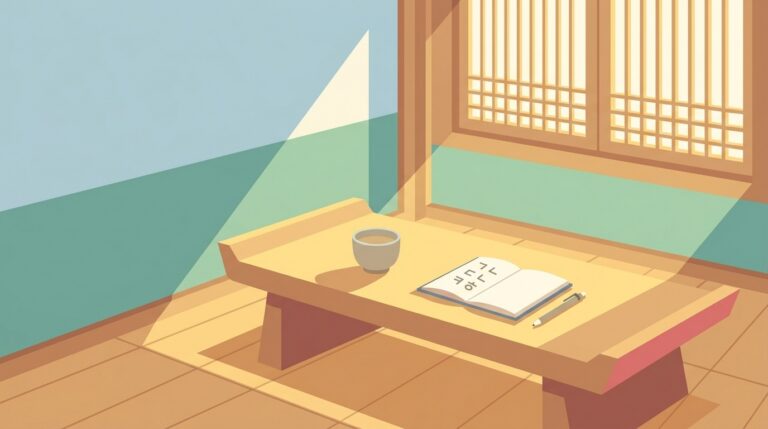
The Art of Living Lightly: Valuing Experiences Over Possessions in Korea
Phase 1: Empathy (Immersion Opening)
안녕하세요! 매일한글 에디터입니다.
Imagine standing in the middle of a trendy pop-up store in Seongsu-dong or strolling along the glittery boulevards of Gangnam. Everywhere you turn, you are greeted by dazzling limited-edition merchandise, designer collabs, and shoppers lining up for the latest must-have “it-items.” In high-density, hyper-trend-driven Korea, consumer culture moves at breakneck speed. Yet, look a little closer at the real lifestyle shift happening among Koreans today: an increasing number of people are ditching cramped apartments filled with impulse buys to seek out “비움의 미학” (the aesthetics of emptying out) and quiet weekend temple stays in Gangwon-do.
Many advanced Korean learners tell me: “Editor, I know how to order food or rent an apartment, but when my Korean friends passionately debate minimalism, buying an expensive luxury bag versus going on a solo sabbatical to Jeju Island, I freeze. I sound like a dull academic text!” That stops today. Drawing from hundreds of hours of conversation coaching with C1-level professionals in Seoul, this guide will equip you with sophisticated, organic expressions that articulate the philosophy of experiential minimalism with razor-sharp cultural wit.
Phase 2: Core Expressions Deep Dive
1. 물건보다 추억을 남기는 게 남는 장사죠. (Mulgeonboda chueog-eul namgineun ge namneun jangsajyo.)
- Pronunciation: [Mul-geon-bo-da chu-eo-geul nam-gi-neun ge nam-neun jang-sa-jyo] (Think of ‘jangsa’ ringing like an antique cash register: cha-ching, but for your soul!)
- Meaning: Literal: “Leaving behind memories rather than objects is a profitable business.” | Real Nuance: “Investing in memories over physical clutter is what truly pays dividends in life.”
- K-Culture Moment: Heard in healing variety shows like Three Meals a Day or Hyori’s Homestay, when hosts reflect over evening tea about why they chose a slow, grounded life over commercial luxury.
- Editor’s Insight: The word 장사 (business/trade) combined with 남는 (leaving a profit) is a beloved native idiom. Using commerce-related terminology to validate an emotional or spiritual truth adds grounded, seasoned Korean charm to your speech.
- Situation Spectrum: Casual ✅ | Semi-formal ✅ | Formal ⚠️
- 🤔 Think About It: In Korean culture, which historically weathered rapid post-war industrialization, why do you think business metaphors like ‘남는 장사’ (profitable trade) are so fondly used to express deep philosophical contentment?
2. 비우는 삶에서 오는 여유가 있어요. (Biuneun salm-eseo oneun yeoyuga isseoyo.)
- Pronunciation: [Bi-u-neun sal-me-seo o-neun yeo-yu-ga i-sseo-yo] (Pronounce ‘bi-u-da’ smoothly like exhaling a long, calming sigh of relief.)
- Meaning: Literal: “There is leisure/room that comes from a life of emptying.” | Real Nuance: “There is an unhurried mental clarity and peace that only an uncluttered lifestyle can give you.”
- K-Culture Moment: A calm lifestyle creator on YouTube giving a tour of their sunlit, furniture-free Hanok studio apartment, explaining why they got rid of their massive TV.
- Editor’s Insight: 여유 (yeoyu) is untranslatable into a single English word; it encompasses spare time, composure, emotional space, and financial buffer all at once. Pairing it with 비우다 (to empty out) marks your fluency as truly reflective and adult.
- Situation Spectrum: Casual ✅ | Semi-formal ✅ | Formal ✅
- 🤔 Think About It: Western minimalism often focuses on functional efficiency (e.g., capsule wardrobes), while Korean ‘비움’ stems from Buddhist and Zen aesthetics of void and breathing room. How does this shift your perception?
3. 소장 욕심은 내려놓고 온전히 경험하려고요. (Sojang yoksim-eun naeryeonoko onjeonhi gyeongheomhallyeogoyo.)
- Pronunciation: [So-jang yok-si-meun nae-ryeo-no-ko on-jeon-hi gyeong-heom-hal-lyeo-go-yo] (‘Naeryeonoko’ feels like gently sliding a 20kg hiking backpack off your exhausted shoulders.)
- Meaning: Literal: “I’m putting down my greed to possess and intending to experience purely.” | Real Nuance: “I’ve let go of the urge to own things so I can be fully present in the experience itself.”
- K-Culture Moment: An artist being interviewed on an indie podcast about why they rent camper vans to chase the autumn foliage rather than saving up for property or rare collectibles.
- Editor’s Insight: 내려놓다 (to put down / let go) is the gold standard verb for emotional detachment in Korean. Pairing it with 온전히 (wholly, purely) signals that your decision is deliberate and mindful.
- Situation Spectrum: Casual ✅ | Semi-formal ✅ | Formal ✅
- 🤔 Think About It: Many cultures equate success with accumulation. How does verbally stating ‘내려놓다’ (putting down) disrupt consumerist expectations in conversation?
Phase 3: Textbook Korean vs. Real Korean
Situation 1: Choosing an immersive trip to Jeju over purchasing an expensive designer coat
- 📖 교과서 한국어 (Textbook): 저는 비싼 코트를 사는 것보다 제주도 여행을 가는 것을 더 선호합니다. (Jeoneun bissan koteureul saneun geotboda Jejudo yeohengeul ganeun geoseul deo seonhohamnida. – “I prefer going on a trip to Jeju over buying an expensive coat.”)
- 🗣️ 진짜 한국어 (Real Native C1): 명품 코트 하나 살 바엔, 그 돈으로 제주도 한 달 살기 다녀오는 게 훨씬 값지죠. (Myeongpum koteu hana sal ba-en, geu doneuro Jejudo han dal salgi danyeo-oneun ge hwolssin gapjijyo. – “Rather than dropping cash on a luxury coat, doing a one-month stay in Jeju with that money is infinitely more priceless.”)
- 💡 왜 다를까? (Why is it different?): C1-level native speakers rarely use stiff Sino-Korean grammar like ‘선호하다’ (to prefer) in casual debate. Instead, they use the comparative construction
-(으)ㄹ 바엔(rather than doing X) paired with evaluative adjectives like값지다(invaluable, spiritually worthy).
Situation 2: Decluttering a home to clear emotional brain fog
- 📖 교과서 한국어 (Textbook): 공간을 넓히기 위해 불필요한 물건들을 정리하여 버렸습니다. (Gongganeul neolphigi wihae bulpilyohan mulgeondeureul jeongrihayeo beoryeotsseumnida. – “I organized and discarded unnecessary items to widen the space.”)
- 🗣️ 진짜 한국어 (Real Native C1): 방에 짐을 쟁여두는 대신 과감하게 덜어내니까 숨통이 좀 트이더라고요. (Bange jimeul jaeng-yeoduneun daesin gwagamhage deoreonaenikka sumtongi jom teuideoragoyo. – “Instead of hoarding clutter in my room, shedding it boldly finally gave me some breathing room.”)
- 💡 왜 다를까? (Why is it different?): Native conversation thrives on sensory imagery. Verbs like
쟁여두다(to stockpile/hoard) and somatic idioms like숨통이 트이다(to be able to breathe again; to feel immense relief) elevate your Korean from mechanical to poetic.
Phase 4: K-Culture Deep Dive & Non-Verbal Manners
4-1. 눈치 (Nunchi) & Gestures
When discussing minimalism or rejecting consumerism in Korea, beware of sounding condescending toward people who enjoy shopping.
* The Humble Palm Tilt: When turning down material gift culture or declining an offer to buy souvenirs, raise one hand halfway with the palm slightly turned outward, tilted downward at 30 degrees, accompanied by a polite half-smile. This signals: “I genuinely appreciate the thought, but my space and lifestyle are intentionally modest.”
* Avoiding the Anti-Flex Trap: Talking excessively about how “little” you own can ironically sound like an elitist humble-brag in Korea. Modulate your tone: keep your vocal pitch grounded and maintain warm eye contact without lecturing.
4-2. Cultural Code Analysis: From “플렉스” (Flex) to “갓생” (God-saeng) & “차박” (Car-camping)
Over the past decade, South Korea bounced between intense extremes: the hyper-conspicuous consumption known as “플렉스” (flexing) versus mindful intentionality. Today’s counter-movement is centered on tangible, sensory experiences: “차박” (minimalist car camping with only a sleeping mat and a portable stove), “원데이 클래스” (one-day craft workshops in ceramics, leather, or perfumery), and “템플스테이” (Buddhist temple stays). Koreans are realizing that while luxury items depreciate and crowd compact city housing, immersive experiences produce neuro-emotional resilience.
Phase 5: Real Role-Play Scenario
Setting: A quiet, tranquil Hanok tea lounge in Bukchon, Jongno-gu. Rain is tapping gently against the wooden eaves.
Characters:
* 민우 (Min-woo): Your ambitious close Korean friend, working 60 hours a week in tech marketing, contemplating whether to spend his big year-end bonus on a luxury Swiss watch.
* You: A thoughtful, minimalist-minded friend helping him re-examine what truly brings fulfillment.
Dialogue:
1. 민우: 이번 성과급 나오면 그냥 롤렉스 하나 시원하게 지를까 봐. 너라면 어떨 것 같아?
(Ibeon seonggwageup naomyeon geunyang Rollekseu hana siwonhage jireulkka bwa. Neoramyeon eotteol geot gata?)
🎭 [복권이라도 맞은 듯 들뜬 표정으로 스마트폰 화면의 시계 사진을 내밀며]
(Looking excited as if he hit the jackpot, thrusting forward a photo of a watch on his smartphone screen)
“I think I might just blow my year-end bonus on a Rolex watch. What would you do if you were me?”
- You: 글쎄, 나라면 물건에 그 큰돈을 묶어두기보단 산티아고 순례길 같은 데 훌쩍 떠날 것 같아.
(Geulsse, naramyeon mulgeone geu keundoneul mukkeodugibodan Santiago sunlyegil gateun de huljjeok tteonal geot gata.)
🎭 [따뜻한 찻잔을 두 손으로 감싸 쥐고 차분한 미소를 지으며]
(Cupping the warm teacup with both hands and smiling calmly)
“Well, if it were me, rather than tying that huge sum up in a material object, I’d take off on a sabbatical like the Camino de Santiago.” -
민우: 그래도 명품 시계는 자산으로 남잖아. 여행이나 경험은 다녀오면 그냥 끝 아니야?
(Geuraedo myeongpum sigyeneun jasaneuro namjana. Yeoheng-ina gyeongheomeun danyeo-omyeon geunyang kkeut aniya?)
🎭 [턱을 괴고 고개를 갸우뚱거리며 의아하다는 눈빛을 보낸다]
(Resting his chin on his hand, tilting his head with an inquisitive gaze)
“Still, a luxury watch remains as an asset. Once a trip or an experience ends, isn’t that just it?” -
You: 물건은 닳고 유행 지나면 애물단지가 되기 십상이지만, 강렬한 경험은 평생 내 안목이 되어주잖아.
(Mulgeoneun dalgo yuhaeng jinamyeon aemuldanji-ga doegi sipsang-ijiman, gangryeolhan gyeongheomeun pyeongsaeng nae anmogi doeeojujana.)
🎭 [단호하지만 부드러운 목소리로 눈을 맞추며 설득한다]
(Looking into his eyes, persuading with a firm yet gentle voice)
“Objects wear down and easily turn into burdensome white elephants when trends change, but powerful experiences shape your worldview and discerning taste for a lifetime.” -
민우: 애물단지라… 하긴 원룸에 택배 상자 쌓일 때마다 묘하게 답답하고 기 빨리는 기분이 들긴 해.
(Aemuldanji-ra… hagin wonrume taekbae sangja ssah-il ttaemada myohage dapdaphago gi ppallineun gibuni deulgin hae.)
🎭 [마른세수를 하며 한숨을 푹 내쉰다]
(Rubbing his tired face with both dry hands and sighing deeply)
“A white elephant… Now that you mention it, every time delivery boxes pile up in my studio, I do feel strangely suffocated and drained.” -
You: 소장 욕심을 한 번 내려놓아 봐. 공간이 비워져야 비로소 일상에 여유가 깃드는 법이거든.
(Sojang yoksimeul han beon naeryeono-a bwa. Gonggani biwojyeoya biroso ilsang-e yeoyuga gitdeuneun beob-igeodeun.)
🎭 [고개를 천천히 끄덕이며 상대의 마음에 공감해 준다]
(Nodding slowly, deeply empathizing with his state of mind)
“Try letting go of the urge to possess just once. It’s only when your physical space clears that true mental room can settle into your daily routine.” -
민우: 네 말 듣고 보니까 뼈 맞았네. 일단 이번 주말에 방 정리부터 하고 안 쓰는 물건은 당근해야겠다.
(Ne mal deutgo bonikka ppyeo majanne. Ildan ibeon jumare bang jeongributeo hago an sseuneun mulgeoneun dang-geun-haeyagetda.)
🎭 [머리를 긁적이며 멋쩍은 듯 헛웃음을 친다]
(Scratching his head and chuckling slightly with bashful recognition)
“Hearing you say that hits right where it hurts. I guess this weekend I’ll start by decluttering my room and selling unneeded stuff on Karrot Market.” -
You: 좋은 생각이야! 짐을 덜어내서 가벼워진 몸으로 같이 북한산 트레킹이나 가자.
(Joeun saenggagiya! Jimeul deoreonaeseo gabyeowojin momeuro gachi Bukhansan teurekaeng-ina gaja.)
🎭 [활짝 웃으며 민우의 어깨를 가볍게 툭 쳐준다]
(Beaming brightly and giving Min-woo’s shoulder an encouraging pat)
“Great idea! Once you lighten your load, let’s head out for a trek up Bukhansan together with light spirits.”
🔀 Interactive Decision Point:
If Min-woo asked you at turn 3: “Isn’t spending money on fleeting travel just throwing it away?”, how do you reply?
* Choice A: “차라리 그 돈으로 삼성전자 주식이나 사 모으는 게 훨씬 이득이지.” (Bad: Shifts a deep soul-searching conversation abruptly into unsolicited financial advice.)
* Choice B: “물건에 집착하는 사람들은 대개 자존감이 부족해서 그래.” (Risk: Excessively harsh and psychologizing; breaks friendship rapport instantly.)
* Choice C: “물건을 채우는 설렘은 며칠이지만, 낯선 곳에서 부딪히며 얻은 감각은 평생 가니까.” (Best: Poetic, empathetic, and demonstrates impeccable C1 discourse competence.)
Phase 6: 10-Second Emotion Shadowing Drill
[🌿 차분하고 깊이 있는 성찰의 목소리로]
“물건은 닳아 없어지지만, / 그 시절 우리가 나눈 온기는 / 영원히 남잖아요.”
(Mulgeoneun dara eopseojijiman, / geu sijeol uriga nanun ongineun / yeong-wonhi namjanayo.)
“Objects wear away, / but the warmth we shared during those times / remains forever.”-
[💡 깨달음을 얻고 개운해진 어조로]
“필요 없는 짐을 과감히 덜어내니까 / 비로소 내가 진짜 원하던 게 / 또렷이 보여요.”
(Pilyo eomneun jimeul gwagamhi deoreonaenikka / biroso naega jinjja wonhadeon ge / ttoryeosi boyeoyo.)
“By boldly stripping away unneeded clutter, / what I truly desired / has finally come into clear focus.” -
[🤝 친구에게 다정하게 권유하듯이]
“소유하려는 집착을 살짝만 내려놓으면 / 경험할 수 있는 세상의 폭이 / 훨씬 넓어져요.”
(Soyuharyeoneun jipchageul saljjakman naeryeonoeumyeon / gyeongheomhal su inneun sesang-ui pogi / hwolssin neolbeojyeoyo.)
“If you just slightly release your attachment to possessing things, / the breadth of the world you can experience / becomes infinitely wider.”
Phase 7: K-Culture Mini Dictionary
- 비움의 미학 (Bi-um-ui mi-hak) | The Aesthetics of Emptying
- Rooted in Korean traditional architectural and philosophical aesthetics (where empty space between rafters or inside a white porcelain moon jar is deemed as precious as solid matter). Used frequently in modern interior design and lifestyle essays.
- 탕진잼 (Tang-jin-jaem) | The Thrill of Squandering (Slang)
- A humorous portmanteau of 탕진 (dissipation/squandering) and 재미 (fun). Refers to the transient dopamine high of blowing small amounts of cash on useless cute trinkets—the exact counter-concept to minimalist living.
- 당근하다 (Dang-geun-hada) | To Sell/Buy Secondhand on Karrot Market
- The hyper-popular neighborhood secondhand trade platform (당근마켓) turned into an active verb. For urban Koreans, “당근하는 삶” is a practical badge of decluttering pride.
- 무지출 챌린지 (Mu-ji-chul Chaellinji) | No-Spend Challenge
- A trending lifestyle movement where Gen Z and Millennials document their zero-spending days on social media, prioritizing cooking with leftover fridge ingredients, free public library visits, and park walks over paid consumer entertainment.
Phase 8: Traveler’s Survival Kit
Top 3 Survival Expressions for the Mindful Explorer:
- “포장이나 쇼핑백은 안 주셔도 괜찮습니다.” (Pojang-ina syopingbaegeun an jusyeodo gwaenchansseumnida.)
- “You don’t need to give me extra packaging or a shopping bag, thank you.”
- Pro Tip: Perfect at zero-waste cafes and eco-markets in Mangwon-dong to politely reject plastic waste.
- “물건 구경보다 직접 참여해 볼 수 있는 체험 프로그램이 있나요?” (Mulgeon gugyeongboda jikjeop cham-yeohae bol su inneun cheheom peurogeuraemi innayo?)
- “Rather than just browsing items, is there a hands-on activity or workshop I can participate in?”
- Pro Tip: In traditional artisan villages (like Insa-dong or Jeonju Hanok Village), this question instantly directs staff to connect you with master workshops.
- “가장 덜 붐비고 고즈넉하게 걸을 수 있는 산책로를 추천해 주시겠어요?” (Gajang deol bumbigo gojeuneokhage georeul su inneun sanchaeknoreul chucheonhae jusigesseoyo?)
- “Could you recommend a quiet, tranquil walking trail that is least crowded?”
- Pro Tip: Use the sophisticated literary adjective 고즈넉하다 (peaceful, antique, serene) to receive locals’ secret spots.
Editor’s Travel Note:
When seeking minimalist, experience-based travel in Korea, leave bulky guidebooks behind. Download local navigation directly via the 네이버 지도 앱 다운로드 to uncover hidden quiet forest pavilions and temple paths inaccessible on standard foreign maps. For seamless eco-conscious regional train travel across provincial Korea, reserve your high-speed rail tickets through the 코레일톡 예매 페이지 바로가기.
Phase 9: A Step Deeper (Humanities Thought Essay)
In South Korea’s densely populated apartment culture—often termed “아파트 공화국” (The Republic of Apartments)—space is an exceptionally scarce and expensive commodity. For decades, one’s social status was outwardly quantified by the square footage of one’s home and the luxury logos displayed in public transit. Choosing an experiential, minimalist life in Korea is therefore not merely a personal interior decoration choice; it is an act of quiet, radical autonomy. By actively declaring that one’s self-worth is constructed from accumulated memories, walks along the Han River, and shared laughter rather than consumer invoices, young Koreans are quietly redefining what it means to lead a successful life.
💬 Your Turn: What is one physical item you gave up recently, and what unforgettable memory or emotional space did you gain in its place? Share your story in Korean in the comments below! (예: 옷 욕심을 버렸더니 여행 갈 기회가 생겼어요.)
Phase 10: FAQ & Common Mistakes
Q: Can I use the word ‘미니멀리스트’ (Minimalist) in everyday Korean conversations?
A: Absolutely! It is widely understood and used naturally (e.g., “저 요즘 미니멀리스트로 살려고 노력 중이에요” – I’m trying to live as a minimalist these days). However, combining it with native Korean expressions like 비우는 삶 (a life of clearing out) or 단출한 일상 (a modest, uncomplicated daily life) sounds far more eloquent and culturally nuanced.
Q: Is it rude to decline a gift from a Korean friend or colleague by saying I am practicing minimalism?
A: It can come across as abrupt if not handled delicately. In Korea, gift-giving is deeply intertwined with “정” (jeong – affectionate social bonding). Rather than saying “물건 안 받아요” (I don’t accept things), soften it with gratitude first: “마음만으로도 정말 감사해요. 요즘 방을 비우는 중이라, 대신 맛있는 밥 한 끼 같이 먹어요!” (I’m so grateful for your kind heart alone. I’m currently decluttering my space, so let’s have a delicious meal together instead!).
Q: How do I express the English concept of “FOMO” regarding missed material sales vs. real life?
A: Koreans frequently use the slang expression 나만 뒤처지는 기분 (the feeling that only I am falling behind) or 득템 실패 (failing to score a rare good). But for experiential living, Koreans contrast it with 소확행 (small but certain happiness derived from quiet daily moments).
🚨 Common Mistakes Alert:
- Mistake: Using “미니멀 라이프를 소비해요” (I consume a minimalist life).
- Correct Action: Minimalism is lived, not consumed. Say “미니멀 라이프를 지향해요” (I aspire toward / orient myself toward a minimalist life) or “실천하고 있어요” (I am putting it into practice).
- Mistake: Confusing “욕심을 버리다” with “욕심을 덜다”.
- Correct Action: While both mean reducing desires, C1 speakers use “소장 욕심을 내려놓다” (to gently put down the possessive greed) for a more peaceful, mature philosophical nuance.
- Mistake: Calling secondhand selling “물건을 버렸다” (I threw away the items).
- Correct Action: Selling or re-homing items thoughtfully on platforms like Karrot is better expressed as “필요한 분께 나눔했어요 / 보냈어요” (I shared/passed them on to someone in need).
Phase 11: Action Mission & Engagement
- 🥉 Bronze Mission (Solo Mastery): Record yourself on your phone reciting the Phase 6 Shadowing Drill sentence #1 three times, focusing on breathing out audibly on the pause marker
/. - 🥈 Silver Mission (Social Engagement): Find an unused object on your desk today. Take a photo, post it on Instagram or Threads, and write this caption: “소장 욕심은 내려놓고 경험을 채우는 중! #매일한글 #미니멀라이프”
- 🥇 Gold Mission (Real-World Application): The next time you are out with a Korean speaker, intentionally steer the topic away from shopping by using: “명품을 사는 것보다 새로운 경험을 해보는 게 훨씬 남는 장사인 것 같아요.”
- 🎮 K-Culture Media Hunt: Watch an episode of a Korean travel/healing show (such as 텐트 밖은 유럽 – Europe Outside the Tent). Spot at least one moment where cast members remark on how little they actually need to be happy.
Phase 12: Interactive Quiz Challenge
1. Situational Judgment Quiz:
Your Korean coworker asks why your desk only has a laptop and a simple mug, while everyone else’s desk is packed with figurines and branded stationery. Which C1-level response is most natural and modest?
* (A) 돈이 없어서 물건을 못 샀어요.
* (B) 물건이 시야를 가리면 집중이 안 돼서, 비우는 삶에서 오는 여유를 즐기는 편이에요.
* (C) 회사 물건들은 전부 제 취향이 아니라서 버렸어요.
👉 Click to reveal Answer & Explanation
- Correct Answer: (B)
- Explanation: (B) utilizes our core idiom
비우는 삶에서 오는 여유in a professional, self-reflective manner without judging colleagues. (A) sounds awkwardly pathetic or self-deprecating, while (C) is shockingly rude in a Korean workplace setting!
2. Fill-in-the-Blank:
Complete the sentence with the appropriate native expression meaning “a troublesome white elephant that is hard to get rid of”:
* “유행 따라 충동구매한 옷들은 결국 옷장 속 [ ]가 되기 십상이에요.”
👉 Click to reveal Answer & Explanation
- Correct Answer: 애물단지 (Aemuldanji)
- Explanation:
애물단지가 되기 십상이다means “is very likely to end up as a burdensome nuisance/white elephant.” It is the perfect natural counter-expression to impulsive shopping.
3. True or False Cultural Quiz:
In modern Korea, the concept of “비움” (emptying) is viewed strictly as a modern Western import from American decluttering influencers.
* [ True / False ]
👉 Click to reveal Answer & Explanation
- Correct Answer: False
- Explanation: “비움의 미학” (Aesthetics of Emptiness) has deep, ancient roots in Korean traditional philosophy, Joseon white porcelain aesthetics (백자), and traditional architecture (Hanok madang courtyard philosophy), where unfilled space is considered essential for harmony and contemplation.







