

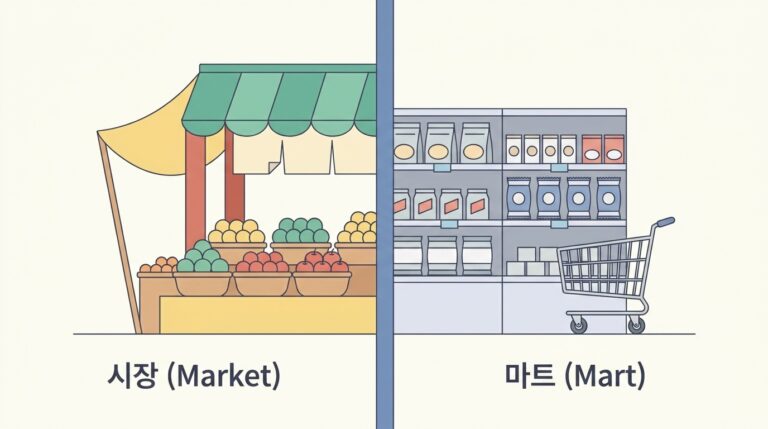
안녕하세요! 매일한글 에디터입니다.
Have you ever stood in the middle of a neon-lit, ultra-modern E-Mart feeling totally comfortable, only to freeze up the next day at Mangwon Market when a loud, smiling vendor thrusts three extra sweet potatoes into your basket while shouting friendly Korean? Many of our intermediate learners tell us: “I know how to say ‘This is big’ and ‘This is small,’ but I have no idea how to naturally explain why I prefer markets over supermarkets!”
Going shopping in Korea is not just a commercial errand; it is a live cultural clash between lightning-fast futuristic convenience and warm, nostalgic community warmth. If you cannot compare these two worlds, you miss out on vibrant conversations with your Korean friends, coworkers, and host families. Today, based on real feedback from over 500 expats, we are breaking down intermediate comparison patterns so you can debate, choose, and barter like a seasoned Seoulite!
Phase 2: Core 3 Expressions In-Depth
1. 마트보다 시장이 훨씬 정이 넘쳐요.
- Pronunciation: [Ma-teu-bo-da si-jang-i hwol-ssin jeong-i neom-chyeo-yo] (Sound tip: ‘Hwol-ssin’ sounds like an emphatic whoosh of air, like ‘whoosh-in’, highlighting the big difference!)
- Meaning: “Markets have far more warm affection (‘jeong’) than supermarkets.”
- K-Culture Moment: Think of variety shows like 2 Days & 1 Night or I Live Alone, where cast members visit rural markets and receive free food samples from vendors bursting with hospitality.
- Editor’s Insight: The particle
~보다attaches directly to the baseline noun (the thing being compared against). Adding훨씬(far more) elevates your speech from basic A2 Korean to a vivid B1 natural style. - Situation Spectrum: Casual (✅) / Semi-formal (✅) / Formal (⚠️ – better in personal essays or interviews)
- 🤔 Think About It: Does your native language have an untranslatable concept like Jeong (정), where emotion and social bond outweigh transaction efficiency?
2. 여기는 덤을 주는 대신에 카드가 안 돼요.
- Pronunciation: [Yeo-gi-neun deom-eul ju-neun dae-sin-e ka-deu-ga an dwae-yo] (Sound tip: ‘Deom’ rhymes with the English word ‘gum’—short and punchy!)
- Meaning: “Here, they give you free bonus items, but instead, they don’t take cards.”
- K-Culture Moment: In neighborhood K-dramas like Reply 1988 or When the Camellia Blooms, market stalls are known for tossing an extra fish or radishes into your bag rather than swiping shiny credit cards.
- Editor’s Insight:
~는 대신에expresses a trade-off: compensatory compensation or balanced contrast. It allows you to express pros and cons in a single, balanced sentence. - Situation Spectrum: Casual (✅) / Semi-formal (✅) / Formal (✅)
- 🤔 Think About It: In many Western societies, transparent pricing and digital receipts are king. How does the concept of an unwritten “bonus gift” (덤) change how you perceive fair business?
3. 대형 마트는 깔끔한 반면에 전통 시장은 활기차요.
- Pronunciation: [Dae-hyeong ma-teu-neun kkal-kkeum-han ban-myeon-e jeon-tong si-jang-eun hwal-gi-cha-yo] (Sound tip: Emphasize the double ‘kk’ in ‘kkal-kkeum’ like the crisp click of a snap fastener!)
- Meaning: “While mega marts are tidy and clean, traditional markets are energetic.”
- K-Culture Moment: In contemporary urban dramas, wealthy corporate protagonists stroll through quiet, pristine supermarket aisles, while the relatable, lively scenes always happen under traditional market awnings.
- Editor’s Insight:
~(으)ㄴ/는 반면에is the gold standard for setting two contrasting qualities side-by-side without sounding overly aggressive or dismissive of either side. - Situation Spectrum: Casual (✅) / Semi-formal (✅) / Formal (✅)
- 🤔 Think About It: How do retail spaces reflect cultural values? Does spotless order mean sterile distance, or does noisy bustle signify authentic humanity?
Phase 3: Textbook Korean vs Real Korean
Situation 1: Talking about price differences
- 📖 교과서 한국어: 대형 마트의 사과가 시장의 사과보다 더 비쌉니다. (Daehyeong mateu-ui sagwaga sijang-ui sagwoboda deo bissamnida.)
- 🗣️ 진짜 한국어: 마트 사과는 비싸긴 한데, 시장에 비하면 훨씬 비싸죠! (Mateu sagwaneun bissagin hande, sijang-e bihamyeon hwolssin bissajyo!)
- 💡 왜 다를까? Real native speakers rarely repeat the same noun twice (
사과... 사과). Instead, they introduce nuanced concession (~긴 한데) and comparative phrases like~에 비하면(compared to).
Situation 2: Asking for a discount or bonus
- 📖 교과서 한국어: 가격을 깎아 주실 수 있습니까? (Gagyeog-eul kkakka jusil su itsseumnikka?)
- 🗣️ 진짜 한국어: 이모, 조금만 깎아주시면 안 돼요? 덤도 좀 주세요~ (Imo, jogeumman kkakka-jusimyeon an dwaeyo? Deomdo jom juseyo~)
- 💡 왜 다를까? Traditional markets run on warmth and rapport. Asking formally sounds cold and confrontational; calling the vendor
이모(auntie) and softening the request makes bargaining enjoyable.
Phase 4: K-Culture Deep Dive & Non-Verbal Manners
4-1. 눈치 (Nunchi) & Gestures
When visiting a traditional market, avoid aggressively handling delicate produce (like strawberries or peaches) unless invited. If you want to compare goods, catch the vendor’s eye, nod politely, and use both hands when handing over cash or vouchers. In a mega mart, the dynamic flips: silence is normal, self-checkout stations are standard, and you step back courteously to give fellow shoppers room in front of promotional displays.
4-2. Cultural Code: ‘시식’ (Free Samples) vs ‘덤’ (Free Bonus)
At mega marts, look out for the iconic 시식 코너 (tasting stations), where attendants cook dumplings or pork belly on hot grills. You are expected to take a toothpick, enjoy the bite, smile, and say: 맛있네요! (Masin-neyo! / “Delicious!”). At traditional markets, food samples happen spontaneously: a fruit vendor will slice an apple right in front of you. Taking that slice implies a bond of trust and friendliness!
Phase 5: Real-Life Roleplay Scenario
Setting: A Saturday afternoon at Mangwon Market. Alex, an intermediate Korean learner, wants to buy some fresh seasonal fruits.
Characters: Alex (learning Korean) and the Market Vendor (warm, energetic shopkeeper).
- Alex: 안녕하세요! 딸기 한 바구니에 얼마예요? (Annyeonghaseyo! Ttalgi han bagunie eolmayeyo?)
🎭 Alex points gently with both hands toward the display. - Vendor: 어서 와요, 총각! 오늘 아침에 온 거라 만 원밖에 안 해. 엄청 달아! (Eoseo wayo, chonggak! Oneul achime on geora man wonbakke an hae. Eomcheong dara!)
🎭 The vendor proudly picks up a strawberry and offers it to Alex. - Alex: 와, 마트보다 확실히 싱싱하네요! (Wa, mateuboda hwaksilhi singsinghaneyo!)
🎭 Alex tastes the sample and gives an appreciative nod. - Vendor: 그렇지? 마트는 포장만 예쁜 반면에, 우리는 신선함이 최고지! (Geureochi? Mateuneun pojangman yeppeun banmyeone, urineun sinseonhami choegoji!)
🎭 She pats the table enthusiastically. - Alex: 대형 마트에 비해서 가격도 훨씬 저렴한 것 같아요. (Daehyeong mateue bihaeseo gagyeokdo hwolssin jeoryeomhan geot gat-ayo.)
🎭 Alex smiles, pulling out his wallet. - Vendor: 두 바구니 사면 덤으로 귤도 챙겨줄게. 어때? (Du baguni samyeon deomeuro gyuldo chaenggyeojulge. Eottae?)
🎭 The vendor gestures toward a basket of mandarins. - Alex: 좋아요! 현금으로 드릴 테니까 귤 많이 주세요! (Joayo! Hyeongeumeuro deuril tenikka gyul mani juseyo!)
🎭 Alex hands over crisp bank bills using both hands. - Vendor: 아이고, 고마워요! 맛있게 먹고 또 와요! (Aigo, gomawoyo! Masitge meokgo tto wayo!)
🎭 She hands Alex a heavy bag brimming with fruit.
🔀 Interactive Decision Point
The vendor asks if you want your fruit in a single-use black plastic bag or if you brought your own tote bag:
* Choice A: “비닐봉지 필요 없어요. 장바구니 있어요!” (Binilbongji piryo eopseoyo. Jangbaguni isseoyo!)
👉 Best! Modern Korean markets encourage eco-friendly shopping. The vendor will applaud your thoughtfulness and might toss in an extra piece of fruit!
* Choice B: “그냥 손으로 다 들고 갈게요.” (Geunyang soneuro da deulgo galgeyo.)
👉 Risk! Unless you have four hands, carrying loose fruit and heavy bags will lead to a strawberry catastrophe on the subway ride home.
* Choice C: “마트는 종이봉투 주던데 여긴 왜 이래요?” (Mateuneun jong-ibongtu judeonde yeogin wae iraeyo?)
👉 Bad! Comparing the market unfavorably to a supermarket will hurt the vendor’s feelings and instantly extinguish the friendly jeong.
Phase 6: 10-Second Emotional Shadowing Drill
Practice matching the rhythm, emotional tone, and natural pauses (/) in these three daily statements:
[😊 감탄하며 밝게]
마트보다 / 시장이 / 훨씬 활기차네요!
(Mateuboda / sijang-i / hwolssin hwal-gi-cha-neyo!)
“It’s way more lively at the market than at the supermarket!”-
[🤔 진지하게 비교하며]
대형 마트는 편리한 반면에 / 시장은 정이 넘쳐요.
(Daehyeong mateuneun pyeon-ri-han ban-myeon-e / sijang-eun jeong-i neom-chyeo-yo.)
“While mega marts are convenient, traditional markets are overflowing with warmth.” -
[🥺 애교 섞어서 조심스럽게]
이모, / 현금으로 낼 테니까 / 덤 좀 더 챙겨주세요~
(Imo, / hyeon-geum-euro nael tenikka / deom jom deo chaeng-gyeo-ju-se-yo~.)
“Auntie, I’ll pay in cash, so please hook me up with some extra goodies~”
Phase 7: K-Culture Mini Dictionary
- 덤 (Deom) | Free extra item / bonus gift
Usage: Added voluntarily by traditional market sellers or street food vendors to show warmth and thank regular patrons. - 시식 코너 (Sisik Koneo) | Food sampling station
Usage: Supermarket areas where staff fry up dumplings or meats; standard weekend entertainment for Korean families. - 온누리상품권 (Onnuri Sangpumgwon) | Traditional market gift certificate
Usage: Government-issued paper or digital voucher valid at registered local markets, often bought at a 5-10% discount. - 원플러스원 (Won-peulleoseu-won / 1+1) | Buy one, get one free
Usage: Ubiquitous supermarket and convenience store marketing promotion for packaged food and toiletries.
Phase 8: Traveler’s Survival Kit
Top 3 Survival Phrases
- 카드 결제 돼요? (Kadeu gyeolje dwaeyo? / “Do you take cards?”)
Pro Tip: Ask politely before vendor bags your items, as some small stalls only take cash or bank transfer. - 계좌이체 해드릴게요. (Gyejwa-iche haedeurilgeyo. / “I’ll transfer the money to your bank account.”)
Pro Tip: Vendors display their bank account numbers on small plaques above their stalls. - 영수증 버려주세요. (Yeongsujeung beoryeojuseyo. / “Please discard the receipt.”)
Pro Tip: Mega mart cashiers will always ask if you want a receipt; this phrase saves paper effortlessly.
Editor’s Travel Note
Before heading out, make sure you download your Naver Map app download for Korean transit. Look up local gems such as Gwangjang Market (for street dining), Tongin Market (famous for the coin lunchbox), or E-Mart Cheonggyecheon Branch. Keep 10,000 KRW bills ready for markets, while mega marts accept all major credit cards and Apple Pay at selected kiosks.
Phase 9: “One Step Deeper” (Critical Thinking Essay)
In modern South Korea, the coexistence of mega marts and traditional markets mirrors the society’s dual nature: hyper-efficient technological advancement and deeply rooted communal interdependence. While retail giants emphasize predictable standardized pricing, cleanliness, and contactless transactions, traditional markets prioritize relational interaction—human banter, impromptu discounts, and emotional exchange. The linguistic structures we use to compare them, like ~는 반면에 and ~는 대신에, encourage us to recognize that neither space is superior; they simply meet different psychological and social needs for community members.
💬 Your Turn: Which shopping experience do you prefer: the air-conditioned efficiency of a mega mart or the lively banter of a traditional market? Share your pick in the comments below!
Phase 10: FAQ & Common Mistakes
Q: Can I haggle prices at a Korean mega mart?
A: No, prices at large supermarkets (E-Mart, Homeplus, Lotte Mart) are fixed by digital barcodes. You can only save money through corporate discounts, membership reward points, or evening clearance sales.
Q: Do traditional markets accept credit cards nowadays?
A: Yes, most established stalls in Seoul accept credit cards and ZeroPay. However, smaller vegetable and fish stalls managed by elderly vendors still favor cash or direct bank transfers, and you might get better 덤 (extras) if paying in cash.
Q: Why do supermarkets close every two weeks in Korea?
A: Under South Korean regulatory law, large supermarkets must close on two Sundays each month (typically the 2nd and 4th Sunday) to encourage residents to support local neighborhood traditional markets.
🚨 Common Mistakes TOP 3
- Mistake: Saying
시장이 마트보다 더 싸요with no subject marking.
Correction: Always anchor the baseline comparison noun with~보다(e.g.,마트보다 시장이 더 싸요). - Mistake: Demanding discounts abruptly (
깎아줘!/ “Give me a discount!”) without honorifics.
Correction: Use a soft question with respectful tone (조금만 깎아주실 수 있으세요?). - Mistake: Confusing
~는 대신에(trade-off/instead) with simple contrast~지만(but).
Correction: Use~는 대신에when one aspect compensates or replaces another directly.
Phase 11: Action Mission & Engagement
- Bronze Mission (Solo Practice): Stand in front of your refrigerator and speak 2 sentences comparing two items using
~보다and~(으)ㄴ 반면에out loud. - Silver Mission (Community Share): Leave a comment below comparing your local hometown supermarket with Korean markets using the phrase
[A]에 비해서 [B]는.... - Gold Mission (Real Life Action): Visit a local Korean grocery or market stall, ask for an item using
~ 얼마예요?, and politely pay with cash while thanking the vendor! - 🎮 K-Culture Mission: Watch an episode of a Korean variety show featuring market visits (like Amazing Saturday or Street Food Fighter) and count how many times you hear the word
덤or싱싱하다!
Phase 12: Interactive Quiz Challenge
Test your knowledge with these three practical questions:
- Situational Judgment: You want to say: “Mega marts are convenient, but on the other hand, traditional markets are cheaper.” Which sentence is grammatically natural?
- (A) 대형 마트는 편리한 반면에 전통 시장은 더 저렴해요.
- (B) 대형 마트는 편리한 대신에 전통 시장은 더 비싸요.
- (C) 대형 마트보다 전통 시장이 편리해요.
- Fill-in-the-Blank: Complete the comparison: “마트( ____ ) 시장이 채소가 훨씬 싱싱해요.”
-
True / False: In Korea, you are legally permitted to negotiate prices at the self-checkout counter of a mega mart. (True / False)
👉 Click here for answers & detailed explanations!
-
Answer: (A)
Explanation:~(으)ㄴ/는 반면에accurately connects two contrasting realities (convenience vs cheaper prices). Option B contradicts itself logically, and Option C states that markets are more convenient than marts, which reverses typical traits. -
Answer: 보다
Explanation:마트보다attaches to the comparative benchmark (“more fresh than the mart”). -
Answer: False
Explanation: Mega marts operate on fixed barcode pricing; bartering is culturally and technologically impossible there!







