

Phase 1: 공감 (Story-Driven Opening)
안녕하세요! 매일한글 에디터입니다.
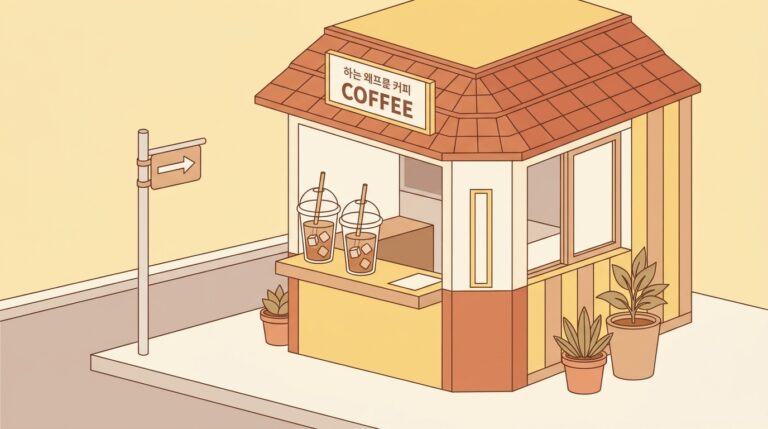
Picture this: It is 12:45 PM on a crisp Tuesday afternoon in Teheran-ro, the bustling financial artery of Gangnam. A sea of office workers wearing company lanyards surges out of towering glass skyscrapers. Within minutes, nearly every single person emerges clutching a massive 32-ounce transparent plastic cup filled with dark amber liquid and crushed ice: the ubiquitous 1,500 KRW ($1.10) Iced Americano. You see storefronts barely ten square meters in size—Mega MGC Coffee, Compose Coffee, Paik’s Coffee—pumping out hundreds of these monstrous cups every thirty minutes.
As a sophisticated Korean learner pushing into the C2 realm, you can effortlessly say “아이스 아메리카노 한 잔 테이크아웃이요” (A-i-seu a-me-ri-ka-no han jan te-i-keu-a-ut-i-yo / One iced Americano to go, please). But have you ever paused to analyze the commercial miracle happening before your eyes? In a metropolitan city infamous for astronomical commercial rents, soaring minimum wages, and skyrocketing green coffee bean futures, how do these low-cost, jumbo-sized franchises not merely survive, but post record-breaking operational margins?
Navigating Korean society at a native-executive level means looking past the surface and articulating the nuanced microeconomics, sociological habits, and structural trade-offs of this retail juggernaut. Our C2 masterclass is drawn from actual franchise disclosures, business consultancies, and field interviews with franchise owners. Today, we bridge the gap between basic conversational fluency and analytical mastery.
Phase 2: 핵심 표현 3선 심층 분석
1. 박리다매로 승부하다 (Bak-ri-da-mae-ro seung-bu-ha-da)
- Pronunciation: [Bak-ri-da-mae-ro seung-bu-ha-da] (Think of bak-ri as rapid clicks ‘bahk-ree’, da-mae like ‘dah-meh’, and seung-bu like a fierce sports match call ‘sung-boo’).
- Meaning: Literal: “To stake one’s contest on small profits and quick returns.” | Nuanced: To execute an aggressive high-volume, razor-thin margin commercial strategy.
- K-Culture Moment: In modern Korean financial documentaries or corporate dramas like Misaeng or Reborn Rich, corporate strategists use this expression when discussing low-cost disruptive market entrants.
- Editor’s Insight: The four-character idiom (사자성어) 박리다매 (薄利多賣) pairs with the dynamic verb 승부하다 (to place one’s strategic wager). It carries a gritty, high-stakes undertone, emphasizing that survival depends strictly on immense sales volume.
- Situation Spectrum: Casual ⚠️ | Semi-formal ✅ | Formal ✅
- 🤔 Think About It: In English, we often discuss “economies of scale” or “penetration pricing,” but 박리다매로 승부하다 implies an active, combat-ready posture. What does this reveal about South Korea’s hyper-competitive retail landscape?
2. 테이크아웃 회전율을 극대화하다 (Te-i-keu-a-ut hoe-jeon-yul-eul geuk-dae-hwa-ha-da)
- Pronunciation: [Te-i-keu-a-ut hoe-jeon-yul-eul geuk-dae-hwa-ha-da] (Pronounce hoe-jeon like ‘hway-jun’, and geuk-dae-hwa like ‘gook-deh-hwah’).
- Meaning: Literal: “To maximize the takeout turnover rate.” | Nuanced: To optimize front-of-house workflow and spatial economics so customers leave instantly with product in hand, eliminating table maintenance costs.
- K-Culture Moment: Frequently analyzed by YouTube business commentators (like Shuka World) when decoding why small-footprint cafes deliberately omit Wi-Fi and power outlets.
- Editor’s Insight: 회전율 (turnover rate) is the beating heart of Korean franchise retail. By explicitly attaching 테이크아웃, the phrase highlights a deliberate design: denying the European “leisurely salon” concept in favor of frictionless, fast-paced fulfillment.
- Situation Spectrum: Casual ⚠️ | Semi-formal ✅ | Formal ✅
- 🤔 Think About It: Why has the physical cafe transformed from a third space (제3의 공간) into a purely functional caffeine distribution station for busy Korean commuters?
3. 미끼 상품으로 객단가를 끌어올리다 (Mi-kki sang-pum-eu-ro gaek-dan-ga-reul kkeul-eo-ol-li-da)
- Pronunciation: [Mi-kki sang-pum-eu-ro gaek-dan-ga-reul kkeul-eo-ol-li-da] (Mi-kki sounds sharp like ‘me-kee’ with tense consonants; gaek-dan-ga flows as ‘gek-dahn-gah’).
- Meaning: Literal: “To pull up the average spend per customer using bait products.” | Nuanced: To deploy an ultra-cheap loss leader (the 1,500 KRW Americano) to draw foot traffic, while generating actual profit through high-margin side items, seasonal smoothies, and desserts.
- K-Culture Moment: Mentioned in retail strategy briefings and franchise owner forums (아프니까 사장이다) when debating whether selling plain drip coffee alone will pay the electricity bills.
- Editor’s Insight: 객단가 (客單價) is a standard C2 executive retail term representing the average revenue per transaction. Pairing it with 미끼 상품 (loss leader/bait product) captures the subtle psychological pricing architecture of budget retail.
- Situation Spectrum: Casual 🚫 | Semi-formal ✅ | Formal ✅
- 🤔 Think About It: Have you noticed that while the Americano costs 1,500 KRW, a strawberry cream frappe or croffle at the same shop costs 4,500 KRW? How does this pricing asymmetry influence consumer perception?
Phase 3: 교과서 한국어 vs 진짜 한국어
Situation 1: Explaining how cheap coffee brands stay profitable
- 📖 교과서 한국어: 이 카페들은 커피를 싸게 많이 팔아서 돈을 벌어요. (I ka-pe-deul-eun keo-pi-reul ssa-ge man-i pal-a-seo don-eul beol-eo-yo.) — “These cafes earn money by selling lots of coffee cheaply.”
- 🗣️ 진짜 한국어: 마진율을 극도로 낮추는 대신, 테이크아웃 특화 매장으로 평당 임대료 부담을 줄이고 박리다매로 승부하는 구조예요. (Ma-jin-yul-eul geuk-do-ro nat-chu-neun dae-sin, te-i-keu-a-ut teuk-hwa mae-jang-eu-ro pyeong-dang im-dae-ryo bu-dam-eul jul-i-go bak-ri-da-mae-ro seung-bu-ha-neun gu-jo-ye-yo.) — “Instead of maintaining high margins, their model relies on slashing per-pyeong rent through takeout-only footprints and betting entirely on high-volume turnover.”
- 💡 왜 다를까? Intermediate speakers rely on generic verbs like 돈을 벌다 (earn money). C2 discourse demands commercial sophistication: isolating key financial drivers like 마진율 (margin rate), 평당 임대료 (rent per 3.3 square meters), and 수익 구조 (revenue architecture).
Situation 2: Discussing where the actual profits come from
- 📖 교과서 한국어: 아메리카노보다 단 음료나 빵이 더 비싸서 이익이 남아요. (A-me-ri-ka-no-bo-da dan eum-ryo-na ppang-i deo bi-ssa-seo i-ik-i nam-a-yo.) — “Sweet drinks or breads are more expensive than Americanos, so they leave a profit.”
- 🗣️ 진짜 한국어: 저가 아메리카노는 일종의 미끼 상품이고, 실질적인 영업이익은 단가가 높은 시즌 메뉴와 베이커리 부가 매출에서 견인하죠. (Jeo-ga a-me-ri-ka-no-neun il-jong-ui mi-kki sang-pum-i-go, sil-jil-jeok-in yeong-eop-i-ik-eun dan-ga-ga nop-eun si-jeun me-nyu-wa be-i-keo-ri bu-ga mae-chul-e-seo gyeon-in-ha-jyo.) — “The budget Americano is essentially a loss leader; real operating profit is driven by high-ticket seasonal beverages and ancillary bakery sales.”
- 💡 왜 다를까? Advanced native business conversation uses verbs like 견인하다 (to pull/drive growth) and terms like 부가 매출 (ancillary revenue) rather than simply stating that dessert items are “more expensive.”
Phase 4: K-Culture 딥다이브 & 비언어적 매너
4-1. 눈치 (Nunchi) & Spatial Choreography at Budget Kiosks
Stepping into a micro-footprint coffee shop in Seoul during the 12:00–1:00 PM lunch rush requires acute spatial awareness (눈치):
* The Kiosk Sidestep: When ordering at the exterior touchscreens, keep your payment card or mobile pay (Samsung Pay/Apple Pay) ready before reaching the screen. Delaying your transaction to search your bag will prompt subtle collective throat-clearing from the queue.
* The 45-Degree Stance: After ordering, step away from the pickup ledge and position your body at a 45-degree angle facing the digital order board. Standing square in front of the counter obstructs departing patrons navigating the narrow sidewalk.
* Two-Handed Pick-and-Go: When your number is called, retrieve your heavy 32oz cup with both hands (or by the cup sleeve and base) with a succinct micro-nod toward the baristas: “감사합니다, 수고하세요!” (Gam-sa-ham-ni-da, su-go-ha-se-yo!). Baristas in these franchises operate at breakneck physical speed; verbal efficiency shows respect for their relentless tempo.
4-2. Cultural Code: The Micro-Economics of “Liquid Survival”
In South Korea, cheap jumbo coffee is not an artisanal luxury; it is affectionately called 생명수 (Saeng-myeong-su / “water of life”) or 합법적 각성제 (legal stimulant).
* The Anti-Salon: Traditional European cafe culture values lingering conversation, bespoke ceramic ware, and romantic ambience. Korean budget chains have severed coffee from the “salon experience.” They treat caffeine as an indispensable fuel source required to endure grueling workdays (야근 and 열공).
* The Scale Moat: Independent single-store cafes find it mathematically impossible to compete with this model. Megachains negotiate bulk bean purchasing directly with international green coffee brokers and distribute proprietary syrups across thousands of franchised doors, creating an impenetrable moat against standalone mom-and-pop shops.
Phase 5: 실전 롤플레이 시나리오
Setting: A modern shared-office lounge in Pangyo Techno Valley.
Characters:
* 민준 (Min-jun): Senior F&B Investment Analyst.
* 수현 (Su-hyeon): Visiting Market Strategy Consultant (You).
민준: 수현 씨, 방금 들고 오신 메가커피 아메리카노, 1,500원 맞죠? 이 상권에서 그 가격이 여전히 지속 가능하다는 게 놀랍지 않나요?
(Su-hyeon ssi, bang-geum deul-go o-sin me-ga-keo-pi a-me-ri-ka-no, cheon-o-baek-won mat-jyo? I sang-gwon-e-seo geu ga-gyeok-i yeo-jeon-hi ji-sok ga-neung-ha-da-neun ge nol-rap-ji an-na-yo?)
“Su-hyeon, that Mega Coffee Americano you just brought in—it’s 1,500 won, right? Doesn’t it amaze you that such a price remains sustainable in this commercial district?”
🎭 [민준이 커피 컵의 거대한 용량을 유심히 바라보며 안경을 고쳐 쓴다]
(Min-jun glances closely at the massive volume of the cup and adjusts his glasses)
수현: 겉보기엔 출혈 경쟁 같지만, 전형적인 박리다매와 공간 효율화의 결합 모델이잖아요.
(Geot-bo-gi-en chul-hyeol gyeong-jaeng gat-ji-man, jeon-hyeong-jeok-in bak-ri-da-mae-wa gong-gan hyo-yul-hwa-ui gyeol-hap mo-del-i-janh-a-yo.)
“It might look like a bleeding price war on the surface, but it’s a classic model combining high-volume sales with spatial hyper-efficiency.”
🎭 [수현이 테이크아웃 컵 홀더를 만지작거리며 담담하게 설명한다]
(Su-hyeon adjusts the cup sleeve, explaining with composure)
민준: 맞아요. 매장 면적을 10평 안팎으로 최소화해서 평당 고정비를 낮추고, 키오스크로 인건비를 줄인 게 주효했죠.
(Mat-a-yo. Mae-jang myeon-jeok-eul sip-pyeong an-ppak-eu-ro choe-so-hwa-hae-seo pyeong-dang go-jeong-bi-reul nat-chu-go, ki-o-seu-keu-ro in-geon-bi-reul jul-in ge ju-hyo-haet-jyo.)
“Exactly. Minimizing storefronts to around 30 square meters reduces fixed overhead per square foot, and automated kiosks cut labor costs drastically.”
🎭 [민준이 태블릿 PC에 적힌 상권 데이터 그래프를 보여주며 고개를 끄덕인다]
(Min-jun nods, flashing a commercial foot-traffic graph on his tablet)
수현: 게다가 핵심은 테이크아웃 회전율을 극한으로 끌어올려 시간당 생산량을 뽑아내는 데 있어요.
(Ge-da-ga haek-sim-eun te-i-keu-a-ut hoe-jeon-yul-eul geuk-han-eu-ro kkeul-eo-ol-lyeo si-gan-dang saeng-san-ryang-eul ppob-a-nae-neun de iss-eo-yo.)
“Furthermore, the crux lies in driving takeout turnover to the limit, churning out maximum output units per hour.”
🎭 [수현이 창밖의 빽다방 테이크아웃 창구로 몰려드는 인파를 가리킨다]
(Su-hyeon points out the window to the crowd surging around a Paik’s Coffee takeout counter)
민준: 그렇지만 원두 선물 가격과 물류비가 계속 오르면, 1,500원 원가 압박은 한계에 부딪히지 않을까요?
(Geu-reoh-ji-man won-du seon-mul ga-gyeok-gwa mul-ryu-bi-ga gye-sok o-reu-myeon, cheon-o-baek-won won-ga ap-bak-eun han-gye-e bu-dit-hi-ji anh-eul-kka-yo?)
“Still, if coffee bean futures and logistics expenses keep climbing, won’t the cost pressure on a 1,500 won cup hit a structural brick wall?”
🎭 [민준이 미간을 찌푸리며 수익성의 임계점을 묻는다]
(Min-jun furrows his brow, questioning the profitability threshold)
수현: 그래서 브랜드들이 저가 아메리카노를 미끼 상품으로 삼고, 시즌 음료와 베이커리로 객단가를 방어하는 거겠죠.
(Geu-rae-seo beu-raen-deu-deul-i jeo-ga a-me-ri-ka-no-reul mi-kki sang-pum-eu-ro sam-go, si-jeun eum-ryo-wa be-i-keo-ri-ro gaek-dan-ga-reul bang-eo-ha-neun geo-get-jyo.)
“Which is precisely why brands treat the budget Americano as a loss leader, defending average ticket size with seasonal drinks and bakeries.”
🎭 [수현이 테이크아웃 봉투 속의 디저트 메뉴를 슬며시 꺼내 보이며 미소 짓는다]
(Su-hyeon pulls a side pastry from the bag with a knowing smile)
민준: 하하, 결국 수현 씨도 아메리카노만 산 게 아니라 소금빵까지 곁들여서 객단가 상승에 기여하셨군요!
(Ha-ha, gyeol-guk Su-hyeon ssi-do a-me-ri-ka-no-man san ge a-ni-ra so-geum-ppang-kka-ji gyeot-deul-yeo-seo gaek-dan-ga sang-seung-e gi-yeo-ha-syeot-gun-yo!)
“Haha, so in the end, Su-hyeon, you didn’t just buy the Americano—you grabbed a salt bread pastry, boosting their average check yourself!”
🎭 [두 사람이 빵 봉투를 보며 유쾌하게 웃음을 터뜨린다]
(Both break into hearty laughter looking at the pastry bag)
수현: 데이터의 위력을 직접 증명해 드린 셈이죠. 소비자 심리를 정확히 꿰뚫은 설계예요.
(De-i-teo-ui wi-ryeok-eul jik-jeop jeung-myeong-hae deu-rin sem-i-jyo. So-bi-ja sim-ri-reul jeong-hwak-hi kkwe-ttulh-eun seol-gye-ye-yo.)
“Consider it living proof of the data. It’s a commercial architecture that reads consumer psychology with pinpoint accuracy.”
🔀 인터랙티브 분기점 (Interactive Decision Point)
Imagine Min-jun asks you: “그렇다면 이런 저가 커피 프랜차이즈가 장기적으로 직면할 가장 큰 리스크는 무엇일까요?” (What is the greatest long-term risk facing these low-cost coffee chains?)
- 선택지 A: “커피 맛이 너무 없어서 소비자들이 결국 스페셜티 커피 전문점으로 대거 이탈할 거예요.”
- 피드백 [Bad]: Overlooks commercial reality. Korean consumers purchase budget Americanos for functional caffeine utility, not artisanal cupping notes. Blaming flavor underestimates the inelasticity of convenience consumption.
- 선택지 B: “원자재 가격 상승과 가맹점 간의 과도한 근접 출점으로 인한 제 살 깎아먹기 경쟁이에요.”
- 피드백 [Best ✅]: Outstanding C2 insight! You correctly identify supply-chain vulnerability (원자재 가격 상승) alongside predatory cannibalization between adjacent franchisees (제 살 깎아먹기 / 카니발라이제이션).
- 선택지 C: “다들 매장에 앉아서 노트북을 오래 쓰니까 전기세가 너무 많이 나올 거예요.”
- 피드백 [Risk]: Factually flawed. These budget franchises intentionally operate small storefronts with minimal seating and no power outlets precisely to eliminate laptop campers (카공족).
Phase 6: 10초 감정 섀도잉 드릴
Practice these high-level sentences by matching the intonation pauses marked with / and internalizing the contextual emotion.
[🧐 날카롭고 분석적인 어조로]
단순히 / 가격을 낮춘 게 아니라, / 평당 임대료를 줄이고 / 회전율을 극대화한 / 고도의 비즈니스 모델입니다.
(Dan-sun-hi / ga-gyeok-eul nat-chun ge a-ni-ra, / pyeong-dang im-dae-ryo-reul jul-i-go / hoe-jeon-yul-eul geuk-dae-hwa-han / go-do-ui bi-jeu-ni-seu mo-del-im-ni-da.)
“It is not merely cutting prices; it is a sophisticated business model that slashes per-pyeong rent and maximizes turnover rate.”-
[💡 무릎을 탁 치며 감탄하듯]
결국 / 1,500원짜리 아메리카노는 / 고객을 끌어들이는 / 미끼 상품에 불과했던 거군요!
(Gyeol-guk / cheon-o-baek-won-jja-ri a-me-ri-ka-no-neun / go-gaek-eul kkeul-eo-deul-i-neun / mi-kki sang-pum-e bul-gwa-haet-deon geo-gun-yo!)
“So in the end, the 1,500 won Americano was nothing more than a loss leader to draw foot traffic!” -
[⚠️ 우려 섞인 어조로 신중하게]
가맹점 간의 / 과도한 출점 경쟁이 / 지속된다면, / 박리다매 구조 자체가 / 흔들릴 위험이 있습니다.
(Ga-maeng-jeom gan-ui / gwa-do-han chul-jeom gyeong-jaeng-i / ji-sok-doen-da-myeon, / bak-ri-da-mae gu-jo ja-che-ga / heun-deul-ril wi-heom-i iss-seum-ni-da.)
“If predatory store-opening competition between franchisees persists, the very high-volume low-margin structure risks collapsing.”
Phase 7: K-Culture 미니 사전 (핵심 키워드 4선)
- 박리다매 (薄利多賣 – Bak-ri-da-mae)
- Translation: Small profits, large volumes.
- Usage: Essential retail descriptor. Used in executive boards and business news to describe operational models that trade gross margins for explosive scale.
- 객단가 (客單價 – Gaek-dan-ga)
- Translation: Average revenue per customer (Ticket size).
- Usage: Retail metrics. Example: “디저트 세트 메뉴를 출시해 객단가를 20% 끌어올렸습니다.” (We boosted average ticket size by 20% by launching dessert set menus.)
- 회전율 (回轉率 – Hoe-jeon-yul)
- Translation: Turnover rate.
- Usage: F&B real-estate metrics. Refers to both seat turnover (테이블 회전율) and operational product speed (재고/주문 회전율).
- 카공족 (Ka-gong-jok)
- Translation: Cafe-studying tribe (People who study/work in cafes for hours).
- Usage: Cultural sociology. Highly relevant here because budget franchises intentionally optimize their physical design to deter 카공족, thereby protecting profitability.
Phase 8: 여행자를 위한 생존 키트
서바이벌 표현 TOP 3
- “얼음 가득 채워서 테이크아웃 잔에 담아주세요.”
- Romanization: Eor-eum ga-deuk chae-wo-seo te-i-keu-a-ut jan-e dam-a-ju-se-yo.
- Pro Tip: Use this at kiosks or counters when you need your jumbo coffee intensely chilled for a long walk around Seoul.
- “키오스크 주문 시 개인 텀블러 할인 적용되나요?”
- Romanization: Ki-o-seu-keu ju-mun si gae-in teom-beul-reo hal-in jeok-yong-doe-na-yo?
- Pro Tip: Many low-cost franchises offer a 100~300 KRW discount for personal tumblers, but the option is often tucked away inside a sub-menu on the touch screen.
- “캐리어에 담아주실 수 있나요?”
- Romanization: Kae-ri-eo-e dam-a-ju-sil su iss-na-yo?
- Pro Tip: If you are carrying two or more heavy jumbo drinks back to your office or hotel, ask for a 캐리어 (cardboard or plastic takeaway drink carrier).
Editor’s Travel Note
- App Navigation: To find the nearest kiosk-enabled budget cafe before arriving at the subway station, utilize the 네이버 지도 앱 다운로드 to search “메가커피” or “컴포즈커피”. You can check their real-time opening hours.
- Smart Pre-Ordering: If you despise waiting in lunchtime queues, download “Mega Order” or “Compose Order.” You can pay ahead via international credit cards or mobile payment, walking straight to the pickup counter.
Phase 9: “한 발 더 깊이” (생각 질문)
South Korea’s low-cost coffee empire reflects the hyper-rationalization of modern urban survival. In an intense society defined by rapid delivery and late-night intellectual labor, caffeine is not consumed for leisure; it is an infrastructural utility. These franchises have commoditized that exact utility with clockwork precision, transforming prime retail streetfronts into streamlined liquid-fueling depots.
💬 Your Turn: Does your home country treat coffee primarily as a leisure-driven “third space” experience, or has it also undergone this intense commoditization into ultra-cheap, functional convenience? Share your thoughts below in advanced Korean!
Phase 10: FAQ & 오해 방지
Q: Why don’t budget coffee chains let customers sit down for hours if they have tables?
A: While some larger locations have seating, many deliberately install hard wooden benches without backrests, omit electrical outlets, and disable Wi-Fi. In a business model operating on margins of only a few hundred won per cup, an occupant staying for three hours transforms the customer from a profit into an operational deficit.
Q: Is the quality of beans at 1,500 KRW chains dramatically worse than premium chains?
A: Not necessarily. Because mega-franchises operate thousands of stores nationwide, their raw bulk procurement power rivals or exceeds mid-tier specialty roasters. They keep prices low through logistics scale, automated roasting, and robotic kiosk efficiencies, not solely by purchasing defective green beans.
Q: Can independent coffee shops survive next to these giant budget chains?
A: Standalone cafes cannot win a price war (치킨게임) against them. To survive, independent cafes in Korea pivot toward hyper-niche positioning: artisanal single-origin pour-overs, distinctive spatial aesthetics (인스타 감성), or unique specialty bakery items.
🚨 흔한 실수 (Common Mistakes) 경고판
| Mistake | Why it Sounds Unnatural | Correct C2 Action |
|---|---|---|
| Calling takeout “To go” in Konglish (투고해 주세요) | While understood, native Koreans exclusively say 테이크아웃 or 포장. | Say “포장해 갈게요” (Po-jang-hae gal-ge-yo) or “테이크아웃이요”. |
| Saying “싸게 팔아서 남는 게 없다” in business discussions | Sounds overly colloquial and like an emotional complaint. | Use analytical discourse: “마진율이 극히 낮아 박리다매에 의존하는 구조입니다.” |
| Assuming 가성비 (cost-effectiveness) explains everything | 가성비 is an entry-level consumer term that lacks strategic depth. | Discuss 객단가 방어 전략 (average ticket defense strategy) or 원가율 통제 (cost-of-goods-sold control). |
Phase 11: 액션 미션 & 참여 유도
- 🥉 Bronze Mission (Solo Shadowing): Record yourself delivering the Phase 6 sentences. Pay strict attention to the breath pauses at each slash
/. - 🥈 Silver Mission (Social Dialogue): Analyze your favorite Korean beverage brand on Instagram or LinkedIn using the terms 박리다매 and 객단가.
- 🥇 Gold Mission (Real-world Challenge): Next time you visit a Korean budget franchise, pay close attention to the order screen. Identify their 미끼 상품 (loss leader) versus their 객단가 상승용 디저트 (margin-boosting dessert), and order in Korean!
- 🎮 K-Culture Mission: Watch an episode of an F&B business variety show (like Paik Jong-won’s 골목식당 or corporate YouTube channels). Spot how often professional restaurateurs mention 회전율.
Phase 12: 인터랙티브 퀴즈 챌린지
1. Situational Judgment
어떤 프랜차이즈 카페가 매장 내 좌석을 모두 없애고 키오스크 2대만 설치하여 운영 비용을 절감하고자 합니다. 이 전략을 가장 정확하게 설명한 C2 수준의 경제적 논평은?
(A) 커피를 마시는 사람들의 기분을 배려하지 않은 불친절한 매장 운영이다.
(B) 공간 임대료와 인건비를 최소화하고 테이크아웃 회전율을 극대화하려는 전략이다.
(C) 손님들이 커피를 천천히 마시게 하여 브랜드 충성도를 높이려는 시도이다.
🔍 정답 및 해설 보기 (Click to Reveal)
정답: (B)
해설: 좌석을 배제하고 무인 키오스크를 도입하는 것은 매장 평수를 줄여 임대료 부담을 낮추고(공간 임대료 최소화), 테이크아웃 중심의 대량 판매(회전율 극대화)를 달성하기 위한 전형적인 저가 커피 프랜차이즈의 수익 모델입니다.
2. Fill-in-the-Blank
저가 커피 브랜드는 1,500원짜리 아메리카노를 ( )으로 내세워 손님을 유인한 뒤, 마진율이 높은 베이커리와 스무디를 판매하여 ( )를 끌어올린다.
🔍 정답 및 해설 보기 (Click to Reveal)
정답: 미끼 상품 / 객단가
해설: 저렴한 가격으로 발길을 끄는 제품을 미끼 상품(loss leader)이라 부르며, 고객 1인당 평균 결제 금액을 객단가라고 합니다.
3. True / False Cultural Insight
한국의 저가 커피 프랜차이즈 매장은 Wi-Fi와 콘센트를 무제한 제공하여 장시간 공부하는 ‘카공족’을 유치함으로써 수익을 낸다. (True / False)
🔍 정답 및 해설 보기 (Click to Reveal)
정답: False
해설: 저가 프랜차이즈는 빠른 회전율과 테이크아웃 중심의 판매로 수익을 창출하므로, 매장에 장시간 머무는 카공족의 유입은 오히려 회전율을 저해하는 요인이 됩니다. 따라서 콘센트와 Wi-Fi를 제한하는 매장이 많습니다.







