

What Did That K-Drama Ending Really Mean? How to Debate Finale Theories Like a Native
Phase 1: 공감 (Story-Immersive Opening)
안녕하세요! 매일한글 에디터입니다. (Hello! I’m your Daily Hangul editor.)
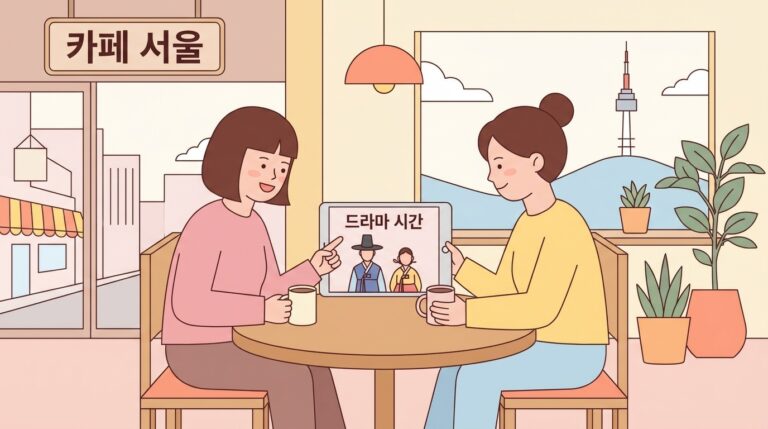
Picture this: It is Sunday midnight, and the grand finale of this season’s hottest thriller just finished streaming. You are huddled in a cozy cafe in Yeonnam-dong with your Korean drama buddies, or maybe you just hopped onto a lively voice chat. The credits fade into black, and sudden chaos breaks out. One friend grabs their head shouting, “말도 안 돼! (No way!)” while another is already typing furiously on their phone, declaring that the male lead was in a coma the whole time.
You have an incredible theory of your own. You noticed the pocket watch in episode 4 and connected it to the mystery train in episode 16! But when all eyes turn to you and someone asks, “너는 어떻게 생각해? (What do you think?)”, your mind blanks. You desperately search your mental vocabulary bank, only to mutter: “어… 결말이 슬펐어요. 좋았어요. (Uh… the ending was sad. It was good.)”
Does that sound painfully familiar? You have deep, analytical thoughts about storytelling, artistic symbolism, and narrative arcs in your native tongue, but the moment you try to express them in Korean, you feel trapped in elementary school sentences. Discussing complex plot resolutions and open endings at a B2 (Intermediate) level requires nuance—the ability to hedge your theories gracefully, talk about foreshadowing, and disagree without sounding argumentative.
This guide was built specifically from real feedback from intermediate learners who wanted to graduate from simple drama recaps to authentic cinephile discussions. By the end of this article, you will confidently unpack plot twists, debate ambiguous endings, and share your wild fan theories like a seasoned Seoulite!
Phase 2: 핵심 표현 3선 심층 분석 (Top 3 Core Expressions)
1. 해석하기 나름인 것 같아요 (Haeseokhagi nareumin geot gat-ayo)
- Pronunciation: [Hae-seok-ha-gi na-reum-in geot ga-ta-yo] (Think: “Hae-seok” rhymes with “beck”, “nareum” sounds like a rhythmic “nah-reum”, and “geot gat-ayo” rolls smoothly off your tongue as “got-got-eye-oh”)
- Meaning: Literal: “It seems to depend on doing interpretation” vs. Actual: “I think it really depends on how you look at it / It’s open to interpretation.”
- K-Culture Moment: You will hear this constantly on Korean YouTube review channels (like Minho King or B Man) when analyzing ambiguous endings where the protagonist’s survival is left unconfirmed.
- Editor’s Insight: The grammatical pattern
~기 나름이다means “it depends on how one does [verb].” Adding~인 것 같아요(it seems like) is the ultimate Korean communication superpower. It softens your statement, preventing you from sounding dogmatic while warmly welcoming differing viewpoints.- Situation Spectrum: Casual: ✅ | Semi-formal: ✅ | Formal: ⚠️
- 🤔 Think About It: In English, people frequently assert, “That clearly means X!” Why do Korean speakers naturally default to softening phrases like
~인 것 같아요even in spirited creative debates?2. 떡밥 회수가 좀 아쉬웠어요 (Tteokbap hoesuga jom aswiwosseoyo)
- Pronunciation: [Tteok-bap hoe-su-ga jom a-swi-wo-sseo-yo] (Think: “Tteok-bap” with a snappy, crisp double-T sound like “stop pete”, followed by “hway-soo-gah jom ah-shee-wo-ssuh-yo”)
- Meaning: Literal: “The retrieval of rice-cake bait was a bit regrettable” vs. Actual: “It is a shame they didn’t tie up all the loose ends / resolve the plot clues.”
- K-Culture Moment: Every Korean drama community forum (like Theqoo or DC Inside) floods with this phrase during finale week when a writer leaves major mysteries unsolved.
- Editor’s Insight: “떡밥” (tteokbap) is internet slang derived from fishing bait, referring to narrative breadcrumbs, Easter eggs, or foreshadowing. Saying “스토리가 나빠요 (The story is bad)” sounds unrefined, but saying “떡밥 회수가 아쉬워요” shows that you understand narrative mechanics.
- Situation Spectrum: Casual: ✅ | Semi-formal: ✅ | Formal: 🚫 (In formal essays, use “복선 회수가 미흡했습니다” instead.)
- 🤔 Think About It: Why do you think Korean digital culture adopted a visceral fishing term (“rice-cake bait”) to describe storytelling clues?
3. 여운이 오랫동안 남을 것 같아요 (Yeo-uni oraetdong-an nameul geot gat-ayo)
- Pronunciation: [Yeo-u-ni o-raet-dong-an na-meul geot ga-ta-yo] (Think: “Yuh-oo-nee oh-raet-dong-ahn nah-mool got-gah-tah-yo”)
- Meaning: Literal: “It seems like a lingering resonance will remain for a long time” vs. Actual: “This ending will stay with me for a long time / It leaves such a profound aftertaste.”
- K-Culture Moment: Used after poignant melodramas or introspective slice-of-life finales (like My Mister or Twenty-Five Twenty-One) that don’t end in neat fairy tales but leave a bittersweet ache.
- Editor’s Insight: “여운” (yeo-un) originates from traditional East Asian aesthetics—the lingering vibration after a temple bell is struck or the evocative white space in ink calligraphy. When applied to drama, it honors an ending that continues to resonate emotionally in your chest long after the screen goes dark.
- Situation Spectrum: Casual: ✅ | Semi-formal: ✅ | Formal: ✅
- 🤔 Think About It: Does your native tongue have a single word that blends emotional residue, aesthetic resonance, and deep nostalgia as elegantly as “여운”?
Phase 3: 교과서 한국어 vs 진짜 한국어 (Textbook vs. Real-World Korean)
Situation 1: Describing a confusing or ambiguous finale
- 📖 교과서 한국어: “이 드라마의 결말은 매우 모호하여 이해하기 힘듭니다.”
(I drama-ui gyeolmal-eun maeu mohohayeo ihae-hagi himdeumnida. / The conclusion of this drama is exceedingly ambiguous and strenuous to comprehend.) - 🗣️ 진짜 한국어: “이거 완전 열린 결말이라 좀 찝찝하지 않아요?”
(Igeo wanjeon yeollin gyeolmal-ira jom jjipjjiphaji anayo? / Isn’t this totally an open ending? It leaves kind of an unsettling, unresolved feeling, don’t you think?) - 💡 왜 다를까? Korean speakers rarely use formal scholastic words like “모호하다” (ambiguous) in casual conversation. Instead, they pair terms like “열린 결말” (open ending) with emotive descriptors like “찝찝하다” (an uneasy, unfinished tickle in the gut).
Situation 2: Proposing your imaginative fan theory
- 📖 교과서 한국어: “제 개인적인 가설로는, 그는 환각을 본 것 같습니다.”
(Je gaeinjeogin gaseollo-neun, geuneun hwan-gag-eul bon geot gatseumnida. / According to my personal hypothesis, it appears he witnessed a hallucination.) - 🗣️ 진짜 한국어: “이거 제 완전 뇌피셜인데요, 다 주인공 꿈이었던 것 같아요.”
(Igeo je wanjeon noepisyol-inde-yo, da juin-gong kkum-ieot-deon geot gat-ayo. / This is totally just my personal headcanon/fan theory, but I think it was all just the lead’s dream.) - 💡 왜 다를까? The word “가설” (hypothesis) makes you sound like a scientist in a laboratory. Modern drama fandoms ubiquitously use “뇌피셜” (brain + official = an unverified theory based purely on one’s own imagination).
Phase 4: K-Culture 딥다이브 & 비언어적 매너 (Deep Dive & Non-Verbal Manners)
4-1. 눈치 (Nunchi) & Body Language
- The Soft Head-Tilt (고개 갸우뚱하기): When someone presents a theory you disagree with, never reply with a blunt “아닌데요? (No, you’re wrong).” Tilt your head slightly to the side, touch your chin pensively, and start with: “음, 그렇게 볼 수도 있겠네요… (Hmm, I suppose you could see it that way…)” before offering your angle.
- The Dramatic Palm Wave (손사래 치기): If you suggest a wild, out-of-the-box fan theory and your friends burst out laughing, wave one hand horizontally in front of your chest with a self-deprecating smile while saying: “아니, 그냥 제 뇌피셜이에요! (No, really, it’s just my silly theory!)”
- Spoiling Etiquette: In Korea, spoiling an ending without consent is considered a major social transgression. Before discussing any finale detail in public spaces, check the table’s progress: “다들 16화까지 다 보셨죠? (Everyone has watched up to episode 16, right?)”
4-2. The Cultural Obsession with ‘용두사미’ (Dragon Head, Snake Tail)
In Korea’s fast-paced broadcasting ecosystem, TV series often film while episodes air. Writers face intense real-time public scrutiny. When a series starts with brilliant cinematic tension but crumbles into a hurried, illogical final week, Koreans universally label it “용두사미” (Yongdusami)—starting majestically like a mythical dragon’s head, but finishing weakly like a tiny snake’s tail. Connecting over shared outrage at a “용두사미” ending is one of the quickest ways to bond with Korean pop-culture fans!
Phase 5: 실전 롤플레이 시나리오 (Real-World Roleplay Scenario)
Setting: A quiet cafe in Yeonnam-dong. You and your Korean drama buddy, Minji (민지), are staring at your empty iced Americano cups. The explosive series finale of the mystery thriller drama 시그널의 밤 (Night of the Signal) concluded just 20 minutes ago.
- 민지: 와, 대박… 너 방금 마지막 장면 봤어? 결말 진짜 충격적이다.
(Wa, daebak… neo bang-geum majimak jangmyeon bwasseo? Gyeolmal jinjja chung-gyeok-jeog-ida. / Wow, insane… Did you just see that last scene? The ending is seriously shocking.)
🎭 눈을 크게 뜨고 스마트폰 커뮤니티 화면을 분주하게 탭하며 -
나 (Learner): 진짜요! 저 턱 빠지는 줄 알았어요. 근데 결말이 좀 해석하기 나름인 것 같아요.
(Jinjja-yo! Jeo teok ppajineun jul arasseoyo. Geunde gyeolmar-i jom haeseokhagi nareumin geot gat-ayo. / Seriously! My jaw almost hit the floor. But I think the ending really depends on how you interpret it.)
🎭 가슴을 쓸어내리며 놀란 표정을 짓는다 -
민지: 맞아! 주인공이 마지막에 뒤돌아보며 웃었잖아. 그거 살았다는 뜻일까, 아니면 환상일까?
(Maja! Ju-in-gong-i majimak-e dwidorabomyeo useotjan-a. Geugeo saratdaneun tteus-ilkka, animyeon hwansang-ilkka? / Exactly! The main character turned around and smiled at the end. Does that mean he survived, or was it an illusion?)
🎭 턱을 괴고 호기심 어린 눈빛으로 바라보며 -
나 (Learner): 제 완전 뇌피셜인데요, 반지 복선을 생각하면 환상에 더 가까운 것 같아요.
(Je wanjeon noepisyol-inde-yo, banji bokseon-eul saeng-gakhayeon hwansang-e deo gakka-un geot gat-ayo. / This is totally my personal theory, but considering the ring foreshadowing, I think it is closer to an illusion.)
🎭 손가락으로 가상의 반지를 가리키는 제스처를 취하며 -
민지: 오, 일리 있다! 근데 그 형사가 남긴 편지 떡밥은 왜 회수를 안 한 거지? 좀 아쉬워.
(O, illi itda! Geunde ge hyeongsa-ga namgin pyeonji tteokbap-eun wae hoesu-reul an han geoji? Jom aswiwo. / Oh, that makes sense! But why didn’t they tie up the clue about the detective’s letter? That was a bit disappointing.)
🎭 아쉬운 듯 입술을 살짝 삐죽 내밀며 -
나 (Learner): 그러게요. 떡밥 회수가 덜 돼서 좀 찝찝하긴 한데, 그래도 여운은 깊게 남네요.
(Geureogeyo. Tteokbap hoesu-ga deol dwaeseo jom jjipjjiphagin hande, geuraedo yeo-un-eun gipge namneyo. / Right? Leaving loose ends unresolved feels a bit frustrating, but it still leaves a deep lingering resonance.)
🎭 고개를 천천히 끄덕이며 엷은 미소를 짓는다 -
민지: 인정! 열린 결말이라 그런지 인터넷 커뮤니티도 지금 난리 났어. 찬반 토론 장난 아니다.
(Injeong! Yeollin gyeolmal-ira geureonji inteonet keomyuniti-do jigeum nalli nasseo. Chanban toron jangnan anida. / Agreed! Because it was an open ending, the forums are going crazy right now. The debate is no joke.)
🎭 웃으면서 스마트폰 화면을 보여준다 -
나 (Learner): 우리 시즌 2 나올 때까지 존버해야겠어요! 작가님이 특별편이라도 풀어주면 좋겠어요.
(Uri sijeun-tu naol ttae-kkaji jonbeohaeyagess-eoyo! Jakganim-i teukbyeolpyeon-irado pureojumyeon jokess-eoyo. / We need to hold out until season 2! I hope the writer releases at least a special spin-off episode.)
🎭 두 손을 모아 간절하게 기도하는 시늉을 하며
🔀 인터랙티브 분기점 (Interactive Branching)
Minji suddenly asks you: “솔직히 너는 이 결말 만족해, 아니면 화나? (Honestly, are you satisfied with this ending, or are you angry?)”
- Option A: “화나요. 작가님한테 완전 배신당했어요. 스토리 완전 엉망이에요!”
(Hwanayo. Jakganim-hante wanjeon baesindanghaesseoyo. Seutori wanjeon eongmang-ieyo!)- Feedback [Bad]: Too aggressive! Completely tearing down the show can make your friend uncomfortable if they actually appreciated aspects of it. It shuts down constructive discussion.
- Option B: “아쉬운 부분도 분명 있지만, 여운이 깊게 남아서 나름 의미 있는 결말 같아요.”
(Aswiun bubun-do bunmyeong itjiman, yeo-un-i gipge namaseo nareum uimi inneun gyeolmal gat-ayo.)- Feedback [Best]: Balanced, nuanced, and mature B2 communication! You acknowledge the narrative shortcomings while praising the emotional depth, keeping the conversation warm and reflective.
- Option C: “상관없어요. 그냥 시간 때우기로 본 거라서 결말은 신경 안 써요.”
(Sanggwaneopseoyo. Geunyang sigan ttae-ugiro bon georaseo gyeolmar-eun sin-gyeong an sseoyo.)- Feedback [Risk]: A total conversational buzzkill. Calling a shared drama watch “just a time-killer” invalidates your friend’s enthusiasm.
Phase 6: 10초 감정 섀도잉 드릴 (10-Second Emotion Shadowing Drill)
Read these lines aloud using the indicated emotional cues and rhythmic pauses (/ marks where you should pause slightly):
[🤔 호기심 가득하고 진지하게 (Thoughtful and curious)]
“제 생각에는 / 보는 사람에 따라 / 해석하기 나름인 것 같아요.”
(Je saeng-gag-eneun / boneun saram-e ttara / haeseokhagi nareumin geot gat-ayo.)-
[😩 답답하고 아쉬운 한숨을 쉬며 (Sighing with mild frustration)]
“마지막 회인데 / 떡밥 회수가 다 안 돼서 / 좀 찝찝해요.”
(Majimak hoe-inde / tteokbap hoesu-ga da an dwaeseo / jom jjipjjiphaeyo.) -
[🥺 벅차오르고 먹먹한 목소리로 (Emotionally moved and bittersweet)]
“비록 새드엔딩이지만 / 가슴 먹먹한 여운이 / 오랫동안 남을 것 같아요.”
(Birok saedeu-ending-ijiman / gaseum meongmeokhan yeo-un-i / oraetdong-an nameul geot gat-ayo.)
Phase 7: K-Culture 미니 사전 (Mini Dictionary)
- 열린 결말 (Yeollin gyeolmal) | Open ending
An ending where characters’ fates or central mysteries are left deliberately ambiguous, inviting viewer speculation. - 떡밥 (Tteokbap) | Narrative bait / Unresolved plot clues
Foreshadowing or symbolic details planted by the screenwriter that spark audience anticipation. - 뇌피셜 (Noepisyol) | Headcanon / Personal fan theory
A combination of “뇌 (brain)” and “오피셜 (official)”—a subjective deduction presented humorously as an unofficial fact. - 용두사미 (Yongdusami) | Dragon head, snake tail
A classical four-character idiom (사자성어) used widely in modern pop culture to describe a show that begins brilliantly but ends disappointingly.
Phase 8: 여행자를 위한 생존 키트 (Survival Kit for Travelers)
Top 3 Survival Expressions
- 1. “결말 스포일러 하지 마세요!” (Gyeolmal seupo-illeo haji maseyo!)
Translation: “Please don’t spoil the ending!”
Pro Tip: Spoilers are considered a major social crime in Korea. Shout this jokingly if friends start whispering plot twists! - 2. “혹시 그 드라마 보셨어요?” (Hoksi geu deurama bosyeosseoyo?)
Translation: “By any chance, have you seen that drama?”
Pro Tip: The ultimate, foolproof icebreaker at any language exchange, guesthouse, or university pub. - 3. “몇 회까지 보셨어요?” (Myeot hoe-kkaji bosyeosseoyo?)
Translation: “Which episode are you on?”
Pro Tip: Always ask this crucial nunchi question before diving into plot details to avoid ruining the story for others.
Editor’s Travel Note
Planning a pilgrimage to iconic K-drama filming locations like the fortress walls of Naksan Park or the romantic alleys of Bukchon Hanok Village? Skip Google Maps, which often fails in Korea. Make sure to complete your 네이버 지도 앱 다운로드 to pinpoint exact drama filming spots with photorealistic street views! For transit, pick up a Climate Card (기후동행카드) at any convenience store for unlimited subway and bus rides while you chase cinematic backdrops.
Phase 9: “한 발 더 깊이” (Taking a Step Deeper)
In Western cinematic traditions, ambiguous or bleak endings are often hailed as artistic realism. However, Korean audiences historically have a complex relationship with story conclusions, shaped by cultural concepts of “한” (Han – unresolved sorrow) and “흥” (Heung – collective joy). Viewers invest emotionally in characters as if they were family members or dear neighbors. Consequently, when a beloved series leaves characters in unresolved misery or throws in an abrupt open ending, the audience feels a visceral sense of collective injustice. Debating finales in Korea is not just a dry intellectual exercise; it is an act of communal healing and emotional resolution.
💬 Your Turn: Which K-drama finale left you tossing and turning at night? Did you love its open ending, or did it feel like 용두사미? Share your thoughts below in Korean using today’s expressions!
Phase 10: FAQ & 흔한 실수 (FAQ & Common Mistakes)
Q: Can I use terms like “해피엔딩” (Happy ending) and “새드엔딩” (Sad ending) in Korean?
A: Absolutely! These Konglish loanwords are standard vocabulary across TV networks and casual conversations. You will frequently hear: “새드엔딩이라 너무 슬퍼요 (I’m so sad because it’s a sad ending).”
Q: What is the exact difference between “복선” (bokseon) and “떡밥” (tteokbap)?
A: “복선” is the standard literary and screenwriting term for foreshadowing. “떡밥” is vibrant everyday slang that encompasses not only formal foreshadowing but any tiny detail, rumor, or unanswered question that fans latch onto.
Q: How do I disagree with a dramatic theory without hurting my friend’s feelings?
A: Always validate first: “그 생각도 일리 있네요! (That point makes sense too!)” followed by the magic buffer: “그런데 다른 관점에서 보면… (However, looking at it from another perspective…)”
🚨 흔한 실수 (Common Mistakes) 경고판
- ❌ Mistake 1: Saying “그 드라마 끝났어요 (The drama finished)” when trying to say “The ending was…”
👉 Correct Action: Use the noun 결말 (ending/conclusion) or 마지막 회 (final episode): “결말이 충격적이었어요 (The ending was shocking).” - ❌ Mistake 2: Translating “I feel uncomfortable with the ending” as “기분이 나빠요.”
👉 Correct Action: “기분이 나빠요” sounds like you are personally offended or mad at someone. Use “좀 찝찝해요” (it feels unresolved/nagging) or “좀 아쉬워요” (it leaves something to be desired). - ❌ Mistake 3: Saying “내 이론에 따르면… (According to my theory…)” in a casual conversation.
👉 Correct Action: That sounds like an academic thesis defense. Use “제 뇌피셜인데요…” or “제가 보기에는…”.
Phase 11: 액션 미션 & 참여 유도 (Action Missions)
- 🥉 Bronze Mission (Solo Practice): Stand before a mirror and practice the 3 Shadowing Drill sentences from Phase 6, paying close attention to pausing and facial expressions. Record your audio to check your intonation.
- 🥈 Silver Mission (Social Share): Post on your Instagram Story or Threads about the last K-drama you completed. Write one sentence using either “열린 결말” or “여운이 남아요” and tag #매일한글.
- 🥇 Gold Mission (Real-World Use): Jump into a K-drama discussion thread on Reddit or Twitter/X and leave a Korean comment evaluating a show’s conclusion using: “해석하기 나름인 것 같아요!”
- 🎮 K-Culture Mission: Go to YouTube, search for any review of your favorite K-drama finale, and scroll through the top Korean comments. See if you can spot the terms “떡밥”, “용두사미”, or “여운”!
Phase 12: 인터랙티브 퀴즈 챌린지 (Interactive Quiz Challenge)
Test your intermediate drama-critic fluency below!
1. 상황 판단 (Situational Judgment):
You just finished an intense mystery drama where the main character wakes up in a hospital, leaving viewers unsure if the preceding events were real or a dream. Your Korean friend asks what you think of the ending. Which response sounds most like a natural B2 speaker?
* (A) 결말의 의미를 전혀 알 수 없어서 기분이 나쁩니다.
* (B) 보는 사람에 따라 해석하기 나름인 열린 결말 같아요.
* (C) 제 가설을 증명하기 위해 재시청을 요구합니다.
2. 빈칸 채우기 (Fill-in-the-Blank):
“초반에는 역대급 명작이었는데, 후반부에 갈수록 스토리 전개가 엉망이 되더니 완전히 [ ]로 끝나버렸어요.”
(Hint: Four-character idiom meaning starting like a dragon’s head and ending like a snake’s tail.)
3. True or False 문화 퀴즈:
In Korean pop-culture slang, “떡밥 회수” refers to the catering truck delivering rice-cakes to the drama filming staff on the final shooting day. (True / False)
👉 정답과 해설 확인하기 (Click to reveal answers & explanations)
1. 정답: (B)
해설: (B) uses the natural, softened intermediate phrase “해석하기 나름인 열린 결말 같아요” (It seems like an open ending open to interpretation). (A) sounds overly hostile (“기분이 나쁩니다”), and (C) sounds like an awkward robotic legal statement.
2. 정답: 용두사미 (Yong-du-sa-mi)
해설: When a promising plot devolves into a rushed and disappointing finale, Koreans call it “용두사미” (Dragon head, snake tail).
3. 정답: False
해설: “떡밥 회수” is dramatic slang meaning “retrieving the bait”—resolving lingering foreshadowing, Easter eggs, and plot mysteries!







