

Phase 1: 공감 (Immersive Cultural Opening)
안녕하세요! 매일한글 에디터입니다.
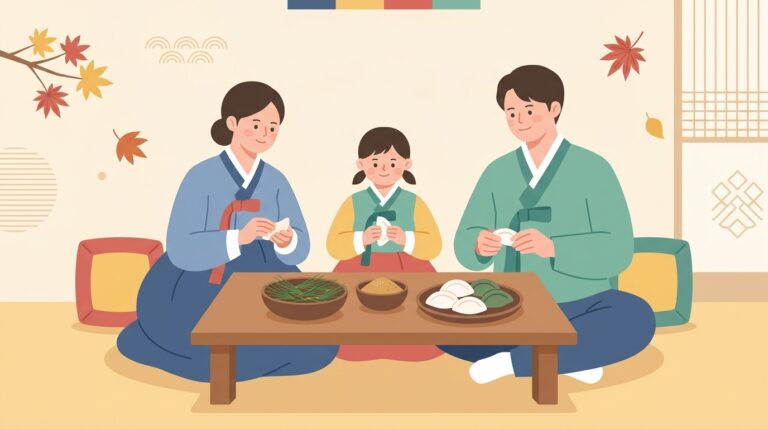
Picture this: You are sitting cross-legged on a silk-bordered mat surrounded by three generations of a Korean family. In front of you sits a fragrant mound of non-glutinous rice dough, a bowl of toasted sesame seeds mixed with dark honey, and a basket of freshly harvested pine needles. Your partner’s grandmother hands you a piece of dough, watching with keen eyes. You carefully pinch and fold it into what you hope resembles a crescent moon, but it ends up looking more like a battered dumpling. Halmeoni bursts into warm laughter, teasing you playfully, while the aunties chime in about whose turn it is to pack the ritual food for tomorrow morning’s seongmyo (성묘, ancestral grave visit).
If you have ever found yourself trapped in this exact high-stakes holiday setting, you know that standard textbook Korean—stiff phrases like “추석은 한국의 대표 명절입니다” (Chuseok is Korea’s representative holiday)—simply won’t cut it. At a C1 level, your challenge is no longer basic comprehension; it is mastering the emotional undercurrents, the delicate communal banter, and the solemn yet warm etiquette that defines Korean ancestral customs. Based on dozens of coaching sessions with advanced learners who dreaded the holiday nunchi (눈치) marathon, this guide equips you with the native nuance, non-verbal cues, and articulate phrasing needed to navigate Chuseok like a cherished insider.
Phase 2: 핵심 표현 3선 심층 분석 (Top 3 Advanced Expressions)
1. 송편을 예쁘게 빚어야 예쁜 딸을 낳는대요 (Songpyeoneul yeppeuge bijeoya yeppeun ttareul nanneundae-yo)
- Pronunciation: [Song-pyeon-eul yep-peu-ge bi-jeo-ya yep-peun tta-reul nan-neun-dae-yo] (Think: “Song-pure-n” with a crisp soft ‘p’, flowing into rhythmic sentence cadence)
- Meaning: Literal: “They say if you shape songpyeon prettily, you will give birth to a pretty daughter.” / Nuanced: The quintessential holiday icebreaker used to playfully praise someone’s delicate handiwork or tease someone making lumpy rice cakes.
- K-Culture Moment: You will hear this in almost every family K-drama holiday special (such as Reply 1988 or Once Again), where unmarried adults or in-laws sit around kneading dough while parents drop subtle hints about marriage and children.
- Editor’s Insight: Even though modern Koreans do not take the superstition literally, quoting this traditional adage shows that you possess deep cultural literacy. It transforms an awkward silence into affectionate family laughter.
- Situation Spectrum:
- Casual (Family/Friends): ✅
- Semi-formal (In-laws/Host family): ✅
- Formal (Public business speech): 🚫
- 🤔 Think About It: Why does Korean culture tie meticulous manual preparation of celebratory food to lineage and generational prosperity? How does this reflect the agrarian roots of Joseon society?
2. 조상님 덕에 올 한 해도 무탈했습니다 (Josangnim deoge ol han haedo mutalhaesseumnida)
- Pronunciation: [Jo-sang-nim deo-ge ol han hae-do mu-tal-haet-seum-ni-da] (Smooth ‘d’ in deok, followed by a soft, reverent tone)
- Meaning: Literal: “Thanks to the ancestors, this past year was without misfortune.” / Nuanced: A graceful, dignified expression of gratitude spoken before or after paying respects at the ancestral gravesite.
- K-Culture Moment: Uttered during solemn family gatherings, or when an elder pours the ceremonial cheongju (refined rice wine) onto the grave mound during a quiet, misty morning ceremony.
- Editor’s Insight: Notice the word 무탈하다 (mutalhada, to be free of accidents or disease). At C1, swapping simple words like 좋았다 (was good) or 괜찮았다 (was okay) for 무탈하다 immediately signals intellectual maturity and deep respect for traditional peace.
- Situation Spectrum:
- Casual: ⚠️ (Sounds overly archaic unless joking)
- Semi-formal: ✅
- Formal (Rituals/Elders): ✅
- 🤔 Think About It: In your native culture, do you attribute personal stability to ancestral protection, personal grit, or divine intervention? How does acknowledging the dead alter social cohesion?
3. 벌초하느라 고생 많으셨어요 (Beolchohaneura gosaeng maneusyeosseoyo)
- Pronunciation: [Beol-cho-ha-neu-ra go-saeng ma-neu-syeot-seo-yo] (Clear ‘b’ with an open ‘eo’ sound as in ‘butter’)
- Meaning: Literal: “You suffered a lot while trimming the grave weeds.” / Nuanced: “Thank you for taking on the grueling physical labor of maintaining our family’s resting place.”
- K-Culture Moment: Said to uncles, cousins, or older relatives who hike deep into mountain ridges with weed trimmers (yechogi) weeks before Chuseok to clear invasive weeds and brush.
- Editor’s Insight: Beolcho (벌초) is one of the most physically demanding filial duties in Korea. Acknowledging this labor with genuine empathy (고생 많으셨어요) builds an instant bond with elder family members who often feel unappreciated for doing the heavy lifting.
- Situation Spectrum:
- Casual: ✅
- Semi-formal: ✅
- Formal: ✅
- 🤔 Think About It: How does physical communal labor reinforce emotional bonds within extended families across generations?
Phase 3: 교과서 한국어 vs 진짜 한국어 (Textbook vs. Real-Life Korean)
Situation 1: Offering to help make Songpyeon
- 📖 교과서 한국어: 제가 송편 만드는 것을 도와드릴까요? (Jega songpyeon mandeuneun geoseul dowadeurilkkayo? – “Shall I help you make songpyeon?”)
- 🗣️ 진짜 한국어: 저도 손 보탤 테니까 요령 좀 알려주세요! (Jeodo son botael tenikka yoryeong jom allyeojuseyo! – “Let me lend a hand; please show me the trick to it!”)
- 💡 왜 다를까?: The textbook version sounds like a formal survey question. Real native speakers use the idiomatic idiom 손을 보태다 (to add a hand / pitch in) paired with 요령 (the knack / insider trick), portraying modesty, enthusiasm, and active engagement.
Situation 2: Expressing appreciation after the ancestral grave service (Seongmyo)
- 📖 교과서 한국어: 산소 방문이 매우 의미 있었습니다. (Sanso bangmuni maeu uimi isseotseumnida. – “The visit to the grave was very meaningful.”)
- 🗣️ 진짜 한국어: 직접 뵙고 인사드리니 마음이 참 든든하고 편안해지네요. (Jikjeop boepgo insadeurini maeumi cham deundeunhago pyeon-anhaejineyo. – “Greeting them in person brings such deep reassurance and peace to my heart.”)
- 💡 왜 다를까?: Using the dry term 산소 방문 (grave visit) objectifies the ritual. Natives personalize the grave as a living encounter using honorifics (직접 뵙고 인사드리다) and introspective emotional adjectives like 든든하다 (feeling deeply grounded and supported).
Phase 4: K-Culture 딥다이브 & 비언어적 매너 (Deep Dive & Non-Verbal Nuance)
4-1. 눈치 (Nunchi) & Physical Protocol
- The Songpyeon Workstation: Never sit back with your arms crossed while elders are preparing dough. Sit down, wash your hands thoroughly in plain sight, and dust your palms with a tiny dab of sesame oil. Even if your shapes look messy, enthusiasm (정성, devotion) always trumps aesthetic perfection.
- The Sacred Mountain Topography: At the ancestral burial mound (bongbun, 봉분), never step on the raised grassy mound. Walk strictly around the flat stone marker (sangseok, 상석). When pouring ritual wine into the cup (jandae), hold the bottle with both hands, the right hand supporting the neck and the left hand gently touching your right wrist or forearm—a timeless gesture of honor.
- The Deep Bow (Jeol, 절): During seongmyo, men and women perform two full deep floor bows followed by a slight standing bow (banjeol). Ensure your head lowers fully, eyes fixed downward, showing zero haste.
4-2. Cultural Code Analysis: Joy, Grief, and Holiday Friction
Korean media frequently portrays Chuseok as a double-edged sword: a heartwarming reunion and a hotbed of “Myeongjeol Jeunghugun” (명절증후군, Holiday Stress Syndrome). Behind the picturesque image of handmade rice cakes lies intense domestic labor, heavy highway traffic jams (gwiseong-gil), and generational friction. When you comprehend that songpyeon is not just food, but the culinary crystallization of women’s tireless labor and ancestral reverence, your conversational tone shifts from light curiosity to profound emotional resonance.
Phase 5: 실전 롤플레이 시나리오 (Interactive Roleplay)
Setting: The sunlit living room of a traditional house in Gyeongju during Chuseok morning, moving later to the family hill plot for seongmyo.
Characters:
* Halmeoni (Grandmother): The warm matriarch with 60 years of songpyeon craftsmanship.
* Minho (Cousin): An easygoing college cousin who is secretly dreading the hike up the mountain.
* You (Advanced Learner): A respectful foreign guest visiting for the holiday.
- 할머니: 어서 와라. 어디 우리 손님, 송편 한번 야무지게 빚어볼 테냐?
(Eoseo wara. Eodi uri sonnim, songpyeon hanbeon yamujige bijeobol tenya?)
“Welcome in! Shall our guest try shaping some songpyeon with skill?”
🎭 [Dough bowl sliding toward you with an encouraging grin] -
You: 네, 할머니! 예쁘게 빚어야 예쁜 딸 낳는다고 하던데, 최선을 다해보겠습니다.
(Ne, halmeoni! Yeppeuge bijeoya yeppeun ttal nanneundago hadeonde, choeseoneul dahae-bogeotseumnida.)
“Yes, Grandmother! I heard shaping pretty songpyeon yields a pretty daughter; I’ll give it my absolute best!”
🎭 [Smiling brightly while rolling dough into a sphere] -
민호: 와, 형/누나 멘트 완전 토종 한국인인데요? 깨소금 너무 많이 넣으면 터지니까 조심해요!
(Wa, hyeong/nuna menteu wanjeon tojong hangugindeeyo? Kkaesogeum neomu mani neoeumyeon teojinikka josimhaeyo!)
“Whoa, your comeback is 100% native Korean! Be careful not to stuff too much sesame sugar, or it’ll burst!”
🎭 [Giggling while wiping flour off his cheek] -
You: 터지면 제 복도 터지는 거 아닌가 몰라요. 할머니, 이 정도 반죽 두께면 적당한가요?
(Teojimyeon je bokdo teojineun geo aninga mollayo. Halmeoni, i jeongdo banjuk dukkyemyeon jeokdanghangayo?)
“If it bursts, I hope my good fortune bursts open too! Grandmother, is this dough thickness just right?”
🎭 [Tilting head modestly, presenting the shaped dough] -
할머니: 아이고, 손끝이 맵고 야무지네! 자, 다 쪘으니 솔향 배게 솔잎 위에 올리자꾸나.
(Aigo, sonkkeuti maepgo yamujine! Ja, da jjeosseuni solhyang baege sorip wie ollijakkuna.)
“My goodness, you have remarkably deft fingers! Right, they are steamed; let’s place them on the pine needles to infuse the aroma.”
🎭 [Affectionately patting your forearm] -
민호: 이제 벌초 끝난 산소로 성묘 갈 시간이에요. 트렁크에 돗자리랑 제수음식 실을게요.
(Ije beolcho kkeunnan sansoro seongmyo gal siganieyo. Teureongkeue dotjarirang jesu-eumsik sireulgeyo.)
“Time to head up to the grave now that the trimming is done. I’ll load the mat and ritual food in the trunk.”
🎭 [Grabbing the heavy cooler box] -
You: 민호 씨, 벌초하느라 고생 많았을 텐데 짐은 제가 들게요. 조상님 뵈러 가시죠.
(Minho ssi, beolchohaneura gosaeng manasseul tende jimeun jega deulgeyo. Josangnim boereo gasijyo.)
“Minho, you worked so hard weeding the gravesite; let me carry the bags. Let’s go greet the ancestors.”
🎭 [Taking the heavy load effortlessly] -
할머니: 마음 씀씀이가 참 고맙구나. 올 한 해도 우리 식구들 다 무탈하겠어.
(Maeum sseumsseumiga cham gomapguna. Ol han haedo uri sikgudeul da mutalhagesseo.)
“What a thoughtful heart you have. Our entire family will surely be safe and sound this year.”
🎭 [Looking at you with deep pride and contentment]
🔀 인터랙티브 분기점 (Interactive Fork)
At the gravesite, Halmeoni offers you the ceremonial brass wine cup (jak) after bowing.
* Choice A: Take it with one hand, swallow the entire drink quickly, and exclaim “원샷!” (One shot!).
* Choice B: Receive the cup using two hands, turn your body slightly away to sip a small portion (eumbok, 음복), and pour the remainder gently around the edge of the mound.
* Choice C: Refuse the cup instantly, saying: “술은 건강에 안 좋아서 사양하겠습니다” (I decline because alcohol is bad for health).
Detailed Feedback:
* Choice A (Risk): 🚫 Disastrous. Calling “one-shot” at a grave site transforms a sacred ancestral sacrament into a chaotic college fraternity party.
* Choice B (Best): ✅ Flawless! Turning your torso slightly respects the elders present, and sharing the wine (eumbok) signifies receiving ancestral blessings.
* Choice C (Bad): ⚠️ If you don’t drink alcohol, simply raise the cup to your lips politely, pretend to sip, and hand it back to be poured onto the soil. Outright medical lectures ruin the spiritual harmony.
Phase 6: 10초 감정 섀도잉 드릴 (Emotional Shadowing Drill)
Read these aloud, pausing strictly at / and adopting the indicated emotional nuance:
[😊 Playfully modest, light laughter]
“송편 모양은 삐뚤빼뚤하지만 / 정성만큼은 / 일등이에요!”
(Songpyeon moyangeun bbittul-bbaettulhajiman / jeongseongmankeumeun / ildeung-ieyo!)
“My songpyeon might look crooked, / but my sincere heart / takes first place!”-
[🙇♂️ Solemn, calm, deep reverence]
“조상님 덕분에 / 올 한 해도 / 큰 탈 없이 평안했습니다.”
(Josangnim deokbune / ol han haedo / keun tal eopsi pyeong-anhaesseumnida.)
“Thanks to our ancestors, / this past year / has been peaceful without major misfortune.” -
[🤝 Empathetic, warm camaraderie]
“이 험한 산길까지 / 벌초하시느라 / 얼마나 땀을 흘리셨어요.”
(I heomhan sanggilkkaji / beolchohasineura / eolmana ttameul heullisyeosseoyo.)
“Coming all the way up this rugged path / to trim the weeds— / how hard you must have sweated!”
Phase 7: K-Culture 미니 사전 (Cultural Lexicon)
-
벌초 [Beolcho] | Ancestral Grave Weeding
The rigorous seasonal custom of weeding and tidying the ancestral burial mounds before Chuseok. Neglecting beolcho is traditionally viewed as a sign of unfilial impiety (bulhyo, 불효). -
차례 [Charye] | Holiday Ancestral Tea Service
A simplified ancestral ritual performed on the morning of major holidays (Chuseok and Seollal), distinct from Gijeosa (memorial services performed on the specific death anniversary). -
음복 [Eumbok] | Partaking in Sacrificial Food & Drink
Literally “drinking the blessings.” Eating the food and wine that was offered to the ancestral spirits, believing their benevolence and luck are ingested into the living family. -
솔잎 [Sorip] | Pine Needles
Fresh pine needles layered in the steamer beneath songpyeon. Beyond infusing a forest aroma, the natural phytoncides prevent the rice cakes from spoiling during the warm harvest season.
Phase 8: 여행자를 위한 생존 키트 (Survival Kit for Travelers)
Top 3 Survival Phrases
- 한식 참 좋아하는데, 송편 속은 뭐가 들어갔어요?
(Hansik cham joahaneunde, songpyeon sogeun mwoga deureogasseoyo?)
Pro Tip: Songpyeon fillings vary between toasted sweet sesame (kkae), whole chestnuts (bam), and mung bean paste (dongbu). Ask this to avoid surprising your palate! - 성묘 드릴 때 절은 몇 번 올리면 되나요?
(Seongmyo deuril ttae jeoreun myeot beon ollimyeon doenayo?)
Pro Tip: For ancestors, it is strictly two full bows (dua-jeol). Living people receive only one bow during celebrations like New Year’s Day! - 가족분들과 뜻깊은 한가위 보내세요.
(Gajokbundeulgwa tteutgipeun hangawi bonaeseyo.)
Pro Tip: The ultimate high-level holiday text to send to Korean colleagues and friends on Chuseok eve.
Editor’s Travel Note
- During Chuseok, national train tickets sell out within minutes months in advance. Keep an eye on the official 코레일 KTX 명절 승차권 예매 페이지 for canceled standby tickets.
- If you are in Seoul while families leave the capital, check the 국립중앙박물관 추석 특별 문화 축제 안내 to experience free royal court games, songpyeon crafting workshops, and traditional percussion performances.
Phase 9: “한 발 더 깊이” (Cultural Essay)
Chuseok is frequently translated as the “Korean Thanksgiving,” but this parallel obscures its profound existential texture. Western Thanksgiving commemorates a historical harvest feast shared between settlers and indigenous peoples. In contrast, Chuseok is an ongoing dialogue with lineage—an intimate reconciliation of life and death.
By hiking up untamed mountain slopes to carefully shear unruly weeds (beolcho) and sharing sacrificial rice wine (eumbok) over the soil, Koreans reaffirm that the living are merely temporary caretakers of an unbroken chain. It reminds modern, hyper-digitalized Koreans that they do not walk the earth alone; their accomplishments and endurance are shared with those who cleared the path before them.
💬 Your Turn: Does your culture honor forebears with food and physical remembrance, or is memory an internal, private practice? Share your story in the comments below!
Phase 10: FAQ & 오해 방지 (FAQ & Common Traps)
Q: Can foreigners participate in the actual bowing (jeol) during Seongmyo?
A: Absolutely! Korean families deeply appreciate foreign guests who show willingness to bow. However, if your personal faith forbids bowing to ancestral tablets, stand quietly and reverently with hands clasped in front of you—families will respect your thoughtful presence.
Q: Why do we put pine needles in the steamer? Can we eat them?
A: Do not eat the pine needles! They serve two scientific purposes: imparting a subtle pine resin aroma (solhyang) and providing natural bactericidal preservation against spoilage. Peel them off the warm dough before eating.
Q: What should I wear if I am invited to participate in Seongmyo?
A: Avoid bright neon clothing, shorts, sandals, or heavy perfumes. Wear comfortable hiking pants and sturdy sneakers, as family burial plots are often located on steep, unpaved mountain ridges covered in loose gravel and wild grass.
🚨 Common Mistakes Warning Board
- Mistake: Stepping onto the grassy mound (bongbun) to take photos.
- Correct Action: Remain strictly on the flat soil or stone altar terrace.
- Mistake: Bowing only once to ancestors at the grave.
- Correct Action: Deceased ancestors receive two full bows, followed by a slight standing nod.
- Mistake: Throwing leftover songpyeon into the kitchen trash in front of the family.
- Correct Action: Food waste is meticulously separated in Korea. Place leftovers in a sealed container for the freezer.
Phase 11: 액션 미션 & 참여 유도 (Action Missions)
- 🥉 Bronze Mission: Practice saying “조상님 덕에 올 한 해도 무탈했습니다” three times with steady, deep intonation in front of a mirror.
- 🥈 Silver Mission: Find a local Korean bakery (tteokjip) this autumn, buy songpyeon, and share a photo using the hashtag
#DailyHangulChuseok. - 🥇 Gold Mission: Send a message to a Korean mentor or acquaintance wishing them “뜻깊고 풍요로운 한가위 보내시길 바랍니다” before the holiday week ends.
- 🎮 K-Culture Mission: Watch Episode 8 of Reply 1988 and notice the subtle non-verbal ways neighbors exchange seasonal food plates across their courtyard doors.
Phase 12: 인터랙티브 퀴즈 챌린지 (Interactive Quiz)
1. Situational Judgment: You are molding songpyeon with elders and notice your shape is noticeably misshapen. What is the most culturally charming response?
* (A) “이거 망했네요, 전 그냥 안 할래요.” (This is ruined; I just won’t do it.)
* (B) “송편 모양은 이래도, 속마음만큼은 꽉 찼습니다!” (The shape might look like this, but my heart is stuffed full!)
* (C) “한국 떡은 서양 빵보다 만들기 비효율적이에요.” (Korean rice cakes are less efficient to make than Western bread.)
2. Fill-in-the-Blank: At the ancestral grave, completing physical labor is acknowledged by saying:
“무더운 날씨에 산에 올라가서 ______하느라 고생 많으셨어요.”
3. True or False: During Chuseok ancestral rituals (Seongmyo / Charye), participants bow once to show respect to their ancestors.
👉 Click to reveal answers & explanations!
-
Answer: (B)
Explanation: Admitting aesthetic imperfection with wit and warmth (정성, devotion) endears you to elders instantly, whereas (A) sounds childish and (C) is offensive. -
Answer: 벌초 (Beolcho)
Explanation: 벌초 refers to cutting and clearing wild weeds around family graves before the holiday. -
Answer: False
Explanation: Ancestral etiquette strictly requires two deep floor bows (i-bae, 이배). A single bow is reserved exclusively for the living!







