

Phase 1: Empathy (Story-Immersive Opening)
안녕하세요! 매일한글 에디터입니다.
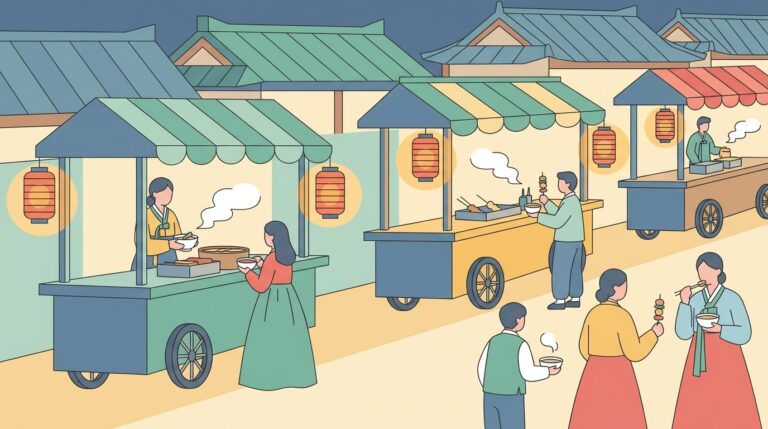
Picture this: You step through the entrance of Seoul’s Mangwon Market on a brisk Friday evening. The air is thick with the irresistible aroma of sizzling bindaetteok (mung bean pancakes), golden fried chicken, and sweet cinnamon hotteok. Neon signs glow, cart wheels clatter, and friendly stall owners belt out rhythmic calls: “Eoseo ose-yo!” (어서 오세요! / Welcome!). Around you, students, grandparents, and foodies weave through the narrow alleyway in a shoulder-to-shoulder dance of pure vitality.
You want to turn to your Korean friend and marvel at how alive, packed, and vibrant this place is. But your mind freezes. In your textbook, you memorized stiff vocabulary like honjaphamnida (it is congested), which sounds like a somber traffic report on the evening news! You want to say, “Wow, it’s so bustling and full of life!” without sounding like a robotic GPS.
Don’t worry—you are not alone. As an editor at Daily Hangul for over a decade, I’ve seen countless A2 learners hit this exact linguistic wall. Today, we’re unlocking the lively, warm phrases native speakers actually use when taking in the electric atmosphere of a traditional market. Master these three simple expressions, and you’ll transform from an awkward onlooker into an insider who truly feels the pulse of Korea!
Phase 2: Core 3 Expressions In-Depth Analysis
1. 사람이 진짜 많아요! (Saram-i jinjja manayo!)
- Pronunciation: [Sah-rahm-ee jeen-jjah mah-nah-yoh] (Think of ‘saram’ like ‘serum’ with an open ‘ah’, and ‘jinjja’ with a crisp, punchy double-j sound like ‘jeans’.)
- Meaning:
- Literal: People are really many.
- Real Nuance: “There are so many people here!” / “Look at this crowd!”
- K-Culture Moment: Seen constantly on K-variety shows like Running Man or food travel vlogs when the cast arrives at a trending night market.
- Editor’s Insight: For A2 learners, this is your trusty foundation. By adding 진짜 (jinjja, really), you inject instant emotion. It’s warm, observational, and completely natural.
- Situation Spectrum: Casual ✅ | Semi-formal ✅ | Formal ⚠️
- 🤔 Think About It: English speakers often say “It’s so crowded,” which can sometimes carry a negative or claustrophobic tone. In Korean, noticing a crowd (사람이 많다) is often an admiring acknowledgment that a place is popular and thriving.
2. 북적북적해요 (Bukjeok-bukjeokhaeyo)
- Pronunciation: [Book-jeok-book-jeok-hae-yoh] (Rhythmically bounce between ‘book’ and ‘juck’ like the chugging beat of a train: book-juck-book-juck!)
- Meaning:
- Literal: It does bukjeok-bukjeok (onomatopoeic/mimetic sound for a milling crowd).
- Real Nuance: “It’s so bustling!” / “It’s buzzing with people!”
- K-Culture Moment: The cozy market scenes in K-dramas like Hometown Cha-Cha-Cha or When the Camellia Blooms, where villagers gather at fish and vegetable stalls.
- Editor’s Insight: This word uses Korean mimetic magic (uitaeeo). Repeating 북적 twice mimics the happy shuffling of shoes and rustling coats. It carries an affectionate, lively vibe rather than an annoying one.
- Situation Spectrum: Casual ✅ | Semi-formal ✅ | Formal 🚫
- 🤔 Think About It: Does your native language have sound-words that specifically describe pleasant crowds? Notice how Korean turns sensory chaos into a rhythmic melody.
3. 활기차요 (Hwalgichayo)
- Pronunciation: [Hwal-gee-chah-yoh] (Pronounce ‘hwal’ like an exhaled ‘hual’, with ‘gi’ sounding like ‘geek’ without the ‘k’, and ‘cha’ like ‘chai’ tea without the ‘i’.)
- Meaning:
- Literal: It is filled with lively energy.
- Real Nuance: “It’s so vibrant!” / “The energy here is amazing!”
- K-Culture Moment: Often uttered by travel show hosts entering sunrise fish markets in Busan or vibrant food streets in Daegu.
- Editor’s Insight: Rooted in Sino-Korean characters (Hwal = life/vitality, Gi = energy), this adjective sounds slightly more refined while remaining completely accessible for beginners.
- Situation Spectrum: Casual ✅ | Semi-formal ✅ | Formal ✅
- 🤔 Think About It: Koreans love describing environments by their Gi (기, vital life force). When a market is active, you are literally celebrating its living breath.
Phase 3: Textbook Korean vs. Real Korean
Situation 1: Walking into a jam-packed snack lane
- 📖 Textbook Korean: 이곳은 매우 혼잡합니다. (Igos-eun maeu honjapamnida. / “This location is extremely congested.”)
- 🗣️ Real Korean: 와, 여기 사람 진짜 많네요! (Wa, yeogi saram jinjja manneyo! / “Wow, there are so many people here!”)
- 💡 Why is it different? 혼잡하다 (honjaphada) belongs on subway warning monitors or safety announcements. Adding exclamation 와 (wa!) and the surprise ending -네요 (-neyo) captures your spontaneous delight as a human explorer.
Situation 2: Squeezing politely past shoppers near a hotteok stall
- 📖 Textbook Korean: 실례합니다, 지나가겠습니다. (Sillyehamnida, jinagagess-eumnida. / “Pardon me, I shall pass through.”)
- 🗣️ Real Korean: 잠시만 지나갈게요~ (Jamsiman jinagalgeyo~ / “Just squeezing past for a moment~”)
- 💡 Why is it different? Ultra-formal textbook phrasing can create awkward social distance. A soft, lilting 잠시만 지나갈게요~ signals mutual cooperation in tight market alleys.
Phase 4: K-Culture Deep Dive & Non-Verbal Manners
4-1. 눈치 (Nunchi) & Body Gestures in the Market
In a bustling market, your body speaks before your mouth does. When paths cross in narrow alleys, do not aggressively weave or freeze. Instead, pull your elbows slightly inward, tilt your head in a micro-bow (목례, mongnye), and extend one hand lightly forward with your palm facing sideways—like a gentle knife slicing through water. This universal Korean gesture visually says: “I see you, I respect your space, just gliding by!”
4-2. Cultural Code: The Warmth of “Jeong” (정) amidst Noise
Western crowds can sometimes feel impersonal or stressful. But a traditional Korean market thrives on Jeong (정)—the invisible bond of empathy and collective affection. The vendors calling out, the clattering ladles, and the shoulder brushes aren’t intrusions; they are communal warmth. Calling the scene 북적북적해요 signals to the stall owners that you appreciate the market’s hard-working spirit.
Phase 5: Real Role-Play Scenario
Setting: Gwangjang Market at 6:30 PM. The fryers are sizzling with golden mung bean pancakes. You and a stall vendor (Imo, or “Auntie”) strike up a quick chat.
- Imo (Vendor): 어서 와요! 빈대떡 하나 먹고 가요! (Eoseo wayo! Bindaetteok hana meokgo gayo!)
🎭 Tossing a crispy golden pancake onto the display rack with a warm grin.
(Welcome! Come have a mung bean pancake!) -
Learner: 와, 여기 사람 진짜 많네요! (Wa, yeogi saram jinjja manneyo!)
🎭 Looking around wide-eyed with an appreciative smile.
(Wow, there really are so many people here!) -
Imo (Vendor): 오늘 불금이라 시장이 아주 북적북적하지? (Oneul bulgeum-ira sijang-i aju bukjeok-bukjeokhaji?)
🎭 Wiping down a tiny plastic stool and patting it for you.
(It’s ‘Fire Friday’, so the market is super bustling, right?) -
Learner: 네! 분위기가 정말 활기차요. (Ne! Bunwigiga jeongmal hwalgichayo.)
🎭 Nodding enthusiastically while taking a seat.
(Yes! The atmosphere is really vibrant.) -
Imo (Vendor): 시장은 이런 맛에 오는 거지! 뭐 줄까, 학생? (Sijang-eun ireon mas-e oneun geoji! Mwo julkka, haksaeng?)
🎭 Handing over a pair of wooden chopsticks.
(That’s the real charm of markets! What can I get you, student?) -
Learner: 빈대떡 하나랑 사이다 하나 주세요. (Bindaetteok hanarang saida hana juseyo.)
🎭 Holding up one finger politely.
(One mung bean pancake and one cider/lemon-lime soda, please.) -
Imo (Vendor): 금방 부쳐줄게, 잠시만 기다려요~ (Geumbang buchyeojulge, jamsiman gidaryeoyo~)
🎭 Pouring fresh batter onto the sizzling grill.
(I’ll fry it fresh right now, wait just a moment~) -
Learner: 네, 감사합니다! (Ne, gamsahamnida!)
🎭 Clasping hands gently on the counter with a happy bow.
(Yes, thank you!)
🔀 Interactive Choice Point
You finish your meal, and the lane behind your stool is now jam-packed with people waiting. How do you get through the line to exit?
- Choice A: Yell loudly: 저기요! 비키세요! (Jeogiyo! Bikiseyo! / “Hey, get out of the way!”)
- Choice B: Softly say with a slight bow: 죄송합니다, 잠시만 지나갈게요~ (Joesonghamnida, jamsiman jinagalgeyo~ / “Excuse me, passing through for a moment~”)
- Choice C: Push through in absolute silence while staring down at your phone.
Feedback:
* Choice A (Bad): 🚫 Ouch! 비키세요 is blunt, rude, and confrontational. You’ll instantly chill the warm market mood.
* Choice B (Best): 🌟 Perfect! You combined basic courtesy (죄송합니다) with smooth forward movement (지나갈게요). People will gladly part like the Red Sea.
* Choice C (Risk): ⚠️ High risk of bumping into someone holding a piping-hot cup of tteokbokki! Never walk silently through a crowd without acknowledging others.
Phase 6: 10-Second Emotion Shadowing Drill
Practice these lines with exaggerated intonation and rhythm! Follow the / pauses.
[😮 Wonderstruck & Delighted]
와, / 사람 진짜 많네요!
(Wa, / saram jinjja manneyo!)-
[😊 Cozy & Warm-hearted]
시장이 / 북적북적해서 / 좋아요.
(Sijang-i / bukjeok-bukjeokhaeseo / joayo.)
(I like that the market is bustling.) -
[🙏 Polite yet Confident]
실례합니다, / 잠시만 / 지나갈게요~
(Sillyehamnida, / jamsiman / jinagalgeyo~)
Phase 7: K-Culture Mini Dictionary
- 시장 (Sijang) | Traditional Market | Refers specifically to open-air or sheltered local stalls, distinct from modern supermarkets (마트, mateu).
- 불금 (Bulgeum) | “Fire Friday” (TGIF) | Compound of 불 (fire) and 금요일 (Friday). Traditional food markets surge with office workers and friends starting Friday evening.
- 인산인해 (Insan-inhae) | A sea of people | A classic four-character idiom (사자성어) literally meaning “people make mountains, people make seas.” Perfect when describing massive weekend festival crowds!
- 정 (Jeong) | Warm communal affection | The deep feeling of emotional connection, seen when market vendors give free extra snacks (서비스, seobiseu).
Phase 8: Survival Kit for Travelers
Top 3 Survival Expressions
- 여기 진짜 북적거리네요! (Yeogi jinjja bukjeokgeorineyo! / “It’s really buzzing here!”)
Pro Tip: Say this to fellow patrons sharing your communal bench to instantly break the ice. - 계산은 어디서 해요? (Gyesan-eun eodiseo haeyo? / “Where do I pay?”)
Pro Tip: At bustling open stalls, pay immediately when your food arrives or right after you finish eating. - 계좌이체 돼요? (Gyejwa-iche dwaeyo? / “Can I do a bank transfer?”)
Pro Tip: While many vendors take cards now, small food stalls love bank transfer or cash.
Editor’s Travel Note
- Navigation: Never rely on Google Maps in Korea! Always download the Naver Map app for smooth Korean navigation to find hidden market stalls and subway exits accurately.
- Payment & Transport: Keep a small stash of 1,000 KRW and 5,000 KRW bills handy for smaller street vendors. For your metro ride back, ensure your card is loaded using the official Seoul Metro subway information guide.
Phase 9: “One Step Deeper” (Cultural Reflection)
In hyper-modern, digitalized Korean cities filled with sleek high-rises and automated self-checkouts, why do Koreans still gravitate toward noisy traditional markets? The answer lies in the craving for human texture. When a vendor asks, “밥은 먹었어?” (Did you eat?) and presses extra food into your bag, you are experiencing the resilient heartbeat of community life that technology cannot replicate. Traditional markets remind us that crowded spaces do not have to feel lonely.
💬 Your Turn: What does a bustling market feel like in your home country? Does it feel exciting or overwhelming? Share your thoughts in the comments below!
Phase 10: FAQ & Avoiding Misunderstandings
Q: Can I use “복잡해요 (bokjaphaeyo)” to describe a market crowd?
A: Yes, but be careful! 복잡해요 usually means “complicated” or uncomfortably “crowded/chaotic.” If you want to say the place is buzzing with positive energy, 북적북적해요 or 활기차요 sounds much warmer.
Q: Is it rude to say “사람이 많아요” to a stall owner?
A: Not at all! In Korean market culture, saying “사람이 많네요!” (There are so many people!) sounds like a compliment meaning “Business is thriving!”
Q: What is the polite way to ask for a seat when stalls are packed?
A: Simply point gently to an empty spot and ask: “여기 앉아도 돼요?” (Yeogi anj材质ado dwaeyo? / Can I sit here?).
🚨 Common Mistakes Alert!
- Mistake: Calling an older female vendor 아줌마 (Ajumma) aloud.
Correct Action: Use the much friendlier, flattering title 이모 (Imo – Auntie) or 사장님 (Sajangnim – Boss/Owner). - Mistake: Standing motionless in the middle of a lane to film a 3-minute video.
Correct Action: Step slightly under stall awnings or near pillar bases to film without blocking elderly shoppers carrying market carts. - Mistake: Shouting “여기요!” at maximum volume.
Correct Action: Raise your hand with eye contact and a moderate “저기요~” (Jeogiyo~) during a brief lull in frying sounds.
Phase 11: Action Mission & Engagement
- 🥉 Bronze Mission: Stand in front of your mirror and practice saying: 와, 사람 진짜 많네요! with high energy 3 times.
- 🥈 Silver Mission: Post a picture of your favorite busy street or cafe on Instagram or X, captioning it: “오늘 여기 완전 북적북적해요! 🇰🇷” and tag @DailyHangul.
- 🥇 Gold Mission: Visit a local Korean supermarket (like H-Mart) or traditional market in Korea this week, make eye contact with a food counter vendor, and say: “오늘 활기차네요!”
🎮 K-Culture Mission: Watch an episode of Gwangjang Market Food Tour on YouTube or a scene from Street Food: Asia (Seoul) on Netflix. Spot how many times you hear the words 사람 (saram) and 많다 (manta)!
Phase 12: Interactive Quiz Challenge
Test your market street-smarts! Check your answers using the toggle below.
1. Situation Decision: You arrive at an outdoor market on Saturday night. The crowd is moving happily, musicians are busking, and vendors are smiling. Which sentence best describes the positive vibe?
* A) 여기 너무 복잡해서 짜증나요. (Yeogi neomu bokjaphaeseo jjajeungnayo.)
* B) 시장이 정말 북적북적하고 활기차요! (Sijang-i jeongmal bukjeok-bukjeokhago hwalgichayo!)
* C) 사람이 아무도 없어요. (Saram-i amudo eopseoyo.)
2. Fill-in-the-Blank: Complete this handy polite passing phrase:
“실례합니다, 잠시만 [ _______ ]~” (Passing through for just a moment)
* Hints: ① 지나갈게요 (jinagalgeyo) | ② 가지마세요 (gajimaseyo)
3. True or False: Saying “사람이 진짜 많네요!” to a restaurant owner in Korea sounds like an insult about poor crowd management.
* True / False
👉 Click to reveal answers & explanations!
-
Answer: B
Explanation: B captures the happy, lively buzz (북적북적하고 활기차요). Option A means “It’s too crowded and annoying,” and Option C means “There is nobody here!” -
Answer: ① 지나갈게요 (jinagalgeyo)
Explanation: 지나가다 means ‘to pass by/through’. Option ② means ‘Please do not go!’ -
Answer: False
Explanation: It is considered a warm compliment! It highlights how popular and beloved their business is.






