

안녕하세요! 매일한글 에디터입니다.
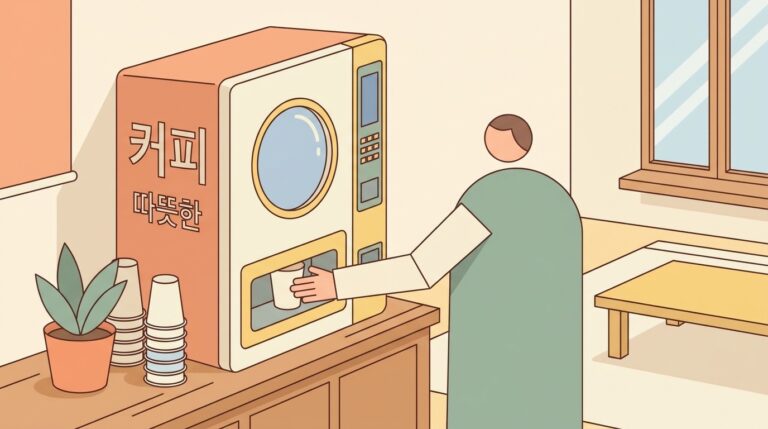
Have you ever stood in front of a classic Korean paper-cup coffee vending machine (자판기) after a hearty meal? You slide in a crisp 1,000-won bill or tap your transit card, press the button for a sweet instant mix coffee (믹스커피), and then… before the machine even whirs to life, you notice your Korean friend’s hand already diving deep into the dispensing slot. They stand there, hand submerged inside the dark flap, waiting for the paper cup to drop, the hot water to trickle, and the chime to ring. To an outsider, it looks borderline dangerous—or at least amusingly frantic. What if the hot water spills? Why can’t we just wait five seconds? Welcome to the ultimate physical embodiment of Korea’s legendary Pali-Pali (빨리빨리 – hurry, hurry!) culture.
Many intermediate Korean learners reach the B2 level knowing textbook grammar for expressing urgency, yet they stumble when trying to navigate the subtle social choreography of impatience in daily life. You might know words like 서두르다 (to hurry), but do you know how to laugh off your own impatience, acknowledge someone else’s frantic pace without sounding rude, or bond over the shared national obsession with saving three seconds? Based on questions from hundreds of our Daily Hangul learners who felt bewildered by this micro-behavior, this guide unpacks the linguistic and cultural nuances behind Korea’s fastest habits so you can speak, think, and react like a seasoned local.
Phase 2: 3 Core Expressions in Depth
1. 마음이 급하다 (Mae-um-i geup-ha-da)
- Pronunciation: [Mae-um-i geup-ha-da] (Think of mae-um like “may-oom” and geup like the “gup” in “gulp” cut short)
- Meaning: Literally “The mind/heart is hurried” vs. Pragmatic nuance: “To be impatient / to rush mentally”
- K-Culture Moment: Often uttered in K-dramas when a character spills coffee all over their white shirt because they tried to pull the cup out before the dispenser finished dispensing.
- Editor’s Insight: Unlike merely saying “I am busy” (바빠요), this describes an internal psychological surge of haste. Koreans use this reflexively when explaining why they made a silly, clumsy mistake due to impatience.
- Situation Spectrum: Casual (✅) / Semi-formal (✅) / Formal (✅)
- 🤔 Think About It: Why does Korean grammar externalize impatience as the “heart/mind being urgent” rather than simply saying “I am an impatient person”?
2. 성미가 급하다 (Seong-mi-ga geup-ha-da)
- Pronunciation: [Seong-mi-ga geup-ha-da] (Seong rhymes with “song”, mi as in “me”, geup as “gup”)
- Meaning: Literally “One’s temperament is urgent” vs. Pragmatic nuance: “To be hot-headed / naturally quick-tempered / unable to stand waiting”
- K-Culture Moment: In variety shows like Running Man, cast members tease someone who pushes the elevator ‘close’ button ten times by calling them 성미가 급하다.
- Editor’s Insight: At the B2 level, replace the generic 성격이 급하다 with 성미가 급하다 when you want to sound more vivid and culturally authentic. It points specifically to an innate itch for speed.
- Situation Spectrum: Casual (✅) / Semi-formal (✅) / Formal (⚠️ Use with superiors requires caution as it can imply a personality flaw)
- 🤔 Think About It: In your home culture, is having a hasty temperament considered entirely negative, or are there contexts where it is praised as efficient?
3. 손부터 나가다 (Son-bu-teo na-ga-da)
- Pronunciation: [Son-bu-teo na-ga-da] (Son sounds like “sawn”, bu-teo sounds like “boo-tuh”)
- Meaning: Literally “One’s hand goes out first” vs. Pragmatic nuance: “To react physically before thinking / to grab instinctively without waiting”
- K-Culture Moment: Exactly what happens at vending machines or barbecue grills when someone reaches for the meat before it’s fully cooked.
- Editor’s Insight: This is a delightfully descriptive idiomatic pattern. It highlights the bodily reflex that precedes cognitive patience—a hallmark of Korean day-to-day pacing.
- Situation Spectrum: Casual (✅) / Semi-formal (✅) / Formal (🚫 Too colloquial for formal speeches)
- 🤔 Think About It: What daily physical reflexes in your culture reveal collective subconscious habits?
Phase 3: Textbook Korean vs. Real Korean
Scenario 1: Waiting for the Vending Machine or Microwave to Finish
- 📖 교과서 한국어 (Textbook): 아직 음료가 다 나오지 않았으니 잠시만 기다리세요. (Ajik eumnyoga da naoji anasseuni jamsiman gidariseyo. – “The beverage has not finished dispensing, so please wait a moment.”)
- 🗣️ 진짜 한국어 (Real-life): 아, 현기증 나니까 손부터 집어넣지 마요! (A, hyeonggijeung nanikka sonbuteo jibeoneotji mayo! – “Ah, you’re making me dizzy, stop sticking your hand in there first!”)
- 💡 왜 다를까? (Why the difference?): Textbook dialogues maintain polite instructional detachment, whereas real Koreans playfully exaggerate distress (현기증 나다 – feeling faint/dizzy from watching someone’s impatience) to tease each other’s hasty reflexes.
Scenario 2: Cautioning a Friend Who Might Get Burned by Hot Liquid
- 📖 교과서 한국어 (Textbook): 뜨거운 음료에 화상을 입을 수 있으니 주의하십시오. (Tteugeoun eumnyoe hwasang-eul ibeul su isseuni juuihasipsio. – “Be careful as you may suffer burns from hot beverages.”)
- 🗣️ 진짜 한국어 (Real-life): 그러다 손 데여요! 삐 소리 나면 꺼내요. (Geureoda son deyeoyo! Ppi sori namyeon kkeonaeyo. – “You’ll burn your hand doing that! Pull it out after the beep!”)
- 💡 왜 다를까? (Why the difference?): Native speakers rely on quick conditional warnings using 그러다 (~ing like that, something bad happens) followed by onomatopoeia (삐 소리 – the beep) for direct, sensory-driven instructions.
Phase 4: K-Culture Deep Dive & Non-Verbal Manners
4-1. 눈치 (Nunchi) & Physical Body Language
When standing before a vending machine or waiting for an order at an automated kiosk in Korea, notice the micro-gestures. A Korean who has succumbed to Pali-Pali mode exhibits a distinctive stance: weight shifted slightly forward onto the balls of the feet, eyes locked onto the dispensing flap, right arm bent at a 90-degree angle with fingers already gently pushing open the plastic door flap.
However, good 눈치 (social situational awareness) demands a balance: if you are sharing a machine with colleagues, diving your hand into the slot too aggressively can make you look agitated or childish. The polite posture is relaxed vigilance: rest your hand nearby, wait for the chime, and smoothly retrieve the cup without lingering. If you accidentally reach in at the same moment as someone else, immediately retract your hand with a short chuckle and say, “어우, 마음이 너무 급했네요!” (Eou, maeumi neomu geupaenneyo! – “Oh dear, my impatience got the better of me!”).
4-2. Cultural Code: The Instant Coffee Dispenser as a National Metaphor
The humble 300-won paper-cup machine gained ubiquitous status during Korea’s explosive economic sprint in the late 20th century. In offices, construction sites, and bus terminals, the instant mixed coffee—pioneered by brands like Dongsuh Maxim—was fuel for rapid modernization. Waiting 15 seconds for a machine to dispense powdered coffee became the baseline test of human patience. In workplace dramas like Misaeng (미생), the break-room vending machine is not merely a drink station; it represents the shared pressure cooker of corporate life where even a 10-second pause feels like dead time. Reaching into the slot is a collective cultural joke—a subconscious celebration of saving a mere two seconds.
Phase 5: Real-Life Roleplay Scenario
Setting: A small highway rest stop (휴게소) on the way to Gangneung. You and your Korean coworker, Manager Kim (김 대리), have stopped to stretch your legs.
Character: Manager Kim is an energetic 30-something who downs three iced Americanos before lunch and is notorious for walking fast.
- Turn 1 (Kim): 날씨도 쌀쌀한데, 자판기 믹스커피 한잔 뽑아 마실까요? (Nalssido ssalssalhande, japangi mikseukeopi hanjan ppoba masilkkayo?)
- “It’s a bit chilly—shall we grab a paper-cup mix coffee from the machine?”
- 🎭 Rubbing hands together and jingling coins eagerly.
- Turn 2 (You): 좋죠! 오랜만에 달달한 다방 커피 스타일 당기네요. (Jotjyo! Orenmane daldalhan dabang keopi seutail danggineyo.)
- “Sounds great! I’ve been craving that sweet old-school café style coffee for a while.”
- 🎭 Stepping toward the vending machine with a grin.
- Turn 3 (Kim): 제가 쏠게요. 동전 넣고… 자, 밀크커피 버튼 꾹! (Jega ssolgeyo. Dongjeon neoko… ja, milkeukeopi beoteun kkuk!)
- “My treat. Inserting coins… and pressing the milk coffee button right now!”
- 🎭 Slams the button enthusiastically and instantly slides his right hand inside the dispenser flap.
- Turn 4 (You): 대리님, 아직 컵도 안 떨어졌는데 손부터 넣으시면 어떡해요? (Daerinim, ajik keopdo an tteoreojeonneunde sonbuteo neoeusimyeon eotteokaeyo?)
- “Manager Kim, the cup hasn’t even dropped yet—why is your hand already inside?”
- 🎭 Looking at his hand inside the machine with raised eyebrows.
- Turn 5 (Kim): 하하, 한국인 종특이잖아요. 이 삼 초가 왜 이렇게 안 가는지 몰라요. (Haha, hangukin jongteuk-ijannayo. I sam choga wae ireoke an ganeunji mollayo.)
- “Haha, classic Korean trait, isn’t it? I swear these two or three seconds feel like forever.”
- 🎭 Chuckling bashfully but refusing to take his hand out.
- Turn 6 (You): 그러다 뜨거운 물 튀면 손 데여요. 좀만 참으세요! (Geureoda tteugeoun mul twimyeon son deyeoyo. Jomman chameuseyo!)
- “You’ll scald your hand if the hot water splashes. Hang in there for just a second!”
- 🎭 Gently gesturing for him to back up half a step.
- Turn 7 (Kim): 앗, 삐 소리 났다! 자, 조심해서 받으세요. (At, ppi sori natda! Ja, josimhaeseo badeuseyo.)
- “Ah, the beep sounded! Here, take this carefully.”
- 🎭 Carefully sliding the steaming miniature paper cup out and handing it to you.
- Turn 8 (You): 감사합니다. 역시 한국의 스피드는 아무도 못 말리네요. (Gamsahamnida. Yeoksi hangugui seupideuneun amudo mot mallineyo.)
- “Thank you! Truly, nobody can stop Korea’s need for speed.”
- 🎭 Taking a warm sip and nodding approvingly.
🔀 Interactive Choice Point
Imagine Manager Kim now presses the button for his own coffee, and the machine starts rumbling loudly. What do you do?
- Option A: 손 데일라, 제가 대신 꺼내 드릴까요? (Son de-il-la, jega daesin kkeonae deurilkkayo? – “Careful, you might burn yourself—should I pull it out for you?”)
- Feedback (Best): Excellent banter! This playfully turns the joke around on him while showing warmth and humor at an advanced conversational level.
- Option B: 한국 사람들은 왜 그렇게 참을성이 없어요? (Hanguk saramdeureun wae geureoke chameulseong-i eopseoyo? – “Why do Korean people have so little patience?”)
- Feedback (Bad): Too blunt and accusatory. While meant as an observation, it sounds like an offensive generalization rather than lighthearted cultural teasing.
- Option C: 아무 말 없이 김 대리님의 손을 잡고 뒤로 확 끌어당긴다. (Silently grab Manager Kim’s arm and jerk him backward.)
- Feedback (Risk): Overly physical and dramatic. Invading personal space with a workplace senior over a coffee cup creates awkward tension.
Phase 6: 10-Second Emotion Shadowing Drill
Read these sentences aloud, respecting the rhythm breaks (/) and internalizing the emotional stage directions.
[😅 당황하며 웃으면서]
아직 컵도 안 떨어졌는데 / 손부터 넣으시면 어떡해요? (Ajik keopdo an tteoreojeonneunde / sonbuteo neoeusimyeon eotteokaeyo?)-
[😤 안달 나고 급한 목소리로]
아, 이 삼 초가 / 왜 이렇게 안 가는지 몰라요! (A, i sam choga / wae ireoke an ganeunji mollayo!) -
[☕ 장난기 가득하고 다정하게]
그러다 손 데여요 / 삐 소리 나면 꺼내세요! (Geureoda son deyeoyo / ppi sori namyeon kkeonaeseyo!)
Phase 7: K-Culture Mini Dictionary
- 종특 (Jong-teuk) | Characteristic of a species/group
- Slang derived from “species special trait” (종족 특성). Used humorously among younger generations to describe stereotypical Korean behaviors, such as closing elevator doors instantly or putting hands inside vending machines.
- 믹스커피 (Mik-seu-keo-pi) | Korean Instant Coffee Mix
- The iconic golden packets containing instant coffee, sugar, and non-dairy creamer. In offices, making a colleague a stick-coffee is an understated gesture of hospitality.
- 성미가 급하다 (Seong-mi-ga geup-ha-da) | Short-tempered / Impatient temperament
- A nuanced B2-level idiom used to describe personality types who cannot tolerate delays, buffering screens, or slow-walking pedestrians.
- 닫힘 버튼 (Dat-him beoteun) | Elevator “Close” Button
- The most worn-out button in any Korean building. It represents the everyday urban equivalent of the vending machine hand-insertion ritual.
Phase 8: Traveler’s Survival Kit
Top 3 Survival Expressions
- 1. 천천히 주셔도 괜찮아요. (Cheoncheonhi jusyeodo gwaenchanayo.)
- Meaning: “It’s totally fine to take your time / give it to me slowly.”
- Pro Tip: Use this at restaurants or cafés when staff seem flustered or rushed. It immediately puts them at ease.
- 2. 아직 멀었어요? (Ajik meoreosseoyo?)
- Meaning: “Is it still a long way off? / Is it not ready yet?”
- Pro Tip: Use this semi-casually when checking on laundry, delayed transport, or food preparation if you’ve waited past the promised time.
- 3. 얼른 갈게요! (Eolleun galgeyo!)
- Meaning: “I’ll come right over / I’m hurrying over!”
- Pro Tip: The quintessential reply when meeting friends who have already arrived at the meeting spot.
Editor’s Travel Note
When traveling across Korea, efficiency is King. If you want to experience authentic local speed, try using the 네이버 지도 길찾기 기능 to catch subway transfers with down-to-the-second precision. When boarding high-speed KTX trains, install the 코레일톡 예매 앱 beforehand so you don’t waste precious minutes at the station counter. And when you encounter classic vending machines at hiking trailheads or subway platforms, watch your fingers! Modern machines often have lock flaps that prevent burns, but the muscle memory of the older generation remains delightfully unchanged.
Phase 9: One Step Deeper
Korea’s Pali-Pali culture is often criticized by sociologists as a byproduct of hyper-compressed industrial growth that breeds unnecessary stress. Yet, for ordinary Koreans, reaching into the vending machine slot isn’t rooted in genuine anger or anxiety—it is a playful, shared theatrical act of collective momentum. It reflects a society that takes quiet pride in frictionless velocity, where being brisk is equated with being attentive and respectful of other people’s time.
💬 Your Turn: Have you ever caught yourself doing the “vending machine reach” or furiously tapping the elevator close button in Korea? Tell us your funniest Pali-Pali experience in the comments below!
Phase 10: FAQ & Common Pitfalls
Q: Is putting your hand inside the vending machine actually dangerous?
A: In older coin-operated machines, hot water can occasionally drip before the cup is stabilized, which could cause minor splashes or burns. Modern machines feature safety shields, but the general advice remains: wait for the audio beep before grabbing your cup.
Q: Can I tell an elder or boss “성격이 급하시네요” if they rush me?
A: Avoid this. Telling an elder or superior that their personality is hurried can sound like a direct critique of their character. Instead, use self-deprecating phrasing such as “제가 손이 좀 느려서 죄송합니다” (I apologize that my hands are a bit slow).
Q: What is the polite way to ask someone to hurry up in a business setting?
A: Use expressions like “가능한 한 서둘러 주시면 감사하겠습니다” (I would appreciate it if you could expedite this as much as possible) rather than casual imperatives like “빨리 해 주세요”.
🚨 흔한 실수 (Common Mistakes) Warning Board
- Mistake: Using “빨리빨리!” (Ppal-li ppal-li) directly to taxi drivers or restaurant servers.
- Correct Action: Say “기사님, 조금만 서둘러 주실 수 있을까요?” (Driver, could you please hurry a little bit if possible?). Bare “빨리빨리” sounds bossy and impolite.
- Mistake: Confusing ‘급하다’ (urgent/hasty) with ‘빠르다’ (fast in speed).
- Correct Action: If you are in a rush, say “제가 지금 좀 급해서요” (Because I am in a hurry right now), not “제가 지금 빨라요”.
- Mistake: Pulling the coffee cup while the dispenser head is still lowered.
- Correct Action: Wait for the mechanical mechanical arm to retract, or you run the risk of crushing the paper cup and spilling hot beverage everywhere.
Phase 11: Action Mission & Engagement
- 🥉 Bronze Mission (Solo Practice): Practice the Phase 6 Shadowing Drill 3 times in front of a mirror, using the exact facial expressions of feigned impatience.
- 🥈 Silver Mission (Social Share): Snap a photo of a vending machine, crosswalk timer, or elevator button and share it on Instagram or Threads with the caption: “마음이 급해서 손부터 나갔어요! #DailyHangul #PaliPali”.
- 🥇 Gold Mission (Real-world Challenge): Next time you order at an automated kiosk or coffee machine in Korea, resist the urge to tap your card before the prompt appears, and observe how many locals around you show subtle signs of Pali-Pali body language!
🎮 K-Culture Mission: Watch an episode of an office-themed K-drama (like Misaeng or Gaus Electronics) and spot the exact minute a character waits in front of a vending machine or microwave. What does their posture say?
Phase 12: Interactive Quiz Challenge
Test your understanding of Korean Pali-Pali nuances below!
- Situational Judgment: You are waiting for the office microwave with a coworker. The timer has 4 seconds left, and they reach to pull the door open early. What is the most natural B2-level playful comment?
- A) 아직 4초 남았으니 규정을 준수하십시오.
- B) 와, 진짜 성미도 급하셔라! 몇 초만 참아요.
- C) 당장 손을 떼지 않으면 다칩니다.
- Fill-in-the-Blank: 한국 사람들은 자판기 버튼을 누르자마자 컵을 잡으려고 (_____) 나가곤 한다.
- A) 발부터
- B) 머리부터
- C) 손부터
- True / False Culture Quiz: True or False? Calling your corporate department head (부장님) “성격이 급하시네요!” in an open meeting is considered a charming and polite icebreaker.
- A) True
- B) False
🔍 Click here to reveal the answers and explanations!
-
Answer: B | Explanation: Option B (“와, 진짜 성미도 급하셔라! 몇 초만 참아요”) uses authentic, natural intermediate phrasing with playful banter. Options A and C are unnaturally stiff, robotic, or aggressively defensive.
-
Answer: C (손부터) | Explanation: The idiom ‘손부터 나가다’ (one’s hand reaches out first before thinking) is the standard phrase for physical reflexes preceding patience.
-
Answer: B (False) | Explanation: Directly attributing haste to a boss’s personality (성격이 급하다) implies an evaluation of their temperament and lacks appropriate honorific distance. It is not considered safe workplace etiquette.







