

Phase 1: Empathy (Story-Driven Opening)
안녕하세요! I’m your Daily Hangul editor and your personal Korean culture bestie.
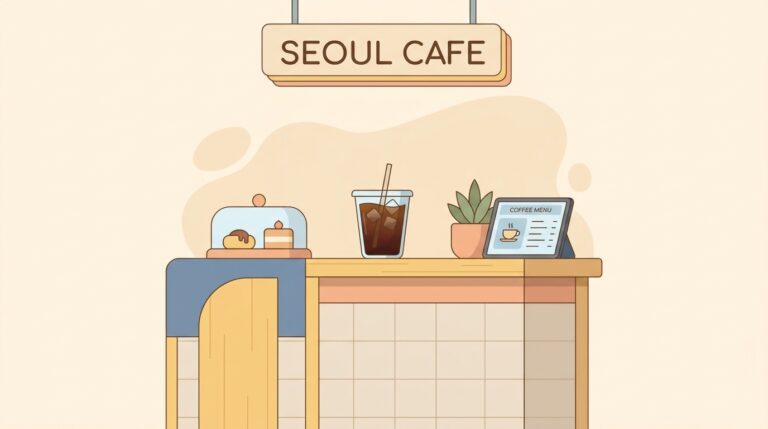
Imagine this: You have just walked into a stunning, sunlit café in the trendy streets of Seongsu-dong. The smell of freshly roasted espresso fills the air, K-indie music plays softly in the background, and you successfully ordered your very first 아이스 아메리카노 (Iced Americano) completely in Korean! Your heart does a little victory dance. The barista slides your sweating, ice-filled cup across the pickup counter with a polite nod.
Then, reality strikes. You look at your cup, look down at your hands, and realize: there is no straw. You look at the ice cubes floating tantalizingly near the rim. How are you supposed to drink this without ice spilling all over your favorite shirt? You scan the counter frantically. The barista is already busy frothing oat milk for the next customer. You freeze. Do you tap on the counter? Do you mimic sucking through an invisible straw like a game of charades?
Don’t panic! Over 80% of our beginner students report feeling totally paralyzed right after getting their drink, simply because Korean cafés organize their accessory stations differently. Today, with just one tiny, magical A1-level phrase, you’ll glide through any Korean café like a seasoned local. No awkward charades, no sweating—just cool sips and pure confidence.
Phase 2: Core 3 Expressions Deep Dive
1. 빨대 어디 있어요? (Ppaldae eodi isseoyo?)
- Pronunciation: [Ppal-dae eo-di i-sseo-yo?] (Think of Ppal sounding like a sharp “ball” popped with energy, dae like “day”, and isseoyo like “is-saw-yo”).
- Meaning: Literal: “Straw where exists?” | Real Nuance: “Where are the straws? / Where can I find a straw?”
- K-Culture Moment: You will see this in almost every lifestyle K-Vlog or slice-of-life K-Drama when characters pick up takeout coffee and look around the pickup area.
- Editor’s Insight: 어디 있어요? (Eodi isseoyo?) is the Swiss Army knife of Korean questions. You can swap 빨대 (ppaldae – straw) with any noun! Cup sleeve? Napkin? Restroom? Just plug it in.
- Situation Spectrum: Casual (⚠️ 친구끼리만 / Friends only: 빨대 어디 있어?) | Semi-formal (✅ Daily life default: 빨대 어디 있어요?) | Formal (✅ Polite & safe: 빨대 어디에 있습니까?)
- 🤔 Think About It: In English, we usually ask “Where can I find…?” centering the question on ourselves. Korean drops the “I” completely and simply asks whether the object exists in a location. Notice how Korean naturally focuses on the shared space rather than the individual!
2. 빨대 하나만 주세요. (Ppaldae hanaman juseyo.)
- Pronunciation: [Ppal-dae ha-na-man ju-se-yo.] (Say ha-na like the Hawaiian word “hana”, man like “mahn”, and juseyo like “jew-say-yo”).
- Meaning: Literal: “Straw only one please give.”
- Real Nuance: “Could I please have just one straw?”
- K-Culture Moment: Seen frequently at busy takeout counters in Gangnam during morning rush hours when workers grab a quick straw directly from the barista.
- Editor’s Insight: Adding -만 (-man, meaning “only / just”) softens your request instantly. It signals: “I know you’re super busy, so I won’t take much of your time, just one little thing!”
- Situation Spectrum: Casual (⚠️ 빨대 하나만 줘) | Semi-formal (✅ 빨대 하나만 주세요) | Formal (✅ 빨대 하나만 주시겠어요?)
- 🤔 Think About It: Why do Koreans add “just one” even if it’s obvious? It reflects 배려 (baeryeo – thoughtfulness), ensuring the listener doesn’t feel burdened by a demanding order.
3. 냅킨도 있어요? (Naepkindo isseoyo?)
- Pronunciation: [Naep-kin-do i-sseo-yo?] (Naep-kin sounds just like “napkin”, followed by do like musical note “Doh”).
- Meaning: Literal: “Napkin also exists?” | Real Nuance: “Do you have napkins too? / Where can I get napkins?”
- K-Culture Moment: When a character in a rom-com spills boba milk tea and looks around in adorable fluster to clean it up.
- Editor’s Insight: The particle -도 (-do) means “also” or “too”. If you already got your straw but notice condensation pooling on the table, use this phrase to smoothly ask for napkins!
- Situation Spectrum: Casual (⚠️ 냅킨도 있어?) | Semi-formal (✅ 냅킨도 있어요?) | Formal (✅ 냅킨도 있나요?)
- 🤔 Think About It: Loanwords like 냅킨 (naepkin) coexist with pure Korean words like 휴지 (hyuji – tissue). In cafés, both are understood, but 냅킨 sounds tailored specifically to café tables!
Phase 3: Textbook Korean vs. Real Korean
Situation 1: Asking where the straws are located
- 📖 교과서 한국어 (Textbook): 빨대가 어디에 위치합니까? (Ppaldaega eodie wichihamnigga? – “At which location does the straw reside?”)
- 🗣️ 진짜 한국어 (Real Korean): 저기요, 빨대 어디 있어요? (Jeogiyo, ppaldae eodi isseoyo? – “Excuse me, where are the straws?”)
- 💡 왜 다를까? (Why is it different?): Textbooks love formal Sino-Korean nouns like 위치 (wichi – location). But in real Seoul life, native speakers keep everyday conversation light and friendly. 어디 있어요? is 100% natural, polite, and universally loved.
Situation 2: Asking the barista to hand you a straw
- 📖 교과서 한국어 (Textbook): 저에게 빨대를 주실 수 있습니까? (Jeoege ppaldaereul jusil su isseumnigga? – “Can you grant a straw unto me?”)
- 🗣️ 진짜 한국어 (Real Korean): 빨대 하나만 주세요! (Ppaldae hanaman juseyo! – “One straw, please!”)
- 💡 왜 다를까? (Why is it different?): English speakers often try to translate “Could you please do me a favor and give me…”. In Korean, long nested grammar sounds overly theatrical. A crisp noun + 주세요 is maximum politeness with zero awkwardness.
Phase 4: K-Culture Deep Dive & Non-Verbal Manners
4-1. 눈치 (Nunchi) & Gestures: The Magic of the “Self-Bar”
Before you immediately shout 저기요! (Excuse me!), activate your Korean café superpower: 눈치 (Nunchi – situational awareness).
In almost every Korean café—from mega chains like Mega Coffee and Ediya to tiny aesthetic hideouts in Hannam-dong—baristas do not hand out straws personally. Instead, look for a small side table called the 셀프바 (Self-Bar) or 컨디바 (Condiment Bar). You will spot a water dispenser, paper cups, syrup bottles, neat stacks of brown napkins, and containers filled with straws.
- Manner Tip: If the counter is slammed, glance towards the pick-up counter or near the trash tray first. If you truly cannot find it, make gentle eye contact with the barista, offer a micro-bow (a 15-degree nod), and ask with a soft, friendly tone.
4-2. Culture Code: The “Eol-Juk-Ah” Nation & Eco Straws
Did you know Koreans have an official cultural nickname for iced coffee lovers? It’s 얼죽아 (Eol-juk-ah), an abbreviation for 얼어 죽어도 아이스 아메리카노 (“Even if I freeze to death, I’m drinking Iced Americano!”). Even during -10°C Seoul snowstorms, people carry iced plastic cups.
Because of massive takeaway consumption, South Korea enforces strict eco-friendly regulations. In many cafés, you might encounter paper straws (종이 빨대 – jongi ppaldae), biodegradable rice straws, or “sip lids” (드링킹 리드 – deuringking rideu) that do not need straws at all! Observing what kind of lid your cup has before asking for a straw is the ultimate pro-traveler move.
Phase 5: Real-World Roleplay Scenario
Setting: Café On-Hwa, a cozy minimalist aesthetic café in Ikseon-dong. Exposed wooden beams, gentle sunlight, and soft jazz.
Characters:
* Min-woo (민우): A warm, calm barista wearing a linen apron.
* You (Alex): A beginner Korean learner holding a frosty Iced Latte.
Turn 1
Min-woo: 주문하신 아이스 라떼 나왔습니다.
(Jumunhasin aiseu ratte nawasseumnida.)
“Your iced latte is ready!”
🎭 [Min-woo places the condensation-covered glass cup onto the pickup counter with a warm smile.]
Turn 2
You: 감사합니다!
(Gamsahamnida!)
“Thank you!”
🎭 [You take the cup with both hands, look at the drink, and notice there is no straw nearby.]
Turn 3
You: 저기요, 혹시 빨대 어디 있어요?
(Jeogiyo, hoksi ppaldae eodi isseoyo?)
“Excuse me, by any chance, where are the straws?”
🎭 [You tilt your head slightly and glance around the counter politely.]
Turn 4
Min-woo: 아, 빨대는 뒤쪽 셀프바에 준비되어 있어요!
(A, ppaldaeneun dwijjok selpeubae junbidoeeo isseoyo!)
“Ah, the straws are set up at the self-bar right behind you!”
🎭 [Min-woo points with an open palm toward a wooden table next to the water pitcher.]
Turn 5
You: 아, 저기 있네요! 냅킨도 거기에 있어요?
(A, jeogi inneyo! Naepkindo geogie isseoyo?)
“Ah, there it is! Are napkins there too?”
🎭 [You spot the neat silver tray and point gently.]
Turn 6
Min-woo: 네, 맞아요. 냅킨이랑 물도 다 거기에 있어요.
(Ne, majayo. Naepkin-irang muldo da geogie isseoyo.)
“Yes, that’s right! Napkins and water are all over there.”
🎭 [Min-woo nods reassuringly.]
Turn 7
You: 네, 알겠습니다. 감사합니다!
(Ne, algesseumnida. Gamsahamnida!)
“Understood. Thank you so much!”
🎭 [You give a polite micro-bow and step toward the condiment station.]
Turn 8
Min-woo: 맛있게 드세요!
(Masitge deuseyo!)
“Enjoy your drink!”
🎭 [Min-woo smiles and turns back to brewing with a friendly wave of hospitality.]
🔀 Interactive Choice Point
You walk over to the Self-Bar, but the straw container is completely empty! What do you do?
- Option A: Walk back to the counter, tap the glass bell, and say: 빨대 빨리 줘! (Ppaldae ppalli jwo!)
- Option B: Make gentle eye contact with Min-woo and say: 저기요, 빨대가 다 떨어졌어요. 하나만 주실 수 있어요? (Jeogiyo, ppaldaega da tteoreojyeosseoyo. Hanaman jusil su isseoyo?)
- Option C: Say nothing, walk out of the café with your drink, and try to drink it without a straw in silence.
Choice Feedback:
* Option A (Bad ❌): Warning! 빨대 빨리 줘 is informal/rude speech (반말) and sounds like “Gimme a straw fast!” The barista will be shocked.
* Option B (Best ✅): Perfect 100 points! You used polite language, explained that the straws ran out (다 떨어졌어요), and asked for one politely.
* Option C (Risk ⚠️): You miss out on enjoying your drink comfortably! Korean café staff are genuinely eager to help; never feel shy about speaking up politely.
Phase 6: 10-Second Emotion Shadowing Drill
Train your muscle memory with these rhythmic shadowing lines! Follow the slash marks / for brief breathing pauses:
- [😊 Bright & Friendly]
저기요! / 빨대 / 어디 있어요?
(Jeogiyo! / Ppaldae / eodi isseoyo?)
“Excuse me! / Straws / where are they?” -
[🥺 Soft & Polite Request]
저기… / 빨대 하나만 / 주세요.
(Jeogi… / Ppaldae hanaman / juseyo.)
“Excuse me… / Just one straw / please.” -
[💡 Curious & Observant]
혹시 / 냅킨도 / 있어요?
(Hoksi / naepkindo / isseoyo?)
“By any chance / napkins too / do you have?”
Phase 7: K-Culture Mini Dictionary
- 빨대 (Ppaldae) | Noun | Straw
Everyday usage: Essential word for drinks. You can also specify 종이 빨대 (jongi ppaldae – paper straw) or 플라스틱 빨대 (peullaseutik ppaldae – plastic straw). - 셀프바 (Sel-peu-ba) | Konglish Noun | Self-Service Condiment Station
Everyday usage: Short for “Self Bar”. Refers to the dedicated counter in cafés and casual eateries where napkins, straws, water, cups, and wet wipes are stocked. - 냅킨 (Naep-kin) | Loanword Noun | Napkin / Paper Tissue
Everyday usage: Standard in café settings. While 휴지 (hyuji) is general bathroom or facial tissue, café staff almost exclusively label paper wipes as 냅킨. - 얼죽아 (Eol-juk-ah) | Slang / Cultural Acronym | Iced Americano Devotee
Everyday usage: Short for 얼어 죽어도 아이스 아메리카노. Used humorously in winter when ordering cold coffee despite freezing weather!
Phase 8: Traveler’s Survival Kit
Top 3 Survival Phrases
- 1. 빨대 어디 있어요? (Ppaldae eodi isseoyo?)
Pro Tip: The golden question for any accessory you can’t locate. - 2. 뚜껑 하나만 주세요. (Dduggeong hanaman juseyo.)
Pro Tip: Want a sip lid for takeaway? 뚜껑 (dduggeong) means “lid”! - 3. 반납 어디에 해요? (Bannap eodie haeyo?)
Pro Tip: Done with your drink? This means “Where do I return my tray?”
Editor’s Travel Note
Before wandering through the cafe alleys of Seoul, make sure to check out the Naver Map app download guide. Google Maps often struggles with pedestrian navigation in Korea, but Naver Map shows the exact locations of independent hidden cafés, their interior photos, and whether they have kiosk ordering!
Phase 9: “One Step Deeper” (Reflective Essay)
Korean café culture operates on a fascinating harmony between lightning-fast speed (빨리빨리 – Ppalli-ppalli) and community mindfulness (배려 – Baeryeo). Because baristas work at breakneck speeds to produce handcrafted drinks for dozens of customers each hour, the existence of the 셀프바 (Self-Bar) is a communal design. Customers naturally take responsibility for their own accessories and tray returns, freeing workers to focus purely on quality espresso.
When you scan the counter for a straw yourself before interrupting a busy barista, you are actively participating in this unspoken Korean rhythm of mutual respect. It’s a small detail, but it makes you an exceptionally considerate guest in Korean society.
💬 Your Turn: Have you ever experienced an awkward “Where is the straw?!” moment while traveling or at a local café? How does self-service culture in your home country compare to Korea? Share your story in the comments below!
Phase 10: FAQ & Avoiding Misunderstandings
Q: Can I just say “빨대 주세요” without saying “하나만”?
A: Yes, absolutely! 빨대 주세요 (Ppaldae juseyo) means “Please give me a straw.” It is 100% correct and polite. Adding 하나만 (hanaman – only one) simply gives it an extra gentle, polite flavor.
Q: Why didn’t the barista give me a straw when I ordered an iced drink?
A: Many Korean eco-friendly regulations restrict staff from automatically giving out disposable single-use plastic straws unless specifically requested or retrieved by the customer at the self-bar.
Q: What should I say if I need two straws for me and my friend?
A: Just change 하나 (one) to 두 개 (two): 빨대 두 개만 주세요! (Ppaldae du gaeman juseyo! – “Two straws please!”).
🚨 Common Mistakes Alert (Top 3)
- Mistake: Shouting 이모! (Imo! – Auntie!) in a hip café.
Correct Action: Save 이모 for traditional K-BBQ restaurants! In modern cafés, use a gentle 저기요~ (Jeogiyo~) or simply step up to the pickup counter. - Mistake: Forgetting the honorific ending and saying 빨대 어디야? (Ppaldae eodiya?).
Correct Action: Always keep the -요 (-yo) at the end! 빨대 어디 있어요? is polite and respectful. - Mistake: Searching inside the trash opening for cup sleeves or extra straws.
Correct Action: Look strictly on top of the counter shelf labeled RETURN (반납) or SELF BAR. Trash bins are strictly for disposal.
Phase 11: Action Missions & Engagement
- 🥉 Bronze Mission (Solo Vocal): Stand in front of your mirror and practice saying: 저기요, 빨대 어디 있어요? three times out loud, varying your tone until it feels smooth and natural.
- 🥈 Silver Mission (Social / Audio): Leave a voice note or post a comment below answering: “What drink do you always order with a straw?” using the Korean word 빨대.
- 🥇 Gold Mission (Real Life): Next time you visit a Korean café or boba shop, challenge yourself to ask for your straw or napkin completely in Korean without switching to English!
- 🎮 K-Culture Scavenger Mission: In the next episode of any modern K-Drama you watch, pause the scene whenever characters are inside a coffee shop. Can you spot the 셀프바 (Self-bar) in the background?
Phase 12: Interactive Quiz Challenge
Test your café navigation instincts! Try answering before checking the spoilers below.
1. Situation Decision: You got an iced green tea latte, but there are no straws on the counter. The barista looks very busy pulling espresso shots. What is your first best step?
* (A) Loudly demand a straw from across the room.
* (B) Look around for the “셀프바” (Self-Bar) station first.
* (C) Leave without drinking.
2. Fill-in-the-Blank: Complete the question:
“저기요, 냅킨 _____ 있어요?” (Excuse me, do you have napkins too?)
* (A) 도 (do)
* (B) 를 (reul)
* (C) 에 (e)
3. True or False: In Korea, saying 빨대 하나만 주세요 (Ppaldae hanaman juseyo) is considered stingy because you only asked for one.
* (A) True
* (B) False
👉 Click to reveal answers & explanations!
-
Answer: (B)
Explanation: In Korean cafés, accessories are almost always placed at the self-bar! Checking there first shows high 눈치 (nunchi) and respect for the barista’s workflow. -
Answer: (A) 도 (do)
Explanation: The particle -도 (-do) means “also” or “too”. So 냅킨도 있어요? translates directly to “Are there napkins too?” -
Answer: (B) False
Explanation: False! Adding 하나만 (hanaman – only one) is a polite linguistic cushion in Korean that makes requests sound considerate and modest.







