

Order Hotteok in Korea Like a Local: Essential Street Food Korean
Phase 1: Empathy (Welcome to the Warmth of Pojangmacha)
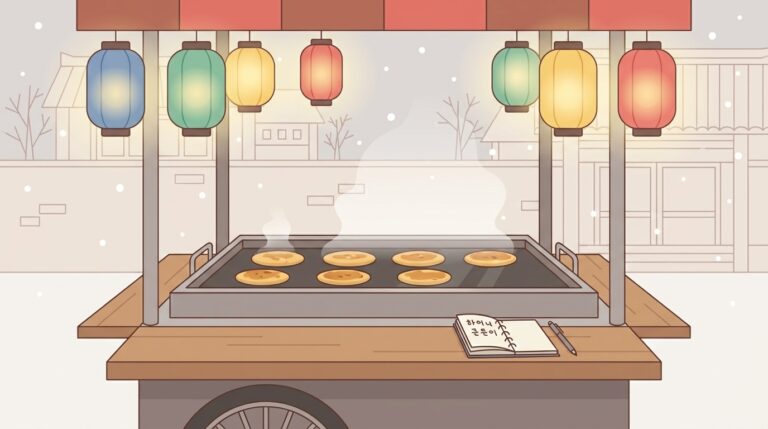
안녕하세요! 매일한글 에디터입니다. Have you ever walked down an icy, wind-swept street in Seoul during late November, shivering in your padded coat, when suddenly a cloud of sweet, buttery steam hits you? You follow your nose to a tiny street cart surrounded by a vinyl curtain. Inside, you see golden, puffy disks of hotteok (호떡) sizzling on a heavy iron griddle, bubbling with dark brown sugar and crushed peanuts. Your stomach growls, but your steps hesitate. You see locals stepping up, exchanging brief words, grabbing folded paper cups holding piping-hot treats, and tapping away with a smile.
Meanwhile, you wonder: What do I say? How do I order just one? What if they don’t take foreign credit cards? What if I burn my tongue? Over the past 10 years at Daily Hangul, hundreds of beginner learners have told me that street stalls feel ten times more intimidating than fancy restaurants because there are no English menus, no touch screens, and no waiter to guide you. But don’t worry! Street food vendors are some of the warmest, most welcoming people in Korea. With just three simple phrases, you can confidently walk up to any stall, order your delicious treat, and enjoy that crispy, sweet bite without any awkward panic.
Phase 2: Core Expressions Deep Dive (핵심 표현 3선)
Here are three magic phrases that will make you sound natural and get you your sweet prize in seconds.
1. 호떡 하나 주세요 (Hotteok hana juseyo)
- Pronunciation: [Hotteok hana juseyo] (Sounds like: Hoh-tteok ha-na joo-seh-yo — imagine saying ‘hot’ with a sharp ‘t’, ‘ha-na’ like the island Honolulu’s ‘Hana’, and ‘joo-say-yo’ like ‘juice, hey, yo!’)
- Meaning: Literal: “Hotteok one give please” | Real Nuance: “One hotteok, please!”
- K-Culture Moment: Seen constantly in winter romance K-dramas where the lead couple stops by a street vendor on their walk home after snow begins to fall.
- Editor’s Insight: In Korean, the counter noun follows the number word. For beginners, simply combining the food item (
호떡) + native Korean number for one (하나) + polite request (주세요) is the golden formula for anything you order on the street. - Situation Spectrum:
- Casual (Friends): 🚫 (Too polite for close friends)
- Semi-formal (Street Vendors, Cafes): ✅ (The ideal polite standard)
- Formal (Business Meeting): ⚠️ (Too conversational)
- 🤔 Think About It: In English, we often say “Can I get a…?” focusing on our own ability to acquire something. In Korean, you say “Please give me” (
주세요), focusing on the action granted by the speaker. How does this shift your perception of politeness?
2. 여기서 먹을게요 (Yeogiseo meogeulgeyo)
- Pronunciation: [Yeogiseo meogeulgeyo] (Sounds like: Yuh-gee-suh muh-geul-geh-yo — ‘yuh’ as in ‘yuck’, ‘gee’ as in ‘geek’, ‘suh’ as in ‘supper’, and ‘muh-geul-geh-yo’.)
- Meaning: Literal: “From here I will eat” | Real Nuance: “I’ll eat it here! (Give it to me in a paper cup now)”
- K-Culture Moment: The vendor picks up tongs and looks at you waiting for direction: do you want it tucked into a paper cup to eat right now, or sealed inside a plastic bag for takeout?
- Editor’s Insight: This short sentence tells the vendor immediately not to pack it into a takeaway bag. They will fold a thick paper cup in half, slide the blazing-hot pancake inside, and hand it to you ready to savor.
- Situation Spectrum:
- Casual: 🚫
- Semi-formal (Everyday vendors): ✅
- Formal: ⚠️
- 🤔 Think About It: Korean dining often differentiates sharply between eating immediately on the go (
여기서 먹다) and packaging to take away (포장하다). Why do you think paper cups became the universal holder for street food in Korea?
3. 얼마예요? (Eolmayeyo?)
- Pronunciation: [Eolmayeyo?] (Sounds like: Uhl-ma-yeh-yo? — ‘uhl’ like the start of ‘ultimate’, ‘ma’ like ‘mama’, ‘yeh-yo’.)
- Meaning: Literal: “How much is it?” | Real Nuance: “How much do I owe you?”
- K-Culture Moment: Said right after taking your snack, pulling out cash or checking the vendor’s bank account details taped to the cart.
- Editor’s Insight: Street stalls often do not have prominent price tags, or seasonal ingredients might change the price.
얼마예요?is your universal Swiss Army knife question throughout all markets across Korea. - Situation Spectrum:
- Casual: 🚫
- Semi-formal: ✅
- Formal: ⚠️
- 🤔 Think About It: Many street vendors are elderly grandmothers (halmeoni) or aunts (imo). Asking simply and cleanly with polite endings shows respect for their hard work in freezing weather.
Phase 3: Textbook Korean vs. Real Korean
Situation 1: Ordering your snack
- 📖 교과서 한국어 (Textbook): 호떡을 한 개 주십시오. (Hotteogeul han gae jusipsio.)
- 🗣️ 진짜 한국어 (Real Life): 호떡 하나 주세요! (Hotteok hana juseyo!)
- 💡 왜 다를까? (Why the difference?): Standard textbooks teach the ultra-formal imperative
-십시오(-sipsio) and noun object markers-을/를. But in real life street carts, this sounds like a military report! Drop the particles and use the soft, warm, friendly polite form-요(-yo).
Situation 2: Asking if you can pay with cash
- 📖 교과서 한국어 (Textbook): 제가 현금으로 지불해도 괜찮겠습니까? (Jega hyeongeumeuro jibulhaedo gwaenchankeotseumnikka?)
- 🗣️ 진짜 한국어 (Real Life): 현금 돼요? (Hyeongeum dwaeyo?)
- 💡 왜 다를까? (Why the difference?): You don’t need complicated grammar structures to ask permission. Just state the noun (
현금= cash) plus돼요?(Does it work? / Can I?), which is how 99% of locals talk at outdoor stalls.
Phase 4: K-Culture Deep Dive & Non-verbal Manners
4-1. Nunchi (눈치) & Gestures: The Paper Cup Technique
When eating hotteok on the street, physical manners matter just as much as words:
* The Two-Handed Hand-off: When the vendor passes you the hotteok or when you hand over cash, use both hands—or support your right wrist lightly with your left hand. This gesture shows genuine respect.
* The Hotteok Squeeze: A hotteok comes served inside a folded paper cup. Never pull the pancake completely out with your bare fingers! The brown sugar syrup inside is boiling hot. Slowly press the bottom of the paper cup upward like a tube of toothpaste as you eat.
* Napkin Eye Contact (Nunchi): Street vendors keep a metal container of tissues on the counter. Don’t grab a whole handful. Take one or two politely, wipe your fingers, and throw it in their small counter basket before leaving.
4-2. Culture Code: Winter Comfort and “Jeong” (정)
Hotteok was introduced to Korea in the late 19th century by Chinese immigrants, but Koreans modified it by stuffing it with rich cinnamon, brown sugar, and seeds (famous in Busan as ssiat hotteok). In winter, standing next to a hot iron griddle is more than just eating; it’s a communal warmth ritual. You’ll often hear vendors call you ttal (딸 – daughter), adeul (아들 – son), or student (학생 – haksaeng), regardless of your age. This warmth is the embodiment of Korean Jeong—an unspoken bond of affection and community care.
Phase 5: Real-Life Roleplay Scenario
Setting: A crisp winter night at a street corner near Jongno 3-ga, Seoul. Steam billows from a cart illuminated by a warm hanging yellow bulb. An energetic older woman (Imo / 이모) is pressing round balls of dough onto a crackling griddle.
- Turn 1 (You): 안녕하세요! (Annyeonghaseyo!)
🎭 (Bowing head slightly, stepping up to the cart counter) - Turn 2 (Imo): 어서 와요! 뭐 줄까? (Eoseo wayo! Mwo julkka?)
🎭 (Flipping two golden hotteoks with a flat spatula, smiling warmly) - Turn 3 (You): 호떡 하나 주세요. (Hotteok hana juseyo.)
🎭 (Holding up one index finger politely while speaking) - Turn 4 (Imo): 바로 먹을 거야? (Baro meogeul geoya?)
🎭 (Reaching for a stack of clean white paper cups) - Turn 5 (You): 네, 여기서 먹을게요! (Ne, yeogiseo meogeulgeyo!)
🎭 (Nodding enthusiastically with both hands ready) - Turn 6 (Imo): 꿀 엄청 뜨거우니까 조심해! 이천 원이야. (Kkul eomcheong tteugeounikka josimhae! Icheon won-iya.)
🎭 (Carefully folding the paper cup around the steaming hotteok and handing it to you) - Turn 7 (You): 네, 감사합니다! 여기 현금 있어요. (Ne, gamsahamnida! Yeogi hyeongeum isseoyo.)
🎭 (Handing over two crisp 1,000-won bills with both hands) - Turn 8 (Imo): 아이고 고마워, 맛있게 먹어요! (Aigo gomawo, mas-itge meogeoyo!)
🎭 (Taking the bills, smiling, and tapping the napkin dispenser for you)
🔀 Interactive Decision Point
The vendor hands you the hotteok and tells you the price. How do you respond?
- Option A: You pull out your international credit card and wave it around, asking: “카드 돼요?” (Kadeu dwaeyo?)
- Outcome (Risk): Many traditional small carts do not have portable card readers. The vendor might look flustered or point apologetically to a cardboard sign with bank account digits.
- Option B: You hand over exact cash using both hands, saying: “여기 현금 있어요.” (Yeogi hyeongeum isseoyo.)
- Outcome (Best): Flawless local victory! Street vendors love cash. You receive a beaming smile and maybe an extra warm napkin!
- Option C: You take a massive bite right in front of the griddle shouting: “안 뜨거워요!” (An tteugeowoyo!)
- Outcome (Bad): Ouch! The melted sugar filling is over 80°C (176°F). You burn the roof of your mouth, and the auntie will panic looking for ice water!
Phase 6: 10-Second Emotion Shadowing Drill
Read these lines out loud! Pay attention to the pauses marked with / and mirror the emotional cue inside the brackets.
[😊 Cheerful and polite]
안녕하세요! / 호떡 하나 / 주세요!
(An-nyeong-ha-se-yo! / Hot-teok ha-na / ju-se-yo!)-
[😋 Excited & mouth-watering]
네! / 여기서 / 바로 먹을게요!
(Ne! / Yeo-gi-seo / ba-ro meo-geul-ge-yo!) -
[🙏 Respectful & thankful]
감사합니다! / 여기 / 현금 있어요!
(Gam-sa-ham-ni-da! / Yeo-gi / hyeon-geum is-seo-yo!)
Phase 7: K-Culture Mini Dictionary
- 호떡 (Hotteok): Korean sweet pancake filled with brown sugar, cinnamon, and nuts. Crispy on the outside, gooey on the inside.
- 종이컵 (Jong-ikeop): Paper cup. Used uniquely as heat shields and holders for street foods like hotteok, tteokbokki, and fish cake skewers.
- 현금 (Hyeongeum): Cash. Essential paper currency (1,000, 5,000, and 10,000 won bills) needed for independent street stall vendors.
- 계좌이체 (Gyejwa-iche): Bank transfer. If you don’t have cash, you will see a handwritten bank account number on the cart where locals transfer money via mobile apps.
Phase 8: Traveler’s Survival Kit
Top 3 Street Food Survival Phrases
- 하나 더 주세요 (Hana deo juseyo) – “One more, please!”
Pro Tip: Hotteok is so delicious you will often want a second one. Use this phrase right before you finish your first! - 휴지 있어요? (Hyuji isseoyo?) – “Do you have tissues?”
Pro Tip: Brown sugar syrup tends to drip onto your chin or sleeves. Use this to locate the napkin holder. - 포장해 주세요 (Pojanghae juseyo) – “Please wrap it for takeout.”
Pro Tip: If you want to take hotteok back to your hotel room, say this instead of 여기서 먹을게요.
Editor’s Travel Note
- Navigation Guide: Looking for the most famous hotteok clusters in Seoul? Don’t use Google Maps, which lacks local transit walking routes. Look up Namdaemun Market or Insadong via the [Naver Map app download for foreign travelers] and search for ‘호떡’.
- Payment Reality: While 99% of brick-and-mortar stores in Korea accept credit cards and Apple Pay, street food carts are an exception. Always keep 5,000 to 10,000 won in physical bills in your coat pocket during night walks.
Phase 9: A Step Deeper (한 발 더 깊이)
In Korean society, eating street food is one of the rare spaces where strict formal hierarchies soften. At a street food cart, people from all walks of life—CEOs in suits, university students, and delivery riders—huddle side by side under a plastic canopy against the winter chill. The vendor auntie treats everyone like family with casual, caring remarks. It highlights the deeply communal nature of Korean food culture, where food is not merely consumed, but shared as a shelter from the harsh world outside.
💬 Your Turn: What is your country’s ultimate winter comfort street food? If you were standing at a Korean pojangmacha right now, what flavor would you hope to find inside your hotteok? Tell us in the comments below!
Phase 10: FAQ & Common Mistakes
Q: Can I pay with a credit card at street food stalls in Korea?
A: Most temporary street stalls cannot process international credit cards. It is strongly advised to carry physical cash in small bills (1,000 and 5,000 won). While domestic locals use direct bank transfers (계좌이체), foreign bank apps cannot do this easily.
Q: How do I eat hotteok without burning my tongue?
A: Never bite straight into the center immediately after receiving it! Take small bites of the crispy dough crust first to let the trapped steam escape. Let the sweet syrup cool slightly before taking a full bite.
Q: Are there different kinds of hotteok in Korea?
A: Yes! The traditional one is Kkul Hotteok (꿀호떡 – brown sugar and cinnamon). In Busan, Ssiat Hotteok (씨앗호떡) packed with sunflower and pumpkin seeds is famous. You can also find savory Japchae Hotteok (잡채호떡 – filled with glass noodles and vegetables) at Namdaemun Market.
🚨 Common Mistakes Alert (흔한 실수 TOP 3)
- Mistake: Trying to order using English finger gestures without greeting.
Correct Action: Always start with a friendly안녕하세요!(Annyeonghaseyo!) before holding up your finger. - Mistake: Throwing away your paper cup in the street garbage bag of another nearby shop.
Correct Action: Finish eating near the stall and dispose of your paper cup in the trash bin right at the hotteok cart. - Mistake: Handing large 50,000-won bills for a 1,500-won hotteok.
Correct Action: Prepare 1,000 or 5,000-won bills beforehand so the vendor doesn’t have to clear out their coin box for change.
Phase 11: Action Missions
- 🥉 Bronze Mission (Solo Practice): Stand in front of your mirror and practice saying
호떡 하나 주세요! (Hotteok hana juseyo!)three times with a bright smile. - 🥈 Silver Mission (Social Share): Share this guide on Instagram or X, tag your favorite travel buddy, and tell them: “Next winter in Seoul, hotteok is on you!”
- 🥇 Gold Mission (Real Life Action): Visit a local Korean grocery store or market in your city, find the snack corner, and order your treat entirely in Korean using today’s phrases!
- 🎮 K-Culture Mission: Watch an episode of a winter Korean drama (like Weightlifting Fairy Kim Bok-joo or Reply 1988) and spot the characters eating street food out of small paper cups.
Phase 12: Interactive Quiz Challenge
Test your street food survival instincts! Click each toggle to reveal the correct answer.
1. Situational Judgment:
You step up to a street stall and want 2 hotteoks to eat right now with your friend. What is the most natural sentence to say?
– A) 호떡 두 개를 지불하십시오. (Hotteok du gaereul jibulsipsio.)
– B) 호떡 둘 주세요! 여기서 먹을게요. (Hotteok dul juseyo! Yeogiseo meogeulgeyo.)
– C) 호떡 어디예요? (Hotteok eodiyeyo?)
👉 Click to reveal Answer & Explanation
Correct Answer: B
Explanation: “호떡 둘 (or 두 개) 주세요! 여기서 먹을게요” perfectly combines the number, polite request, and specifies that you will eat it right there in paper cups! Choice A is overly rigid and grammatically wrong for a customer, while C means “Where is hotteok?”.
2. Fill-in-the-Blank:
Complete the sentence to politely ask for the price:
“이거 _________?” (How much is this?)
👉 Click to reveal Answer & Explanation
Correct Answer: 얼마예요 (eolmayeyo)
Explanation: “이거 얼마예요?” (Igeo eolmayeyo?) translates to “How much is this?”, the universal price question everywhere in Korea.
3. True or False Culture Quiz:
True or False: When eating hotteok served in a paper cup, it is customary to peel open the entire cup with both hands and grab the oily hotteok directly with your bare fingers.
👉 Click to reveal Answer & Explanation
Correct Answer: False!
Explanation: The paper cup is designed to insulate your hands from heat and grease, and catch dripping syrup. You should keep the hotteok inside the cup and gently squeeze the bottom upwards to push the food toward your mouth!







