

Phase 1: Empathy (Story-Immersive Opening)
안녕하세요! 매일한글 에디터입니다.
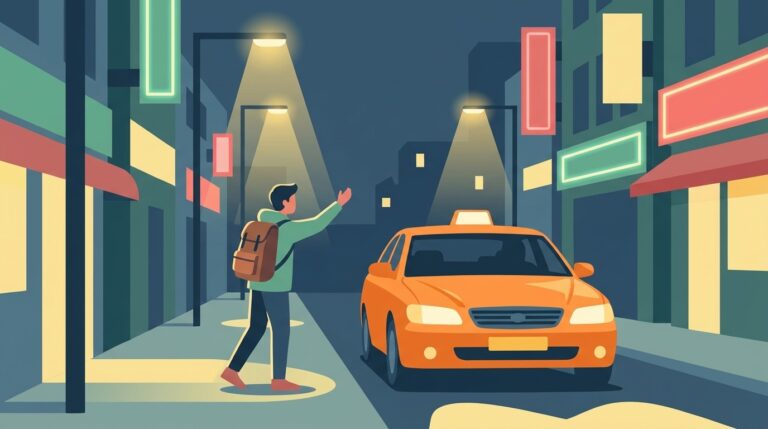
It is 1:45 AM on a chilly Saturday morning in Hongdae. Your ears are still ringing with the bass of indie music, your stomach is warm from sizzling Korean barbecue, and your friends are waving goodbye as they scatter into the neon-lit alleyways. You stand on the curb, confident that getting home will take five minutes. You see a bright orange taxi approaching. You reach out your hand—palm up, like you are hailing a cab in New York or London.
The driver doesn’t stop. In fact, he zooms right past you. Another taxi approaches with a bright red dashboard sign glowing 빈차 (Bincha), yet when you try to open the door, it’s locked, or the driver rolls down the window two inches, shakes his hand, and speeds away. Within thirty minutes, your phone battery drops to 8%, your fingers are freezing, and panic creeps in: How do I tell someone I am stranded? Why won’t any taxi pick me up?
If you have ever felt that sinking sensation on the streets of Seoul, Busan, or Daegu, take a deep breath: you are not alone. Even born-and-raised Koreans face the notorious late-night taxi scramble (심야 택시 대란, simya taeksi daeran). Over the past ten years coaching international travelers and expats, “택시 안 잡혀요!” (I can’t catch a taxi!) has consistently topped the list of midnight distress texts I receive.
Today, you will learn the exact survival phrases, cultural body language, and digital backup plans you need to escape the curb and get back to your hotel safely—even if you are just starting your A1 Korean journey. Let’s make sure you never feel lost in the neon jungle again!
Phase 2: Core Expressions Deep Dive
1. 택시 안 잡혀요 (Taeksi an japhyeoyo)
- Pronunciation: [Taek-si an jap-hyeo-yo] (Sounds like: “Tek-see ahn jahp-hyuh-yo”)
- Meaning: Literal: “The taxi is not being caught.” | Nuance: “I’m having trouble catching a taxi / Taxis aren’t stopping for me.”
- K-Culture Moment: You’ve seen this in almost every modern K-Drama—like in Itaewon Class when characters spill out of a pub at closing time, checking their phones anxiously while stomping their feet in the cold.
- Editor’s Insight: Notice that Koreans say “the taxi isn’t getting caught” (passive verb 잡히다, japhida) rather than “I cannot catch a taxi.” It expresses the situation as an external circumstance rather than personal failure.
- Situation Spectrum: Casual (택시 안 잡혀 – Taeksi an japhyeo): ⚠️ | Semi-formal (택시 안 잡혀요 – Taeksi an japhyeoyo): ✅ | Formal (택시가 잡히지 않습니다 – Taeksiga japhiji anseumnida): ✅
- 🤔 Think About It: In English, we say “I can’t catch a cab,” putting ourselves as the active agent. Korean often describes events happening around you. How does this shift in perspective change how you view frustrating situations?
2. 홍대 가세요? (Hongdae gaseyo?)
- Pronunciation: [Hong-dae ga-se-yo?] (Sounds like: “Hong-deh gah-seh-yo?”)
- Meaning: Literal: “Are you going to Hongdae?” | Nuance: “Excuse me, driver, are you willing to take me toward Hongdae?”
- K-Culture Moment: When a taxi slows down near Gangnam Station at 2 AM, the driver rolls down the passenger window just enough to peek out. Instead of jumping inside, the savvy passenger leans down and quickly asks their destination before reaching for the door handle.
- Editor’s Insight: Late at night, taxi drivers often head back toward their home base or prefer longer routes before their shifts end. Simply naming your district with polite tone “[Location] 가세요?” shows respect and saves you from trying to force open a locked door.
- Situation Spectrum: Casual (홍대 가? – Hongdae ga?): 🚫 | Semi-formal (홍대 가세요? – Hongdae gaseyo?): ✅ | Formal (홍대 방면으로 가십니까? – Hongdae bangmyeon-euro gasimnikka?): ⚠️ (too stiff)
- 🤔 Think About It: Why do you think asking “Are you going?” is more polite in Korea than ordering “Take me to Hongdae”?
3. 카카오택시 불러주세요 (Kakao taeksi bulleojuseyo)
- Pronunciation: [Ka-ka-o taek-si bul-leo-ju-se-yo] (Sounds like: “Kah-kah-oh tek-see bool-luh-joo-seh-yo”)
- Meaning: Literal: “Please call a Kakao Taxi (for me).” | Nuance: “Could you help me hail a ride using the taxi app?”
- K-Culture Moment: Seen in convenience store scenes where a kindly store clerk or a friendly local helps a foreign tourist whose foreign credit card isn’t connecting to the local dispatch system.
- Editor’s Insight: Kakao T is the ubiquitous ride-hailing app in South Korea. If your phone is dead, or your app fails without a local phone number, showing or speaking this sentence to a hotel receptionist, police officer, or 24-hour convenience store clerk will immediately communicate your need.
- Situation Spectrum: Casual (카카오택시 불러줘 – Kakao taeksi bulleojwo): 🚫 | Semi-formal (카카오택시 불러주세요 – Kakao taeksi bulleojuseyo): ✅ | Formal (카카오택시를 호출해 주시겠습니까 – Kakao taeksireul hochulhae jusigesseumnikka): ⚠️
- 🤔 Think About It: How does relying on a single national app ecosystem change the way people navigate urban nightlife compared to your home country?
Phase 3: Textbook Korean vs. Real Korean
Situation 1: Explaining that no cars are coming
- 📖 Textbook Korean: 저는 택시를 탈 수 없습니다. (Jeoneun taeksireul tal su eopseumnida. – “I am unable to board a taxi.”)
- 🗣️ Real Korean: 택시가 진짜 안 잡혀요! (Taeksiga jinjja an japhyeoyo! – “Taxis really aren’t stopping/available!”)
- 💡 Why the difference? Textbook phrases sound like an official announcement from a robot. Real Koreans inject words like 진짜 (jinjja – really) and use the natural passive verb 잡히다 (japhida) to express frustration naturally.
Situation 2: Asking someone for taxi assistance
- 📖 Textbook Korean: 저를 위하여 택시를 요청해 주십시오. (Jeoreul wihayeo taeksireul yocheonghae jusipsio. – “Please request a taxicab for my sake.”)
- 🗣️ Real Korean: 택시 좀 잡아주실 수 있어요? (Taeksi jom jaba-jusil su isseoyo? – “Could you please help me catch a taxi?”)
- 💡 Why the difference? Using “좀” (jom – a little bit/please) softens requests in Korean. It turns an imperative demand into a warm, humble petition for help.
Phase 4: K-Culture Deep Dive & Non-Verbal Manners
4-1. 눈치 (Nunchi) & Gestures: The Seoul Taxi Wave
In many Western cities, hailing a taxi involves holding your arm high in the air with an open palm or an extended index finger. Do not do this in Korea!
- The “Downward Dog” Hand Wave: In Korean body language, raising an upright palm toward someone is how you summon an animal or challenge someone to a fight. To hail a taxi, extend your arm forward at waist or chest height, palm facing down, and gently wave your fingers down toward the ground as if patting the top of an invisible dog’s head.
- Reading the Dashboard Glow:
- 빈차 (Bincha – Red text): Counterintuitively, RED means Empty / Available! Many foreigners see red and assume the taxi is occupied or stopped.
- 예약 (Yeyak – Green or Blue text): Means Reserved via App. If you see green, the taxi is already booked by someone nearby. Don’t chase it!
- 휴무 (Hyumu): Off duty.
4-2. Cultural Code: The Midnight Survival Routine
When the clock strikes midnight in Seoul, subway stations shut their gates. This creates a surge where thousands of partygoers compete for the same fleet of taxis. Instead of standing outside in freezing temperatures:
1. The 24-Hour Cafe Shelter: Locals immediately retreat to 24-hour franchises (like Twosome Place, Angel-in-us, or Lotteria) to charge phones and order rides warmly.
2. Noraebang Refuge (노래방): If taxis are completely impossible, groups often rent a karaoke room until 5:00 AM when the first morning subway (첫차, cheotcha) begins running!
Phase 5: Real-World Roleplay Scenario
Setting: Outside Exit 9 of Gangnam Station, 2:10 AM. Winter wind is blowing. You are trying to get back to your hotel in Myeongdong. A young Korean local, Min-jun, is standing nearby, also checking his phone.
You: 🎭 (Rubbing cold hands together, looking at the street)
저기요, 혹시 택시 잡고 계세요?
(Jeogiyo, hoksi taeksi japgo gyeseyo?)
"Excuse me, by any chance, are you trying to catch a taxi too?"

Min-jun: 🎭 (Sighs and shows his phone screen showing no drivers available)
네, 지금 택시가 진짜 안 잡혀요.
(Ne, jigeum taeksiga jinjja an japhyeoyo.)
"Yes, taxis really aren't being caught right now."

You: 🎭 (Showing a tired and concerned expression)
명동 가야 하는데 큰일이에요.
(Myeongdong gaya haneunde keun-irieoyo.)
"I need to go to Myeongdong, so I'm in big trouble."

Min-jun: 🎭 (Looks sympathetically at your thin jacket)
앱으로도 안 불러져요?
(Aebeurodo an bulleojyeoyo?)
"Won't it call through the app either?"

You: 🎭 (Holding up phone showing 3% battery)
배터리가 없어서 카카오택시 못 불러요.
(Baeteoriga eopseoseo Kakao taeksi mot bulleoyo.)
"My battery is dead, so I can't call Kakao Taxi."

Min-jun: 🎭 (Taps his chin, thinking)
아, 그럼 제 폰으로 같이 잡아볼까요? 어디 호텔이세요?
(A, geureom je打开-poneuro gachi jababolkkayo? Eodi hoter-iseyo?)
"Ah, then shall I try booking one for you on my phone? Which hotel is it?"

You: 🎭 (Bowing head slightly with gratitude)
정말요? 택시 좀 불러주실 수 있어요?
(Jeongmalyo? Taeksi jom bulleojusil su isseoyo?)
"Really? Could you please call a taxi for me?"

Min-jun: 🎭 (Tapping his screen rapidly)
네, 제가 잡아서 기사님께 말씀드릴게요. 잠시만요!
(Ne, jega jabaseo gisanimkke malsseumdeurilgeyo. Jamsimanyo!)
"Sure, I'll catch it and explain to the driver. Just a moment!"
🔀 Interactive Decision Point
A taxi suddenly pulls over 10 meters ahead, its hazard lights blinking. What do you do?
- Option A: Sprint immediately, wrench the passenger door open, and yell: “Myeongdong! Hurry!”
- Feedback (Bad): 🚫 The driver will likely be startled and immediately refuse service. Many taxis stopped with hazards are waiting for specific passengers who ordered through an app.
- Option B: Approach the driver’s side window gently, nod politely, and say: “저기요, 명동 가세요?” (Jeogiyo, Myeongdong gaseyo?)
- Feedback (Best): ✅ Perfect etiquette! You verify if the car is free without invading the vehicle, giving the driver a respectful opportunity to confirm.
- Option C: Stand in front of the vehicle so it cannot leave until you get in.
- Feedback (Risk): ⚠️ Highly dangerous and illegal. You may end up dealing with the local police precinct instead of going home.
Phase 6: 10-Second Emotion Shadowing Drill
Practice these lines out loud! Pay attention to the pause slashes (/) and channel the emotion written in brackets.
[🥶 덜덜 떨며 다급하게 / Shivering and desperate]
택시가 / 진짜 / 안 잡혀요!
(Taeksiga / jinjja / an japhyeoyo!)
“Taxis / really / aren’t stopping!”-
[🥺 조심스럽고 공손하게 / Polite and pleading]
저기요, / 홍대 가세요?
(Jeogiyo, / Hongdae gaseyo?)
“Excuse me, / are you going to / Hongdae?” -
[🙏 간절한 눈빛으로 / Sincere gratitude]
택시 좀 / 불러주실 수 있어요?
(Taeksi jom / bulleojusil su isseoyo?)
“Could you please / help me call / a taxi?”
Phase 7: K-Culture Mini Dictionary
| Word (Hangul + Romanization) | Translation | Real Daily & Nightlife Context |
|---|---|---|
| 1. 막차 (Makcha) | Last train / bus | The absolute cutoff time (usually between 11:45 PM and 12:40 AM). Missing the makcha is the starting line of all Seoul night adventures. |
| 2. 빈차 (Bincha) | Empty car (Available) | The glowing RED LED sign on the front windshield indicating that a taxi is empty and open for hailing. |
| 3. 할증 (Haljeung) | Late-night surcharge | A 20%–40% premium added to taxi fares between 10:00 PM and 4:00 AM. Watch the digital meter beep as the surcharge applies! |
| 4. 올빼미 버스 (Owl Bus) | Midnight Owl Bus | Seoul’s late-night bus network (lines starting with ‘N’, like N15, N26) operating from midnight to 4:00 AM across major party hubs. |
Phase 8: Traveler’s Nightlife Survival Kit
Top 3 Survival Phrases
- 여기서 세워주세요 (Yeogiseo sewojuseyo)
- Meaning: “Please pull over here.”
- Pro Tip: Use this when you are within a block of your hotel or destination so the driver doesn’t have to navigate tricky one-way back alleys.
- 카드 돼요? (Kadeu dwaeyo?)
- Meaning: “Can I pay by credit card?”
- Pro Tip: Virtually all Korean taxis accept cards and T-money, but checking before a long ride provides peace of mind.
- 영수증 주세요 (Yeongsujeung juseyo)
- Meaning: “Please give me the receipt.”
- Pro Tip: Always ask for the receipt! It prints the taxi’s license plate and company phone number—invaluable if you accidentally drop your wallet or phone on the seat.
Editor’s Travel Note: Apps & Navigation
- Install Backup Transit Apps: Google Maps is notoriously limited for walking and transit in South Korea due to local mapping regulations. Before your night out, make sure to finish your 네이버 지도 앱 다운로드 (Naver Map) or 카카오맵 앱 다운로드 setup.
- Kakao T International Mode: You can now use the 카카오 T 앱 다운로드 without a domestic Korean phone number by linking your international credit card through the overseas visitor login.
- Look for ‘N’ Buses: If taxis are completely booked, check the digital roadside screens for “N”-series buses (e.g., N13, N26, N61). They cost standard subway fares and connect Hongdae, Gangnam, Itaewon, and Jongno all night long.
Phase 9: A Step Deeper (Reflection)
The midnight taxi struggle in South Korea reveals a fascinating clash between world-leading digital efficiency and rapid urban consolidation. Because Seoul is remarkably safe even in the early morning hours, tens of thousands of people feel completely comfortable lingering past midnight on workdays and weekends alike. The scarcity of late-night drivers isn’t an indicator of danger; rather, it reflects a society where public transit reigns supreme until midnight, after which the collective rhythm shifts toward mutual survival—sharing rides, lingering in 24-hour diners, or heading to the nearest sauna (찜질방, jjimjilbang).
💬 Your Turn: Have you ever experienced being stranded in a foreign city late at night? What would you do if you missed the last train in Seoul: hunt for a taxi, sing karaoke till dawn, or grab a bowl of late-night soup? Share your thoughts below!
Phase 10: FAQ & Common Mistakes
Q: Why do Korean taxis show a RED sign when they are empty?
A: In Western traffic psychology, red means “stop” or “unavailable.” In Korea, however, red was historically selected for maximum optical contrast through foggy windshields at night. When you see glowing red letters reading 빈차 (Bincha), it means “vacant car.” Green or blue lights typically say 예약 (Yeyak), meaning the car is already reserved by someone who used an app!
Q: Can taxi drivers refuse to take me if my destination is too close?
A: Technically, refusal of service (승차거부, seungchageobu) is illegal under city regulations. However, during peak hours (1:00 AM to 3:00 AM), drivers may avoid short trips that keep them locked in gridlock. To avoid awkwardness, try to hail taxis headed in the general direction of your destination, or use the Kakao T app to book a slightly premium ride (like Kakao Venti or Black) where drivers cannot screen destination distances.
Q: How do I pay if my foreign credit card doesn’t work in the taxi meter?
A: Almost all Korean taxis have card terminals that support T-Money cards (the reloadable public transit card available at convenience stores). As a traveler, always keep at least 30,000 KRW cash or a pre-loaded T-Money card in your wallet as an emergency nightlife backup.
🚨 Common Mistakes Board
- Mistake 1: Waving your hand with your palm facing up.
- Correct Action: Keep your arm below shoulder level, palm down, and gently pat the air.
- Mistake 2: Yanking the taxi door open forcefully.
- Correct Action: Wait for the driver to unlock it, or gently open it after making brief eye contact or asking “[Destination] 가세요?”.
- Mistake 3: Showing an English address on Google Maps to the driver.
- Correct Action: Korean taxi navigation systems only accept Korean Hangul or phone numbers. Always have your hotel’s name written in Hangul (e.g., 명동 롯데호텔) or save the venue’s Korean phone number so the driver can punch it into their GPS.
Phase 11: Action Mission & Engagement
- 🥉 Bronze Mission (Solo Practice): Stand in front of your mirror. Practice the “downward patting” Seoul taxi wave while saying smoothly: “저기요, 홍대 가세요?” three times in 15 seconds.
- 🥈 Silver Mission (Social Share): Snap a photo of your transit card or screenshot your Korean map app, post it to your Instagram stories, and caption it with: “택시 안 잡혀요! Practicing my late-night Seoul survival Korean with @DailyHangul.”
- 🥇 Gold Mission (Real Life Execution): Next time you are in Korea or meeting a Korean friend, ask them about their craziest “택시 대란” (taxi crisis) story using the phrase: “택시 안 잡힐 때 어떻게 해요?” (What do you do when taxis won’t stop?).
🎮 K-Culture Media Mission: Watch Episode 1 or 2 of any slice-of-life K-Drama (like Hospital Playlist or Business Proposal). Listen for the moment a character steps out after dinner drinks. Can you spot them saying “택시 안 와” (The taxi isn’t coming) or “대리 불러야겠다” (I should call a designated driver)?
Phase 12: Interactive Quiz Challenge
1. Situational Judgment:
You are standing outside Gangnam station at 1:30 AM. A silver taxi approaches with a glowing GREEN sign on the windshield. What should you do?
* A) Wave frantically with your palm up.
* B) Step back and let it pass; green means 예약 (Reserved via app).
* C) Open the back door immediately and sit down.
👉 Click to reveal the answer and explanation!
Correct Answer: B
Explanation: In Korea, green/blue lights indicate 예약 (Yeyak – Reserved). The driver is on their way to pick up an app passenger. Available taxis glow RED with the word 빈차 (Bincha).
2. Fill-in-the-Blank:
Complete the sentence to say: “Taxis really aren’t stopping/available!”
택시가 진짜 안 ________!
👉 Click to reveal the answer!
Correct Answer: 잡혀요 (japhyeoyo)
Full sentence: 택시가 진짜 안 잡혀요! (Taeksiga jinjja an japhyeoyo!)
3. True or False Cultural Manners:
In Korea, it is considered polite to hail a taxi by raising your hand high with your palm pointing directly toward the vehicle.
* True
* False
👉 Click to reveal the answer!
Correct Answer: False
Explanation: An upward-facing palm is considered disrespectful or aggressive. Korean etiquette requires you to extend your arm forward with your palm facing down, gently waving fingers downward.







